


Uzzi
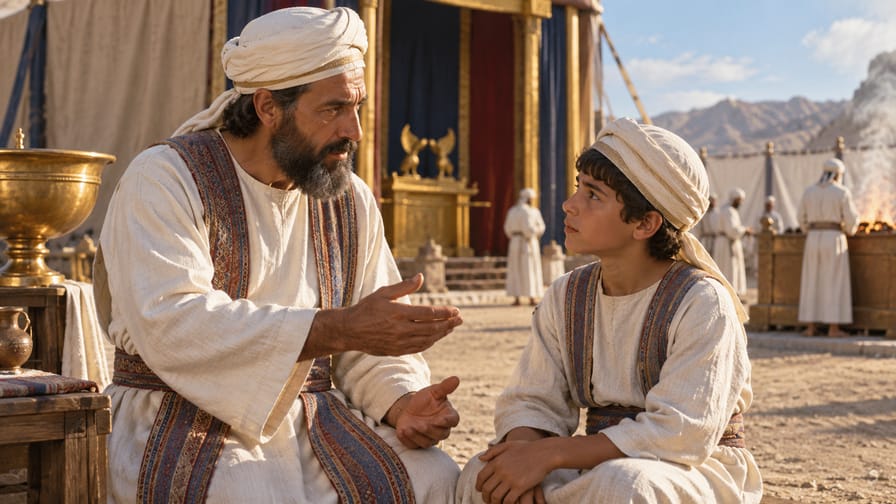
Uzzi was a descendant of Aaron in the line of Eleazar and Phinehas, the branch of the priestly family through which the high priesthood was passed down in Israel. He was the son of Bukki and the father of Zerahiah (1 Chronicles 6:5-6, 51), and centuries later his name appears again in the pedigree of Ezra the scribe (Ezra 7:4).
The Bible tells us nothing about what Uzzi did, said or thought. He appears only in genealogies. It would therefore be dishonest to build a biography for him. What Scripture does give us, however, is meaningful: Uzzi is a link in a chain that God preserved from Aaron in the wilderness to the return from Babylon, a chain that shows the Lord's faithfulness to his promises across many generations.
Studying a man known only by his place in a list teaches us to read the genealogies of the Bible as more than lists. They are testimonies that God keeps his word even through ordinary lives that history has forgotten.
1. Etymology and meaning of the name
The Hebrew name Uzzi (עֻזִּי, ʿUzzî) comes from the root ʿzz, to be strong, and the noun ʿōz, strength or might. With the ending i it is usually understood as my strength. Many scholars regard it as a shortened form of a longer name such as Uzziah (Yahweh is my strength) or Uzziel (God is my strength). That explanation is probable, but it cannot be proven for this particular man.
The idea behind the name is common in the Old Testament, where God is often called the strength of his people: the LORD is my strength and my song (Exodus 15:2). The name itself does not tell us anything about Uzzi's personality; it expresses the faith of those who named him.
2. Historical context and biblical narrative
2.1 Family origin and genealogy
Uzzi belonged to the tribe of Levi and, more narrowly, to the family of Aaron, the first high priest. Aaron had four sons, but Nadab and Abihu died before the LORD, leaving Eleazar and Ithamar to serve as priests (Leviticus 10:1-2; Numbers 3:4). Eleazar succeeded his father as high priest (Numbers 20:25-28), and his son Phinehas received from God a covenant of a perpetual priesthood because of his zeal at Baal Peor (Numbers 25:10-13).
Uzzi stands in that line. The Chronicler gives it twice. The first list runs: Eleazar fathered Phinehas, Phinehas fathered Abishua, Abishua fathered Bukki, Bukki fathered Uzzi, Uzzi fathered Zerahiah, Zerahiah fathered Meraioth (1 Chronicles 6:4-6), and it continues down to Jehozadak, who went into exile (1 Chronicles 6:15). The second list, placed just before the description of the Levitical cities, names the sons of Aaron: Eleazar, Phinehas, Abishua, Bukki, Uzzi, Zerahiah, Meraioth and so on to Zadok and Ahimaaz (1 Chronicles 6:50-53).
Ezra's genealogy confirms the same sequence: Ezra was a descendant of Zerahiah, son of Uzzi, son of Bukki, son of Abishua, son of Phinehas, son of Eleazar, son of Aaron the chief priest (Ezra 7:1-5). Ezra's list is shorter than the one in Chronicles and leaves out several generations between Azariah and Meraioth, a common feature of biblical genealogies, whose aim is to show descent rather than to record every link.
2.2 Main events
No event in Uzzi's life is recorded. Based on his place in the line, three generations after Phinehas, he probably lived during the period of the judges, but the Bible gives no date. Scripture does not state whether he served as high priest. The Jewish historian Josephus, writing in the first century, says that Bukki and his son Uzzi held the high priesthood and that it then passed to Eli, of the house of Ithamar, before returning to Phinehas' line with Zadok. That is an extrabiblical tradition and should be treated with caution. What the Bible itself affirms is simply that Uzzi was the son of Bukki and the father of Zerahiah within Aaron's family.
3. Character and role in the biblical narrative
Because Scripture records no actions of Uzzi, it says nothing directly about his character. His role in the biblical narrative is that of a bearer of continuity. He received the priestly heritage from his father and passed it on to his son. Through generations like his, the line of Eleazar survived the turbulent days of the judges, the monarchy, the destruction of Jerusalem and the exile, until it reached Zadok in Solomon's time and later Ezra, who returned to Jerusalem to teach the law of God (Ezra 7:6, 10).
This role matters. After the exile, those who claimed to be priests but could not find their names in the genealogical records were excluded from the priesthood (Ezra 2:61-63; Nehemiah 7:63-65). Names like Uzzi's were therefore not decoration; they were part of the evidence that the priestly service in the restored community stood in continuity with what God had established through Moses.
4. Theological significance
4.1 God's faithfulness across generations
The line in which Uzzi stands testifies to the faithfulness of God. The Lord had promised Phinehas and his descendants a lasting priesthood (Numbers 25:13), and the genealogies of Chronicles and Ezra show that promise being kept through centuries of upheaval. Even where individual lives are unknown to us, God's purpose moved forward.
4.2 From Aaron's priesthood to Christ
The priesthood of Aaron's descendants depended on physical descent, which is why records such as those containing Uzzi's name were so important. The letter to the Hebrews explains that Jesus is a priest of a different kind. He came from the tribe of Judah, not Levi, and he is a priest after the order of Melchizedek, not on the basis of a legal requirement concerning bodily descent, but by the power of an indestructible life (Hebrews 7:11-16). Uzzi's line served its purpose faithfully, yet it pointed beyond itself to the one high priest who lives forever to intercede for his people (Hebrews 7:23-25).
5. Legacy and canonical references
Uzzi the priest is mentioned in four verses. He appears as the son of Bukki (1 Chronicles 6:5) and as the father of Zerahiah (1 Chronicles 6:6) in the line of the high priests, again in the list of Aaron's sons before the Levitical cities (1 Chronicles 6:51), and finally in the genealogy of Ezra (Ezra 7:4).
He should not be confused with several other men named Uzzi in the Old Testament: a son of Tola of the tribe of Issachar (1 Chronicles 7:2-3), a son of Bela of the tribe of Benjamin (1 Chronicles 7:7), a Benjamite ancestor of Elah (1 Chronicles 9:8), a Levite who was overseer in Jerusalem after the exile (Nehemiah 11:22), and a priest at the head of the house of Jedaiah in the days of Joiakim, probably the same one who took part in the dedication of the wall (Nehemiah 12:19, 42).
6. Application for today
Uzzi's life reminds us that most of God's work in history is carried by people whose deeds are never written down. We know his name only because he stood between a father and a son in a line God was keeping. Many believers live that kind of hidden faithfulness, receiving the faith from one generation and handing it to the next, and the Lord does not forget them.
It also invites us to value what we pass on. Uzzi's descendants included Ezra, a man who set his heart to study the law of the LORD, to do it and to teach it (Ezra 7:10). We cannot control what later generations will do, but we can faithfully transmit what we have received.
Finally, Uzzi's genealogy points us to the security of the gospel. Our access to God does not depend on proving the right ancestry. In Christ, the perfect high priest, all who believe become a royal priesthood (1 Peter 2:9), and their names are written not in a temple register but in heaven.