


Solomon
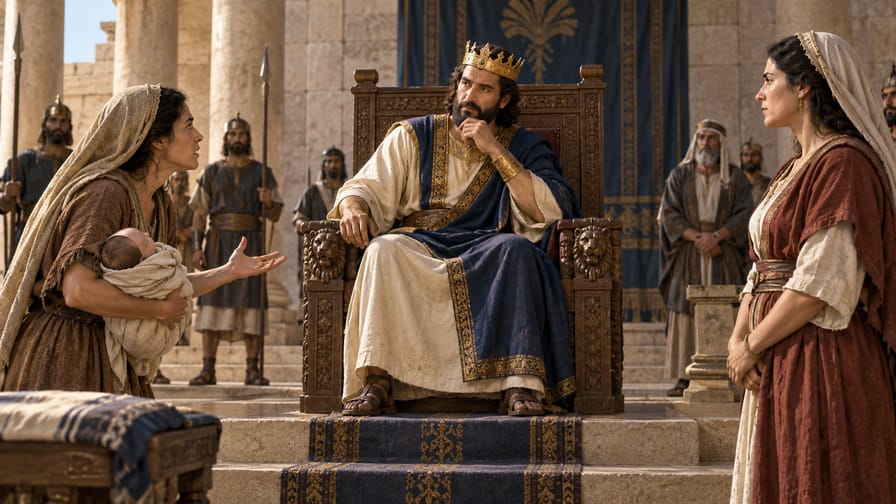
The figure of Solomon (Hebrew: שְׁלֹמֹה, Shelomoh), son of David and Bathsheba, emerges in the Scriptures as one of the most complex and significant characters of the Old Testament. His reign marked the apex of Israel's united monarchy, characterized by incomparable wisdom, wealth, and peace, but also by a tragic apostasy that foreshadowed the kingdom's division. An analysis of his life offers profound theological lessons on divine grace, human responsibility, and God's sovereignty in the history of redemption, from a Protestant evangelical perspective.
As the builder of the first Temple in Jerusalem and author of a significant portion of wisdom literature, Solomon exerts a lasting influence on biblical theology. His story is a microcosm of Israel's experience — from blessing and proximity to God to disobedience and its consequences. He points, in a typological way, to the coming Messiah, a King greater in wisdom and justice, who would not fail in His covenant with God.
1. Etymology and Meaning of the Name
The Hebrew name of Solomon is שְׁלֹמֹה (Shelomoh). Its etymological root derives from the verb שָׁלֵם (shalem), which means "to be complete," "to be intact," "to be peaceful," or "to repay." From this root also derives the Hebrew word for "peace," שָׁלוֹם (shalom). Thus, the name Solomon is commonly interpreted as "peaceful" or "man of peace," a meaning that reflects the nature of his reign, which was predominantly a period of peace in contrast to the warring reign of his father, David (1 Chronicles 22:9).
Besides Shelomoh, Solomon received another name from the prophet Nathan, by divine command: יְדִידְיָהּ (Yedidiah), which means "beloved of the Lord" or "friend of the Lord" (2 Samuel 12:25). This name emphasizes God's favor and election upon him from his birth, contrasting with his parents' sin that preceded his birth. The coexistence of these two names underscores both the peaceful vocation of his reign and the special relationship God desired to have with him.
Although the name Solomon is not common to other prominent biblical characters, its theological significance is profound. It represents the messianic aspiration for a king who would bring lasting peace and justice, an imperfect prefiguration of the true Prince of Peace. The name Shelomoh, therefore, is not merely descriptive, but prophetic in its implication of a messianic reign of peace that would be fully realized in Christ.
The promise of a successor who would build the Temple and have a reign of peace was already linked to the house of David (1 Chronicles 22:9-10). The meaning of Solomon's name, "peaceful," was intrinsically linked to the divine purpose for his reign, which was to consolidate and pacify the kingdom of Israel, allowing for the construction of the sanctuary. Solomon's peace, however, would only be a prelude to the eternal peace offered by the Messiah.
2. Historical Context and Biblical Narrative
The reign of Solomon occurred approximately between 970 and 931 BC, succeeding that of his father David. This period marks the apex of Israel's united monarchy, a time of great prosperity, territorial expansion, and cultural influence. Politically, Israel enjoyed relative stability and regional hegemony, a result of David's conquests, who had subjugated many of the neighboring peoples.
The social and religious context was one of transition. Israel had consolidated itself as a nation under the monarchy, but tensions between the tribes and the persistence of idolatrous practices of the Canaanite peoples were still latent challenges. The official religion was the worship of Yahweh, centered in the Tabernacle and, later, in the Temple built by Solomon, but the temptation of idolatry was a constant threat, as Solomon's story would come to demonstrate.
Solomon was the second son of David and Bathsheba who survived, born after the death of the first child as divine judgment for David's sin (2 Samuel 12:24). His ascent to the throne was not without disputes he was anointed king by David in his final days to thwart the attempt of Adonijah, his half-brother, to usurp the throne (1 Kings 1:11-40). This transition demonstrated God's sovereignty and faithfulness to the promise of a royal lineage for David.
The main events of Solomon's life are narrated in 1 Kings 1-11 and 2 Chronicles 1-9. After consolidating his power by eliminating rivals and asserting his authority, Solomon asked God for wisdom to govern the people (1 Kings 3:5-9). God granted him not only incomparable wisdom but also wealth and glory (1 Kings 3:10-13). His wisdom manifested itself in just judgments, such as the famous case of the two prostitutes (1 Kings 3:16-28), and in a vast literary output.
The highlight of his reign was the construction of the Temple in Jerusalem, a monumental undertaking that took seven years (1 Kings 6:1, 38). He also built his own palace and fortifications throughout the kingdom (1 Kings 7:1-12 9:15-19). Solomon established commercial and political alliances with neighboring nations, such as Egypt and Tyre, and his fame attracted dignitaries like the Queen of Sheba (1 Kings 10:1-13). The geography of his kingdom extended from the Euphrates to Egypt, controlling important trade routes (1 Kings 4:21).
However, the biblical narrative also details his downfall. Despite divine warnings, Solomon accumulated excessive horses, silver, and gold, and took for himself many foreign women, who turned his heart to idolatry in his old age (1 Kings 11:1-8). This disobedience led to God's judgment, who promised to tear the kingdom from his hands, leaving only one tribe for his descendant for David's sake (1 Kings 11:9-13). Solomon's reign, despite being glorious, ended with the seed of disintegration planted by his own apostasy.
3. Character and Role in the Biblical Narrative
Solomon's character is presented in the Bible with a striking duality, revealing both great virtues and tragic flaws. At the beginning of his reign, he is portrayed as a pious and humble young man, who recognizes his inadequacy to govern God's people and seeks divine wisdom above all else (1 Kings 3:7-9). This initial attitude of dependence and reverence for God is one of his greatest qualities.
His wisdom, granted by God, became legendary, encompassing everything from the ability to judge with discernment to a profound knowledge of nature and life (1 Kings 4:29-34). He was a perceptive administrator, capable of organizing a vast empire and overseeing monumental construction projects, such as the Temple in Jerusalem. His initial devotion is evident in the dedication of the Temple, where he offers a long and fervent prayer of consecration (1 Kings 8:22-53).
Solomon's primary role in the biblical narrative is that of king and builder of the Temple. He was the instrument chosen by God to fulfill the promise made to David that one of his descendants would build a house for the name of the Lord (2 Samuel 7:13). As king, he was responsible for bringing peace and prosperity to Israel, solidifying its borders and establishing a golden age for the nation.
However, the development of Solomon's character throughout the narrative is marked by a gradual deterioration. His weaknesses and moral failures are clearly documented. Despite God's warnings (1 Kings 9:4-9), he disobeyed specific commandments for the kings of Israel: he should not accumulate many horses, nor many women, nor a great quantity of gold and silver (Deuteronomy 17:16-17).
Solomon accumulated 1,400 chariots and 12,000 horsemen (1 Kings 10:26), loved many foreign women — seven hundred princesses and three hundred concubines (1 Kings 11:3) — and his wealth was immense, making silver as common as stones in Jerusalem (1 Kings 10:27). These actions led to his apostasy, for his wives turned him away to worship other gods, such as Ashtoreth, Moloch, and Chemosh (1 Kings 11:4-8). He even built altars for these gods in Jerusalem.
This apostasy is the darkest stain on his character and the turning point of his reign. The wisdom God had given him, though not withdrawn, was not sufficient to preserve his heart from disobedience and idolatry. Solomon's story serves as a powerful warning about the fragility of human faith, even amidst great blessings and divine revelations, and the importance of continuous obedience to the Word of God.
4. Theological Significance and Typology
Solomon's theological significance is multifaceted, playing a crucial role in redemptive history and the progressive revelation of God. His reign represents the pinnacle of the Davidic kingdom, a period of peace and glory that prefigured the messianic age. He is a testament to God's faithfulness to the Davidic covenant (2 Samuel 7:12-16), which promised a descendant of David whose throne would be established forever.
Solomon's most prominent theological connection is his Christocentric typology. He is a type of Christ, though imperfect. As a "man of peace" (Shelomoh), he prefigures Jesus, the true Prince of Peace (Isaiah 9:6), who establishes a kingdom of lasting and eternal peace, not only for Israel but for all nations. Solomon's wisdom points to Christ as the very Wisdom of God incarnate (1 Corinthians 1:30).
Jesus Himself refers to Solomon, stating that He is "greater than Solomon" (Matthew 12:42 Luke 11:31). The Queen of the South came from afar to hear Solomon's wisdom much more reason there is to listen to Jesus, who is the source of all wisdom and truth. Likewise, Jesus mentions Solomon's glory in his robes, which does not compare to the beauty of the field flowers, to teach about divine providence (Matthew 6:29 Luke 12:27).
The building of the Temple by Solomon is another strong prefiguration. Although the Temple was the center of worship to God in the Old Testament, it was only a shadow of the true Temple: Jesus Christ, in whom all the fullness of the Godhead dwells (Colossians 2:9). Jesus is the builder of the spiritual temple, the Church, made of living stones (Ephesians 2:20-22 1 Peter 2:5). Solomon's Temple, with its glory and sacrifices, pointed to the perfect sacrifice of Christ and the dwelling of God among His people in a new way.
Solomon's fall into idolatry and his disobedience serve as a vital theological contrast. His failure highlights the need for a perfect, sinless King, who would fulfill the covenant without failure. Solomon's story demonstrates that even the wisest and most blessed of men cannot sustain the kingdom of God without continuous obedience and sustaining grace. He illustrates the truth that salvation does not reside in human works or wisdom, but in God's faithfulness and the provision of a flawless Savior.
Despite his apostasy, God's promise to David remained unshaken, ensuring that the royal lineage would continue, culminating in Christ. Solomon's life, therefore, not only reveals God's glory but also human fragility and the need for a Messiah who would be a faithful king and a perfect priest, capable of mediating a superior and eternal covenant (Hebrews 8:6).
5. Biblical-Theological Legacy and Canonical References
Solomon's legacy in biblical theology is immense, extending throughout the entire canon. He is the attributed author of a significant portion of wisdom literature. The books of Proverbs, Ecclesiastes, and Song of Songs are traditionally associated with him, and his authorship is explicitly mentioned at their beginnings (Proverbs 1:1 Ecclesiastes 1:1 Song of Songs 1:1). Additionally, Psalm 72 and Psalm 127 are attributed to him, both reflecting themes of justice, wisdom, and divine blessing.
Proverbs, with its vast collection of maxims and aphorisms, reflects Solomon's practical and ethical wisdom, instructing on pious living. Ecclesiastes, on the other hand, presents a more skeptical and philosophical perspective on the futility of life "under the sun," culminating in the exhortation to fear God and keep His commandments. Song of Songs is a poetic celebration of conjugal love, often interpreted allegorically as the love between Christ and His Church.
Solomon's influence on biblical theology is particularly felt in the theology of wisdom and the theology of kingship. He embodies the ideal of the wise king who governs with justice, but his fall underscores the insufficiency of human wisdom without continuous obedience to God. His life and writings shaped Israel's understanding of divine wisdom and the consequences of disobedience.
In the New Testament, as already mentioned, Solomon is referred to by Jesus in Matthew 6:29 and Matthew 12:42, establishing a direct connection and a comparison with the Person of Christ. These references not only confirm Solomon's historicity but also elevate the figure of Jesus above any earthly king, however wise or glorious he might have been. Solomon is a point of reference for the greatness that Jesus surpasses.
In Jewish and Christian interpretive tradition, Solomon is frequently seen as the archetype of the wise king, but also as an example of temptation and the fall. Reformed and conservative evangelical theology frequently highlights Solomon as a paradigmatic case of God's grace and judgment, and as an imperfect type of Christ. His story is a vivid reminder of the consequences of sin, even for those who have been greatly blessed by God.
Solomon's importance for understanding the biblical canon lies in his fundamental role in the narrative of the Davidic covenant and in the development of the theology of kingship and wisdom. He represents the culmination and, at the same time, the beginning of the decline of Israel's united monarchy, setting the stage for the need for a new and perfect King. His life teaches that true peace and wisdom come only from faithful obedience to God and are fully realized in Jesus Christ, who is greater than Solomon.