


Daniel
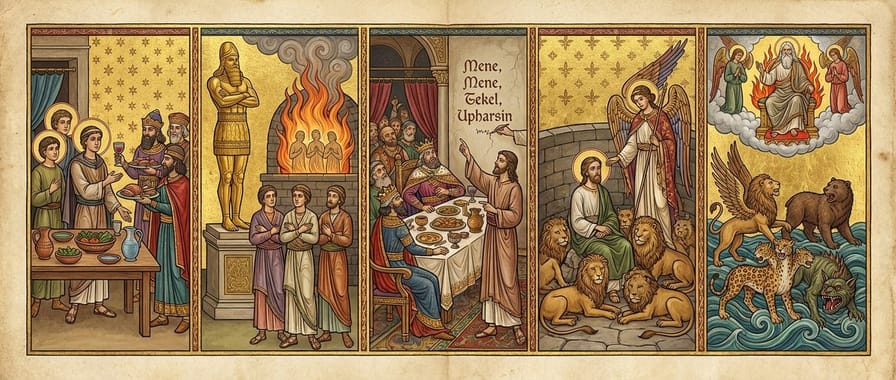
Illustration of the Book of Daniel, one of the 39 books of the Old Testament (Nano Banana Pro).
The primary objective of this introduction is to outline a robust analytical framework for the study of any canonical book of Holy Scripture, applying it exemplarily to the book of Daniel. The Bible, as the divinely inspired and inerrant Word of God, demands an approach that honors its unique nature and supreme authority. For the Protestant evangelical student, the understanding of each biblical text must be informed by a theological worldview that values progressive revelation, divine sovereignty, and, primarily, the centrality of Christ in the entire redemptive narrative.
The book of Daniel, in particular, presents itself as a fascinating compendium of historical narratives and prophetic visions, set in a crucial period of the history of Israel and the Gentile nations. Its theological richness and hermeneutical complexity demand careful analysis, one that not only uncovers its multiple meanings but also highlights its perennial relevance for Christian faith and practice. We will approach Daniel with the conviction that it is a unified, authentic, and prophetically accurate work, written by its namesake in the sixth century BC, challenging the skeptical objections of higher criticism and reaffirming its inalienable position in the canon of Scripture.
In this introduction, we will seek to balance academic rigor with pastoral piety, offering an analysis that is theologically dense yet accessible. Each section has been designed to provide a lens through which other biblical books can be examined, establishing a model of study that prioritizes textual faithfulness, doctrinal coherence, and practical application. By delving into the depths of Daniel, we aspire to strengthen faith in the Word of God and inspire a robust hope in the coming and eternal kingdom of our Lord and Savior, Jesus Christ.
1. Historical Context, Dating, and Authorship
1.1 The Traditional Authorship of Daniel and Sixth-Century BC Dating
The conservative Protestant evangelical perspective firmly upholds Daniel's authorship of the book that bears his name, placing its composition in the sixth century BC, during the period of the Babylonian exile and the beginning of Persian rule. Daniel, one of the young nobles of Judah taken captive by Nebuchadnezzar in 605 BC, as per Daniel 1:1-6, lived and served in the Babylonian and Persian courts for over six decades. His privileged position and prophetic gift, acknowledged by God Himself, enabled him to record the historical events and apocalyptic revelations that comprise the book.
This dating and authorship represent the majority position of the church throughout history, from Josephus to the Church Fathers, and are defended by reformers and modern evangelical theologians. The book of Daniel itself consistently presents Daniel as the author of its visions (Daniel 7:1, 8:1, 9:2, 10:1-2, 12:4-5) and the narrator of his experiences. The first-person language is powerful internal evidence for direct authorship. Furthermore, Jesus Christ, the ultimate authority, referred to Daniel as the prophet in Matthew 24:15, validating both his historical person and his prophetic work.
1.2 The Political, Social, and Cultural Setting of the Exile
The book of Daniel unfolds against the backdrop of the Ancient Near East, in a period of intense geopolitical turbulence. Judah had been subjugated by Babylon, the dominant empire of the time, which had succeeded Assyria in power. Daniel and his companions were transplanted from Jerusalem to the imperial capital, Babylon, a center of unprecedented culture, religion, and power. This context of exile is crucial for understanding the book's message: how God's people are to live faithfully in a pagan and hostile culture, under the dominion of Gentile empires.
The Babylonian court, with its magicians, astrologers, and wise men, serves as the stage for the first chapters, where the wisdom and power of the God of Israel are dramatically demonstrated, surpassing all pagan deities and knowledge. The transition to the Persian Empire, with the fall of Babylon in 539 BC, is also meticulously recorded, culminating in visions that encompass the rise and fall of subsequent empires. Daniel lived and wrote in a cultural melting pot, where Israel's monotheistic faith was constantly challenged by polytheism and imperial idolatry.
1.3 Response to Higher Criticism and Academic Skepticism
Since the third century AD, and more intensely from the eighteenth century onwards, the book of Daniel has been the target of skeptical criticism, especially concerning its dating. "Higher criticism" frequently argues that Daniel is a pseudepigraphal work, written in the second century BC, during the Maccabean period, and attributed to a fictitious Daniel. The primary reason for this redating is the remarkable precision of Daniel's prophecies, which detail subsequent historical events with an accuracy that critics deem impossible for genuine prophecy, interpreting them as vaticinia ex eventu (prophecies after the event).
Nevertheless, the defense of the traditional dating is robust. First, the argument that the prophecies are "too precise" is a begging of the question, which denies the possibility of divine predictive prophecy in anticipation. Second, linguistic evidence supports an early date. The presence of Persian and Greek words in the text, although used by critics to argue for a later date, is consistent with Daniel's long lifespan in the Persian court and with the presence of Greek influence in the Near East as early as the sixth century BC (e.g., Greek trade). The proportion and type of linguistic borrowings do not fit well into a Maccabean context.
Third, the discovery of the Dead Sea Scrolls at Qumran revealed copies of Daniel dated to the second century BC, which demonstrates that the book was already considered canonical and widely disseminated long before the supposed Maccabean date. It is implausible that such an extensive and detailed book, purportedly written to encourage the Jews in the Maccabean revolt, would have been accepted as Scripture so quickly and disseminated so widely. Fourth, Daniel's familiarity with Babylonian and Persian customs and history is notable and detailed, including names of kings and events that have been confirmed by archaeology (such as the existence of Belshazzar, Daniel 5, previously questioned by critics).
Finally, Daniel's theology, with its emphasis on the sovereignty of God over Gentile empires and the hope of the eternal Messianic kingdom, is perfectly suited for the exile period, offering comfort and encouragement to a disoriented people. The rejection of Daniel's traditional authorship and dating is, ultimately, an act of philosophical skepticism regarding the supernatural nature of prophecy, rather than a conclusion based on superior textual or historical evidence.
2. Structure, Division, and Main Content
2.1 Literary Organization: Narrative and Apocalyptic
The book of Daniel is notable for its bipartite structure, combining two distinct yet complementary literary genres: historical narrative and apocalyptic prophecy. This duality is evident in the book's division into two main parts, which are distinguished not only by their style but also by their original language. Chapters 1 to 6 are predominantly narrative, recounting the stories of Daniel and his three friends in the Babylonian and Persian courts, written in Hebrew in chapter 1 and the beginning of chapter 2, and in Aramaic from chapter 2:4b to the end of chapter 7. Chapters 7 to 12, in turn, are primarily prophetic and apocalyptic, describing Daniel's visions concerning the future of Gentile empires and the establishment of God's kingdom, returning to Hebrew from chapter 8 onwards.
This linguistic and genre transition is significant. The Aramaic section (Daniel 2:4b-7:28) focuses on Gentile empires and their rise and fall, while the Hebrew sections (Daniel 1:1-2:4a and Daniel 8:1-12:13) concentrate on the experiences of God's people and specific prophecies related to Israel. The structure reflects the book's central message: God is sovereign over all nations, and His plan for Israel and the world will infallibly be fulfilled, culminating in the kingdom of His Messiah.
2.2 Main Divisions and Their Characteristics
The book of Daniel can be divided into two main sections, each with distinct characteristics:
- Chapters 1-6: Faithfulness amidst persecution. This section consists of narratives that illustrate the faithfulness of Daniel and his friends to God in a hostile environment. The stories include the dietary challenge (Daniel 1), the interpretation of Nebuchadnezzar's dream (Daniel 2), the fiery furnace (Daniel 3), Nebuchadnezzar's madness (Daniel 4), Belshazzar's feast and the writing on the wall (Daniel 5), and the lion's den (Daniel 6). Each narrative demonstrates the sovereignty of God over earthly kings and kingdoms, His ability to protect His faithful servants, and the superiority of His wisdom over human wisdom. These stories serve as examples of how God's people are to live in a world that does not acknowledge Him.
- Chapters 7-12: The apocalyptic visions of the future. This section contains the prophetic visions Daniel received, detailing the rise and fall of world empires and the ultimate establishment of God's kingdom.
- Daniel 7: The vision of the four great beasts, representing the Babylonian, Medo-Persian, Greek, and Roman empires, culminating in the appearance of the "Son of Man" and the eternal kingdom.
- Daniel 8: The vision of the ram and the goat, detailing the fall of the Medo-Persian Empire and the rise of the Greek Empire under Alexander the Great and his successors, with a particular focus on the figure of Antiochus IV Epiphanes.
- Daniel 9: The prophecy of the seventy weeks, one of the most significant passages in the Bible, outlining the timeline of Israel's history up to the coming of the Messiah and eschatological events.
- Daniel 10-12: A long and detailed prophecy about the wars between the "kings of the North and the South" (the Ptolemies and Seleucids), culminating in a description of the time of the end, the resurrection of the dead, and the reward of the righteous.
2.3 Narrative and Argumentative Flow: From Exile to the Eternal Kingdom
The flow of the book of Daniel is intentional and progressive, moving from matters of personal faithfulness in exile to the comprehensive vision of salvation history. The early chapters establish the character of Daniel and his friends as models of piety and courage, demonstrating that it is possible to honor God even under extreme pressure. These narratives serve as a prelude and foundation for the prophetic visions, as the credibility of Daniel's revelations is established by his life of integrity and his proven ability to interpret mysteries.
The transition to the apocalyptic visions in the later chapters is not abrupt but represents an expansion of perspective. While the narratives deal with the sovereignty of God over individual kings and immediate events, the visions lift the gaze to the sovereignty of God over the course of all human history, from Daniel's time to the consummation of the ages. The underlying argument is that the God who rescues Daniel from the lion's den is the same God who orchestrates the rise and fall of empires and who will, ultimately, establish a kingdom that will never be destroyed.
The book culminates with a message of hope and encouragement. Despite the apparent darkness and oppression of Gentile empires, God's plan for His people is infallible. Daniel's prophecies serve to reaffirm divine foreknowledge, divine providence, and the certainty of the Messianic kingdom. Daniel's structure, therefore, is designed to strengthen the faith of the exiles (and readers of all ages) in God's faithfulness and the inevitability of His final triumph.
3. Central Theological Themes and Purpose
3.1 God's Sovereignty Over History and Empires
One of the most prominent and theologically rich themes in Daniel is the absolute sovereignty of God over all human history, especially over Gentile kingdoms and empires. Repeatedly, the book demonstrates that God is the one who "changes times and seasons; he removes kings and sets up kings" (Daniel 2:21). Nebuchadnezzar, the most powerful king of his era, learns this lesson dramatically in Daniel 4, being humbled until he recognizes that "the Most High is sovereign over the kingdoms of men and gives them to anyone he wishes" (Daniel 4:17).
This divine sovereignty is not merely a passive force, but an active providence that orchestrates world events to fulfill His purposes. The visions of chapters 7, 8, 9, and 10-12 detail with astonishing precision the sequence of world empires – Babylon, Medo-Persia, Greece, and Rome – and their respective destinies, showing that God has a meticulous plan for history. For God's people in exile, this truth was a balm, assuring them that, although they were under the dominion of foreign powers, their God was still the Lord of all, and His promise of restoration would be fulfilled.
3.2 The Faithfulness of God's People Amidst Persecution
Another central theme in Daniel is the unwavering faithfulness required of God's people, even under intense pressure and persecution. Daniel and his friends, Hananiah, Mishael, and Azariah (better known as Shadrach, Meshach, and Abednego), serve as models of integrity. They refuse to compromise their dietary principles (Daniel 1), to worship idols (Daniel 3), and to cease prayer (Daniel 6), even in the face of death threats. Their stories demonstrate that true faith is not passive, but active and resilient, ready to face the consequences of an uncompromising commitment to God.
The message is clear: faithfulness to God is more important than earthly life. God honors and defends those who honor Him, miraculously intervening to rescue them from the fiery furnace and the lion's den. This theme resonates deeply with Reformed theology, which emphasizes soli Deo gloria (glory to God alone) and the necessity of living a life of holiness and obedience, regardless of external circumstances. The perseverance of the saints, in the face of adversity, is a powerful testimony to God's sustaining grace.
3.3 The Future Messianic Kingdom and Eschatological Hope
The theological climax of Daniel is the revelation of the eternal and universal kingdom of the Messiah. Nebuchadnezzar's dream statue (Daniel 2) and the visions of the four beasts (Daniel 7) culminate in the destruction of all earthly kingdoms by a "stone" cut out by no human hand, which becomes a great mountain and fills the whole earth, and by the coming of "one like the Son of Man" who receives "authority, glory and sovereign power; all peoples, nations and men of every language worshiped him. His dominion is an everlasting dominion that will not pass away, and his kingdom is one that will never be destroyed" (Daniel 7:13-14).
This eschatological hope is the focal point of all prophecy. It points to a future where God's dominion will be fully and incontestably established through His Messiah. The prophecy of the seventy weeks in Daniel 9, though complex, centers on the coming of the "Anointed One, the Prince" (the Messiah) and the accomplishment of His redemptive work. This theme is fundamental to Christocentric theology and evangelical eschatology, for Daniel not only foresees a deliverer but a divine ruler whose kingdom will transcend all human empires and endure forever. It is the promise of the consummation of God's redemptive plan.
3.4 The Primary Purpose of the Book of Daniel
The primary purpose of the book of Daniel for its original audience, the exiled Jews in Babylon and later in Persia, was threefold. First, to encourage faithfulness. The stories of Daniel and his friends served as models of how to maintain identity and faith in a hostile cultural and religious environment. They demonstrated that God is faithful to protect and honor those loyal to Him, even in the face of death.
Second, to reveal God's sovereignty over history. The prophetic visions assured the exiles that, despite the apparent supremacy of Gentile empires, God was in control. He had orchestrated the exile and would continue to orchestrate world events to fulfill His purposes, including the restoration of Israel and the coming of His eternal kingdom. This cosmic perspective offered hope in a time of despair.
Third, to prepare God's people for the future. Daniel's prophecies provide a panorama of future history, warning of coming persecutions and pointing to the eventual victory of God's kingdom. This not only offered immediate comfort but also equipped believers with a prophetic understanding that would allow them to interpret future events in light of the divine plan. In essence, Daniel serves to strengthen faith, sustain hope, and promote obedience in all generations of God's people.
4. Relevance and Canonical Connections
4.1 The Importance of Daniel Within the Complete Canon
The book of Daniel occupies a prominent position in the biblical canon, acting as a crucial bridge between the Old and New Testaments and providing an eschatological lens for understanding the entire biblical narrative. Its importance resides in several dimensions. Primarily, Daniel is the most extensive and detailed apocalyptic prophetic book of the Old Testament, providing the framework for understanding later works, such as the book of Revelation. Without Daniel, many of the images and concepts of Revelation would be incomprehensible.
Secondly, Daniel is fundamental to covenant theology, demonstrating the continuity of God's plan for Israel and the nations, even during the intertestamental period and beyond. It reaffirms that the promise of an eternal kingdom, made to David, will be fulfilled in a surprising and glorious way through the Messiah. Thirdly, Daniel establishes the sovereignty of God in an unquestionable manner, serving as a constant reminder that God is in control of history, no matter how chaotic circumstances may seem. This truth is a pillar for faith in all ages.
4.2 Typological Connections with Christ and Fulfillment in the New Testament
Daniel is rich in Christocentric typology and direct prophecies that point to Jesus Christ. The figure of the "Son of Man" in Daniel 7:13-14 is one of the clearest and most powerful prefigurations of Christ in the Old Testament. Jesus frequently referred to Himself as the "Son of Man," deliberately evoking this image from Daniel to describe His divine authority, His eternal kingdom, and His role as judge (Matthew 24:27, 26:64; Mark 13:26, 14:62; Luke 21:27, 22:69). Daniel presents the Messiah as a celestial, divine, and sovereign figure who will come with the clouds of heaven to establish an eternal kingdom.
The prophecy of the seventy weeks in Daniel 9:24-27 is another vital connection. Although its interpretation is complex, most evangelicals recognize that it predicts the coming of the "Anointed One, the Prince" (the Messiah), His atoning death, and the establishment of His new covenant. The "cutting off of the Anointed One" (Daniel 9:26) is a clear reference to the crucifixion of Jesus, which occurred at the time foretold by Daniel. The destruction of Jerusalem and the Temple in AD 70 also echoes Daniel's prophecies about the "abomination of desolation" and the armies that would come. Jesus Himself refers to this "abomination of desolation" in Matthew 24:15, applying it to future events related to His second coming, thus connecting Daniel's prophecies directly to the end times.
4.3 Quotations and Allusions in Other Biblical Books
The influence of Daniel significantly permeates the New Testament. In addition to Jesus' direct references to the "Son of Man" and the "abomination of desolation," the book of Revelation is deeply rooted in Daniel's imagery and structure. John's visions in Revelation echo Daniel's in their themes of world empires, persecution of the saints, divine judgment, and the final establishment of God's kingdom. The "four beasts" of Daniel 7 find parallels in the beasts of Revelation 13, and Daniel's "Ancient of Days" is reflected in the description of God in Revelation.
Other allusions can be found in various epistles. Paul, in 2 Thessalonians 2, describes the "man of lawlessness," a figure resembling Daniel's "little horn," who exalts himself against God. The New Testament writers, therefore, viewed Daniel not merely as a historical record, but as a continuous prophetic revelation that informed their understanding of end-time events and Christ's central role in them.
4.4 Relevance for the Contemporary Church
Daniel's relevance for the contemporary church is multifaceted and profound. Firstly, Daniel offers a model of Christian faithfulness in a pluralistic and often hostile world. The stories of Daniel and his friends teach us to live with integrity, to defend the faith, and to trust God, even when it entails personal sacrifice. In a culture that often challenges biblical values, Daniel is a call to courage and holy non-conformity.
Secondly, Daniel reaffirms the sovereignty of God over all nations and governments. In times of political and social uncertainty, the book reminds us that God is on the throne, orchestrating history to fulfill His purposes. This truth offers comfort and hope, empowering believers to pray with confidence for leaders and to work for justice, knowing that God's kingdom will prevail.
Finally, Daniel nurtures the church's eschatological hope. The book's prophecies point to the second coming of Christ and the establishment of His eternal kingdom. This hope motivates evangelism, discipleship, and holy living, as believers long for the day when the "Son of Man" will rule unopposed. Daniel, therefore, is not merely a book of ancient history or prophecy, but a vibrant source of encouragement, challenge, and hope for the church today.
5. Hermeneutical Challenges and Critical Issues
5.1 Specific Interpretational Difficulties of the Book
The book of Daniel presents considerable hermeneutical challenges, primarily due to its apocalyptic genre and the nature of its prophecies. One of the greatest difficulties lies in interpreting the prophetic sequences, such as those of the statue (Daniel 2), the four beasts (Daniel 7), and, especially, the seventy weeks (Daniel 9). The precise identification of the empires and rulers represented by symbols like the horns, the animals, and the "kings of the North and the South" has generated various schools of interpretation throughout church history.
The prophecy of the seventy weeks, in particular, is a hermeneutical minefield. The different approaches – preterist, historicist, futurist, and idealist – diverge on the fulfillment of these "weeks" of years, the identity of the "Anointed One," the nature of the "cutting off," and the interpretation of the "abomination of desolation." The question of the "gap" between the 69th and 70th week is a crucial point for futurist eschatology, while other views seek a more continuous fulfillment. The complexity of apocalyptic numbers and symbolism demands humility, diligent study, and dependence on the Holy Spirit for faithful understanding.
5.2 Issues of Literary Genre and Cultural Context
Daniel's literary genre is a unique blend of historical narrative and apocalyptic. Understanding the apocalyptic genre is vital for correct interpretation. Apocalyptic literature is characterized by vivid symbolism, fantastic imagery, cosmic dualism (good vs. evil), angelic-mediated revelation, and an eschatological perspective that emphasizes divine intervention at the end of time. Interpreting these symbols overly literally, without considering the genre's conventions, can lead to erroneous conclusions.
The Babylonian and Persian cultural context is also essential. Daniel's familiarity with court customs, idol worship, divination practices, and the structure of imperial government, as detailed in the narratives, helps contextualize his experiences and the messages of the visions. For example, Nebuchadnezzar's statue (Daniel 2) and the fiery furnace (Daniel 3) are understood in their full significance when viewed in light of Babylonian imperial ideology and its demand for absolute religious loyalty to the emperor and his gods. Understanding these cultural elements avoids anachronisms and allows for a richer reading of the text.
5.3 Apparent Ethical or Theological Problems and the Evangelical Response
Although Daniel does not present ethical or theological problems as prominent as some other biblical books, some questions may arise. For example, the issue of divine retribution in Daniel 4, where Nebuchadnezzar is humbled for his pride, may raise questions about God's justice. The evangelical response emphasizes the justice of God and His patience. Nebuchadnezzar was warned, and his humiliation was an act of divine discipline to lead him to repentance and the recognition of God's sovereignty, which he ultimately did (Daniel 4:34-37). This is an example of God's grace in action, even through judgment.
Another question may be the apparent "violence" in the apocalyptic visions, with the destruction of empires and judgment upon the wicked. The evangelical perspective understands these to be representations of divine justice against evil and rebellion against God. They are not an endorsement of human violence, but a revelation of the inevitability of divine judgment and the ultimate victory of good. Biblical inerrancy assures us that such passages are part of God's revelation, who is just in all His ways.
5.4 Faithful Evangelical Response to Skeptical Criticism
As discussed in the authorship and dating section, skeptical criticisms of the book of Daniel, primarily the denial of predictive prophecy and the advocacy for a Maccabean date, are answered based on internal and external evidence, as well as on a worldview that accepts the possibility of the supernatural. The evangelical defense of traditional authorship and the sixth-century BC dating rests upon the integrity of the biblical text, the testimony of Jesus Christ, historical coherence (including archaeological discoveries), and linguistic evidence. The denial of genuine prophecy is, ultimately, a philosophical presupposition that opposes the very nature of biblical revelation.
The evangelical approach does not shy away from textual or historical difficulties but addresses them with a hermeneutic of trust in the Word of God. Questions such as the identity of "Darius the Mede" (Daniel 5:31), which is not directly attested in secular extrabiblical sources, are seen as gaps in our external knowledge, not as refutations of biblical inerrancy. History has repeatedly confirmed biblical details that were previously questioned by critical scholarship, and evangelical faith patiently awaits further confirmations, maintaining confidence in the veracity of Scripture.
5.5 Hermeneutical Principles for Correct Interpretation
For a correct interpretation of Daniel, and indeed any biblical book, some hermeneutical principles are indispensable for the Protestant evangelical perspective:
- Literal-historical-grammatical interpretation: To seek the obvious and intentional meaning of the text, considering its historical, grammatical, and literary context. This means recognizing that, although Daniel contains symbolism, the basis of its message is historical and objective.
- Recognition of literary genre: To understand that apocalyptic literature has its own conventions. Symbols should be interpreted as symbols, but without denying the reality of the events they represent. Apocalyptic symbolism does not nullify historical or prophetic truth, but communicates it in a particular way.
- Christocentric perspective: To interpret Daniel in light of Jesus Christ. All prophecies and types should be seen as pointing to Him and His kingdom. The "Son of Man" is Jesus, and the promises of an eternal kingdom are fulfilled in Him.
- Canonical coherence: To interpret Daniel in harmony with the rest of Scripture, allowing the Bible to interpret the Bible itself. This is especially important for difficult passages, such as the seventy weeks, which should be understood in relation to the broader biblical theology of covenant and eschatology.
- Dependence on the Holy Spirit: To recognize that spiritual truth is spiritually discerned (1 Corinthians 2:14). Prayer and the pursuit of divine illumination are essential for understanding the depths of God's Word.
By applying these principles, the Bible student can approach the book of Daniel with confidence, uncovering its rich truths and applying its transformative message to contemporary life and faith, always with the glory of God as the supreme goal.