


2 Chronicles
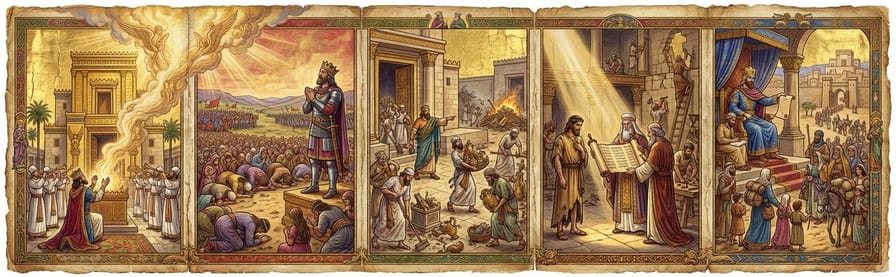
Illustration of the Book of 2 Chronicles, one of the 39 books of the Old Testament (Nano Banana Pro).
This introduction aims to unveil the multiple layers of meaning in the book of 2 Chronicles, a sacred text often underestimated in its profound theological and historical value. Far from being a mere repetition of narratives already present in the books of Samuel and Kings, 2 Chronicles offers a unique and divinely inspired perspective on the history of God's people, with a sharp focus on the Davidic lineage, the centrality of the Temple in Jerusalem, and the consequences of obedience and disobedience to the divine covenant. For the evangelical Protestant reader, imbued with the conviction of the inerrancy and plenary inspiration of Scripture, this book is not merely a record of the past, but an enduring source of revelation about the nature of God, the role of worship, and the messianic hope that culminates in Christ Jesus.
Our approach will be multifaceted, seeking to balance academic rigor with fervent pastoral devotion. We propose an analytical structure that can serve as a robust model for exploring any biblical book, ensuring a comprehensive understanding of its context, content, theology, canonical relevance, and interpretive challenges. Throughout this exploration, we will defend the traditional positions of conservative evangelical scholarship, engaging respectfully with questions raised by higher criticism, but always reaffirming the authority and faithfulness of God's Word. The book of 2 Chronicles, with its emphasis on divine sovereignty over human history and God's continuous faithfulness to His covenant, deeply resonates with the pillars of Reformed theology and the Christ-centered vision of all Scripture.
The post-exilic community, for which the Chronicler wrote, needed a theological reframing of its history, one that would reaffirm their identity as a covenant people and encourage them in the rebuilding of their faith and in the hope of a future under the leadership of a Davidic king. For us today, 2 Chronicles continues to be a beacon, illuminating the importance of genuine worship, godly leadership, and unwavering trust in divine providence, as we await the consummation of the Kingdom of God under the rule of our Lord Jesus Christ.
1. Historical Context, Dating, and Authorship
Understanding the historical context, dating, and authorship of 2 Chronicles is fundamental to unraveling its theological message and original purpose. This book, along with 1 Chronicles, forms a distinct literary unit, often referred to as "The Chronicles." Although Jewish and early Christian tradition attributed authorship to Ezra, the scribe and priest, modern scholarship, even among conservatives, prefers to speak of an anonymous "Chronicler," who may have been Ezra or someone from his theological school and historical period.
1.1 Traditional Authorship and the Chronicler
Jewish tradition, as recorded in the Babylonian Talmud (Bava Batra 15a), attributes the authorship of Chronicles (and Ezra-Nehemiah) to Ezra. This view has been widely accepted throughout church history and finds resonance in several pieces of evidence. The main one is the textual and thematic continuity between 2 Chronicles and the book of Ezra. The end of 2 Chronicles (2 Chronicles 36:22-23) is practically identical to the beginning of Ezra (Ezra 1:1-3), suggesting a literary unit or, at minimum, an intentional connection on the part of the editor or author.
The "Chronicler" was, without doubt, an individual with deep familiarity with Israel's history and theology, a scribe or group of scribes well-versed in the Scriptures of their time. His work demonstrates a detailed knowledge of the Mosaic Law, genealogies, Temple rituals, and the history of the kings of Judah. This erudition points to someone with the training and role of Ezra, who is described in Ezra 7:6 as "a scribe skilled in the Law of Moses".
1.2 Period of Writing and Post-Exilic Context
The dating of 2 Chronicles is widely accepted as being the post-exilic period, probably between 450 and 400 B.C. This dating is inferred from several factors. The text mentions events that occurred after the Babylonian exile, such as Cyrus's decree allowing the return of the Jews (2 Chronicles 36:22-23). Furthermore, the genealogies in 1 Chronicles extend for several generations after the exile, indicating a viewpoint subsequent to that cataclysmic event.
The social, political, and cultural context of the community for which the Chronicler wrote is crucial. Jerusalem and the Temple had been rebuilt, but the nation did not possess a king from the Davidic lineage and was under Persian rule. The Jewish people, disillusioned and perhaps disheartened, needed a reminder of their covenant identity and God's faithfulness. The Chronicler, therefore, writes for a community seeking to reaffirm their faith, their heritage, and their hope amidst a new political and social reality. The focus on Judah and the Davidic lineage was a way to strengthen their identity and messianic hope.
1.3 Response to Criticisms from Higher Criticism
Modern higher criticism has raised various questions about traditional authorship, dating, and especially the historical reliability of Chronicles. Some scholars suggest that Chronicles is a biased work, exaggerating numbers, omitting unfavorable facts, and reinterpreting the history of Samuel and Kings with a specific theological agenda, thus compromising its veracity. Criticisms regarding anachronisms and the possible invention of speeches are also common.
In response, conservative evangelical scholarship defends the inerrancy of Chronicles and its historical reliability, while acknowledging its distinct theological purpose. The Chronicler did not intend to write a "history" in the modern sense of neutrality and exhaustiveness, but rather a "theological history" or "inspired historiography." His selectivity and emphases are not flaws, but rather intentional choices made under the inspiration of the Holy Spirit to communicate specific truths to his audience.
The apparent discrepancies with Samuel and Kings can be explained by different sources, literary purposes, scribal errors over the centuries (minor and not affecting central doctrines), or by understanding that the Chronicler was emphasizing specific aspects of history. For example, his omission of the history of the Northern Kingdom or of specific sins of David and Solomon does not negate these facts, but serves to maintain focus on the Davidic lineage and the centrality of worship in Jerusalem for the post-exilic community. The Chronicler is not a fabricator, but an inspired interpreter of Israel's history.
1.4 Internal and External Evidence
Internal evidence supports the unity and post-exilic dating of the work. The vocabulary and literary style of Chronicles contain Aramaicisms and late Hebrew forms, which are consistent with the Persian period. The concern for genealogies, the priesthood, and cultic reforms reflects the needs of a community returning from exile and seeking to re-establish its religious and social identity. The emphasis on Temple worship and obedience to the Law is a central theme that resonated strongly with the ministry of Ezra and Nehemiah.
While there are no direct archaeological discoveries that "prove" the authorship of Ezra, indirect external evidence supports the general context. The existence of scribes and the central role of the Law and the Temple in the Persian period are well documented. The very acceptance of Chronicles into the Jewish canon, although sometimes in a different position from the books of Samuel and Kings, attests to its authority and recognition as inspired Scripture. Evangelical scholarship, therefore, maintains the view that 2 Chronicles is a faithful and divinely inspired record, essential for understanding the history of redemption.
2. Structure, Division, and Main Content
The book of 2 Chronicles is not a simple linear chronicle, but a theologically organized narrative that reinterprets the history of the kings of Judah. Its structure reflects a clear purpose of the Chronicler: to instruct and encourage the post-exilic community. Unlike Samuel and Kings, which cover both the northern kingdom (Israel) and the southern kingdom (Judah), 2 Chronicles focuses almost exclusively on the kingdom of Judah and the Davidic lineage, emphasizing the centrality of Jerusalem and the Temple.
2.1 Literary Organization and Narrative Focus
2 Chronicles is a work of theological historiography. The Chronicler selects, arranges, and emphasizes events and figures with a specific doctrinal purpose. His aim is not just to report facts, but to interpret history in light of God's covenant with David and the Mosaic Law. There is a notable focus on worship, the Temple, the priesthood, and the direct consequences of obedience and disobedience (the theology of retribution).
The narrative style is enriched with speeches and prayers that, even if not literal transcriptions, capture the theological essence of the moments and express the divine principles at play. The Chronicler frequently omits details that could distract from his main focus, such as the gravest sins of David and Solomon, or the history of the northern kingdom, which he considers illegitimate in its secession from the Davidic lineage and worship in Jerusalem.
2.2 Main Divisions and Their Characteristics
The book of 2 Chronicles can be divided into two main sections, which chronologically follow the history of the kingdom of Judah:
2.2.1 The Reign of Solomon (2 Chronicles 1-9)
This section describes the reign of Solomon, the son and successor of David. The Chronicler presents Solomon in an idealized way, emphasizing his wisdom (2 Chronicles 1:7-12), the construction and dedication of the Temple (2 Chronicles 2-7), and the glory of his kingdom. Solomon's dedication prayer in 2 Chronicles 6 is a high point, underscoring the Temple's role as a place of prayer, repentance, and forgiveness.
Although the Chronicler mentions Solomon's wealth and wisdom, he minimizes the negative aspects of his reign, such as his idolatry and his many marriages, which are more prominent in 1 Kings. This selectivity serves the purpose of presenting an idealized model of godly, Temple-focused leadership, a pattern for subsequent kings, and a reminder of the glory that could be restored.
2.2.2 The Kings of Judah (2 Chronicles 10-36)
This is the most extensive section of the book, covering the history of the kings of the Davidic lineage, from Rehoboam to the Babylonian exile. The Chronicler evaluates each king based on his faithfulness to the Lord and the Law, and on his attitude toward the Temple and worship. Kings who sought God and promoted religious reforms (such as Asa, Jehoshaphat, Joash, Hezekiah, and Josiah) are praised, and their actions result in blessings and victories.
Conversely, kings who abandoned the Lord and allowed idolatry (such as Ahaz and Manasseh before his repentance) face judgment and defeat. The inclusion of Manasseh's repentance (2 Chronicles 33:10-19), an event not recorded in 2 Kings, is notable; it demonstrates the Chronicler's belief in the possibility of forgiveness and restoration even after deep apostasy, a message of hope for the post-exilic community.
2.3 Narrative Flow and Synthetic Outlines
The narrative flow of 2 Chronicles is characterized by a recurring pattern of obedience/blessing and disobedience/judgment. The Chronicler uses devices such as prophetic speeches and prayers to emphasize this pattern. The prophets play a crucial role, acting as God's messengers to the kings, calling them to repentance or confirming divine promises.
A synthetic outline of the content would be:
- Chapters 1-9: The reign of Solomon. Emphasis on wisdom, wealth, and, crucially, the construction and dedication of the Temple. The nation's glory under a king who seeks God.
- Chapters 10-12: Rehoboam and the division of the kingdom. Initial apostasy and judgment, but also God's mercy when there is repentance.
- Chapters 13-16: Kings Abijah and Asa. Military victories and religious reforms under Asa, but also his failure to fully trust in God.
- Chapters 17-20: Jehoshaphat. A godly king who strengthened Judah and promoted the instruction of the Law, but with some problematic alliances.
- Chapters 21-28: From Jehoram to Ahaz. A period of decline and apostasy, with only a few brief moments of return to God.
- Chapters 29-32: Hezekiah. One of the most godly kings, who undertook great religious reforms and trusted in God in the face of the Assyrian threat.
- Chapters 33-35: Manasseh and Amon, then Josiah. Manasseh's deep apostasy followed by his repentance, and the great revival under Josiah, the last great king of Judah.
- Chapter 36: The last kings of Judah and the exile. Continuous unfaithfulness leads to the final judgment of the exile, but ends with the hope of return through Cyrus's decree.
This outline demonstrates the progression of Judah's history, always filtered through the theological lens of the Chronicler, who seeks to extract lessons about God's covenant faithfulness and human responsibility.
3. Central Theological Themes and Purpose
The book of 2 Chronicles is rich in theological themes that resonate deeply with Reformed theology and the evangelical perspective. The Chronicler not only records history but interprets and shapes it to communicate eternal truths about God, man, and the covenant. His primary purpose was to offer hope and direction to the post-exilic community, reaffirming their identity and future.
3.1 God's Sovereignty and the Davidic Covenant
One of the most prominent themes in 2 Chronicles is God's sovereignty over human history. God is portrayed as the supreme controller of events, raising up and bringing down kings, granting victories and allowing defeats. Even in the face of human unfaithfulness, God's faithfulness to His covenant with David remains unshaken. The Davidic covenant (2 Samuel 7), which promised an eternal dynasty and a stable kingdom, is the theological thread that justifies the Chronicler's exclusive focus on Judah.
The Davidic lineage is the only legitimate one to rule Israel, and the kings of Judah are judged by their conformity to this ideal. The promise of a "son" who would build a house for God (the Temple) and whose throne would be established forever points beyond the earthly kings of Judah, preparing the ground for the coming of the Messiah, the true "Son of David," Jesus Christ.
3.2 The Centrality of the Temple and Worship
The Temple in Jerusalem is the theological epicenter of 2 Chronicles. From its glorious construction by Solomon (2 Chronicles 2-7) to the reforms of kings like Hezekiah and Josiah, the Temple is presented as the divinely ordained place for God's dwelling among His people and for legitimate worship. Solomon's dedication prayer (2 Chronicles 6) is crucial, as it establishes the Temple as a place of encounter with God, where repentance leads to forgiveness and prayer is heard.
The kings' attitude toward the Temple and worship is the primary criterion by which they are evaluated. Those who purify the Temple and restore proper worship are blessed; those who neglect it or allow idolatry within its precincts suffer divine judgment. This theme served to encourage the post-exilic community to invest in the reconstruction and maintenance of the second Temple, reaffirming their faith and identity as the people who worship the Lord in Jerusalem.
3.3 Divine Retribution: Obedience, Disobedience, and Judgment
The theology of divine retribution is a striking theme in 2 Chronicles. There is a clear and immediate connection between obedience to God's Law and blessings (military victories, prosperity, peace) and between disobedience and judgment (defeats, diseases, exile). The Chronicler illustrates this truth repeatedly through the reigns of the kings of Judah. Kings like Asa and Jehoshaphat experience divine help in battle when they trust in the Lord, while others face calamities due to their unfaithfulness.
This emphasis on retribution might seem simplistic to the modern reader, but it was a powerful pedagogical tool for the post-exilic community. It served to reinforce the idea that God is just and that He governs the world morally. Although the New Covenant reveals a more complex understanding of the relationship between sin and suffering, the principle that disobedience to God has consequences and obedience brings blessings remains true, especially at a corporate and covenantal level.
3.4 Repentance and Restoration
Despite the strong emphasis on retribution, 2 Chronicles also offers a powerful message of hope through the theme of repentance and restoration. The most notable example is that of Manasseh (2 Chronicles 33:10-19), one of Judah's most wicked kings. After being taken captive to Babylon, he humbled himself and sought the Lord, and God restored him to his throne. This account, absent in Kings, is vital to the Chronicler's purpose.
It demonstrates that, even in the most extreme cases of apostasy, a contrite heart and supplication to God can result in forgiveness and restoration. This message was of immense importance for a people who had experienced exile as judgment for their unfaithfulness, but who now had the opportunity to repent and be restored by God in their land.
3.5 Primary Purpose of the Book
The primary purpose of 2 Chronicles for the original audience was threefold:
- Reaffirm Covenantal Identity: To remind the post-exilic people of their heritage as the people of the Davidic covenant, with a Temple and legitimate worship in Jerusalem.
- Instruct on Faithfulness: To teach that obedience to God and the Mosaic Law, especially concerning Temple worship, leads to blessing, while disobedience leads to judgment.
- Inspire Messianic Hope: To keep alive the hope in the Davidic promise of an eternal king, pointing to a future where the glory of God's kingdom would be fully restored.
4. Relevance and Canonical Connections
The relevance of 2 Chronicles transcends its historical and theological importance for the post-exilic people. Within the complete biblical canon, it serves as an essential bridge, connecting the promises of the Old Testament with their full realization in the New Testament, especially through a Christ-centered and typological reading.
4.1 Importance of the Book within the Canon
2 Chronicles is more than an appendix or a repetition of the books of Samuel and Kings; it is a theologically inspired reinterpretation of Israel's history that serves a unique purpose in the canon. It consolidates the theology of the Davidic covenant and the centrality of the Temple, preparing the reader for messianic expectation. By focusing on Judah and the line of David, it traces the lineage through which the Messiah would come, ensuring that the promise of an eternal king would not be forgotten.
The book also demonstrates the persistence of God's grace, even in the face of persistent human unfaithfulness. Although the exile was the climax of judgment, the end of 2 Chronicles, with Cyrus's decree, points to restoration and the hope of a future, a future that would be fully realized in Christ. It is a testament to God's faithfulness in fulfilling His promises, despite all human failure.
4.2 Typological Connections with Christ
A Christ-centered reading of 2 Chronicles reveals rich typological connections with Jesus Christ. The book points to Christ in several ways:
- The Ideal Davidic King: The kings of Judah, even the most godly ones like Hezekiah and Josiah, are mere shadows and types of the true Davidic King. Solomon, in his wisdom and glory, prefigures the wisdom and kingdom of Christ, who is "greater than Solomon" (Matthew 12:42). Jesus is the Messiah, the Son of David who will reign eternally, whose throne is established forever, fully fulfilling the promise of the Davidic covenant (Luke 1:32-33).
- The Perfect Temple: The Temple in Jerusalem, central to worship and encounter with God in 2 Chronicles, is the type of the true Temple, Jesus Christ. He is the place where God dwells among men (John 1:14), the perfect sacrifice that purifies sin (Hebrews 9:11-14), and the door of access to the Father (John 14:6). Jesus affirmed that He was the Temple that would be destroyed and rebuilt in three days (John 2:19-21), referring to His own body and resurrection.
- The Priesthood and Worship: The emphasis on the Levitical priesthood and Temple rituals in 2 Chronicles anticipates the superior priesthood of Christ, who is our great High Priest according to the order of Melchizedek (Hebrews 7). The Old Testament worship, with its sacrifices and offerings, finds its fulfillment in the unique and perfect sacrifice of Christ on the cross.
4.3 Fulfillments in the New Testament
Although 2 Chronicles is not directly quoted with the same frequency as other Old Testament books in the New Testament, its themes and promises find unequivocal fulfillment. The genealogy of Jesus in Matthew 1:1-17 and Luke 3:23-38 traces His descent through the Davidic lineage, confirming Him as the legitimate heir to David's throne, as emphasized by the Chronicler.
God's promise to David in 2 Samuel 7, central to 2 Chronicles, is reiterated in the New Testament as fulfilled in Jesus (Acts 2:29-36; Romans 1:3). The hope of an eternal kingdom and a righteous king, so present in Chronicles, is realized in Christ's spiritual and future kingdom. The very identity of the church as the "temple of the Holy Spirit" (1 Corinthians 3:16) is a progression of 2 Chronicles' Temple theology.
4.4 Quotations and Allusions in Other Biblical Books
As mentioned, the end of 2 Chronicles and the beginning of Ezra form a unit, indicating an intentional connection. Allusions to the "books of the kings of Judah and Israel" or to the "commentary of the prophet Iddo" (2 Chronicles 13:22; 2 Chronicles 24:27) show that the Chronicler was aware of and drew upon earlier historical sources, which may have been the books of Samuel and Kings or other records that have not reached us.
The New Testament, by focusing on Jesus' Davidic lineage, echoes the Chronicler's central concern. When Jesus is acclaimed as "Son of David," the audience understands the depth of this messianic claim, in part, due to the historical theology preserved in Chronicles. The emphasis on worship and God's presence is a theme that permeates all Scripture, from the Tabernacle to the Temple and, finally, in Christ and the church.
4.5 Relevance for the Contemporary Church
For the contemporary church, 2 Chronicles offers timeless lessons. It reminds us of God's sovereignty over history and the importance of trusting Him in all circumstances. The history of the kings of Judah serves as a mirror for leadership in the church, highlighting the need for godliness, obedience to the Word, and promotion of genuine worship. The examples of reform and revival (under Hezekiah and Josiah) inspire the church to seek spiritual renewal and return to faithfulness.
The theology of the Temple directs us to Christ as the center of our worship and the means of our access to God. The message of repentance and restoration offers hope and encouragement for individuals and communities that have failed. Above all, 2 Chronicles points to God's unwavering faithfulness to His covenant, ensuring that His promises in Christ are "yes" and "amen" (2 Corinthians 1:20), and that the kingdom of our Lord Jesus Christ is eternal and victorious.
5. Hermeneutical Challenges and Critical Issues
The interpretation of 2 Chronicles, like that of any biblical book, presents specific hermeneutical challenges that require a careful approach founded on a conservative evangelical perspective. The questions raised by higher criticism, though sometimes skeptical in their premise, compel us to deepen our understanding of the text and to defend the inerrancy and authority of Scripture.
5.1 Specific Interpretive Difficulties of the Book
One of the main difficulties in interpreting 2 Chronicles lies in its relationship with the books of Samuel and Kings. The Chronicler frequently presents different information, omits details, or emphasizes aspects in a distinct way. For example, the omission of David's sins (the case of Bathsheba and Uriah) and Solomon's (idolatry and many wives) in Chronicles, or the inclusion of Manasseh's repentance only in Chronicles (2 Chronicles 33:10-19), raises questions about the harmonization and nature of biblical historiography.
Furthermore, there are apparent numerical discrepancies and minor details in some narratives. For example, the number of Solomon's stalls is different in 1 Kings 4:26 and 2 Chronicles 9:25. Such variations are often explained by differences in the Chronicler's sources, scribal errors throughout textual transmission (which do not affect central doctrines), or the author's literary freedom to summarize or emphasize, without compromising the essential factual truth or theological purpose.
5.2 Questions of Literary Genre and Cultural Context
Understanding the literary genre of 2 Chronicles as "theological historiography" or "interpretive history" is crucial. The Chronicler was not writing an exhaustive secular chronicle, but an inspired narrative with a doctrinal purpose for his post-exilic community. He selected and arranged events to teach truths about God, the Davidic covenant, the centrality of the Temple, and the consequences of obedience and disobedience.
Ignoring the Chronicler's literary genre leads to anachronistic and unfair evaluations, comparing it with standards of modern historiography that were not applicable in antiquity. The cultural context of the Ancient Near East, where history was often told to convey values and religious truths, helps to validate the Chronicler's approach as legitimate and inspired.
5.3 Apparent Ethical or Theological Problems
The theology of retribution in 2 Chronicles can raise apparent ethical or theological problems for the modern reader. The idea that obedience directly leads to blessing and disobedience to immediate and severe judgment sometimes seems simplistic or even harsh. Collective punishment for individual sins, or the severity of certain consequences, can be difficult to reconcile with our understanding of God's grace and mercy, especially in light of the New Testament.
However, it is important to remember that the theology of retribution in the Old Testament operated within a specific covenantal context, with direct consequences for the nation of Israel. While the New Testament reveals a deeper dimension of God's grace and sovereignty that transcends immediate retribution, the principle that God is just and that He judges sin remains. The Chronicler emphasizes that God is faithful to bless obedience and discipline disobedience, a principle that still applies, though in different ways, in the New Covenant.
5.4 Faithful Evangelical Response to Skeptical Criticisms
Conservative evangelical scholarship responds to skeptical criticisms from higher criticism by reaffirming the inerrancy and plenary inspiration of 2 Chronicles. The apparent discrepancies are seen not as errors, but as a result of the Chronicler's theological purpose and literary freedom, who, under the direction of the Holy Spirit, selected and arranged the material to communicate a specific message.
The Chronicler's selectivity does not imply falsehood; he is not denying the facts, but rather choosing what is most relevant for his audience and his purpose. His emphasis on the Davidic lineage and the Temple was crucial for the identity and hope of the post-exilic community. The inclusion of speeches and prayers, even if not literal "recordings," captures the essence of the message and the theological truth of the historical moment. The historical accuracy of Chronicles, within its own framework and purpose, is defended as consistent with the nature of inspired Scripture.
5.5 Hermeneutical Principles for Correct Interpretation
For a correct interpretation of 2 Chronicles, the following hermeneutical principles are essential for the evangelical reader:
- Grammatical-Historical Interpretation: To seek the original meaning of the text within its grammatical, historical, and cultural context. This includes understanding late Hebrew and the Chronicler's literary conventions.
- Recognition of Literary Genre: To understand that 2 Chronicles is theological historiography, not a modern history textbook. The author's purpose shapes its presentation.
- Reading in Canonical Context: To interpret 2 Chronicles in light of all Scripture, recognizing its position in God's redemptive plan. To harmonize with other biblical books, understanding their different perspectives and purposes.
- Christ-centered Reading: To see how 2 Chronicles typologically points to Jesus Christ – the perfect Davidic King, the true Temple, the High Priest. This principle is fundamental to evangelical theology.
- Principle of Progressive Revelation: To recognize that God's revelation is progressive. The truths of 2 Chronicles, such as the theology of retribution, are deepened and transformed in the New Covenant, but not annulled.
- Pastoral Application: To extract timeless principles for Christian life and the church today, such as the importance of worship, obedience, repentance, and trust in God's faithfulness.
By applying these principles, the reader can appreciate 2 Chronicles as a vital and inspired part of God's Word, which continues to speak powerfully to faith and life, always pointing to our Lord and Savior, Jesus Christ.