


Benjamin
1. Etymology and Meaning of the Name
The name Benjamin, in Hebrew Binyamin (בִּנְיָמִין), possesses a profound and poignant meaning, intrinsically linked to the circumstances of his birth. Its etymological root is composed of two parts: ben (בֶּן), which means "son," and yamin (יָמִין), which can be translated as "right" or "right hand."
Literally, Benjamin means "son of the right hand" or "son of the right." This meaning is contrasted with the name his mother, Rachel, gave him on her deathbed: Ben-oni (בֶּן־אוֹנִי), which means "son of my sorrow" or "son of my suffering," as recorded in Genesis 35:18.
Jacob, his father, changed the name to Benjamin, perhaps to avoid the connotation of sadness and to express hope or favor. The "right hand" in Semitic culture symbolizes strength, honor, favor, blessing, and the place of greatest distinction. Thus, Benjamin became the "son of favor" or "son of strength."
There are no other prominent biblical figures with the name Benjamin in the canonical narrative, though the name primarily refers to Jacob's son and, subsequently, to his tribe. The theological significance of the name lies in divine providence that transforms sorrow into blessing and in the elevation of a son, even the youngest, to a position of honor.
This name carries prophetic and theological weight, for the "right hand" is often associated with the power of God and the exaltation of the Messiah. Christ is described as seated at the right hand of the Father (Mark 16:19 Hebrews 1:3), symbolizing His authority and glory, echoing the idea of favor and strength present in the name Benjamin.
2. Historical Context and Biblical Narrative
2.1 Family Origin and Genealogy
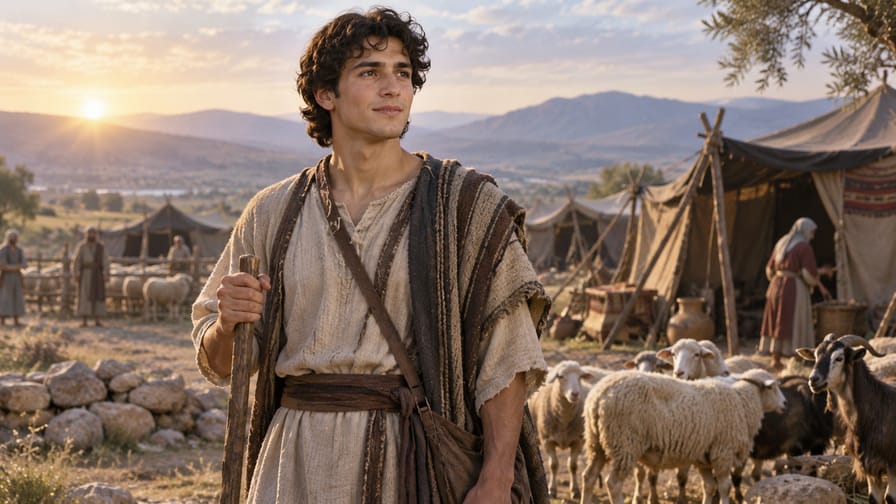
Benjamin is the twelfth and last son of Jacob, born to Rachel, his beloved wife and the second of his two main wives. He is the only son of Jacob born in Canaan, and the youngest of all twelve patriarchs who would give rise to the twelve tribes of Israel. His genealogy is crucial for the formation of the nation.
His mother, Rachel, died during childbirth, near Ephrath, which is Bethlehem (Genesis 35:16-19). This tragic event deeply marked the life of Benjamin and his father, Jacob, who had already lost Joseph, Rachel's elder son, of whom Benjamin was the only full brother.
The birth of Benjamin occurred in the patriarchal period, approximately between 1800 and 1700 BC, in a context of semi-nomadic life, where the family structure was the foundation of society and fertility was seen as a great divine blessing. Polygamy was practiced, but Jacob's preference for Rachel is evident.
2.2 Key Life Events
The narrative of Benjamin begins with his birth and the tragic death of Rachel (Genesis 35:16-20). As the youngest son and the only remaining son of beloved Rachel, he became the center of Jacob's overprotective affection, especially after the presumed death of Joseph.
The most significant events involving Benjamin occur during the famine crisis that led his brothers to Egypt. Joseph, who had been sold as a slave and ascended to governor of Egypt, tested his brothers repeatedly, demanding that they bring Benjamin to prove their honesty (Genesis 42:15-20).
Jacob, reluctant to allow Benjamin to go to Egypt for fear of losing him too, eventually yielded due to the severity of the famine and the insistence of Judah, who offered himself as guarantor for him (Genesis 43:8-14). This journey to Egypt was a moment of great tension and revelation in the family's history.
In Egypt, Benjamin was subjected to a final test orchestrated by Joseph, who placed his silver cup in Benjamin's sack to incriminate him and observe his brothers' reaction (Genesis 44:1-12). The willingness of the brothers, especially Judah, to suffer for him, demonstrated a change of character and family reconciliation.
After Joseph's revelation and the family reunion, Benjamin went down to Egypt with Jacob and his brothers, being blessed by Joseph with a portion of food five times greater than that of the others (Genesis 45:22 Genesis 46:19-21). He and his tribe prospered in Egypt before the Exodus.
The geography associated with Benjamin is primarily Canaan, where he was born, and then Egypt, where the family remained for centuries. The tribe of Benjamin would later occupy a strategic land between Judah and Ephraim, including parts of Jerusalem, Jericho, and Gibeah.
3. Character and Role in the Biblical Narrative
The character of Benjamin, the individual, is less developed in Scripture than that of his elder brothers. He is portrayed primarily as the object of his father Jacob's and his brother Joseph's love and protection. His youth and the tragic loss of his mother make him a figure of vulnerability and familial affection.
There are no records of personal moral failures or sins directly attributed to Benjamin in the Genesis narratives. He appears to be a passive character, whose existence and safety are central to the drama of family reconciliation, especially in the reunion with Joseph.
His main role in the Genesis narrative is that of a catalyst for the manifestation of the change of heart in Joseph's brothers. Joseph's demand that Benjamin be brought to Egypt served as a crucial test to see if the brothers had overcome the envy and cruelty that led them to sell Joseph (Genesis 42:20).
Judah's willingness to become a substitute and to suffer for Benjamin (Genesis 44:32-34) is a high point in the narrative, demonstrating the redemption and transformation of the brothers' character. Benjamin, thus, functions as a symbol of innocence and the need for protection.
However, the history of the tribe of Benjamin, descendant of the patriarch, reveals a more complex character. The tribe is notable for its ferocity and warrior skill, as prophesied by Jacob in Genesis 49:27: "Benjamin is a ravenous wolf in the morning he devours the prey, and in the evening he divides the spoil."
This ferocity manifested tragically in the book of Judges, when the tribe of Benjamin protected wicked men from Gibeah, leading to a devastating civil war against the other tribes of Israel (Judges 19-21). Almost the entire tribe was annihilated, a somber testimony to their obstinacy and misguided tribal loyalty.
Despite this stain, the tribe of Benjamin also produced notable figures, including the first king of Israel, Saul (1 Samuel 9:1-2), and, surprisingly, the apostle Paul (Romans 11:1 Philippians 3:5), who became one of the greatest proponents of Christianity.
4. Theological Significance and Typology
The figure of Benjamin, both as an individual and as a tribe, carries a multifaceted theological significance in the redemptive history of Israel. He represents God's providence that operates through the most painful circumstances, transforming the "son of sorrow" into the "son of favor."
The exaltation of Benjamin by Joseph in Egypt (receiving larger portions) can be seen as a reflection of divine election and favor, even for the smallest and weakest. This dynamic prefigures the way God often chooses the humble and despised to fulfill His purposes, as seen in 1 Corinthians 1:27-29.
The designation "son of the right hand" has a strong Christocentric resonance. Jesus Christ is the Son par excellence, exalted at the right hand of God the Father (Acts 7:55-56 Colossians 3:1). He is God's "Son of Favor," upon whom rests all blessing and authority.
The story of Joseph's test involving Benjamin illustrates central theological themes such as divine judgment, the need for repentance, and grace. The brothers are confronted with their past sin (the selling of Joseph) and have the opportunity to demonstrate sacrificial love for Benjamin, prefiguring redemption through a substitute.
The tribe of Benjamin, with its reputation for fierce warriors, but also with its fall in Judges 19-21, serves as a vivid reminder of human sinfulness and the need for divine grace. Even a tribe blessed with a name of favor can fall into deep depravity.
In the New Testament, the Benjamite heritage of the apostle Paul is significantly mentioned. Paul prides himself on his lineage as "a Hebrew of Hebrews as to the Law, a Pharisee" and from the "tribe of Israel, of the tribe of Benjamin" (Philippians 3:5 Romans 11:1).
This demonstrates that God uses individuals from all backgrounds, even those from tribes with complex histories, for His redemptive purposes. Paul, a persecutor of the church, was transformed into one of the greatest apostles, illustrating the sovereign grace of God.
5. Biblical-Theological Legacy and Canonical References
The legacy of Benjamin and his tribe is vast and permeates various layers of the biblical narrative. From his birth in Genesis to references in the New Testament, the tribe of Benjamin played a significant role in the formation and history of Israel.
After the patriarchal period, the tribe of Benjamin is notable for its strategic location in the promised land, between the powerful tribes of Judah and Ephraim (Joshua 18:11-20). This position made it a border tribe and a point of conflict and defense.
The Scriptures record the military prowess of the Benjamites, notably their archers and left-handed slingers (Judges 20:16 1 Chronicles 12:2), who were feared by their enemies. This martial skill, however, was also the cause of their near annihilation in the civil war of the Judges.
The tribe of Benjamin produced the first king of Israel, Saul, son of Kish (1 Samuel 9:1-2), an impressive man in stature and beauty, who was initially chosen by God, but whose reign ended in tragedy due to his disobedience (1 Samuel 15:22-23).
Later, when the kingdom divided, Benjamin remained loyal to Judah, forming the Southern Kingdom (Judah and Benjamin), while the other ten tribes formed the Northern Kingdom (1 Kings 12:21). This loyalty was crucial for the continuity of the Davidic line and, consequently, of the messianic promise.
The influence of Benjamin in biblical theology is felt through figures such as the apostle Paul, who explicitly identifies himself as a Benjamite. Paul's experience, a zealous Pharisee of the law, who becomes the apostle to the Gentiles, illustrates God's sovereignty in election and grace, transcending tribal and ethnic boundaries for salvation in Christ.
The presence of Benjamin in Jewish and Christian interpretive tradition is notable. In Judaism, his tribe is seen as the one that remained loyal to Judah, and its territory included the Temple in Jerusalem. In Reformed and Evangelical theology, the history of Benjamin and his tribe serves to illustrate God's faithfulness to His covenant, even amidst human failure, and the divine providence that prepares the way for Christ.
The importance of Benjamin for understanding the canon lies in his connection with patriarchal history, the formation of the tribes, the era of the Judges, the monarchy (Saul), the division of the kingdom, and finally, with the apostolic era through Paul. He is a vital link in the tapestry of salvation history, pointing to God's redemptive purpose in all ages.