


Jacob
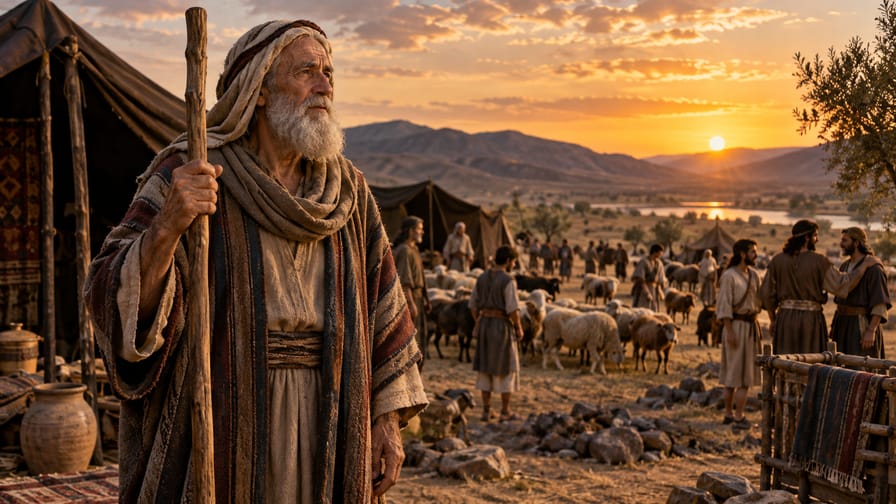
The figure of Jacob, one of the fundamental patriarchs of biblical faith, is central to understanding the history of redemption and the formation of the people of Israel. His life, marked by struggles, failures, and a profound transformation by divine grace, offers rich theological lessons. This analysis explores his etymology, narrative, character, theological significance, and legacy from an evangelical Protestant perspective, suitable for a biblical-theological dictionary.
1. Etymology and Meaning of the Name
1.1 Original Name and Linguistic Derivation
The name Jacob comes from the Hebrew Ya'aqov (יַעֲקֹב), a masculine name that appears abundantly in the Old Testament. Its etymological root is linked to the noun 'aqev (עָקֵב), which means "heel" or "sole of the foot."
The associated verb, 'aqav (עָקַב), can mean "to grasp by the heel," "to supplant," "to deceive," or "to subvert." This duality in meaning is crucial for understanding the patriarch's initial character and destiny.
1.2 Literal and Symbolic Meaning
Literally, the name Jacob means "he who grasps the heel." This interpretation is explicitly given in the biblical narrative, describing his birth as the second twin, holding onto the heel of his brother Esau (Genesis 25:26).
Symbolically, the name quickly acquired the meaning of "supplanter" or "deceiver," reflecting the cunning and manipulative nature that Jacob demonstrated in his early years. Esau, in a moment of bitterness, acknowledges this characteristic by saying: "Is he not rightly named Jacob? For he has supplanted me these two times" (Genesis 27:36).
1.3 Name Variations and Other Characters
In the New Testament, the Greek form of the name is Iakob (Ἰακώβ), which is transliterated into English as "James." Thus, characters such as James, son of Zebedee, and James, brother of Jesus, share the same nominal root as Jacob.
This linguistic connection reinforces the continuity of biblical tradition and the importance of the name throughout the ages, linking the Old Testament patriarch to the apostles and prominent New Testament figures.
1.4 Theological Significance of the Name
The theological significance of the name Jacob lies in its prefiguration of the journey of faith and transformation. The initial name "deceiver" is a stark contrast to the new name "Israel" (Yisra'el, יִשְׂרָאֵל), which means "he who struggles with God" or "prince of God" (Genesis 32:28).
This change of name is not merely nominal but symbolizes a profound work of grace and redemption, where God transforms Jacob's flawed character to fulfill His sovereign purposes. It is a testimony to divine sovereignty over election and regeneration, even of imperfect individuals.
2. Historical Context and Biblical Narrative
2.1 Historical Period and Environment
Jacob lived during the patriarchal period, approximately between 2000 and 1700 BC. This was a time of semi-nomadic clans in the Near East, with social and economic life centered on family and the ownership of flocks.
The political context was fragmented, with city-states and small kingdoms, without a dominant central authority. Religion was often polytheistic, but Jacob's family maintained monotheistic faith in the LORD, the God of Abraham and Isaac.
2.2 Genealogy and Family Origin
Jacob was the son of Isaac and Rebekah, and the grandson of Abraham and Sarah. He was the second of twins, born shortly after Esau. His genealogy connects him directly to the lineage of the promise made by God to Abraham (Genesis 12:1-3).
His mother, Rebekah, received a prophecy before the birth of the twins, indicating that "two nations are in your womb, and two peoples from within you shall be divided the one shall be stronger than the other, the older shall serve the younger" (Genesis 25:23). This prophecy prefigured the rivalry and destiny of Jacob and Esau.
2.3 Main Events in Jacob's Life
The narrative of Jacob's life is one of the most extensive and detailed in the book of Genesis (chapters 25-50). It begins with his rivalry with Esau, where Jacob buys his brother's birthright for a bowl of stew (Genesis 25:29-34).
Subsequently, with the help of his mother Rebekah, he deceives his father Isaac to receive the blessing of the birthright, intended for Esau (Genesis 27:1-40). This act of deception forced Jacob to flee from his enraged brother.
In his flight to Haran, Jacob has a transformative encounter with God at Bethel, where he sees a ladder connecting heaven to earth and receives confirmation of the Abrahamic promises (Genesis 28:10-22). He makes a vow to God, promising faithfulness.
In Haran, he serves Laban, his uncle, for many years. He is deceived into marrying Leah first, instead of Rachel, his beloved, and works a total of fourteen years for the two sisters, in addition to six years for his flocks (Genesis 29:1-30:43).
During his time with Laban, Jacob becomes the father of eleven of his twelve sons (Reuben, Simeon, Levi, Judah, Dan, Naphtali, Gad, Asher, Issachar, Zebulun, Joseph) and his daughter Dinah, through Leah, Rachel, and their servants Zilpah and Bilhah (Genesis 29:31-30:24).
After twenty years, Jacob flees from Laban with his family and possessions, returning to Canaan (Genesis 31). On the way, he prepares to meet Esau, fearing his vengeance.
The night before the encounter with Esau, Jacob wrestles with a mysterious man at Peniel, who is identified as God or an angel. His hip is dislocated, and he receives a new name, Israel, symbolizing his new identity and his perseverance in faith (Genesis 32:22-32).
Reconciliation with Esau occurs peacefully, contrary to his fears (Genesis 33:1-17). In Canaan, Jacob faces challenges such as the rape of Dinah and the death of Rachel while giving birth to Benjamin (Genesis 34-35).
The story of Jacob culminates with the loss of his favorite son, Joseph, and his subsequent descent into Egypt to reunite with him during the famine. There, he blesses his sons and Joseph's sons, prophesying about the future tribes of Israel (Genesis 37, 42-49).
Jacob dies in Egypt, but his desire is to be buried in the promised land, in the cave of Machpelah, alongside his ancestors (Genesis 49:29-32). Joseph and his brothers fulfill this desire (Genesis 50:1-14).
2.4 Geography and Relationships with Other Characters
Jacob's life spans several regions: Beersheba (his birthplace), Bethel (where he had the vision of the ladder), Haran (where he lived with Laban), Peniel (where he wrestled with God), Shechem and Hebron (in Canaan), and finally, Egypt.
His relationships with other characters are complex and formative: with his parents Isaac and Rebekah, with his brother Esau, with his uncle Laban and his wives Leah and Rachel, and especially with his twelve sons, who would become the heads of the twelve tribes of Israel.
3. Character and Role in the Biblical Narrative
3.1 Analysis of Character and Development
Jacob's character is multifaceted and undergoes a remarkable transformation. Initially, he is portrayed as cunning, calculating, and prone to deception, seeking selfish advantages. His purchase of the birthright and the deception regarding the paternal blessing are clear examples of his "supplanting" nature.
However, Jacob also demonstrates profound perseverance and a genuine desire for God's blessing, which distinguishes him from Esau. His determination to obtain the blessing at Peniel, declaring "I will not let you go unless you bless me" (Genesis 32:26), reveals an underlying faith, despite his failures.
Throughout his life, Jacob experiences the consequences of his actions, being himself deceived by Laban (Genesis 29:21-25) and suffering from family conflicts. These experiences and, crucially, his encounters with God, shape his character.
He emerges as a more humble man, dependent on God and aware of divine sovereignty, culminating in his prophetic blessing to his sons before his death, an act of profound faith (Genesis 49 Hebrews 11:21).
3.2 Virtues and Spiritual Qualities
Despite his failures, Jacob exhibited qualities such as perseverance and an tireless pursuit of divine blessing. His dedication to family, though imperfect, was evident in his hard work for Laban and his care for his children.
His faith, though at times mixed with human cunning, was real. He believed God's promises and clung to them, as demonstrated at Bethel and Peniel. This imperfect yet genuine faith is a testament to God's grace working amidst human weakness.
3.3 Sins, Weaknesses, and Moral Failings
Jacob's sins are clearly documented: deception, manipulation, favoritism (especially towards Joseph), and a tendency to rely on his own cunning rather than divine providence. These failings resulted in family conflicts and personal suffering.
His life is a reminder that even God's chosen ones are sinners and are in need of His transforming grace. Scripture does not omit the imperfections of its heroes but uses them to glorify God's faithfulness.
3.4 Vocation and Role in Salvation History
Jacob's vocation was to be the father of the twelve tribes of Israel, the patriarch through whom the promise of the Abrahamic covenant would be perpetuated and expanded. He was a crucial link in the messianic lineage, for from his offspring would come the Messiah.
His role was to establish the family that would become the nation of Israel, the people chosen by God to be the bearer of His revelation and the channel of His salvation to the world. His story sets the stage for the Exodus and the formation of the Israelite theocracy.
4. Theological Significance and Typology
4.1 Role in Redemptive History and Progressive Revelation
Jacob plays a fundamental role in God's redemptive history. Through him, the promises made to Abraham and Isaac are reiterated, and the divine covenant is confirmed (Genesis 28:13-15). He is the direct ancestor of the entire nation of Israel, which would become the covenant people.
His life demonstrates God's sovereignty in election, choosing the younger and less "fit" son in human eyes, to fulfill His purposes (Romans 9:10-13). Jacob's story is a progressive revelation of God's faithfulness, even in the face of human imperfection.
4.2 Christocentric Prefiguration or Typology
Although Jacob is not a direct type of Christ in the sense of being sinless, certain aspects of his life can be seen as prefigurations or shadows of truths that find their fulfillment in Christ.
Jacob's ladder at Bethel (Genesis 28:12), with angels ascending and descending, is interpreted by Jesus as a reference to Himself: "Truly, truly, I say to you, you will see heaven opened, and the angels of God ascending and descending on the Son of Man" (John 1:51). Christ is the bridge, the mediator between God and men.
His journey of exile and return, and his struggle at Peniel, can typify the spiritual journey of the believer, who wrestles with God in prayer and dependence, resulting in a new identity and blessing through Christ. Jacob's transformation into Israel points to the new creation in Christ.
4.3 Covenants, Promises, and Prophecies
The promises of the Abrahamic covenant of land, numerous offspring, and blessing for all nations are confirmed to Jacob at Bethel (Genesis 28:13-15). God reaffirms that the land on which he was lying would be given to him and his descendants.
Jacob's prophetic blessings to his sons in Genesis 49 contain important messianic promises, especially that concerning Judah: "The scepter shall not depart from Judah, nor the ruler's staff from between his feet, until Shiloh comes and to him shall be the obedience of the peoples" (Genesis 49:10). This is a clear prophecy of the coming of the Messiah from the tribe of Judah.
4.4 Quotations and References in the New Testament
Jacob is frequently mentioned in the New Testament, attesting to his continued importance. He is included in the genealogy of Jesus (Matthew 1:2 Luke 3:34). Jesus refers to him as one of the patriarchs in the kingdom of heaven (Matthew 8:11).
In Hebrews 11:9, 20-21, Jacob is commended for his faith, which led him to live in tents in the land of promise and to bless Joseph's sons. The apostle Paul uses Jacob's election over Esau to illustrate the sovereignty of divine election, not based on works, but on God's will (Romans 9:10-13).
4.5 Connection with Central Theological Themes
Jacob's life illustrates the doctrine of sovereign grace, where God chooses and blesses not by human merit, but by His own will and purpose. His transformation from "deceiver" to "prince of God" is a powerful testimony to regeneration and progressive sanctification.
Jacob's story also addresses God's faithfulness to His promises, even when His servants fail. It demonstrates divine providence, which orchestrates events to fulfill His plans, using human weaknesses to manifest His strength.
5. Biblical-Theological Legacy and Canonical References
5.1 Mentions in Other Biblical Books and Influence
Jacob's influence transcends the book of Genesis. His name, and especially his new name Israel, becomes synonymous with the people of God throughout the Old Testament. Moses refers to the "sons of Israel" and the "God of Abraham, Isaac, and Jacob" repeatedly (Exodus 3:6, Deuteronomy 1:8).
The Psalms and the prophets frequently invoke Jacob's name to refer to the nation of Israel, recalling God's promises and covenant with their ancestors (Psalms 14:7 Isaiah 41:8 Jeremiah 30:10).
In the New Testament, in addition to the mentions already cited, the "house of Jacob" is used to refer to the Jewish people, and God's promise to him is seen as part of the inheritance of faith for Christians (Luke 1:33 Acts 7:46).
5.2 Literary Contributions and Biblical Theology
Although Jacob was not an author of biblical books, his story is a pillar of biblical theology, particularly covenant theology. He is the third of the covenant patriarchs, and his life is essential for understanding the continuity and development of divine promises.
His story establishes the foundation for the formation of the nation of Israel and, consequently, for the revelation of the Law, the establishment of the priesthood, and the messianic royal lineage.
5.3 Presence in Interpretative Tradition
In Jewish tradition, Jacob (Israel) is seen as the archetype of the Jewish people, a symbol of their struggle, resilience, and special relationship with God. His blessings to his sons are frequently studied to understand the characteristics and destinies of the tribes of Israel.
In Christian tradition, Jacob's story is interpreted as a powerful testimony to God's redemptive grace. Evangelical commentators like John Calvin and Matthew Henry emphasize God's sovereignty in election and the transformation wrought by the Holy Spirit in the lives of sinners.
5.4 Treatment in Reformed and Evangelical Theology
Reformed and conservative evangelical theology highlights Jacob's story to illustrate key doctrines such as unconditional election (Romans 9), the perseverance of the saints (God does not abandon Jacob despite his mistakes), and God's sovereignty over human history and the plan of salvation.
Jacob's life is a reminder that God uses imperfect individuals to fulfill His perfect purposes, demonstrating that salvation is entirely the work of divine grace and not human merit. His transformation from Ya'aqov to Yisra'el is a model of conversion and sanctification.
5.5 Importance for Understanding the Canon
The figure of Jacob is vital for understanding the biblical canon as a whole. His story connects the patriarchal era to the formation of the nation of Israel in the Exodus, establishing the identity of God's people.
He serves as a genealogical and theological bridge between Abraham, the father of faith, and the subsequent events of Israel's history, culminating in the coming of Christ. To understand Jacob is to understand the roots of God's redemptive plan.