


Abihu
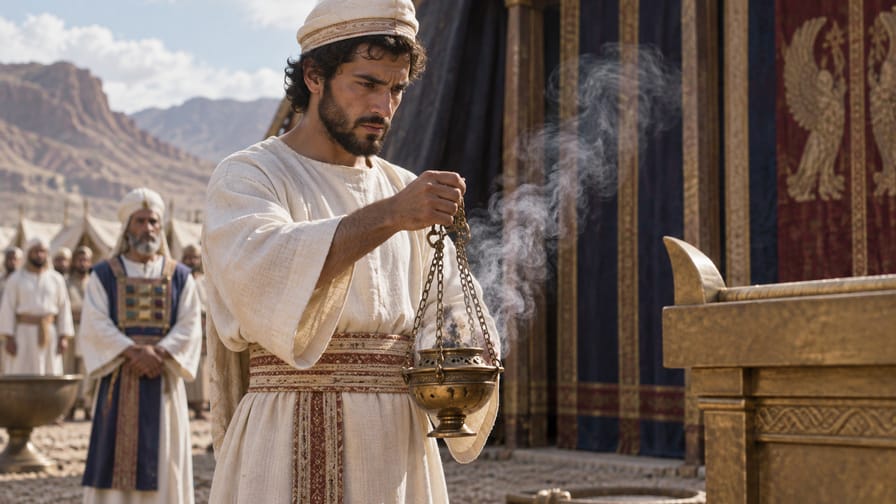
Abihu, whose name means “my father is he” or “my father is God,” holds a prominent yet tragic place in the early history of Israel’s priesthood. As one of the four sons of Aaron, the first high priest, Abihu was set apart for sacred service alongside his brothers Nadab, Eleazar, and Ithamar. His story serves as a stark reminder of the holiness of God and the seriousness of approaching Him on His own terms.
His brief but impactful narrative is found in the book of Leviticus, detailing a moment of divine judgment that underscored the absolute necessity of obedience in worship. The account of Abihu’s death has resonated through generations, prompting reflection on reverence, authority, and the nature of true worship.
1. Name and origin
1.1 Etymology and meaning
The name Abihu (אֲבִיהוּא) is a Hebrew compound name. It combines 'avi, meaning “my father,” and hu', meaning “he” or “he is.” Thus, the name can be understood as “my father is he” or, more profoundly, “my father is God.” This etymology is particularly poignant given Abihu’s priestly role, suggesting a deep, inherent connection to the divine through his lineage and calling.
The name itself speaks to a theological truth: God is the ultimate Father, the source of all authority and life. For Abihu, this name would have been a constant reminder of his unique position as a son of Aaron, chosen by God for sacred service, and the profound responsibility that came with it.
1.2 Family, era, and geography
Abihu was the second son of Aaron, the elder brother of Moses, and his wife Elisheba (Exod 6:23). His brothers were Nadab (the eldest), Eleazar, and Ithamar. This family belonged to the tribe of Levi, specifically the Kohathite clan, which was designated for priestly duties. Abihu lived during the Exodus period, specifically during the wilderness wanderings of Israel, around the 15th to 13th century BC, following their liberation from Egypt.
His life was centered around the Tabernacle, the portable sanctuary where God’s presence dwelt among His people. The geographical context is the wilderness, a place of divine revelation and the establishment of the covenant, where the laws for worship and priestly service were meticulously laid out.
2. Biblical narrative
2.1 Calling and key episodes
Abihu, along with his father Aaron and his three brothers, was explicitly chosen by God for priestly service. Exodus 28:1 states, “Call for your brother Aaron and his sons Nadab, Abihu, Eleazar, and Ithamar. Bring them here from among the Israelites to serve as my priests.” He was consecrated for this holy office, participating in the elaborate ordination ceremony described in Leviticus 8, which involved ritual washing, anointing, and sacrifices.
He was even privileged to ascend Mount Sinai with Moses, Aaron, and the seventy elders of Israel, where they “saw the God of Israel” (Exod 24:9-11). This experience marked him as one who had been exceptionally close to the divine presence, a profound honor and responsibility.
2.2 Relationships and turning points
Abihu’s most significant relationship was with his family, particularly his father Aaron and his elder brother Nadab. The turning point in his life, and indeed his tragic end, occurred shortly after the Tabernacle was dedicated and the priestly service began. Leviticus 10:1-2 records: “Aaron’s sons Nadab and Abihu put coals of fire in their incense burners and sprinkled incense on them. But the fire they used was not holy, for it was not taken from the altar as the Lord had commanded. So fire blazed forth from the Lord’s presence and burned them up, and they died there in his presence.”
This act of offering “unauthorized fire” (often translated as “strange fire”) was a direct violation of God’s specific instructions for worship. The immediate and severe judgment served as a powerful lesson to all Israel about the sanctity of God and the precise nature of His commands regarding worship.
3. Character and faith
3.1 Virtues and devotion
Before his fatal transgression, Abihu was among those chosen for a high and holy calling. His participation in the consecration rituals and the vision of God on Mount Sinai suggest a period of devotion and obedience. He was part of the inaugural priestly class, entrusted with mediating between God and His people. This required a certain level of faith and commitment to undertake such a demanding and sacred role.
We can infer that he possessed the initial zeal and willingness to serve, as he stepped into the priesthood alongside his family. The tragedy of his story is not that he was inherently evil, but that even those set apart for God’s service could falter in obedience.
3.2 Failures and lessons
Abihu’s primary failure, shared with his brother Nadab, was their disregard for God’s explicit instructions concerning the sacred fire. The text is clear: “the fire they used was not holy, for it was not taken from the altar as the Lord had commanded” (Lev 10:1). This was not a minor oversight but a profound act of disobedience, perhaps born of presumption, carelessness, or even intoxication (as suggested by the subsequent prohibition against priests drinking wine before entering the Tabernacle, Lev 10:9).
The lesson from Abihu’s death is profound: God is holy, and He must be approached on His terms, not ours. Worship is not a casual affair; it demands reverence, obedience, and adherence to divine revelation. This event underscored the principle that proximity to God’s holiness requires greater purity and stricter adherence to His commands.
4. Theological significance and legacy
4.1 Christological foreshadowing or typology
The tragic death of Abihu, resulting from an improper approach to God, highlights the absolute necessity of a perfect mediator and a perfect sacrifice. The Old Testament priesthood, with its stringent rules and the constant need for atonement, foreshadowed the ultimate High Priest, Jesus Christ. Unlike Abihu, whose offering was flawed and led to death, Jesus offered himself as the perfect, once-for-all sacrifice, fulfilling all the requirements of the Law (Heb 7:27).
Christ’s sacrifice provides the “holy fire” (the Holy Spirit) that enables us to approach God not through our own efforts or unauthorized means, but through His perfect mediation. He is the way, the truth, and the life, and no one comes to the Father except through Him (John 14:6). Abihu’s failure underscores the human inability to bridge the gap to God without divine provision.
4.2 Witness in later Scripture and church memory
The account of Nadab and Abihu is referenced in later Scripture as a warning. Numbers 3:4 and 26:61 reiterate their death “when they offered unauthorized fire before the Lord in the wilderness of Sinai.” This repeated mention emphasizes the enduring lesson of their transgression. In the New Testament, while not directly named, the principle of reverent and obedient worship is consistently upheld (e.g., Heb 12:28-29).
In church memory, Abihu’s story serves as a perennial reminder for believers and leaders alike about the sanctity of worship and the danger of casual or self-invented approaches to God. It calls for humility, careful adherence to God’s Word, and a deep respect for His holiness in all aspects of life and worship.
5. Conclusion
Abihu’s life, though tragically cut short, speaks volumes about the character of God and the nature of true worship. His story reminds us that God is both loving and holy, and His commands are not arbitrary but are given for our good and His glory. The severe judgment on Abihu and Nadab underscores the profound truth that access to God is a privilege, not a right, and must be approached with reverence and obedience. Ultimately, this narrative points us to Christ, who, as our perfect High Priest, has opened a new and living way for us to draw near to God, not through our own flawed offerings, but through His perfect sacrifice and mediation.