


Nadab
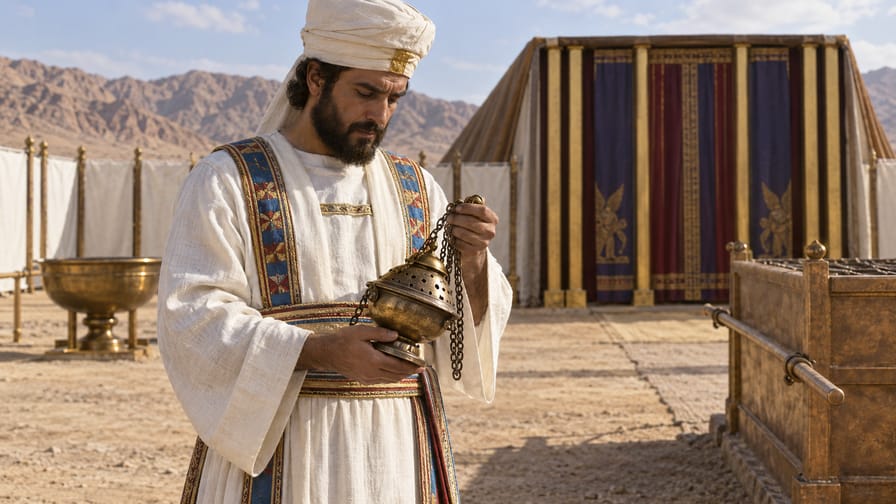
The figure of Nadab, one of Aaron's sons, is a biblical character whose brief, yet impactful, narrative offers profound theological and exegetical lessons, especially from an evangelical Protestant perspective. His story, recorded mainly in the books of Exodus and Leviticus, serves as a powerful reminder of God's uncompromising holiness and the seriousness of divinely ordered worship. An analysis of his life and death is crucial for understanding fundamental principles about the nature of God, priestly mediation, and the purity of worship.
This in-depth study will seek to explore the onomastic meaning of Nadab, his historical context, the nuances of his character as revealed in the Scriptures, his profound theological significance, and the legacy his story has left for the Christian faith. The tragedy of Nadab and Abihu is not merely an isolated incident, but a cornerstone in the progressive revelation of God's will for His people, with lasting implications for the doctrine of worship and the understanding of Christ's work.
1. Etymology and meaning of the name
The name Nadab (Hebrew: נָדָב, Nadab) is of Hebrew origin and carries an intrinsic meaning that, ironically, contrasts with the tragic outcome of his life. It derives from the verbal root נדב (nadab), meaning "to incite," "to be generous," "to offer voluntarily," or "to be noble."
Thus, the name Nadab can be interpreted as "generous," "noble," or "voluntary." This meaning suggests a disposition of heart to give or act with liberality. In the biblical context, the root nadab is frequently used to describe voluntary offerings (e.g., Leviticus 7:16) or readiness to serve God (e.g., Exodus 35:21).
The connotation of "voluntary" or "impulsive" in the name can be seen as a foreshadowing, or at least a bitter irony, considering the nature of his transgression. The offering of "strange fire" may have been an act of self-initiative, a "generosity" or "willingness" that was not in conformity with divine instructions, transforming a potential virtue into a fatal flaw.
It is important to note that there are other biblical characters named Nadab, though less prominent. One Nadab was one of the sons of King Saul, mentioned in 1 Chronicles 8:30 and 9:36. Another Nadab was a king of Israel, son and successor of Jeroboam I, whose reign lasted only two years before he was assassinated by Baasha (1 Kings 15:25-28).
However, the most significant figure with this name is, without a doubt, the son of Aaron. The distinction is crucial to avoid confusion. The theological significance of the name, in the context of Aaron's son, lies in the potential dissonance between what the name suggests (generosity, willingness) and how this "will" was expressed in an unauthorized manner, resulting in divine judgment.
The etymology of the name, therefore, can serve as a subtle reminder that devotion and willingness, however well-intented, must always be subject to God's sovereign will and explicit instructions. "Generosity" in worship must be guided by revealed truth, not human invention.
The Hebrew word for "voluntary offering" is nedabah (נְדָבָה), which shares the same root. This reinforces the idea that the name Nadab is intimately linked to the concept of giving and offering. The tragedy of Nadab illustrates that not every offering, even if "voluntary" or "generous" in its human intention, is acceptable to a holy God if it is not aligned with His commandments.
2. Historical context and biblical narrative
The story of Nadab is embedded in one of the most crucial periods of Israel's history: the formation of the nation in the wilderness of Sinai, shortly after the exodus from Egypt. This period, traditionally dated around 1446 BC, is marked by the giving of the Mosaic Law, the construction of the Tabernacle, and the institution of the Aaronic priesthood.
The political, social, and religious context of the time was that of a people recently freed from slavery, in the process of forming their national and religious identity under the leadership of Moses and the direct intervention of God. The worship of Yahweh was being formalized, radically distinguishing itself from the polytheistic and idolatrous practices of Egypt and neighboring nations.
2.1 Family origin and genealogy
Nadab was the eldest son of Aaron, the first high priest of Israel, and Elisheba, daughter of Amminadab and sister of Nahshon (Exodus 6:23). He had three brothers: Abihu, Eleazar, and Ithamar. His position as Aaron's firstborn conferred upon him a place of prominence and responsibility within the new priestly order established by God.
Nadab's genealogy connected him directly to the priestly lineage chosen by God, which underscores the high privilege and great expectation placed upon him and his brothers. They were anointed and consecrated to serve the Lord in the Tabernacle, mediating between God and the people of Israel (Exodus 28:1, 29:9).
2.2 Main events of his life
Nadab's life, though brief, is marked by two main events that reveal both his privilege and his transgression.
First, Nadab was one of the few individuals granted the extraordinary privilege of ascending Mount Sinai with Moses, Aaron, and seventy elders of Israel. There, they "saw the God of Israel" and ate and drank in His presence (Exodus 24:1, 9-11). This event demonstrates an intimacy and closeness with God that few experienced, indicating a position of great honor.
The second and most well-known event is his tragic death. After the consecration of the Tabernacle and the manifestation of God's glory that consumed Aaron's offering (Leviticus 9:24), Nadab and his brother Abihu took their censers, put fire in them, and offered "strange fire" ('esh zarah, אֵשׁ זָרָה) before the Lord, which He had not commanded them. As a result, "fire came out from the Lord and consumed them, and they died before the Lord" (Leviticus 10:1-2).
This act of divine judgment was immediate and severe, establishing a solemn precedent for worship and priestly conduct. The narrative of Nadab and Abihu is concise, but its events have profound theological reverberations, especially concerning God's holiness and the need for strict obedience in His service.
2.3 Geography and relationships
The events of Nadab's life occurred in the region of the wilderness of Sinai, specifically in the camp of Israel where the Tabernacle was erected. His proximity to the Tabernacle and Mount Sinai is fundamental to understanding the gravity of his transgression, as he was at the epicenter of divine revelation and the institution of worship.
His most important relationships were with his father, Aaron, his uncle Moses, and his brothers, especially Abihu, with whom he shared both privilege and condemnation. The reaction of Moses and Aaron to the death of Nadab and Abihu (Leviticus 10:3-7) is also instructive, showing submission to God's will even amidst personal pain.
3. Character and role in the biblical narrative
The biblical narrative does not offer an extensive description of Nadab's character, but his actions and the divine judgment that followed reveal crucial aspects of his personality and his moral failure. Initially, his character appears to be that of someone highly privileged and perhaps even zealous, given his role in ascending Sinai and his priestly appointment.
However, the incident of the "strange fire" points to a serious flaw in his character, which can be interpreted in various ways: presumption, irreverence, disrespect for divine instructions, or even drunkenness (which is suggested by the subsequent prohibition against drinking wine or strong drink before entering the Tent of Meeting, Leviticus 10:9).
The main fault of Nadab and Abihu was disobedience to God's explicit commands regarding worship. They offered "strange fire" ('esh zarah), which had not been "commanded" (lo' tsivvah, לֹא צִוָּה) by God. The exact nature of this "strange fire" has been a subject of debate among commentators.
Some interpretations suggest that the "strange fire" was fire from an unauthorized source, rather than the fire that continuously burned on the altar of burnt offering, which had been kindled by the Lord Himself (Leviticus 9:24). Others propose that the transgression was in offering incense at an inappropriate time, or in a non-prescribed manner.
Regardless of the exact nature of the transgression, the core issue is the violation of the regulative principle of worship: God must be worshipped only in the manner He has prescribed. The action of Nadab and Abihu was an act of human initiative that usurped the divine prerogative to define the terms of worship, demonstrating a lack of reverence for God's holiness.
Nadab's role in the biblical narrative is, therefore, that of an admonitory example. His story is not about a hero of faith, but about the seriousness of disobedience in matters of worship. He was called to a sublime priestly vocation, to mediate between God and men, but he failed in his most basic duty: obedience and respect for divine holiness.
The tragedy of Nadab and Abihu was not an accident, but a deliberate judgment of God to teach Israel and, subsequently, all generations, that God's holiness is absolute and that He must be approached on His own terms. Moses, in his explanation to Aaron, quoted God's words: "Among those who are near to me I will be sanctified, and before all the people I will be glorified" (Leviticus 10:3).
The development of Nadab's character is abrupt: from a state of privilege and closeness with God on Sinai, he falls into disgrace and death due to his transgression. His story serves as a paradigm for the importance of strict obedience and reverence in worship, especially for those in positions of spiritual leadership.
4. Theological meaning and typology
The episode of Nadab and Abihu holds monumental theological significance, serving as a pillar for understanding God's holiness, the nature of worship, and the need for perfect mediation. Their story is integrated into redemptive history as a solemn reminder of the consequences of sin and the importance of obedience.
First, the death of Nadab and Abihu emphasizes the absolute holiness of God. The Lord is a consuming fire (Deuteronomy 4:24 Hebrews 12:29), and His presence demands purity and obedience. God's "holiness" is not merely a moral quality, but His total separation from everything profane and sinful. The transgression of Nadab and Abihu was an act of profanation, and the divine response demonstrated that God's holiness cannot be compromised.
Secondly, Nadab's story is fundamental to the theology of worship. It establishes the Regulative Principle of Worship, a crucial doctrine in evangelical Reformed theology. This principle states that God must be worshipped only in the manner He Himself has commanded in His Word, and not through human innovations or preferences. The offering of "strange fire" was "what He had not commanded them" (Leviticus 10:1), underscoring the exclusivity of divine instruction in worship.
The severity of the judgment on Nadab and Abihu demonstrates that worship is not a trivial matter. To worship God in an unauthorized manner is a disrespect to His sovereignty and holiness. This principle resonates throughout the Old Testament and is implicitly confirmed in the New Testament, which emphasizes worship "in spirit and in truth" (John 4:24), as revealed by Christ.
Third, the incident highlights the imperfection of the Aaronic priesthood and the need for a perfect mediator. Nadab and Abihu, though anointed and privileged, were sinful men, subject to failures. Their death underscores the inability of the Levitical priesthood to purify itself and the people definitively. This points to the need for a Superior Priest.
In this sense, the story of Nadab and Abihu has a profound Christocentric typological significance. The failure and judgment upon these imperfect priests foreshadow the need for Jesus Christ, the perfect High Priest, "according to the order of Melchizedek" (Hebrews 7:11-28). Unlike the Levitical priests who offered sacrifices repeatedly and died, Christ offered Himself as a unique and perfect sacrifice, entering the heavenly sanctuary through His own blood (Hebrews 9:11-14, 24-28).
Christ never offered "strange fire" His obedience was absolute and perfect. He fulfilled all righteousness and offered the sacrifice that was fully acceptable to God. The imperfection and failure of the Levitical priesthood, exemplified in Nadab and Abihu, serve to magnify the perfection and sufficiency of Christ's priesthood.
The story of Nadab and Abihu also connects with central theological themes such as judgment, grace, and obedience. The judgment was immediate and severe, but it served to establish the boundaries of holiness and prepare the way for understanding grace, which would come through appropriate sacrifices and, ultimately, in Christ. Obedience, even for those in positions of great privilege, is imperative for approaching God.
In the New Testament, warnings against presumption and disrespect for God's holiness echo the lesson of Nadab and Abihu. For example, Paul warns the Corinthians about the danger of partaking unworthily of the Lord's Supper, resulting in sickness and death for some (1 Corinthians 11:27-30). Reverence and obedience continue to be essential in Christian worship.
5. Biblical-theological legacy and canonical references
The story of Nadab, though concise, has left a lasting legacy in biblical theology and Christian tradition. His canonical mentions are primarily in the books of Exodus and Leviticus, where his story unfolds, and in Numbers and 1 Chronicles, where his death is reiterated in genealogical contexts, always with the note of his transgression.
In Numbers 3:2-4 and 26:60-61, Aaron's genealogy is presented, and the names of Nadab and Abihu are listed as sons of Aaron, but with the explicit caveat that "they died before the Lord when they offered strange fire before the Lord in the wilderness of Sinai." Likewise, in 1 Chronicles 6:3 and 24:1-2, their deaths are mentioned with the same cause, solidifying the theological lesson for future generations.
Nadab's influence on biblical theology is profound, especially concerning the doctrine of worship. Jewish and Christian interpretive tradition has consistently used the incident of Nadab and Abihu to emphasize the seriousness of worshipping God. In Judaism, the account serves as a reminder of the need to strictly follow Halakha (Jewish law) in all ritual practices.
In Reformed and evangelical theology, the story of Nadab and Abihu is a foundational text for the defense of the Regulative Principle of Worship. Theologians like John Calvin and the Puritans frequently cited this episode to argue that worship should not include anything not expressly commanded by God in His Word. This principle contrasts with the Normative Principle, which permits everything not explicitly forbidden.
The death of Nadab and Abihu is seen as a warning against human invention in worship, religious syncretism, and the presumption that one can approach God in any manner. It underscores God's sovereignty in establishing the terms of His own worship and the need for reverence and obedience on the part of worshippers.
Beyond worship, Nadab's story contributes to the understanding of God's holiness and the gravity of sin, even among those called to sacred service. The idea that "God is not mocked" (Galatians 6:7) finds a powerful echo in this Old Testament account, showing that God takes seriously the purity of His name and obedience to His law, especially on the part of His leaders.
The character's relevance for understanding the canon lies in its function of establishing a precedent. The judgment on Nadab and Abihu was not an arbitrary act, but a pedagogical demonstration of God's nature and the demand for holiness. This event shaped subsequent laws regarding the priesthood, ritual purity, and conduct in the Tabernacle, ensuring that the people of Israel understood the seriousness of their covenantal relationship with a holy God.
In summary, the figure of Nadab, despite his brief appearance and tragic end, remains a vivid reminder of God's holiness, the importance of divinely prescribed worship, and the urgent need for a perfect mediator. His story, interpreted in light of evangelical Reformed theology, continues to instruct and warn the Church about the seriousness of worship and the glory of Christ, our High Priest.