


Aaron
1. Etymology and meaning of the name
The name Aaron, in Hebrew אֲהַרֹן (ʾAharon), is of uncertain etymology, which has generated various proposals among scholars. The difficulty lies in the absence of a clear Hebrew root that unanimously explains its meaning. This ambiguity is a notable point in the onomastic analysis of the character.
One of the most accepted theories suggests an Egyptian origin, given the residence of Aaron's family in Egypt for centuries. Some propose it derives from terms like aha-rw, which could mean "lion of a hero" or "he who is conceived." This connection with Egyptian is plausible, considering the historical context of his childhood.
Other Hebrew hypotheses include derivation from the root 'ōr (אוֹר), "light," suggesting a meaning like "enlightened" or "bearer of light." Alternatively, some connect Aaron to the root harar (הָרַר), "to be high" or "mountainous," which could imply "mountain of strength" or "exalted." However, none of these Hebrew derivations has absolute consensus.
In the Greek of the Septuagint and the New Testament, the name is transliterated as Ἀαρών (Aarōn). This consistency in transliteration across biblical languages demonstrates the importance and recognition of the name, regardless of its exact etymology.
There are no other prominent biblical characters with the name Aaron, which makes him singular in the biblical narrative. This exclusivity reinforces the centrality of the Levite Aaron in the history of redemption and the foundation of the priesthood.
Although the etymology of the name Aaron does not offer a direct and irrefutable theological meaning, the role he played as high priest of Israel lends the name a symbolic significance. He became synonymous with mediation, sacrifice, and access to the divine presence, regardless of what his name might have originally meant.
2. Historical context and biblical narrative
Aaron's historical period is intrinsically linked to the Exodus and Israel's wilderness wandering, events that, according to traditional biblical chronology, occurred in the 15th century B.C. (c. 1446 B.C.) or, according to later dating, in the 13th century B.C. (c. 1290 B.C.). He was born in Egypt, under the yoke of pharaonic slavery, in a context of oppression and suffering for the Hebrew people.
The political and social context was one of a dominant Egyptian empire, which viewed the Israelites as a threat and subjected them to forced labor. Religiously, Israel was immersed in a polytheistic Egyptian culture, although it maintained its ancestral monotheistic traditions, inherited from Abraham, Isaac, and Jacob. The calling of Aaron and Moses marks the beginning of Israel's liberation and formation as a theocratic nation.
Aaron's genealogy is clearly traced in the Scriptures. He was the son of Amram and Jochebed, from the tribe of Levi, and the older brother of Moses and Miriam (Exodus 6:20 Numbers 26:59). His Levitical lineage was fundamental for the establishment of the priesthood, which would be exclusive to his descendants.
The main events of Aaron's life begin with his calling to be Moses' spokesperson before Pharaoh, due to his brother's speech difficulty (Exodus 4:14-16). He accompanied Moses during the ten plagues (Exodus 7-10) and the Exodus from Egypt, witnessing the divine miracles. On Mount Sinai, he ascended with Moses to receive the Law, although he did not enter into the immediate presence of God (Exodus 24:1, 9-11).
The most significant moment of his life was his anointing and consecration as the first High Priest of Israel, along with his sons, according to God's detailed instructions (Exodus 28-29 Leviticus 8). This institution of the Aaronic priesthood was a milestone in Israel's religious history, establishing the system of sacrifices and mediation.
However, his journey was not without flaws, such as his participation in the making of the golden calf at Sinai (Exodus 32), a grave act of idolatry. He was also involved in the episode of rebellion by Korah, Dathan, and Abiram, when his priestly authority was divinely confirmed by the budding of his staff (Numbers 16-17). His life ended on Mount Hor, where he died and was succeeded by his son Eleazar, before Israel entered the Promised Land (Numbers 20:23-29).
The geography related to Aaron covers Egypt, the Sinai Peninsula, and the various encampments of the wandering, culminating in his death on Mount Hor, on the border of Edom. His relationships with Moses were of partnership and subordination, with Miriam, of brotherhood, and with his sons, of father and priestly mentor. Eleazar and Ithamar were the sons who survived and continued the priestly line, after the death of Nadab and Abihu for offering "strange fire" (Leviticus 10:1-7).
3. Character and role in the biblical narrative
Aaron's character, as revealed in the Scriptures, presents a complex mixture of obedience, loyalty, but also weakness and susceptibility to pressure. Initially, he demonstrates an immediate willingness to serve as Moses' spokesperson, even in the face of the magnitude of the task of confronting Pharaoh (Exodus 4:27-31).
Among his virtues, his general faithfulness to Moses and God in the performance of his priestly duties stands out. He executed the complex consecration ceremonies and Tabernacle rituals diligently, according to divine prescriptions (Leviticus 8-9). His intercession in times of judgment, such as in the plague that followed Korah's rebellion, demonstrates a compassionate and mediating side (Numbers 16:46-48).
However, Aaron is also marked by significant moral failures. The most notorious is his participation in the creation of the golden calf. Under the pressure of the impatient people, he yielded and forged an idol, declaring it the god who had brought them out of Egypt (Exodus 32:1-6). This episode reveals a lack of firmness and a tendency to succumb to popular will at the expense of divine will.
Another important failure occurred at Meribah, where he, together with Moses, disobeyed God by striking the rock twice instead of merely speaking to it, demonstrating impatience and a failure to sanctify God's name before the people (Numbers 20:10-12). This disobedience cost both of them entry into the Promised Land.
Aaron's specific calling and function were those of High Priest of Israel, the first to occupy this divinely instituted office. He was the principal mediator between God and the people, responsible for offering sacrifices for sins, administering the rituals of the Tabernacle, and entering the Holy of Holies once a year, on the Day of Atonement (Leviticus 16).
His role was crucial for the maintenance of the Mosaic covenant, symbolizing God's holiness and the need for atonement so that the people could relate to Him. He was the guardian of the ritual Law and the interpreter of the divine will through the Urim and Thummim (Exodus 28:30).
Throughout the narrative, Aaron's character development shows a transition from a subordinate to Moses to a central and autonomous figure in the priesthood. Despite his weaknesses, God's faithfulness to His promise of a priestly lineage through Aaron is consistently demonstrated, even after the death of his sons Nadab and Abihu due to disobedience (Leviticus 10:1-7). His death on Mount Hor marks the end of an era and the transition of the priesthood to his son Eleazar, maintaining the continuity of the priestly line (Numbers 20:23-29).
4. Theological significance and typology
Aaron's theological significance is immense, central to understanding Israel's redemptive history and the progressive revelation of God's plan of salvation. His institution as High Priest marks the establishment of a sacrificial and mediating system that was essential for the Mosaic covenant. This system was the shadow of future realities in Christ.
The figure of Aaron is a prominent Christocentric type, prefiguring the perfect and eternal priesthood of Jesus Christ. The Epistle to the Hebrews is the main New Testament text that develops this typology, contrasting and comparing the Aaronic priesthood with the priesthood of Christ according to the order of Melchizedek.
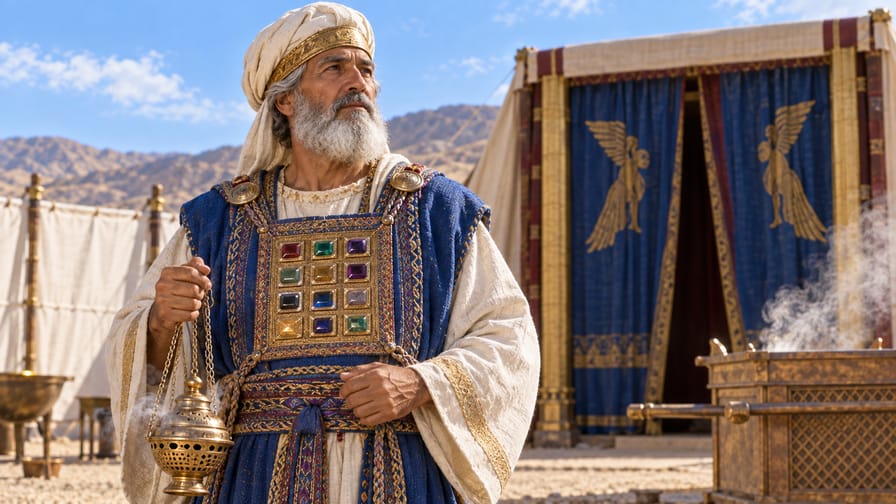
Typological similarities include the role of mediator between God and men, intercession for the people, and the need for holiness to approach God. Both Aaron and Christ were divinely called to their offices (Hebrews 5:4-5). Aaron wore the names of the tribes of Israel on his breastpiece and ephod shoulders when entering the Holy Place, symbolizing his representation of the people before God (Exodus 28:9-12, 29). Christ, in a superior way, represents and intercedes for all the elect before the Father.
However, the differences are crucial for evangelical Protestant theology. Aaron's priesthood was imperfect, transitory, and hereditary, requiring the succession of mortal priests (Hebrews 7:23). He needed to offer sacrifices first for his own sins and then for those of the people, indicating his own fallibility and the inability of animal sacrifices to completely remove sin (Hebrews 7:27 Hebrews 10:1-4).
In contrast, Christ is the perfect, sinless High Priest, who does not need to offer sacrifices for Himself (Hebrews 7:26-27). His priesthood is eternal and unchangeable, for He lives forever to intercede for us (Hebrews 7:24-25). His sacrifice was a single and sufficient offering of Himself, shedding His own blood, which is capable of purifying the conscience and obtaining eternal redemption (Hebrews 9:11-14, 26-28).
The Mosaic covenant, in which Aaron was central, was a "shadow of the good things to come" (Hebrews 10:1), a tutor that pointed to the need for a Savior and to the reality of the New Covenant in Christ. The promises and prophecies related to the Aaronic priesthood find their final fulfillment and abrogation in the superior and definitive priesthood of Christ.
The figure of Aaron, therefore, illustrates central theological themes such as the holiness of God, the gravity of sin, the need for atonement, and God's grace in providing a means of access to Him. His life and ministry demonstrate that faith and obedience are requirements for service to God, but also that human weakness requires a more excellent mediator. Evangelical theology emphasizes that the Aaronic priesthood was a preparatory stage, fully realized and surpassed by the priestly work of Jesus Christ.
5. Biblical-theological legacy and canonical references
Aaron's legacy in the Bible is vast and enduring, being one of the most mentioned characters in the books of the Pentateuch, especially in Exodus, Leviticus, and Numbers. His life and ministry are fundamental for understanding the constitution of the Levitical priesthood and the system of worship in Israel. He is the central figure who inaugurates a priestly lineage that would endure for centuries.
Beyond the Pentateuch, Aaron is mentioned in other historical books, such as 1 Chronicles, where his priestly genealogy is reiterated (1 Chronicles 6:3-15), and in Nehemiah, which lists the priests and Levites who returned from exile (Nehemiah 7:39-42). In the Psalms, he is remembered as one of God's chosen servants, alongside Moses (Psalm 77:20 Psalm 105:26), although Psalm 106:16 also alludes to rebellion against him.
There are no direct literary contributions attributed to Aaron, such as the authorship of books or psalms. However, his life and the establishment of the priesthood that bears his name are the central theme of much of the books of Leviticus and Numbers, which detail the laws and rituals that he and his descendants were to observe.
His influence on biblical theology is profound. He established the model for the priesthood in Israel, which was the vital link between God and the people under the Old Covenant. His role is crucial for understanding the doctrine of atonement, holiness, and mediation. The sacrificial system, with Aaron at its head, pointed to the need for a perfect sacrifice and a final mediator.
In the Jewish interpretive tradition, Aaron is revered as the first High Priest, a model of meekness and a peacemaker. Rabbinic Judaism often contrasts him with Moses, seeing Aaron as more accessible and compassionate, especially in his role as intercessor. His staff that budded is a symbol of his divinely confirmed authority (Numbers 17:8).
In Christianity, and particularly in Reformed and evangelical theology, the treatment of Aaron is primarily typological, as articulated in the Epistle to the Hebrews. His figure is seen as a shadow or type that finds its antitype and supreme fulfillment in Jesus Christ, the Great High Priest. This perspective emphasizes the superiority and finality of Christ's priesthood in relation to the Levitical priesthood.
Evangelical theology emphasizes that the Aaronic priesthood, with its limitations and the need for continuous sacrifices, demonstrates the insufficiency of the Law to provide complete salvation and the perfection of Christ's work. Aaron's failure in the golden calf incident also serves as a reminder of the inherent sinfulness even of leaders chosen by God, reinforcing the need for a sinless Savior.
Aaron's importance for understanding the canon lies in his function as a bridge between the divine promise and its fulfillment. He is an indispensable piece in the puzzle of redemptive history, revealing God's patience, the preparation for Christ's coming, and the nature of the New Covenant. His legacy helps us appreciate the magnitude of Jesus' sacrifice and intercession, which infinitely surpass the rituals and mediation of the Old Testament.