


Zechariah
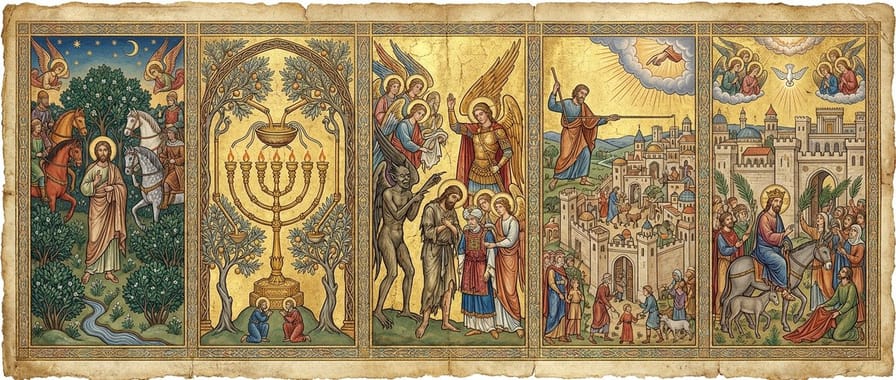
Illustration of the Book of Zechariah, one of the 39 books of the Old Testament (Nano Banana Pro).
The book of the prophet Zechariah, one of the twelve Minor Prophets of the Old Testament, stands as a beacon of hope and eschatological revelation amidst the ruins of the Babylonian exile and the challenge of post-exilic reconstruction. Situated in a crucial period of Israel's history, when the nation was returning to its homeland with a heavy heart from the memory of captivity and the monumental task of rebuilding the Temple and their faith, Zechariah presents himself as a divine voice that transcends immediate concerns to point towards a glorious future, centered on the sovereignty of God and the coming of the Messiah. This introduction aims to unveil the riches of this prophetic book, establishing an analytical framework that can be replicated for any book of the Bible, from a conservative evangelical Protestant perspective.
The approach adopted here is founded on the belief in the inerrancy and verbal and plenary inspiration of the Scriptures, upholding traditional authorship and the unity of the text. We seek to balance academic rigor with pastoral relevance, providing an in-depth understanding of Zechariah's historical and theological contexts, literary structure, and central themes. Above all, we will emphasize a Christ-centered reading of the book, recognizing that, like all Scripture, Zechariah testifies of Christ and God's redemptive plan. As we delve into its enigmatic visions, oracles of judgment, and promises of salvation, we will be guided by hermeneutical principles that prioritize historical-grammatical and canonical interpretation, seeking to discern God's message for His people, both in the past and in the present.
The study of Zechariah is an invitation to reflect on God's faithfulness, the nature of true repentance, the Messiah's role in salvation history, and the ultimate destiny of humanity and creation. It is a book that challenges complacency and inspires hope, reminding us that, despite present adversities, the Lord of hosts is in control and His Kingdom will come in fullness. May this analysis serve as a guide to explore the depths of God's Word, revealing the beauty and truth contained in this remarkable prophetic book.
1. Historical Context, Dating, and Authorship
The book of Zechariah emerges from one of the most significant and challenging periods in Israel's history: the return from the Babylonian exile. After seventy years of captivity, a remnant of the Jewish people, under the leadership of Zerubbabel (governor) and Joshua (high priest), returned to Jerusalem with the permission of the Persian king Cyrus, as recorded in Ezra 1-6. The primary task awaiting them was the rebuilding of the Temple, which had been destroyed by Nebuchadnezzar. However, initial enthusiasm soon gave way to apathy, discouragement, and external opposition, leading to a hiatus of about sixteen years in the Temple work.
1.1 The Post-Exilic Setting and the Prophetic Mission
It is in this context of stagnation and disillusionment that Zechariah, along with his contemporary Haggai, is raised up by God. The book of Zechariah begins with a precise date: "in the eighth month, in the second year of Darius" (Zechariah 1:1), which corresponds to October/November 520 BC. This period is crucial, as it marks the revival of the Temple reconstruction project. The prophets Haggai and Zechariah were instruments of God to exhort the people to prioritize the Lord's work, reminding them of His faithfulness and of the glorious future promises that depended, in part, on the restoration of worship in Jerusalem. The political landscape was dominated by the Persian Empire, which had succeeded Babylon. Although the Jews had permission to return and rebuild, they were still under foreign rule, which created a sense of vulnerability and dependence.
1.2 Traditional Authorship and Internal Evidence
The conservative evangelical perspective firmly defends the unitary authorship of Zechariah, attributing the entire book to the prophet Zechariah, son of Berechiah, son of Iddo, as he himself identifies in Zechariah 1:1. He was not only a prophet but also a priest (Nehemiah 12:4, 16), which gave him particular authority and understanding of matters concerning the Temple and worship. Internal evidence from the book supports this authorship. The dates provided in chapters 1 and 7 place the prophet in the post-exilic period. The mention of Zerubbabel and Joshua as prominent figures in the initial chapters (Zechariah 3:1-10; 4:6-10; 6:11-12) aligns perfectly with the 6th century BC context. The prophetic style, with its night visions and oracles, is consistent with other Old Testament prophets.
1.3 Response to Higher Criticism
Despite the clarity of authorship statements and historical context, modern higher criticism, since the 19th century, has questioned the unity of the book of Zechariah. The most widespread hypothesis is that chapters 9-14 (or sometimes 12-14) were written by a different author, often called "Deutero-Zechariah," and at a later date, possibly in the Hellenistic period (4th-2nd centuries BC). Arguments for this division include alleged differences in style, vocabulary, and themes between the two sections. The first part (chapters 1-8) focuses on the reconstruction of the Temple and the figures of Zerubbabel and Joshua, while the second (chapters 9-14) seems to address more distant eschatological events, without direct references to the Temple or post-exilic leaders, and with a more poetic and apocalyptic style.
However, the conservative evangelical position refutes these criticisms based on solid evidence. Firstly, the Bible itself offers no indication of multiple authorship; on the contrary, Zechariah 7:1 and Zechariah 9:1 introduce new sections under the same prophetic authority. Secondly, the differences in style and themes can be explained by the progressive nature of prophetic revelation and the change in literary genre. A prophet may employ different styles and address different themes throughout his ministry, especially when dealing with immediate events (chapters 1-8) and distant eschatological prophecies (chapters 9-14). The transition from a local to a universal and eschatological focus is common in prophetic literature (compare Isaiah or Ezekiel).
Thirdly, the New Testament cites passages from both sections of Zechariah and consistently attributes them to the prophet Zechariah. For example, Matthew 27:9-10 quotes Zechariah 11:12-13, attributing it to "Jeremiah the prophet," but the substance of the quote is from Zechariah, which may be a generic attribution to a major prophet or a reference to a prophetic collection. More directly, John 19:37 quotes Zechariah 12:10 and attributes it to "Scripture." In Matthew 21:5, Jesus' triumphal entry is described using language from Zechariah 9:9. These New Testament references presuppose an authorial, or at least canonical, unity of the book. Finally, there is an underlying theological unity throughout the book, with themes such as God's sovereignty, the restoration of Israel, the need for repentance, and, crucially, the centrality of the Messiah, permeating both sections. The defense of Zechariah's unitary authorship is, therefore, consistent with the inerrancy of Scripture and faithfulness to biblical tradition.
2. Structure, Division, and Main Content
The book of Zechariah is notable for its literary complexity, combining elements of prophecy, apocalyptic, and exhortation. Its structure, though challenging in some aspects, reveals a logical flow that moves the reader from the immediate concerns of the return from exile to God's grand eschatological promises. Most scholars divide Zechariah into two or three main parts, reflecting changes in genre and themes.
2.1 Literary Organization and Main Divisions
A common and widely accepted division of Zechariah is into two main sections, each introduced by a formula that translates as "The word of the Lord came to Zechariah" or "A burden, the word of the Lord":
- Part 1: Eight Night Visions and Four Messages (Chapters 1-8)
This section is specifically dated to the beginning of Zechariah's ministry (520-518 BC) and is characterized by a series of symbolic visions, followed by oracles and exhortations. The main focus is encouragement for the rebuilding of the Temple and the restoration of the post-exilic community. The visions are interpreted by an angel, making them more accessible.
- Part 2: Two Prophetic Burdens (Chapters 9-14)
This part is introduced by "A burden: The word of the Lord" (Zechariah 9:1 and Zechariah 12:1) and has no specific dates. Its style is more poetic, oracular, and overtly eschatological, focusing on God's future interventions in history, judgment on the nations, the coming of the Messiah, and the ultimate glory of Jerusalem. This section is the primary source of the debate over multiple authorship, but, as argued, it maintains thematic and theological unity with the initial chapters.
2.2 Narrative or Argumentative Flow
Zechariah's flow begins with an immediate urgency and expands into a universal and eschatological vision. The first part (chapters 1-8) serves to reorient the people of Israel, reminding them of their past disobedience and the resulting captivity, but also assuring them of God's faithfulness in restoring His presence (the Temple) and His people. The visions offer an overview of divine control over history and the nations, ensuring that God's plan for Israel and for humanity is underway. The crowning of Joshua (Zechariah 6:9-15) serves as a culmination point, pointing to the Messiah as priest and king.
The second part (chapters 9-14) elevates the prophetic horizon, delving deeply into Messianic and eschatological theology. The two "burdens" function as distinct but interconnected oracles that detail the events culminating in the coming and reign of the Messiah. The first oracle (chapters 9-11) addresses the coming of the humble Messiah, His rejection, and judgment on the "bad shepherds." The second oracle (chapters 12-14) describes the final battle against Jerusalem, the repentance and purification of Israel, and the coming of the Lord to reign over the whole earth. There is a clear progression from the immediacy of the post-exile to the grandeur of the end times, all seen through the lens of divine sovereignty.
2.3 Synthetic Outline of Content
For a more detailed understanding, the book can be outlined as follows:
- I. Introduction and Call to Repentance (1:1-6)
- Dating and identification of the prophet.
- Exhortation not to follow the ways of the ancestors.
- II. The Eight Night Visions (1:7-6:15)
- 1. The Horseman Among the Myrtles (1:7-17): God promises comfort and restoration for Jerusalem.
- 2. The Four Horns and the Four Craftsmen (1:18-21): Judgment on the nations that oppressed Israel.
- 3. The Man with the Measuring Line (2:1-13): Jerusalem will be rebuilt and inhabited, with God as its glory and protection.
- 4. The High Priest Joshua and the Angel of the Lord (3:1-10): Purification of Joshua, typifying the removal of Israel's sin and the coming of the "Branch" (Messiah).
- 5. The Golden Lampstand and the Two Olive Trees (4:1-14): The Spirit of God will enable Zerubbabel to complete the Temple; the Messiah as the "Branch".
- 6. The Flying Scroll (5:1-4): Judgment on sinners and thieves throughout the land.
- 7. The Woman in the Basket (5:5-11): The removal of iniquity (wickedness) from the land of Israel to Babylon.
- 8. The Four Chariots (6:1-8): The heavenly spirits execute God's judgment on the nations.
- The Crowning of Joshua (6:9-15): Symbol of the "Branch" (Messiah), who will be priest and king.
- III. Messages on Fasting and Future Restoration (7:1-8:23)
- The Question of Fasting (7:1-7): God demands justice and mercy, not empty rituals.
- Warning Against Disobedience (7:8-14): The consequences of past sin.
- Promises of Restoration and Blessing (8:1-23): God will return to Zion, bring peace, prosperity, and turn fasting into joy; the nations will come to Jerusalem.
- IV. First Burden: The Coming King and the Rejected Shepherd (9:1-11:17)
- Judgment on Neighboring Nations (9:1-8): Damascus, Tyre, Sidon, Philistia.
- The Coming of the Messiah King (9:9-10): Humble, mounted on a donkey, bringing peace to the nations.
- Restoration of Israel and Ephraim (9:11-10:12): The Lord will rescue His people and strengthen them.
- The Worthless Shepherds and the True Shepherd (11:1-17): The judgment of corrupt leaders and the figure of the rejected shepherd, sold for thirty pieces of silver.
- V. Second Burden: The Final Struggle for Jerusalem and the Coming of the Lord (12:1-14:21)
- Jerusalem, the Cup, and the Stone (12:1-9): God will protect Jerusalem on the final day.
- Mourning for the "Pierced One" (12:10-14): Israel will repent and mourn for Him whom they have pierced.
- The Fountain for Purification (13:1-6): Purification from sin and idolatry.
- The Smitten Shepherd and the Remnant (13:7-9): The Messiah will be smitten, the sheep scattered, but a third will be purified.
- The Day of the Lord and the Messianic Kingdom (14:1-21): The final battle in Jerusalem, the coming of the Lord, the transformation of the earth, and universal holiness.
3. Central Theological Themes and Purpose
The book of Zechariah is a treasure of profound theological truths, intertwining to form a rich tapestry of God's work and character. While diverse themes can be identified, five stand out as central to the prophet's message, all converging on the book's primary purpose.
3.1 Restoration and Covenant Renewal
One of the most prominent themes in Zechariah is the promise of Israel's restoration and the renewal of God's covenant with His people. After the Babylonian captivity, Israel was in a state of vulnerability and discouragement. Zechariah rises to assure that, despite their past failures, God had not abandoned His promises. The rebuilding of the Temple is a tangible symbol of this restoration (Zechariah 1:16; 6:12-15), signifying the return of God's presence among His people. The visions and oracles reiterate that God "is very jealous for Jerusalem and for Zion" (Zechariah 1:14) and that He will return to bless His land and His people (Zechariah 8:3). This restoration is not merely physical, but also spiritual, with promises of purification and renewal of the heart, culminating in obedience and recognition of the Lord (Zechariah 13:1-2).
3.2 The Messiah and the Coming Kingdom
Zechariah is, without a doubt, one of the most Christ-centered books of the Old Testament. Messianic prophecies are abundant and remarkably detailed, offering a multifaceted portrait of the Messiah as priest, king, servant, and savior. He is called the "Branch" (Zechariah 3:8; 6:12), a reference to the Davidic lineage and His ability to build the spiritual Temple. He is portrayed as the humble king who enters Jerusalem mounted on a donkey (Zechariah 9:9), a prophecy directly fulfilled in Jesus' triumphal entry. The betrayal for thirty pieces of silver (Zechariah 11:12-13) is a vivid foreshadowing of what Judas would do. The figure of the "pierced one" for whom Israel will mourn (Zechariah 12:10) points to the crucifixion of Christ and Israel's future repentance. The "Shepherd" who will be struck, resulting in the scattering of the sheep (Zechariah 13:7), is a prophecy quoted by Jesus Himself in Matthew 26:31. The Messiah is the central figure of God's coming Kingdom, which will bring peace, justice, and universal holiness (Zechariah 14:9-21). These themes connect directly with the Christology and eschatology of Reformed systematic theology, which sees in Christ the fulfillment of all God's promises.
3.3 God's Sovereignty and Divine Judgment
Throughout the book of Zechariah, God's sovereignty is unequivocally affirmed. He is the "Lord of hosts," a title appearing more than 50 times in the book, emphasizing His absolute power and control over all things – nations, armies, historical events, and the destiny of His people. The night visions demonstrate that God is actively involved in world affairs, using nations as instruments of His judgment and His restoration. Divine judgment is not arbitrary, but a just response to disobedience and iniquity, both of Israel and of the nations (Zechariah 1:2-6; 7:8-14). However, judgment is always accompanied by the promise of salvation for those who repent. Reformed theology emphasizes divine sovereignty as a fundamental attribute of God, who governs all things for His glory and for the good of His covenant people.
3.4 Holiness and Repentance
Zechariah not only offers promises of blessing but also issues an urgent call to holiness and repentance. The prophet reminds the people that the exile was a direct consequence of their sins and the disobedience of their ancestors (Zechariah 1:2-6). True worship is not manifested in empty rituals, such as hypocritical fasts, but in acts of justice, mercy, and righteousness (Zechariah 7:4-10). God desires a transformed heart, not merely outward conformity. The purification of the high priest Joshua (Zechariah 3:1-5) and the promise of a "fountain opened for the house of David and for the inhabitants of Jerusalem, for sin and for uncleanness" (Zechariah 13:1) underscore the need for a radical purification from sin. This theme resonates with the Reformed doctrine of sanctification and the importance of genuine repentance as a response to God's grace.
3.5 The Future Glory of Jerusalem and the Nations
The book of Zechariah culminates in a grand vision of the future glory of Jerusalem and the inclusion of the nations in God's redemptive plan. Jerusalem will be restored and magnified, not merely as a physical city, but as the center of God's Messianic government (Zechariah 2:4-5; 8:3). The promise that "many peoples and strong nations shall come to seek the Lord of hosts in Jerusalem and to entreat the favor of the Lord" (Zechariah 8:22) and that "ten men from all languages of the nations shall take hold of the hem of a Jew's garment, saying, 'Let us go with you, for we have heard that God is with you'" (Zechariah 8:23) is a remarkable anticipation of the New Testament Gentile mission. Chapter 14 describes the coming of the Lord to reign over the whole earth, transforming Jerusalem into a place of universal holiness, where even the bells on the horses will have the inscription "Holy to the Lord" (Zechariah 14:20-21). This theme reflects the optimistic eschatology of Reformed theology, which awaits the full manifestation of God's Kingdom and the final glorification of the Church, comprised of both Jews and Gentiles.
3.6 Primary Purpose of the Book
Zechariah's primary purpose for his original audience was twofold: to encourage the returned exiles in the task of rebuilding the Temple and the city, and to spiritually reorient them toward genuine faith and hope in the coming Messiah. He sought to combat discouragement, apathy, and complacency, reminding them of God's faithfulness to His covenant promises and the future glory that awaited them. At the same time, Zechariah confronted their religious superficiality, calling them to a repentance that would manifest in justice and holiness, not merely in rituals. Ultimately, Zechariah aimed to strengthen the faith of the remnant, preparing them for the fulfillment of God's redemptive plan, which would culminate in the coming and reign of the Messiah.
4. Relevance and Canonical Connections
The book of Zechariah, though one of the Minor Prophets, holds a disproportionate importance within the biblical canon. Its theological density, richness of imagery, and, above all, its abundant Messianic prophecies make it a vital bridge between the Old and New Testaments, demonstrating the unity and coherence of God's redemptive plan.
4.1 Importance of the Book within the Complete Canon
Zechariah is crucial for understanding the continuity of salvation history. It places the post-exilic remnant within the grand drama of redemption, connecting God's faithfulness to His covenant with Israel to the universal promises of a Messianic Kingdom. It provides one of the clearest and most detailed images of the Messiah in the Old Testament, serving as a "manual" for New Testament readers to identify Jesus of Nazareth as the promised Christ. Without Zechariah, our understanding of Messianic typology and biblical eschatology would be significantly impoverished. It also highlights the importance of true worship (rebuilding of the Temple) and holiness as prerequisites for God's blessings, themes that resonate throughout the canon.
4.2 Typological Connections with Christ and Fulfillments in the New Testament
Zechariah's connections with Christ are so numerous and explicit that the book is often called the "Gospel of the Old Testament." A Christ-centered reading of Zechariah is not only valid but indispensable for a complete interpretation.
- The “Branch” (Zechariah 3:8; 6:12): This Messianic figure points to Jesus as the Davidic descendant who will build the true Temple of God (the Church) and reign as priest-king.
- The High Priest Joshua (Zechariah 3:1-10): Joshua, purified and crowned, is a type of Christ, the Great High Priest who intercedes for His people and removes sin.
- The Humble King (Zechariah 9:9): The prophecy of a king coming "mounted on a donkey, on a colt, the foal of a donkey" is directly quoted in Matthew 21:5 and John 12:15 to describe Jesus' triumphal entry into Jerusalem, demonstrating His humble and peaceful kingship.
- The Shepherd Sold for Thirty Pieces of Silver (Zechariah 11:12-13): This detailed prophecy is fulfilled in the betrayal of Jesus by Judas Iscariot, as recounted in Matthew 27:9-10. The money, thrown into the Temple, is used to buy the "Potter's Field," exactly as predicted.
- The "Pierced One" (Zechariah 12:10): The prophecy that Israel "will look on him whom they have pierced" is a vivid fulfillment of Jesus' crucifixion. John 19:37 and Revelation 1:7 apply this prophecy to Christ, indicating Israel's future repentance and the second coming.
- The Smitten Shepherd (Zechariah 13:7): "Strike the shepherd, and the sheep will be scattered" is quoted by Jesus in Matthew 26:31 and Mark 14:27 to describe the dispersion of the disciples after His arrest.
- The Fountain for the Purification of Sin (Zechariah 13:1): The "fountain opened for the house of David and for the inhabitants of Jerusalem, for sin and for impurity" is a powerful image of Christ's blood shed on the cross, which is the only source of forgiveness and purification for all of God's people.
4.3 Quotations and Allusions in Other Biblical Books
Beyond direct New Testament quotations, Zechariah resonates in various New Testament passages, demonstrating its influence on apostolic theology. For example, the description of the Lord's eyes that range throughout the earth (Zechariah 4:10) may have influenced the image of the "seven eyes" of the Lamb in Revelation 5:6. The vision of the new Jerusalem and universal holiness in Zechariah 14 finds echoes in Revelation 21-22, with the description of the New Jerusalem and the absence of curse. The figure of the Angel of the Lord in Zechariah 3 has parallels with the figure of Christ as the Angel of the Covenant. The theology of the new covenant, purification, and the indwelling of the Holy Spirit, though not explicitly cited in Zechariah, is anticipated in its promises of inner transformation and a new era of blessings.
4.4 Relevance for the Contemporary Church
For the contemporary church, Zechariah offers a wealth of teachings and encouragement. Firstly, it reminds us of God's sovereignty over history and world events. In times of uncertainty and turbulence, Zechariah's message that the "Lord of hosts" is in control is a balm for the soul. Secondly, the book reinforces the centrality of Christ in Christian faith. By seeing so many detailed prophecies fulfilled in Jesus, our faith in His divinity and His redemptive work is strengthened. It encourages us to a Christ-centered reading of all Scripture.
Thirdly, Zechariah challenges the church to genuine holiness and repentance. The critique of empty fasts (Zechariah 7:4-10) is a perennial reminder that God values justice, mercy, and humility more than superficial religiosity. It calls us to a life that reflects God's character, free from idolatry and sin. Fourthly, the book inspires eschatological hope. The promises of a future Kingdom of peace, justice, and universal holiness remind us that history is moving towards a glorious climax, the second coming of Christ and the establishment of His eternal Kingdom. This motivates perseverance and mission, for we know that the Lord's work is not in vain. Finally, Zechariah reminds us of the importance of worship and the presence of God. Just as the Temple was central to Israel, the church, as the spiritual Temple, is the place where God dwells and where His glory should be manifested. The book, therefore, continues to be a vital source of instruction and inspiration for all believers.
5. Hermeneutical Challenges and Critical Issues
Despite its theological richness and canonical importance, the book of Zechariah presents significant challenges for the interpreter. Its prophetic and apocalyptic nature, coupled with issues raised by higher criticism, demand a careful hermeneutical approach grounded in the inerrancy and inspiration of Scripture.
5.1 Specific Interpretive Difficulties of the Book
The main difficulties in interpreting Zechariah stem from its literary genre and its eschatological content:
- Apocalyptic and symbolic imagery: Chapters 1-6 contain a series of eight night visions rich in symbolism (colored horses, horns, craftsmen, a lampstand, olive trees, a flying scroll, a woman in a basket, chariots). Interpreting these symbols requires discernment and an understanding of the vocabulary and prophetic imagery of the Ancient Near East. Not all details have a direct meaning, and it is important to focus on the central message each vision conveys.
- Messianic and eschatological prophecies: The prophecies about the Messiah (the Branch, the humble King, the pierced one, the smitten Shepherd) are clear in their application to Christ, but some eschatological passages (chapters 9-14) are more complex. The description of the final battle against Jerusalem, the coming of the Lord, the transformation of the earth, and universal holiness raise questions about the timing and nature of their fulfillment (literal or symbolic, premillennial, postmillennial, or amillennial).
- Nature of the Messianic kingdom: Although Zechariah clearly points to a universal kingdom of peace and justice under the Messiah, the exact relationship between the promises to Israel and the Church, and the nature of that kingdom (spiritual or physical-spiritual) are points of debate among different schools of eschatological thought.
5.2 Issues of Literary Genre and Cultural Context
To interpret Zechariah correctly, it is vital to understand its primary literary genre. The book is predominantly prophetic, with apocalyptic (visions) and oracular sections. The apocalyptic genre, in particular, uses highly symbolic and visionary language to convey truths about God's divine control of history and ultimate triumph. It should not be interpreted strictly literally in every detail, but by seeking the underlying theological message. The post-exilic cultural context, with its expectations of restoration and the struggle against discouragement, also shapes how prophecies are presented and the emphasis on hope.
5.3 Apparent Ethical or Theological Problems
Some passages may appear ethically or theologically challenging at first glance:
- Judgment on the nations: The severity of God's judgment on neighboring nations (Zechariah 9:1-8) may seem harsh. However, it must be understood in the context of divine justice against oppression, idolatry, and iniquity. God is just in His judgments and defends His people.
- The curse on the worthless shepherds (Zechariah 11:4-17): This passage, which describes God acting against the corrupt leaders of Israel, can be difficult to unravel in its historical and symbolic details. Nevertheless, the theological message is clear: God will judge those who abuse their authority and mistreat His flock.
5.4 Faithful Evangelical Response to Skeptical Criticisms
The most significant criticism of Zechariah, as discussed in Section 1, is the "Deutero-Zechariah" hypothesis. The evangelical response to this criticism is based on several pillars:
- Authorial and canonical unity: Scripture presents itself as a unified book under the authorship of Zechariah. The absence of textual or canonical evidence for multiple authorship is a strong argument.
- New Testament testimony: The New Testament attributes passages from both sections to Zechariah, reinforcing the book's unity.
- Theological coherence: Despite changes in style and focus, there is an underlying theological unity throughout the book. Themes such as God's sovereignty, the restoration of Israel, the need for repentance, and the centrality of the Messiah permeate all parts. Differences can be attributed to the progression of revelation and the use of different literary genres by the same author in different phases of his ministry.
- Inerrancy and inspiration: The conservative evangelical perspective upholds the inerrancy of the Bible. Accepting multiple authorship based solely on stylistic and thematic arguments questions the integrity of Scripture itself and how it presents itself.
5.5 Hermeneutical Principles for Correct Interpretation
To interpret Zechariah faithfully and profitably, some hermeneutical principles are essential:
- Historical-grammatical interpretation: Understand the original meaning of words in their historical and grammatical context. This includes researching the cultural and political background of the post-exilic period.
- Canonical reading: Interpret Zechariah in light of all Scripture. Its prophecies should be understood in relation to the rest of the Old Testament and, crucially, in their fulfillment in the New Testament. The Bible interprets the Bible.
- Christ-centered approach: Recognize that Zechariah, like all Scripture, testifies of Christ (Luke 24:27, 44; John 5:39). Seek out the typological and prophetic connections with Jesus, the Messiah.
- Discerning literary genre: Distinguish between narrative, poetry, oracle, and apocalyptic. The symbolic language of apocalyptic requires an interpretation that seeks the theological truth behind the imagery, without necessarily literalizing every detail.
- Humility and eschatological caution: Recognize that some eschatological prophecies have not yet been fully fulfilled and that different interpretations of the millennium and final events are possible within evangelical orthodoxy. Avoid excessive dogmatism in areas of prophetic uncertainty, while holding firm to central truths.
- Theological and pastoral application: Beyond understanding the original meaning, seek the theological relevance and pastoral application for the contemporary church. Zechariah continues to encourage, challenge, and edify believers today.
By applying these principles, the Bible student can navigate the complexities of Zechariah with confidence, extracting its eternal truths and allowing the Holy Spirit to illuminate God's Word in their life and in the life of the Church.