


Jesus
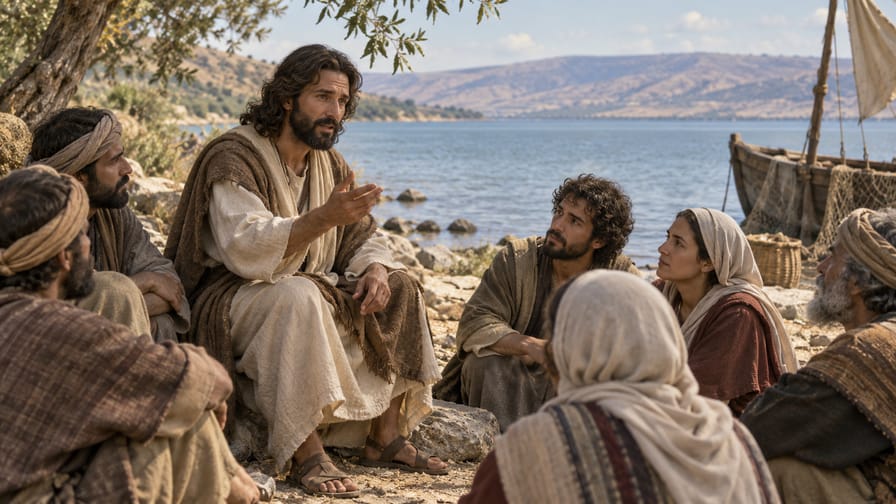
The figure of Jesus of Nazareth is the central point of the Christian faith and the most prominent and impactful character in all of biblical and human history. His life, death, and resurrection form the foundation of evangelical Protestant theology, with Him being the object of faith, the mediator of the new covenant, and the supreme revealer of God. This in-depth analysis explores His multifaceted identity from a rigorous biblical-theological perspective.
1. Etymology and meaning of the name
The name Jesus derives from the Greek Iesous (Ἰησοῦς), which in turn is a transliteration of the Hebrew/Aramaic name Yeshua (יֵשׁוּעַ) or Yehoshua (יְהוֹשׁוּעַ). The longer form, Yehoshua, means "Yahweh is salvation" or "Yahweh saves". The abbreviated form, Yeshua, retains this essential meaning of "salvation" or "savior".
This name was not uncommon in Jewish antiquity Joshua, the successor of Moses, also bore this name (*Yehoshua*), as recorded in *Numbers 13:16*. In the context of the New Testament, the choice of the name for the Messiah is profoundly significant and divinely ordained, as revealed to Joseph in *Matthew 1:21*.
The angel Gabriel instructed Joseph: "She will give birth to a son, and you are to give him the name Jesus, because he will save his people from their sins" (*Matthew 1:21*). This declaration directly connects the name of Jesus to His redemptive mission. He is the Savior, and His name proclaims His primary role in salvation history.
The theological meaning of the name is, therefore, intrinsic to His identity and work. Jesus is not merely a name it is a fulfilled prophecy and a declaration of His divine purpose. He is God Himself who descends to save humanity, according to the promise of *Isaiah 43:11*: "I, even I, am the Lord, and apart from me there is no savior".
The variation Iesous in the Greek Septuagint and New Testament for the Hebrew Yehoshua demonstrates the continuity of God's promise. The salvation promised to the people of Israel through Yahweh would be fully manifested in the person and work of Jesus Christ, who is the fulfillment of the messianic hope. He is the definitive and eternal savior.
2. Historical context and biblical narrative
Jesus was born in a period of great political turmoil and religious fervor in Judea, around 4-6 B.C. (approximate dates, considering the error in Dionysius Exiguus' calendar). The region was under the dominion of the Roman Empire, represented by governors such as Pontius Pilate and client kings like Herod the Great and his successors.
The social context was marked by a rigid hierarchy, with the majority of the population living under oppression and poverty. Jewish religions and sects, such as Pharisees, Sadducees, Essenes, and Zealots, disputed the interpretation of the Law and the messianic expectation. The hope for a liberating Messiah, both political and spiritual, was intense.
2.1 Family origin and genealogy
The genealogy of Jesus is presented in two Gospels: *Matthew 1:1-17* and *Luke 3:23-38*. Both genealogies establish His descent from Abraham and David, fulfilling important messianic prophecies, such as those in *2 Samuel 7:12-16* and *Isaiah 11:1*. Matthew traces the lineage through Joseph, the legal father, while Luke, many scholars suggest, traces through Mary, His biological mother.
He was born in Bethlehem of Judea (*Matthew 2:1* *Luke 2:4-7*), fulfilling the prophecy of *Micah 5:2*. His childhood and youth were spent in Nazareth of Galilee (*Luke 2:39-40*), a region viewed with some contempt by the Jews of Judea (*John 1:46*). His family included Mary, His mother, and Joseph, His adoptive father, as well as brothers and sisters (*Mark 6:3*).
2.2 Main events of life and ministry
The life of Jesus can be divided into distinct phases:
- Birth and Childhood: Annunciation to Mary (*Luke 1:26-38*), birth in Bethlehem (*Luke 2:1-7*), visit of the Magi (*Matthew 2:1-12*), flight to Egypt (*Matthew 2:13-15*), and growth in Nazareth (*Luke 2:39-40*). The visit to the Temple at age 12 (*Luke 2:41-52*) is the only record of His youth.
- Beginning of Ministry: Baptism by John the Baptist in the Jordan River (*Matthew 3:13-17* *Mark 1:9-11* *Luke 3:21-22*), temptation in the wilderness (*Matthew 4:1-11* *Mark 1:12-13* *Luke 4:1-13*), and the calling of the first disciples (*Mark 1:16-20*).
- Public Ministry: Lasted approximately three and a half years, focused in Galilee, Judea, and Perea. He taught in synagogues and outdoors, performed miracles (healings, exorcisms, control over nature), proclaimed the Kingdom of God, and called disciples. Key events include the Sermon on the Mount (*Matthew 5-7*), the Transfiguration (*Matthew 17:1-8*), and the raising of Lazarus (*John 11:1-44*).
- Passion and Death: Triumphal entry into Jerusalem (*Matthew 21:1-11*), cleansing of the Temple (*Matthew 21:12-17*), Last Supper (*Matthew 26:26-29*), prayer in Gethsemane (*Matthew 26:36-46*), arrest (*John 18:1-11*), trial before the Sanhedrin and Pilate (*Matthew 26:57-27:26*), crucifixion on Golgotha (*Matthew 27:32-56*), and burial (*Matthew 27:57-61*).
- Resurrection and Ascension: Resurrection on the third day (*Matthew 28:1-10* *Mark 16:1-8* *Luke 24:1-12* *John 20:1-10*), appearances to disciples for 40 days (*Acts 1:3*), and ascension to heaven (*Luke 24:50-53* *Acts 1:9-11*), from where He intercedes and will reign.
Geographically, His ministry primarily covered Galilee (Capernaum, Nazareth, Cana), Samaria (Sychar), and Judea (Jerusalem, Bethlehem, Jericho). His relationship with the apostles, especially Peter, James, and John, was central to the formation of the early Church. He also interacted with figures such as Mary Magdalene, Martha and Mary, Lazarus, Nicodemus, and Zacchaeus.
3. Character and role in the biblical narrative
The character of Jesus is singular and incomparable, revealing the perfection of divinity in human form. He is presented in the Scriptures as the sinless man, the model of virtue, and the supreme expression of God's love. His full humanity and complete divinity are inseparable, a hypostatic union that is fundamental doctrine.
The Scriptures consistently attest to the impeccability of Jesus. He committed no sin (*1 Peter 2:22*), knew no sin (*2 Corinthians 5:21*), and in Him there was no sin (*1 John 3:5*). Though tempted in every way, just as we are, He remained without sin (*Hebrews 4:15*), which qualifies Him as the perfect and effective sacrifice for the sins of humanity.
Among His most evident virtues and spiritual qualities, the following stand out:
- Love: His unconditional love was demonstrated in His sacrifice (*John 15:13*) and in His ministry of service and compassion (*Mark 6:34*).
- Humility: He, being God, emptied Himself, taking the form of a servant (*Philippians 2:6-8*), and washed the feet of His disciples (*John 13:1-17*).
- Obedience: His life was one of perfect obedience to the Father's will, even to death on the cross (*John 5:30* *Hebrews 5:8*).
- Holiness: His moral and spiritual purity was absolute, manifested in His words and actions (*John 8:46*).
- Wisdom and Authority: His words were full of divine wisdom, and He taught with authority, not as the scribes (*Matthew 7:29*).
- Compassion: He was moved with deep empathy in the face of human suffering, healing the sick and feeding multitudes (*Matthew 14:14*).
The role of Jesus in the biblical narrative is multifaceted and central. He is the fulfillment of the great messianic expectations of the Old Testament, acting as:
- Prophet: He proclaimed the will of God, revealed divine truths, and prophesied future events (*Deuteronomy 18:15* *Luke 24:19*).
- Priest: He is the eternal high priest, who offered Himself as the unique and perfect sacrifice for sins, continually interceding for His people (*Hebrews 7:24-27* *Hebrews 9:11-14*).
- King: He is the Davidic Messiah, the King of the Kingdom of God, whose dominion is eternal and just (*Luke 1:32-33* *John 18:36-37*).
- Son of God: His divinity is repeatedly affirmed, being co-equal and co-eternal with the Father (*John 10:30* *Colossians 1:15-17*).
- Son of Man: A title that emphasizes His humanity and His identity as the suffering and glorious Messiah of *Daniel 7:13-14*.
- Lamb of God: The atoning sacrifice who takes away the sin of the world (*John 1:29* *Isaiah 53:7*).
His key actions and decisions, from the choosing of His disciples to His voluntary submission to the cross, demonstrate His redemptive purpose. He consistently pointed to the Kingdom of God, called for repentance and faith, and established the new covenant through His blood. His development, in His humanity, is noted in *Luke 2:52*: "And Jesus grew in wisdom and stature, and in favor with God and man."
4. Theological significance and typology
The theological significance of Jesus is the core of evangelical Protestant Christian faith, grounding the entire redemptive history. He is the ultimate and final revelation of God, the apex of the progressive divine revelation that began in the Old Testament. His coming marked the fullness of time (*Galatians 4:4*).
Christocentric typology is central to understanding the Old Testament in relation to Jesus. Many figures, events, and institutions of the Old Testament prefigure the person and work of Christ. Adam, as the head of humanity, is a type of Christ, the second Adam who brings life (*Romans 5:12-21*). Moses, the deliverer and lawgiver, points to Jesus as the great deliverer and the lawgiver of the new covenant (*Deuteronomy 18:15* *John 1:17*).
The Levitical priesthood and Temple sacrifices are clear types that find their fulfillment in Jesus, the perfect high priest and the definitive sacrifice that removes sin once for all (*Hebrews 9:11-14* *Hebrews 10:1-18*). The Passover, with the sacrificial lamb, prefigures Christ as the Passover Lamb who frees us from the bondage of sin (*1 Corinthians 5:7*).
The divine covenants culminate in the new covenant established by Jesus through His blood (*Luke 22:20* *Hebrews 8:6-13*). The promises given to Abraham (*Genesis 12:3*) and David (*2 Samuel 7:12-16*) find their fulfillment in Christ, through whom all nations are blessed and whose kingdom is eternal. The messianic prophecies, such as those in *Isaiah 53* (the Suffering Servant) and *Psalm 22* (the Crucified One), were literally fulfilled in His passion and death.
The New Testament is, in its entirety, a witness to Jesus Christ. The Gospels narrate His life, ministry, death, and resurrection. The Epistles interpret the meaning of His work, developing crucial doctrines such as the incarnation (God became flesh, *John 1:14* *Philippians 2:5-11*), vicarious atonement (He died in our place, *Romans 5:8* *2 Corinthians 5:21*), justification by faith (we are declared righteous by His work, *Romans 3:21-26*), sanctification (we are transformed into His image, *Romans 8:29*), and the resurrection (guarantee of our own resurrection, *1 Corinthians 15:20-22*).
Jesus is the center of the doctrine of salvation (soteriology), being the only way to God (*John 14:6*). He is the manifestation of divine grace (*John 1:17*) and the embodiment of truth. His death and resurrection are the basis of the Church's eschatological hope, which awaits His return to consummate the Kingdom of God and establish new heavens and new earth (*Revelation 21:1-4*).
5. Biblical-theological legacy and canonical references
The legacy of Jesus Christ is the New Testament canon itself and the existence of the Christian Church. He is the central theme of all 27 books of the New Testament. In the Old Testament, He is prefigured and prophesied in numerous passages, making Him the guiding thread of the entire biblical narrative of redemption. He is the Alpha and the Omega, the beginning and the end of everything (*Revelation 1:8*).
His influence on biblical theology is absolute. He not only founded the Church with His death and resurrection (*Matthew 16:18*) and sent the Holy Spirit (*John 14:26*), but is also the content of the apostolic message. The epistles of Paul, Peter, John, and others are essentially expositions of the person and work of Jesus Christ, applying His salvation to the life of the believer and the community.
In the Jewish interpretive tradition, the figure of the Messiah is awaited, though the identification of Jesus as this Messiah is rejected by the majority. Nevertheless, Jewish messianic expectation provided the backdrop for the early Christians' understanding of Jesus. In Christian tradition, from the Church Fathers to the Reformers and contemporary theologians, Jesus is the main focus of study and worship. Councils such as Nicaea and Chalcedon defined the doctrines of the Trinity and the nature of Christ.
Intertestamental literature, such as the Books of Enoch and the Dead Sea Scrolls, reveals a period of intense messianic and apocalyptic expectation, which helps to contextualize the hopes and debates of Jesus' time. Though not canonical, these texts show the Jewish mindset that Jesus encountered and transformed.
In Reformed and evangelical theology, Jesus Christ is central to the Reformation *solas*:
- Sola Gratia (grace alone): salvation is an undeserved gift from God through Christ.
- Sola Fide (faith alone): justification is received through faith in Christ, not by works.
- Solus Christus (Christ alone): He is the only mediator between God and mankind (*1 Timothy 2:5*).
- Sola Scriptura (Scripture alone): the Bible is the primary and infallible source of revelation about Christ.
- Soli Deo Gloria (glory to God alone): all salvation and Christian life aim at the glory of God in Christ.
The importance of Jesus for understanding the canon is inestimable. He is the hermeneutical key to interpreting all Scripture. The Old Testament points to Him, and the New Testament reveals and explains His work. Without Jesus, the biblical canon would be a collection of stories and laws without its unifying redemptive purpose. He is the full revelation of God, the fulfillment of the promises, the Savior of humanity, and the Lord of all creation.