


Uzziah
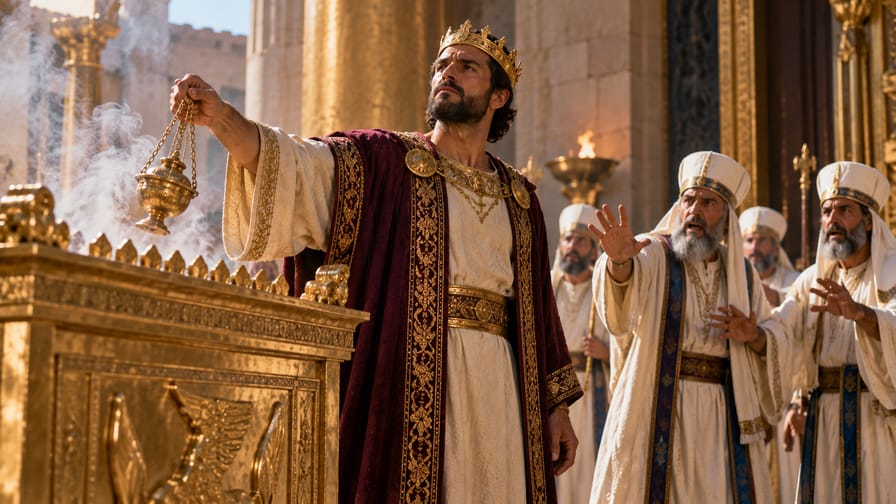
The figure of Uzziah, also known as Azariah in some passages (2 Kings 15:1, though most references call him Uzziah), is one of the most prominent in the history of the kings of Judah. His long reign is marked by a period of notable prosperity and military expansion, followed by a tragic fall due to presumption and disobedience to God. His story serves as a powerful reminder of divine sovereignty and the dangers of human pride.
From an evangelical Protestant perspective, the life of Uzziah offers rich lessons on the nature of leadership, the importance of obedience to the Word of God, and the distinction between civil and priestly authority. The analysis of his character and actions reveals the complexity of faith and the consequences of apostasy, even for those who initially seek the Lord.
1. Etymology and Meaning of the Name
The name Uzziah derives from the Hebrew עוּזִיָּהוּ (‘Uziyyahu) or עוּזִיָּה (‘Uziyyah). The primary root, עז (‘oz), means "strength," "power," or "fortress." The suffix יהו (-yyahu) or יה (-yah) is an abbreviated form of the tetragrammaton YHWH, the personal name of God, Yahweh.
Thus, the literal meaning of the name Uzziah is "My strength is Yahweh" or "Yahweh is my strength." This onomastic meaning is deeply resonant with the narrative of his life. At the beginning of his reign, when he sought the Lord, his strength and success indeed came from God. However, at the height of his power, he seems to have forgotten this truth, relying on his own strength, which led him to ruin.
Although the name Uzziah is the most common for the king of Judah, he is occasionally referred to as Azariah (אֲזַרְיָה - ‘Azaryah) in 2 Kings 15:1, 15:6, 15:7, and 15:8. The name Azariah means "Yahweh helped" or "Yahweh is my helper." This variation may be due to textual confusion or, more probably, to the use of alternative or coronation names, a common practice in antiquity.
Other biblical characters named Uzziah include a Levite priest (1 Chronicles 6:24), a family head in Judah (1 Chronicles 27:25), and one of David's mighty men (1 Chronicles 11:44). However, King Uzziah is, without doubt, the most famous and significant bearer of this name in Scripture, with his story detailed in the books of Kings and Chronicles.
The theological significance of the name lies in the constant reminder that true strength and prosperity come from God. Uzziah’s trajectory dramatically illustrates the contrast between the strength that originates from Yahweh and the strength that man tries to manufacture by himself. His life serves as a living parable for the warning of Proverbs 3:5-6: "Trust in the LORD with all your heart and lean not on your own understanding in all your ways submit to him, and he will make your paths straight."
2. Historical Context and Biblical Narrative
Uzziah reigned over Judah for 52 years, approximately from 792 to 740 BC, with a period of co-regency with his father Amaziah and, later, with his son Jotham. He ascended to the throne at only sixteen years of age, after the assassination of his father Amaziah (2 Kings 14:21 2 Chronicles 26:1-3).
His reign occurred during a period of relative stability and prosperity for the Kingdom of Judah, after decades of conflicts and instability. Politically, Judah was recovering and experiencing a revival under Uzziah’s leadership. Assyria, although a growing power, was in a period of temporary relative weakness, allowing Judah and Israel (under Jeroboam II) to enjoy an era of economic and military prosperity.
The religious context of the era was complex. Although Uzziah began his reign seeking God and being influenced by the prophet Zechariah (2 Chronicles 26:5), the people of Judah had not yet completely removed the high places and idolatrous places of worship (2 Kings 15:4). This religious syncretism was a constant threat to the purity of faith in Yahweh.
2.1 Family Origin and Genealogy
Uzziah was the son of King Amaziah and Jecoliah, from Jerusalem (2 Kings 15:2 2 Chronicles 26:3). He belonged to the Davidic line, being the tenth king after the division of the kingdom. His genealogy connected him directly to the promise of an eternal king from the house of David (2 Samuel 7:12-16), a promise that the history of each king of Judah would testify, whether by their faithfulness or unfaithfulness.
2.2 Main Events and Biblical Passages
The biblical narrative of Uzziah’s life is found primarily in 2 Kings 15:1-7 and, in more detail, in 2 Chronicles 26. These passages describe a trajectory of initial success and a subsequent fall:
- Promising Beginning and Seeking God: 2 Chronicles 26:4-5 states that Uzziah "did what was right in the eyes of the LORD, just as his father Amaziah had done. He sought God in the days of Zechariah, who instructed him in the fear of God and in the days when he sought the LORD, God made him prosper." This is a clear testimony that his prosperity was directly linked to his dependence on God.
- Military Successes: He waged victorious wars against the Philistines, breaking down their walls in Gath, Jabneh, and Ashdod, and building cities in the region (2 Chronicles 26:6). He defeated the Arabs and the Meunites, and the Ammonites paid him tribute (2 Chronicles 26:7-8). His army was powerful and well-equipped (2 Chronicles 26:11-15).
- Fortification and Development: Uzziah fortified Jerusalem with towers (2 Chronicles 26:9) and built towers in the desert to protect flocks and caravans. He also encouraged agriculture, viticulture, and animal husbandry, proving himself a versatile king concerned with the economic development of his kingdom (2 Chronicles 26:10).
- Military Innovation: He equipped his army with shields, spears, helmets, coats of mail, bows, and slings. Most notably, he developed war machines in Jerusalem, capable of shooting arrows and large stones, showing his military ingenuity (2 Chronicles 26:14-15).
- The Fall: Pride and Presumption: "But after Uzziah became powerful, his pride led to his downfall. He was unfaithful to the LORD his God, for he entered the temple of the LORD to burn incense on the altar of incense" (2 Chronicles 26:16). This was his fatal transgression. The burning of incense was an exclusive prerogative of the Levite priests, descendants of Aaron (Numbers 18:7).
- Confrontation and Judgment: The high priest Azariah, accompanied by eighty courageous priests, confronted Uzziah (2 Chronicles 26:17-18). In his anger and disobedience, Uzziah was immediately struck with leprosy on his forehead (2 Chronicles 26:19-20).
- Isolation and Death: Due to leprosy, Uzziah was forced to live in a separate house, isolated from society and the temple, and his son Jotham took over the responsibilities of the kingdom as co-regent and then king (2 Kings 15:5 2 Chronicles 26:21). He died a leper and was buried with his fathers, but not in the royal tombs, because of his disease (2 Kings 15:7 2 Chronicles 26:23).
The death of Uzziah is an important temporal landmark, as it is mentioned by Isaiah at the beginning of his prophetic ministry: "In the year that King Uzziah died, I saw the Lord seated on a high and exalted throne..." (Isaiah 6:1). This connects his reign to one of the most intense prophetic periods of Judah, with Isaiah, Amos (Amos 1:1), Hosea (Hosea 1:1), and Micah prophesying during or shortly after his time.
3. Character and Role in the Biblical Narrative
The character of Uzziah is presented dualistically in Scripture. Initially, he is portrayed as a virtuous king, who sought God and was blessed with great success. His administrative and military wisdom is undeniable, leading Judah to a period of prosperity and security. He was a proactive leader, who invested in defense, agriculture, and military organization, demonstrating qualities of a competent and visionary ruler.
Uzziah’s virtues include diligence, strategic intelligence, and an apparent initial piety, manifested in his seeking God. 2 Chronicles 26:5 is explicit in stating that "in the days when he sought the LORD, God made him prosper." This indicates a source of his strength and success that went beyond his own abilities.
However, the biblical narrative does not omit his moral and spiritual failings. The turning point in his character is pride, described in 2 Chronicles 26:16: "But after Uzziah became powerful, his pride led to his downfall..." Material success and political power corrupted his heart, leading him to believe he could transgress divine laws and usurp a function that did not belong to him. This arrogance was the cause of his fall.
His role in the biblical narrative is multifaceted. As king of Judah, he was an instrument in God's hands to bring prosperity and security to his people, fulfilling the Davidic promise of an established kingdom. He served as an example of how obedience to God brings blessings and how disobedience leads to ruin, even for a powerful ruler.
Uzziah’s significant action that sealed his fate was his attempt to burn incense in the Temple, an act reserved exclusively for the priests. This key decision was not merely a moral failing, but a serious theological transgression, which violated the divinely instituted separation between royal and priestly authority. In doing so, he challenged the order established by God and the sanctity of worship.
The development of Uzziah’s character is a cautionary parable. He begins as a model king, but his heart hardens with power, transforming him into an example of how pride precedes a fall (Proverbs 16:18). His leprosy, as immediate divine judgment, sealed his fate and removed him from the active throne, serving as a visible lesson for the entire kingdom of Judah.
4. Theological Significance and Typology
The life of Uzziah holds profound theological significance in redemptive history and the progressive revelation of God. He governs in a crucial period, between the decline of Israel and the rise of the Assyrian threat, serving as a link in the Davidic line that would culminate in Christ. His story, therefore, is not merely a historical record, but a vivid demonstration of theological principles.
There is no direct Christocentric typology in Uzziah, in the sense that he is a figure who positively prefigures Christ. On the contrary, his story serves more as a contrast and an illustration of the need for a perfect King. While Uzziah, in his pride, attempted to usurp a priestly function that did not belong to him, Christ is the perfect King-Priest, who divinely unites these two functions (Hebrews 7:1-3, Zechariah 6:13), but without sin or presumption.
The story of Uzziah reinforces the conditional nature of the Davidic covenant (2 Samuel 7) regarding temporal blessings on the individual king. Although the promise of an eternal lineage was unconditional, the prosperity and permanence of a king on the throne were conditional on his obedience. Uzziah’s fall illustrates that not even a king from the line of David was exempt from divine judgment for disobedience.
Although Uzziah is not directly quoted in the New Testament, the context of his death is crucial for Isaiah's call (Isaiah 6:1), a prophet widely quoted in the New Testament in reference to Christ and salvation. Isaiah's vision of the exalted Lord, in the year of the earthly king's death, symbolizes the transition from reliance on human kings to reliance on the divine and eternal King.
Uzziah’s connection with central theological themes is evident:
- Obedience and Blessing: His early reign demonstrates that seeking God and obedience bring prosperity and success (2 Chronicles 26:5).
- Pride and Fall: The most prominent lesson is that pride and self-exaltation lead to ruin and divine judgment (Proverbs 16:18). Uzziah’s success led him to trust in himself, forgetting that "the LORD is my strength."
- Holiness and Divine Authority: Uzziah’s transgression highlights the holiness of divine institutions, particularly the priesthood. God established clear boundaries between royal and priestly authority, and violating these boundaries was a direct affront to His order and holiness (Numbers 3:10, 18:7).
- God's Sovereignty and Judgment: The immediate judgment of leprosy upon Uzziah is an unquestionable demonstration of God's sovereignty over kings and the seriousness of His wrath against sin, especially presumption.
- Grace and Law: Uzziah’s story illustrates the reality of divine law and its consequences, even in a covenantal context. He was blessed by God's grace in his beginning, but his disobedience to the law brought judgment.
Uzziah’s leprosy, which isolated him and disqualified him from ruling fully, is a powerful symbol of the stain of sin that affects man's ability to relate to God and exercise his calling. In contrast, Christ, our King-Priest, is pure and unblemished, capable of perfectly mediating between God and humanity.
5. Biblical-Theological Legacy and Canonical References
The legacy of Uzziah in biblical theology is significant although his story does not result in direct literary contributions, he is a crucial point of reference in several prophetic books. His mentions are not limited to 2 Kings and 2 Chronicles he is the temporal marker for the beginning of the ministry of great prophets:
- Isaiah 6:1: "In the year that King Uzziah died, I saw the Lord seated on a high and exalted throne..." This is one of the most emblematic references, as Isaiah's vision occurs at a time of political transition and uncertainty. The death of the earthly king highlights the sovereignty of the heavenly King.
- Amos 1:1: "The words of Amos, a herdman from Tekoa, which he saw concerning Israel, in the days of Uzziah, king of Judah, and in the days of Jeroboam, son of Joash, king of Israel, two years before the earthquake."
- Hosea 1:1: "The word of the LORD that came to Hosea, son of Beeri, in the days of Uzziah, Jotham, Ahaz, and Hezekiah, kings of Judah, and in the days of Jeroboam, son of Joash, king of Israel."
- Zechariah 14:5 refers to an earthquake in the days of Uzziah, though it is not detailed in 2 Kings or 2 Chronicles. This suggests that the memory of catastrophic events during his reign persisted.
Uzziah’s influence on biblical theology lies primarily in his story as a cautionary tale. He is a classic example of the maxim "pride precedes a fall" (Proverbs 16:18). His life illustrates the seriousness with which God treats the usurpation of divinely appointed functions and the transgression of His commandments, even by those in positions of great power and authority.
In Jewish and Christian interpretive tradition, Uzziah is often discussed in relation to the separation between royal/secular and priestly/religious authority. His transgression is seen as a serious error that disrespected the boundaries established by God, a principle that has implications for the governance of church and state in various theologies. The Protestant Reformation, for example, emphasized the distinction between these two domains, while recognizing God's sovereignty over both.
In Reformed and evangelical theology, Uzziah’s story is frequently used to teach about human depravity (even in its most subtle manifestation, pride), God's holiness, and the necessity of submission to His Word. It reinforces the doctrine of God's sovereignty, who judges even the most powerful kings. His fall serves as a vivid reminder that true strength and authority do not reside in human power or self-reliance, but in humble dependence on Yahweh, who is the true "strength" of His people.
The importance of Uzziah for understanding the biblical canon lies in his role as a king who marked an era. His prosperity, followed by his humiliation, provides a complex backdrop for the message of the prophets who ministered in his time. The message of these prophets, of repentance and trust in God, gains particular urgency when viewed in light of the rise and fall of such a prominent king.
Uzziah’s story invites us to reflect on the nature of power, the temptation of pride, and God's faithfulness in upholding His standards of holiness. He remains as an enduring testimony that all success and glory belong to God, and that any attempt to usurp His glory or authority results in judgment.