


Eleazar
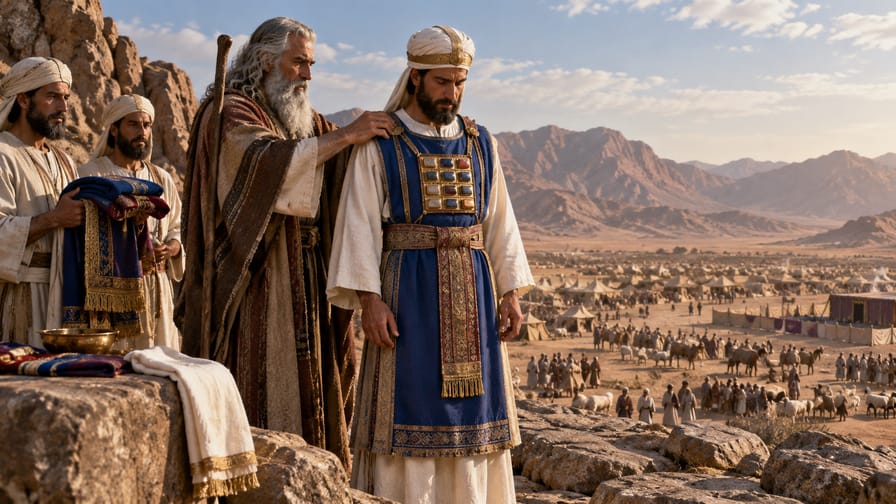
Eleazar was the third son of Aaron and the man who succeeded him as high priest of Israel. His life spans the wilderness journey and the conquest of Canaan: he was consecrated with his father and brothers at Sinai, survived the day his older brothers Nadab and Abihu were struck down, received the high priestly garments on Mount Hor when Aaron died, and stood beside Joshua when the land was divided among the tribes.
Eleazar rarely speaks in the biblical narrative, and no dramatic miracle is attached to his name. His importance lies in faithful continuity. Through him the priestly office passed from the generation that left Egypt to the generation that entered the promised land, and from his line came Phinehas, Zadok and, many centuries later, Ezra the scribe.
This article deals only with Eleazar son of Aaron. The Bible mentions several other men with the same name, noted briefly in section 5, and they should not be confused with the high priest.
1. Etymology and meaning of the name
The Hebrew name Eleazar (אֶלְעָזָר, 'El'azar) joins 'El, 'God', to the verb 'azar, 'to help'. Its most accepted meaning is 'God has helped' or 'God is help'. The same root appears in Ebenezer, 'stone of help' (1 Samuel 7:12). The Septuagint writes the name as Ἐλεάζαρ, and the New Testament name Lazarus (Λάζαρος) is generally understood as a shortened form of the same Hebrew name.
The Bible does not say why Aaron and Elisheba chose this name. Even so, it suits the man: his whole ministry depended not on personal brilliance but on the help of the God he served.
2. Historical context and biblical narrative
2.1 Family origin and genealogy
Eleazar belonged to the tribe of Levi, through the clan of Kohath and the family of Amram. His father was Aaron, brother of Moses and Miriam, and his mother was Elisheba, daughter of Amminadab and sister of Nahshon, the leader of the tribe of Judah (Exodus 6:23; Numbers 1:7). His brothers were Nadab, Abihu and Ithamar. Eleazar married one of the daughters of Putiel, and she bore him Phinehas (Exodus 6:25).
The priestly genealogies of Chronicles trace the line of high priests from Eleazar through Phinehas and Abishua down to Zadok, the priest of David and Solomon, and on to the Babylonian exile (1 Chronicles 6:3-15; 6:50-53). Ezra the scribe traces his own ancestry back through Zadok to Eleazar and Aaron (Ezra 7:1-5).
2.2 Main events
Consecration and tragedy. Eleazar was set apart with his father and brothers to serve as priest (Exodus 28:1) and was ordained in the seven-day ceremony of Leviticus 8. Soon afterwards Nadab and Abihu offered 'unauthorized fire' before the Lord and died (Leviticus 10:1-2). Moses told Aaron, Eleazar and Ithamar not to show the usual signs of mourning and not to leave the entrance of the tabernacle, because the anointing oil was on them (Leviticus 10:6-7). In the same chapter Moses was angry with Eleazar and Ithamar because the goat of the sin offering had been burned instead of eaten in the holy place; Aaron answered for them, and Moses accepted the explanation (Leviticus 10:16-20). From then on 'Eleazar and Ithamar served as priests in the lifetime of Aaron their father' (Numbers 3:4).
Guardian of the sanctuary. Eleazar was made chief over the leaders of the Levites and supervisor of those who kept the sanctuary (Numbers 3:32). He was responsible for the oil for the light, the fragrant incense, the regular grain offering, the anointing oil and the oversight of the whole tabernacle and its furnishings (Numbers 4:16). After the rebellion of Korah, the Lord told him to gather the bronze censers of the rebels and hammer them into a covering for the altar, as a reminder that only the descendants of Aaron could offer incense (Numbers 16:37-40). The heifer whose ashes were used for the water of purification was also handed to him (Numbers 19:3-4).
Mount Hor. At the end of the wilderness years God commanded Moses to take Aaron and Eleazar up Mount Hor, remove Aaron's garments and put them on his son. Aaron died there, and Moses and Eleazar came down the mountain together (Numbers 20:25-28). Deuteronomy summarizes the same transition: 'Aaron died, and there he was buried, and Eleazar his son ministered as priest in his place' (Deuteronomy 10:6).
High priest of the new generation. Eleazar took part with Moses in the second census, on the plains of Moab (Numbers 26:1-4, 63). The daughters of Zelophehad presented their case before Moses and Eleazar (Numbers 27:1-2). When Joshua was appointed as Moses' successor, he was commissioned in the presence of Eleazar, and the Lord established that Joshua would stand before Eleazar, who would inquire of the Lord for him by the judgment of the Urim (Numbers 27:18-23). After the war against Midian, in which Phinehas went out with the holy articles, Eleazar received the captives with Moses, gave the statute for purifying the spoils and helped divide them (Numbers 31:6, 12-13, 21-31, 51-54). He also heard the request of the tribes of Reuben and Gad (Numbers 32:2, 28).
The division of the land and his death. God named Eleazar and Joshua as the ones who would divide the land (Numbers 34:17), and the book of Joshua shows them doing exactly that (Joshua 14:1; 17:4; 19:51; 21:1). The last notice says that Eleazar died and was buried at Gibeah, the town given to his son Phinehas in the hill country of Ephraim (Joshua 24:33).
3. Character and role in the biblical narrative
Scripture tells us very little about Eleazar's inner life. We are not given his prayers, his feelings or his age at death, and it would be unwise to invent them. What the text shows is a pattern of conduct. He obeyed a hard command on the day his brothers died, when public grief was forbidden to him. He handled holy things with care and was trusted with the most sensitive duties of the sanctuary. He served for years in the shadow of his father and then carried the same office without any record of rivalry or self-promotion.
His partnership with Joshua is especially instructive. Joshua led the people in battle and government, but he was to seek the Lord's guidance through the priest (Numbers 27:21). Eleazar did not take Joshua's place, and Joshua did not take his. Each served in his own calling under the authority of God.
4. Theological significance
4.1 Holiness and mediation
Eleazar's ministry keeps before Israel the holiness of God. The death of Nadab and Abihu, the censers turned into a covering for the altar and the rules of purification all teach that sinful people cannot approach God on their own terms. The priest stood between a holy God and a sinful people, offering sacrifices and bearing the Urim by which the Lord made his will known.
4.2 God's faithfulness across generations
The scene on Mount Hor shows that the priesthood did not depend on any one man. Aaron died, but the office continued, because God had promised it. Later the Lord gave Phinehas, Eleazar's son, 'a covenant of a perpetual priesthood' (Numbers 25:13), and the line of Zadok, descended from Eleazar, served in Solomon's temple and is honored in Ezekiel's vision (Ezekiel 44:15).
4.3 Pointing to Christ
The very need for a succession reveals the weakness of the old covenant. The letter to the Hebrews observes that the former priests 'were many in number, because they were prevented by death from continuing in office', but Jesus 'holds his priesthood permanently, because he continues forever' and 'always lives to make intercession' for those who draw near to God through him (Hebrews 7:23-25). Eleazar put on garments taken from a dying father. Christ, raised from the dead, needs no successor, and he entered the holy places once for all by his own blood (Hebrews 9:11-12).
5. Legacy and canonical references
When David organized the priests into divisions, more heads of families were found among the descendants of Eleazar than among those of Ithamar, sixteen against eight (1 Chronicles 24:1-6). Through Zadok the line of Eleazar held the high priesthood during much of the monarchy and returned after the exile in the person of Ezra's family.
Eleazar son of Aaron is mentioned in these passages: Exodus 6:23, 25; 28:1; Leviticus 10:6, 12, 16; Numbers 3:2, 4, 32; 4:16; 16:37, 39; 19:3-4; 20:25-28; 25:7, 11; 26:1, 3, 60, 63; 27:2, 19, 21-22; 31:6, 12-13, 21, 26, 29, 31, 41, 51, 54; 32:2, 28; 34:17; Deuteronomy 10:6; Joshua 14:1; 17:4; 19:51; 21:1; 22:13, 31-32; 24:33; Judges 20:28; 1 Chronicles 6:3-4, 50; 9:20; 24:1-6; and Ezra 7:5. Several of these name him only as the father of Phinehas.
Not to be confused with: Eleazar son of Abinadab, who kept the ark at Kiriath-jearim (1 Samuel 7:1); Eleazar son of Dodo, one of David's mighty men (2 Samuel 23:9; 1 Chronicles 11:12); Eleazar son of Mahli, a Levite of Merari who had no sons (1 Chronicles 23:21-22); the Eleazars of the return from exile (Ezra 8:33; 10:25; Nehemiah 12:42); and Eleazar in the genealogy of Jesus (Matthew 1:15).
6. Application for today
Eleazar reminds us that faithfulness is often quiet. Most of his ministry consisted of guarding oil, incense and sacred vessels, weighing spoils and dividing land. None of it was glamorous, yet all of it mattered to the life of God's people. Christians today are also called to steady, unseen faithfulness in the tasks God has given them.
His story also teaches that God's work outlives God's servants. Aaron died on Mount Hor, Moses died on Mount Nebo, and still the Lord led his people into the land. We do not have to carry the burden of being indispensable. We are called to serve well in our generation and to hand on the faith to the next.
Above all, Eleazar points beyond himself. Every priest in his line eventually died. We have a High Priest who lives forever, who knows our weakness and who invites us to 'draw near to the throne of grace' with confidence (Hebrews 4:14-16). The name Eleazar says 'God has helped'. In Jesus Christ that help has come in full.