


2 Kings
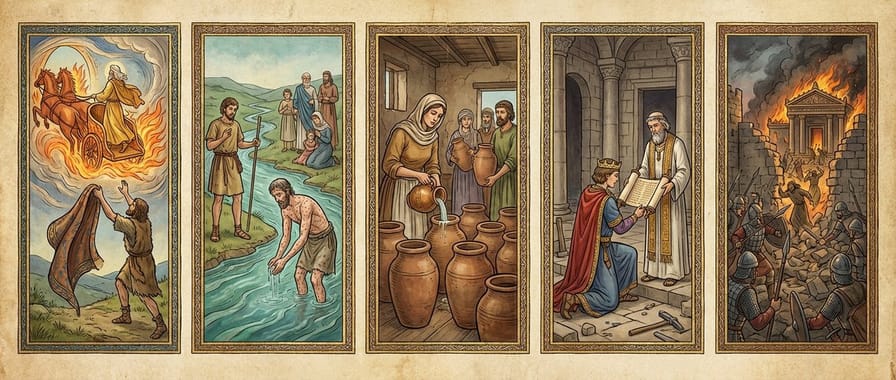
Illustration of the Book of 2 Kings, one of the 39 books of the Old Testament (Nano Banana Pro).
1. Historical Context, Dating, and Authorship
The book of 2 Kings, a direct continuation of the narrative begun in 1 Kings, immerses the reader in a tumultuous and crucial period of the history of Israel and Judah. It spans approximately 250 years, from Elijah’s ascension to heaven at the end of the ninth century B.C. to Judah’s Babylonian exile in 586 B.C. This period is marked by a succession of kings, prominent prophets, and the constant struggle between faithfulness to the covenant with God and the seduction of idolatry and religious syncretism. Understanding the historical context, authorship, and dating is fundamental for a robust and theologically informed interpretation, especially from an evangelical Protestant perspective that values the inerrancy and historicity of the Scriptures.
The narrative of 2 Kings is not merely a historical chronicle; it is a theology of history, presenting events through the lens of the Mosaic covenant and the consequences of obedience or disobedience to God. The book serves as a prophetic witness to divine justice and sovereignty, explaining the decline and eventual fall of the kingdoms of Israel and Judah as the direct result of the persistent infidelity of the people and their leaders.
1.1 Traditional Authorship and Evidence
The question of the authorship of 2 Kings, like that of 1 Kings, is traditionally attributed to a single author or compiler, often identified as the prophet Jeremiah. This view is supported by various lines of reasoning within Jewish and Christian tradition, although Scripture itself does not explicitly name the author. Talmudic tradition, for example, suggests that "Jeremiah wrote his book, the Book of Kings, and Lamentations" (Baba Bathra 15a). This attribution is plausible, considering that Jeremiah lived during the final events narrated in 2 Kings and would have had access to historical records and eyewitness testimonies.
Internal evidence supporting Jeremiah's authorship includes the literary style, which exhibits similarities to the book of Jeremiah, and the theological perspective. Both books share a deep concern for idolatry, covenant violation, the need for repentance, and the inevitability of divine judgment. The narrative of 2 Kings ends with the release of Jehoiachin from Babylonian captivity (2 Kings 25:27-30), an event that occurred during Jeremiah’s time and is consistent with the knowledge of an author who lived through the exile.
Modern critics, adherents of the Deuteronomistic Hypothesis (DtrH), often argue that 1 and 2 Kings are part of a larger historiographical work, compiled and edited in multiple layers over centuries, culminating in its final form during the Babylonian exile or post-exilic period. According to this view, the "Deuteronomistic Historian" would have used various sources (royal archives, chronicles, prophetic traditions) and shaped them with a specific theological perspective, strongly influenced by the theology of Deuteronomy.
While we acknowledge that the author of 2 Kings certainly used pre-existing sources, such as the "Chronicles of the Kings of Israel" and the "Chronicles of the Kings of Judah" (mentioned repeatedly throughout the text), the conservative evangelical perspective upholds the unity and theological coherence of the book, attributing its compilation and final editing to an inspired author, such as Jeremiah, who acted under the guidance of the Holy Spirit. This approach does not deny the use of sources but affirms that the inspired author integrated them into a cohesive and theologically accurate narrative, under divine supervision that guarantees the inerrancy of the final text. The idea that a prophet like Jeremiah, with his deep understanding of the covenant and the history of Israel, could have compiled and interpreted these records is theologically more satisfying than the fragmentation proposed by higher criticism.
1.2 The Period of Writing and Historical Context
The book of 2 Kings was likely finalized during the Babylonian exile or shortly thereafter. The narrative extends to the 37th year of Jehoiachin's exile (c. 561 B.C.), which suggests that the final form of the book was established at some point after this date. This post-exilic dating is crucial for understanding the book's purpose: it not only records history but also interprets it for an audience that was experiencing the consequences of divine judgment.
The historical context of 2 Kings is dominated by two great Ancient Near Eastern empires: Assyria and Babylon. The book details the relentless rise of Assyria, which culminated in the destruction of the Northern Kingdom (Israel) in 722 B.C. and the exile of its ten tribes (2 Kings 17). This event is a dramatic turning point, demonstrating God's faithfulness in fulfilling His warnings of judgment against idolatry and disobedience.
After the fall of Israel, Judah, the Southern Kingdom, continued to exist, but under the shadow of Assyria and, later, Babylon. The book narrates the lives of kings like Hezekiah and Josiah, who implemented significant religious reforms, but also records the reigns of impious monarchs like Manasseh, whose idolatry and bloodshed led Judah to a point of no return. The rise of Babylon under Nebuchadnezzar is the climax of the narrative, culminating in three deportations from Judah and the eventual destruction of Jerusalem and the Temple in 586 B.C. (2 Kings 25).
This period was one of intense political and religious upheaval. Israel and Judah were constantly maneuvering among the great powers, seeking alliances that often led them to compromise their faith in God. The idolatry of Canaanite, Assyrian, and Babylonian gods, child sacrifice, divination, and cultic prostitution were widespread practices that the prophets incessantly denounced. The book of 2 Kings documents the repeated failure of the people and their leaders to live according to the terms of the covenant, which, from a divine perspective, fully justified the judgments that befell them.
1.3 Response to Higher Critical Challenges
Modern higher criticism has raised several questions about the historicity and authorship of 2 Kings. The Deuteronomistic view (DtrH), for example, argues that the book is more of a theological construction than an accurate historical record, aiming to justify the exile. However, the conservative evangelical perspective upholds the historicity of the events narrated in 2 Kings, based on the inerrancy of Scripture and external evidence.
Archaeological evidence has consistently corroborated many of the historical details presented in 2 Kings. The Mesha Stele (Moabite Stone), for example, mentions Omri, king of Israel, and the war between Moab and Israel, alluding to events that fit the context of 2 Kings. The Black Obelisk of Shalmaneser III depicts Jehu, king of Israel, paying tribute to the Assyrian king, a remarkable external testimony. The Annals of Sennacherib describe the Assyrian siege of Jerusalem during Hezekiah's reign, with details that align with the narrative of 2 Kings 18-19.
The existence of seals and seal impressions (bulla) of royal officials mentioned in the book, such as those of Hezekiah and his servants, reinforces the accuracy of the records. Although there are chronological challenges and some differences in the presentation of events compared to extra-biblical records, most evangelical scholars argue that these issues are harmonizable with a careful understanding of ancient counting methods and different perspectives in the records.
The criticism that views the book as mere Deuteronomistic "propaganda" fails to recognize that the history of Israel was, by its very nature, a theological history. The nation was formed by a covenant with God, and its existence and destiny were intrinsically linked to its faithfulness to that covenant. Therefore, a historical narrative that ignored this theological dimension would, in fact, be incomplete and distorted. 2 Kings presents a real history, interpreted by an inspired author who understood the divine meaning of events.
2. Structure, Division, and Main Content
The book of 2 Kings, as part of the great historiographical narrative of the Old Testament, adopts a predominantly narrative structure, but with a strong theological thread. It follows a chronological pattern of reign after reign, interspersed with prophetic episodes that serve to interpret events and proclaim God's will. The literary organization is not merely a list of facts but a divinely inspired exposition of God's relationship with His covenant people.
The structure of 2 Kings can be understood as a downward spiral, culminating in the fall and exile. The narrative is marked by the regular evaluation of each king of Israel and Judah, usually with the formula "he did what was evil in the eyes of the Lord" or "he did what was right in the eyes of the Lord," followed by a brief description of his reign and, frequently, his connection to the sins of Jeroboam in Israel or Manasseh in Judah. This repetitive structure reinforces the book's central message about God's faithfulness to His covenant and the consequences of disobedience.
2.1 Literary Organization and Characteristics
2 Kings is a book of theological history. Although it records historical events, its main objective is not just to inform, but to transform. It is characterized by:
- Historical Narrative: Most of the book consists of accounts of reigns, wars, alliances, and internal events of the kingdoms of Israel and Judah.
- Royal Biography: Each king is introduced with a formula that includes his name, the year of his counterpart's reign in the other kingdom, the length of his reign, his mother's name (for the kings of Judah), and a moral/spiritual evaluation.
- Prophetic Narrative: Episodes involving the prophets Elijah and Elisha (a continuation from 1 Kings) are prominent at the beginning of the book, and the influence of prophets like Isaiah and Huldah is felt later. The prophets are the spokespersons for God, calling the people to repentance and proclaiming judgment or salvation.
- Theological Discourse: Although there are no long discourses like in Deuteronomy, theology is intrinsic to the narrative, especially in how events are interpreted as divine judgment or blessing.
The literary form of 2 Kings is a testament to Israel's worldview, where history is not seen as a series of random events but as the stage for God's sovereign action. Each king is judged not by his political or military skill, but by his faithfulness or unfaithfulness to the Lord, which reflects covenant theology.
2.2 Main Divisions and Characteristics
The book of 2 Kings can be divided into two main sections, reflecting the divergent destinies of the two kingdoms:
I. The Decline and Fall of the Northern Kingdom (Israel): 2 Kings 1:1 – 17:41
- The Continuation of Elijah’s and Elisha’s Ministry (2 Kings 1:1 – 8:15): This section begins with Elijah's ascension to heaven and Elisha's succession, who performs numerous miracles (healing Naaman, raising the Shunammite woman's son, multiplying bread, etc.) that demonstrate God's power and authenticate his prophetic ministry. Elisha also plays a significant political role, anointing Jehu to destroy the house of Ahab.
- Jehu’s Dynasty and the Decline of Israel (2 Kings 8:16 – 15:31): Jehu executes God’s judgment on the house of Ahab and the Baal worshipers but does not remove Jeroboam’s golden calves. From here, Israel enters a cycle of wicked kings, political instability, and increasing weakness before Assyria.
- The Fall of Samaria and the Exile of Israel (2 Kings 15:32 – 17:41): This section culminates in the destruction of Samaria, the capital of Israel, by the Assyrian king Shalmaneser V and Sargon II in 722 B.C. Chapter 17 offers a profound theological reflection on the reasons for Israel's fall, attributing it to persistent idolatry, disobedience to the Law of God, and the rejection of the prophets.
II. The Decline and Fall of the Southern Kingdom (Judah): 2 Kings 18:1 – 25:30
- Kings of Judah and the Confrontation with Assyria (2 Kings 18:1 – 21:26): This section highlights the reigns of notable kings like Hezekiah, who led a religious reform and trusted in God during Sennacherib's Assyrian siege, and Manasseh, whose idolatrous and violent reign is considered a point of no return for Judah.
- Josiah’s Reform and the Rise of Babylon (2 Kings 22:1 – 24:7): Josiah, the last great reforming king of Judah, discovers the Book of the Law and initiates a profound religious purification. However, God's judgment had already been sealed. The rise of Babylon as a new world power marks Judah's destiny.
- The Fall of Jerusalem and the Exile of Judah (2 Kings 24:8 – 25:30): The last kings of Judah are mere puppets of Babylon. The narrative culminates in three deportations, the destruction of Jerusalem and the Temple by Nebuchadnezzar in 586 B.C., and the beginning of the exile. The book ends with a glimpse of hope in Jehoiachin's release from captivity, suggesting that God still remembers His promises.
2.3 The Narrative Flow and Synthetic Outline
The narrative flow of 2 Kings is linear and chronological, following the succession of kings in Israel and Judah in parallel. With each new reign, the inspired author provides a theological evaluation of the monarch's conduct, contrasting it with the Davidic ideal and the Mosaic law. The prophetic accounts, especially those of Elisha, serve as moments of divine intervention, showing that, even amidst apostasy, God is active and communicating His will.
The book is a painful chronicle of human failure and divine patience. The repetition of sins of idolatry and injustice is a constant theme, inevitably leading to judgment. The fall of Israel is a foreshadowing of the fall of Judah, and the reason for both events is clearly articulated: disobedience to the covenant with God.
Synthetic outline of the content:
- Chapters 1-8: The ministry of Elisha and the succession of kings in Israel and Judah (Joram, Ahaziah, Jehoram, Jehu).
- Chapters 9-13: Jehu's revolution in Israel and its effects; reigns in Judah (Athaliah, Joash) and Israel (Jehoahaz, Jehoash).
- Chapters 14-16: Reigns of Amaziah, Azariah (Uzziah), and Jotham in Judah; Jeroboam II, Zechariah, Shallum, Menahem, Pekahiah, Pekah, and Hoshea in Israel. Growing Assyrian threat.
- Chapter 17: The fall of Samaria and the exile of Israel; theological reflection on the causes.
- Chapters 18-20: The reign of Hezekiah in Judah and the deliverance of Jerusalem from the Assyrian siege.
- Chapters 21-23: The reigns of Manasseh and Amon; Josiah's reform and the discovery of the Book of the Law.
- Chapters 24-25: The last kings of Judah (Jehoiakim, Jehoiachin, Zedekiah); the Babylonian deportations; the destruction of Jerusalem and the Temple; the exile.
This outline reveals the inexorable progression of divine judgment, but also the persistence of God's grace, which, even in exile, offers a glimpse of hope through the release of Jehoiachin.
3. Central Theological Themes and Purpose
2 Kings is a book of profound theological depth, whose historical narrative serves as a vehicle for transmitting eternal truths about God, humanity, and the covenant relationship. The evangelical Protestant perspective, founded on the inerrancy of Scripture, recognizes that the recorded events are not mere human occurrences, but acts of divine providence, interpreted by an inspired author with a specific theological purpose.
The book is a powerful exposition of covenant theology, demonstrating the consequences of faithfulness and unfaithfulness. It serves as a witness to God's justice and holiness, who will not tolerate the sin of His people, but also to His sovereignty over history and His faithfulness to His promises, even amidst judgment.
3.1 The Main Doctrinal Themes
We can identify several central doctrinal themes in 2 Kings, which interlink and reinforce the overall message of the book:
1. God’s sovereignty over history and nations:
- 2 Kings unequivocally demonstrates that God is the absolute Lord of history, governing both the small kingdoms of Israel and Judah and the great Assyrian and Babylonian empires. He uses kings and nations as His instruments to fulfill His purposes, whether for judgment or for protection.
- The fall of Israel to Assyria (2 Kings 17) and the fall of Judah to Babylon (2 Kings 25) are not historical accidents, but deliberate acts of divine judgment. God raises and brings down empires (2 Kings 19:20-28), and even the most powerful kings are merely pawns on His board.
- This theme reinforces the doctrine of divine providence, where God not only created the world but actively sustains and directs it for His glorious ends.
2. Covenant faithfulness and the consequences of disobedience:
- The book of 2 Kings is a dramatic illustration of the theology of Deuteronomy, which establishes blessings for covenant obedience and curses for disobedience (Deuteronomy 28). The fall of the two kingdoms is presented as the fulfillment of the covenant warnings.
- Idolatry, religious syncretism, and social injustice are repeatedly identified as the main violations of the covenant. Israel and Judah fail to love God with all their heart and their neighbor as themselves, resulting in the loss of the promised land and exile.
- This theme highlights divine justice: God is just in His judgments, and His people are responsible for their choices. The covenant was not unconditional in its stipulations for remaining in the land.
3. The crucial role of the prophet as God’s spokesperson:
- The prophets, especially Elijah and Elisha, play a central role in 2 Kings. They are God's ambassadors, denouncing the sin of kings and people, calling for repentance, proclaiming the divine will, and at times performing miracles that authenticate their message.
- The rejection of the prophets is one of the sins listed as a cause of Israel's fall (2 Kings 17:13-14). This underscores the importance of the Word of God and of those who faithfully proclaim it.
- The ministry of the prophets demonstrates God's patience in repeatedly warning His people before executing final judgment.
4. The need for a righteous king and the failure of earthly monarchy:
- Most kings of Israel and Judah are negatively evaluated for not following the standard of David, who was the model of a king who feared God. Even the "good" kings, like Hezekiah and Josiah, cannot completely reverse the tide of apostasy or prevent final judgment.
- This failure of human monarchy points to the need for a perfect King, a Messiah, who would rule with justice and righteousness, establishing an eternal kingdom. The book, therefore, prepares the ground for messianic hope.
- Jesus' genealogy in Matthew and Luke traces His lineage through the Davidic line of kings, showing that He is the fulfillment of the promised righteous king.
5. Idolatry and syncretism as the fundamental sin:
- The book is a long and somber record of the persistence of idolatry in Israel and Judah. From Jeroboam's golden calves to child sacrifices to Molech and the worship of foreign deities, religious infidelity is the root of many other sins.
- Syncretism, the mixing of God's worship with pagan practices, is a direct violation of the first commandment and is consistently condemned. This serves as a perennial warning against the dilution of faith and the adoption of worldly values.
3.2 The Primary Purpose of the Book
The primary purpose of 2 Kings is twofold:
1. To theologically explain the reason for the fall of Israel and Judah: For the original audience, likely exiled in Babylon, the book answered the agonizing question: "Why did this happen to us?" The answer is clear: it was not a failure of God, but a direct result of the people's persistent infidelity to their covenant with Him. The exile was not an accident, but a just and predictable judgment.
2. To serve as a warning and exhortation for future generations: By documenting the repetitive patterns of sin and judgment, the book offers a powerful lesson on the consequences of disobedience and the importance of remaining faithful to the Lord. It exhorts the remnant to learn from past mistakes and to seek repentance and restoration.
In essence, 2 Kings is a theodicy, a defense of God's justice in the face of His people's suffering. It demonstrates that God is faithful to His promises, both of blessing and of cursing, and that His holiness demands a response of obedience from His people.
3.3 Connection with Reformed Systematic Theology
The themes of 2 Kings resonate deeply with Reformed systematic theology. The sovereignty of God over all things, including human history and the destiny of nations, is a cornerstone of the Reformed faith. The doctrine of the total depravity of humanity is vividly illustrated by the inability of the kings and people of Israel and Judah to remain faithful to God, even after repeated warnings and demonstrations of His grace.
Divine justice and God's holiness are manifested in His judgment on sin, which is an essential part of His character. The book also alludes to the covenant of grace, for, even amidst judgment, Jehoiachin's release at the end of the book offers a small glimpse of hope and God's faithfulness to His promise to maintain the Davidic line, pointing to the future Messiah. The authority and inerrancy of Scripture are underlying presuppositions, as the book is the inspired Word of God that interprets history for us.
4. Relevance and Canonical Connections
The book of 2 Kings is not an isolated island in the biblical canon; it is a vital piece in the great mosaic of redemptive history. Its importance goes beyond historical record, providing the theological and prophetic foundations for understanding later books, especially the Major and Minor Prophets, and preparing the way for the full revelation in Jesus Christ. A Christ-centered and canonical reading of 2 Kings is essential to appreciate its lasting relevance.
The narrative of 2 Kings, though somber in its outcome, serves as a powerful illustration of the need for a Savior and of God's faithfulness in fulfilling His promises, even when His people fail. It fills a crucial gap in understanding God's redemptive plan, connecting the era of the divided monarchy with the messianic expectation that permeates the entire Old Testament.
4.1 Importance of the Book within the Complete Canon
2 Kings is indispensable for understanding the biblical canon for several reasons:
- Completes the history of the monarchy: Together with 1 Kings, it narrates the climax and collapse of the united and divided monarchy, explaining the theological reasons for the destruction of Israel and Judah. Without 2 Kings, biblical history would be incomplete, and the rise of the exile would be inexplicable.
- Context for the prophets: The book provides the historical setting for most of the literary prophets (Isaiah, Jeremiah, Ezekiel, Hosea, Amos, Micah, Nahum, Habakkuk, Zephaniah). Understanding the context of the reigns of Ahab, Hezekiah, or Josiah in 2 Kings is vital for interpreting the prophetic messages uttered during these periods. The prophets' denunciations of idolatry and injustice come alive when viewed in light of the events in 2 Kings.
- Demonstrates the progression of revelation: 2 Kings shows God's patience and justice in dealing with His people's sin over centuries. It illustrates the seriousness of the covenant and the need for a new covenant, prefiguring the New Covenant in Christ.
- Foundation for post-exilic literature: The books of Ezra, Nehemiah, and Chronicles make direct reference to the exile and restoration, events whose climax is narrated in 2 Kings. The hope of a remnant and the rebuilding of the temple and the nation are understood in light of the destruction detailed in this book.
The absence of 2 Kings from the canon would leave a theological and historical void, hindering the understanding of God's sovereignty, the gravity of sin, and the need for redemption.
4.2 Typological Connections to Christ and New Testament Fulfilments
A Christ-centered reading of 2 Kings reveals several typological connections to Jesus Christ:
- The prophets Elijah and Elisha as types of Christ:
- Elijah, who ascended to heaven without seeing death (2 Kings 2:11), prefigures Christ's ascension. His expectation of return (Malachi 4:5-6) is fulfilled in John the Baptist, who came "in the spirit and power of Elijah" (Luke 1:17) to prepare the way for the Messiah.
- Elisha, whose ministry is filled with miracles (healing Naaman, raising the Shunammite woman's son, multiplying food, purifying water, etc.) that demonstrate God's power and authenticate his prophetic ministry, is a notable type of Christ. His miracles of compassion and power over nature and death point to Jesus, the great Prophet and Son of God, who performed even greater miracles and brought true life and healing. The resurrection of the Shunammite woman's son (2 Kings 4) is an echo of Lazarus' resurrection and Christ's own resurrection.
- The failure of earthly kings points to the perfect King: The succession of flawed kings in 2 Kings, who fail to guide the people in righteousness, creates a deep expectation for a King who would rule with perfect justice and righteousness. This King is Jesus, the Messiah, of the line of David, whose kingdom is eternal and flawless. He is the true King who fulfills all the promises of the Davidic covenant.
- Judgment and exile prefigure the need for redemption: The destruction of Israel and Judah and the exile are the result of sin. This judgment prefigures the final judgment on sin and separation from God. However, Jehoiachin's release at the end (2 Kings 25:27-30) offers a glimmer of hope, pointing to the greater deliverance that would come through Christ, who frees us from the captivity of sin and death.
- The destruction of the Temple: The destruction of Solomon's Temple in 586 B.C. prefigures the destruction of the Second Temple in 70 A.D. and, more deeply, the replacement of physical temple worship with worship in spirit and truth, centered in Christ, who is the true Temple (John 2:19-21).
In the New Testament, although 2 Kings is not directly quoted with the same frequency as other books, its themes and narratives underlie apostolic theology. Jesus alludes to the ministry of Elijah and Elisha (Luke 4:25-27) to illustrate God's sovereignty in extending grace beyond Israel's borders. The history of exile and restoration is fundamental to understanding messianic hope and the coming of the Kingdom of God in Christ.
4.3 Relevance for the Contemporary Church
2 Kings offers timeless lessons and practical applications for the contemporary church:
- Warning against modern idolatry: Just as Israel and Judah fell into the idolatry of Canaanite and Assyrian gods, the church today faces the temptation to idolize money, power, success, pleasure, or secular ideologies. The book calls us to a radical monotheism and the exclusive worship of the true God.
- The importance of obedience to the Word of God: Repeated disobedience to the covenant led to ruin. For the church, this underscores the need to live in submission to God's inspired Word, the Bible, as the only rule of faith and practice. Josiah's reform, driven by the discovery of the Book of the Law, is a model for spiritual revival through a return to the Scriptures.
- God's faithfulness amidst human unfaithfulness: Even when Israel and Judah were unfaithful, God remained true to His promises of judgment and, ultimately, of grace. This offers comfort and hope to the church, reminding us of the immutability of God's character and His sovereignty over all circumstances.
- The need for godly leadership: The book evaluates kings based on their faithfulness to God. This is a challenge for church leaders today, calling them to be models of integrity, godliness, and submission to God's will.
- Hope in the Kingdom of God and in Christ: The story of failure and judgment in 2 Kings points to the deep need for a Savior and a Kingdom that cannot be shaken. The church finds its hope and purpose in Jesus Christ, the King of kings, and in the consummation of His Kingdom.
In sum, 2 Kings is a mirror that reflects our own human condition of sin and the glory of God's grace, which, through history, points to the final redemption in Christ.
5. Hermeneutical Challenges and Critical Issues
The interpretation of 2 Kings, like that of any ancient biblical book, presents hermeneutical challenges that require a careful approach founded on the inerrancy of Scripture. Modern higher criticism often raises questions about the historicity, ethics, and theological coherence of the text. A conservative evangelical perspective does not shy away from these questions but addresses them with a hermeneutic that respects the divine authority of the text and seeks to harmonize apparent difficulties.
The literary genre of theological history, the cultural context of the Ancient Near East, and the nature of miracles and divine judgment are areas that require special attention for a faithful and relevant interpretation for the contemporary reader.
5.1 Specific Interpretive Difficulties of the Book
1. Chronology of the kings: One of the most notorious difficulties is harmonizing the chronologies of the kings of Israel and Judah. There are apparent discrepancies in the numbers of years of reign and the dates of ascension to the throne when comparing the records of 1 and 2 Kings and other biblical and extra-biblical sources.
- Evangelical response: Conservative scholars, such as Edwin Thiele, have shown that these discrepancies can be resolved by considering the different time-counting methods employed in the Ancient Near East (e.g., accession-year vs. non-accession year counting, co-regency systems). The complexity of ancient dating systems does not invalidate historical accuracy but requires in-depth study for its understanding.
2. The nature of Elijah’s and Elisha’s miracles: The miracles described in 2 Kings (raising the dead, multiplying food, healing incurable diseases, Elijah’s ascension) are supernatural interventions that defy naturalistic logic.
- Evangelical response: The evangelical perspective affirms the literal and historical reality of these miracles as genuine acts of God, which demonstrate His power, authenticate His prophets, and reveal His compassion and judgment. To reject miracles is to deny God's ability to intervene in His own creation.
3. Divine violence and judgment: The destruction of cities, the death of kings, and the eventual fall of the kingdoms of Israel and Judah by divine command or permission can be ethically disturbing for the modern reader.
- Evangelical response: It is crucial to understand that God is the sovereign Creator and Judge of all the earth. His wrath against sin is not capricious but an expression of His perfect holiness and justice. The judgment on Israel and Judah was the result of centuries of persistent idolatry, social injustice, and rejection of the covenant, after numerous prophetic warnings. The Old Testament reveals a God who demands holiness and who, in His sovereignty, uses nations as instruments of judgment.
5.2 Issues of Literary Genre and Cultural Context
The literary genre of 2 Kings is that of "theological history" or "prophetic history," not a historical record in the modern, secular sense. The inspired author is concerned not just with reporting what happened, but with interpreting why it happened, in light of God's covenant with His people.
- Cultural context: It is fundamental to interpret 2 Kings within its Ancient Near Eastern context. Practices of warfare, monarchy, religion, and social interactions were very different from ours. For example, the figure of the prophet as counselor and critic of the king was common, but in Israel, the prophet spoke with the authority of YHWH, not merely as a wise man.
- Selective narrative: The author chooses which events to report and which to omit, always with a theological purpose. This does not mean he distorts history, but that he shapes it to convey a specific message. Our hermeneutic must recognize this purpose and avoid imposing modern historiographical expectations on the ancient text.
5.3 Apparent Ethical or Theological Problems
1. The episode of the bears and the boys (2 Kings 2:23-25): The death of 42 youths by she-bears after mocking Elisha is often cited as an ethical problem.
- Evangelical response: The interpretation must consider the context. "Youths" (ne'arim qetannim) can refer to older lads, not small children. The mockery of "Go up, baldhead!" was not just a personal insult, but a challenge to Elisha's prophetic authority and, therefore, to God's authority. Elisha's baldness could have been a sign of mourning or asceticism. The scorn about "going up" ("as Elijah went up") was a direct affront to God's work. The severe judgment served as a demonstration of God's holiness and the seriousness of treating His prophets with disrespect, protecting the integrity of prophetic ministry in a time of great apostasy.
2. Child sacrifice and idolatry (2 Kings 16:3; 17:17; 21:6): The description of child sacrifices by kings of Judah is shocking.
- Evangelical response: The text does not approve of these practices but vehemently condemns them as abominations that led to divine judgment. The horror of these practices serves to illustrate the depth of human depravity and the justification of God's judgment on His people.
5.4 Faithful Evangelical Response to Skeptical Criticism
Higher criticism, especially the Deuteronomistic Hypothesis (DtrH), often views 2 Kings as a late work, ideologically motivated and with little historicity in its details. The conservative evangelical response, based on the inerrancy and authority of Scripture, defends the historical and theological reliability of the book:
- Historicity: As mentioned, archaeology has provided corroboration for many details in 2 Kings. Although the Bible is not a modern history book, it is a book of true history, recorded by inspired authors. Apparent contradictions are often resolved by a deeper understanding of the methods and conventions of ancient historiography.
- Authorship and compilation: While the hypothesis of a "Deuteronomistic historian" is accepted by some, the evangelical view preferentially sees an inspired author, such as Jeremiah, who compiled and edited existing sources under the guidance of the Holy Spirit. This ensures the theological unity and accuracy of the text, in contrast to the idea of multiple layers and editions that could compromise coherence and authority.
- Theology versus propaganda: The DtrH suggests that the theology of judgment in 2 Kings is "propaganda" to justify the exile. The evangelical response is that covenant theology was the reality of Israel's existence. The book does not invent judgment but records and interprets the fulfillment of divine warnings that were given since Moses. It is not propaganda, but prophecy and truth.
5.5 Hermeneutical Principles for Correct Interpretation
To interpret 2 Kings correctly, the following hermeneutical principles should be applied:
- Historical-grammatical-theological interpretation: Understand the original meaning of the text in its historical and cultural context (grammatical), taking into account the literary genre, and then extract its timeless theological truths.
- Christ-centered reading: Recognize that 2 Kings, like all the Old Testament, points to Jesus Christ. Seek typological connections, messianic promises, and the progressive revelation of God's plan of salvation that culminates in Christ.
- Recognition of the progression of revelation: Understand that God's revelation is progressive. The Old Testament reveals God in a preparatory way, while the New Testament does so fully in Christ. This helps to understand the differences in ethics and practices between the two covenants.
- Submission to the authority of Scripture: Approach the text with faith in its inerrancy and infallibility as the inspired Word of God, seeking to understand and apply its truths, even when they challenge our modern preconceptions.
- Prayer and dependence on the Holy Spirit: Recognize that true understanding of Scripture is a gift from the Holy Spirit, who illuminates the mind and heart of the believer.
By applying these principles, 2 Kings reveals itself not only as a fascinating record of a bygone era but as a powerful revelation of God's nature, the seriousness of sin, and the glory of the plan of redemption that finds its culmination in our Lord and Savior, Jesus Christ.