


Jedaiah
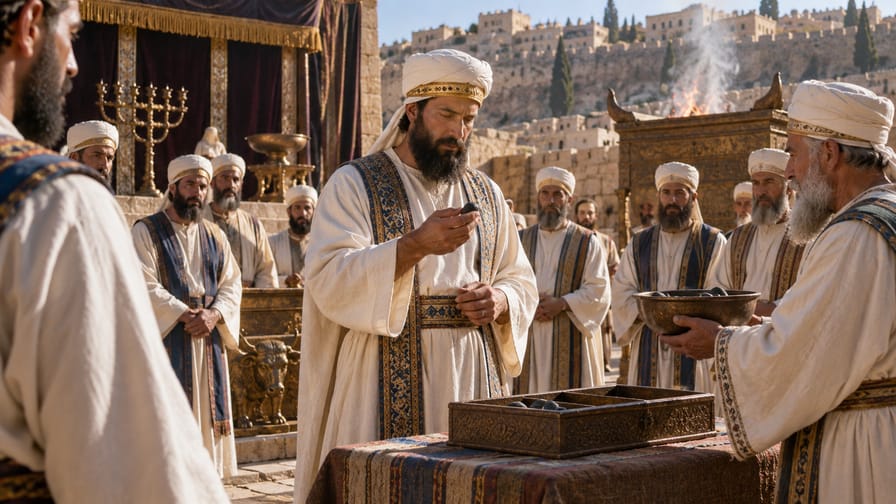
Jedaiah was a priest of the line of Aaron in the days of King David. When David, with the help of Zadok and Ahimelech, organized the priests into twenty-four divisions for service in the house of the LORD, the second lot fell to Jedaiah (1 Chronicles 24:7). From then on his name designated a priestly family and a course of temple service. Centuries later, after the Babylonian exile, the sons of Jedaiah headed the list of priests who returned with Zerubbabel, 973 in number (Ezra 2:36; Nehemiah 7:39).
Scripture tells us very little about Jedaiah himself. It does not record his words, his deeds, his father's name or the length of his life. What it records is his place in the ordered worship of Israel and the endurance of the family that carried his name. Any study of him must respect this silence: we know Jedaiah through an office and a lineage, not through a narrative.
That lineage, however, is remarkable. It links the worship organized under David, the catastrophe of the exile and the rebuilding of the temple under Zerubbabel and Jeshua. Following the name of Jedaiah through the Bible is a way of seeing how God preserved a priesthood to serve at his altar until the coming of the true High Priest, Jesus Christ.
1. Etymology and meaning of the name
The Hebrew name is יְדַעְיָה (Yedaʿyah). It combines the verb yadaʿ, “to know”, with Yah, a short form of the divine name. The usual meaning is “the LORD knows” or “the LORD has known”. In the Old Testament, God's knowing often includes the idea of caring for and choosing, as when he says to Israel, “You only have I known of all the families of the earth” (Amos 3:2). The name may have expressed confidence that God had noticed and cared for the child, although the Bible does not explain why it was given.
English Bibles use the same spelling, Jedaiah, for two other men whose Hebrew name is different, Yedayah (יְדָיָה), a name whose meaning is uncertain. Those men are mentioned below so that they are not confused with the priest of the second division.
2. Historical context and biblical narrative
2.1 Family origin and genealogy
Jedaiah belonged to the priestly line descended from Aaron. According to 1 Chronicles 24:1-2, Aaron's sons Nadab and Abihu died before their father and had no sons, so the priesthood continued through Eleazar and Ithamar. When the divisions were formed, sixteen heads of fathers' houses came from Eleazar and eight from Ithamar (1 Chronicles 24:4). The text does not tell us to which of these two branches Jedaiah belonged, nor does it name his father.
It also helps to understand how the list in 1 Chronicles 24 works. The names are those of heads of fathers' houses (1 Chronicles 24:6). Jedaiah may have been the head of his family in David's day, or the family may already have been known by the name of an earlier ancestor. In either case, after David's reign the name functioned as the name of a priestly house and of its turn of service.
2.2 Main events
The central event is the casting of lots. David, Zadok of the sons of Eleazar and Ahimelech of the sons of Ithamar divided the priests by lot, impartially, since there were officers of the sanctuary and officers of God among the descendants of both (1 Chronicles 24:3-5). The scribe Shemaiah, a Levite, recorded the result in the presence of the king, the princes, the priests and the heads of the fathers' houses (1 Chronicles 24:6). The first lot fell to Jehoiarib and the second to Jedaiah (1 Chronicles 24:7). This became their appointed order for coming into the house of the LORD (1 Chronicles 24:19). Elsewhere the divisions are seen going on and off duty on the Sabbath (2 Chronicles 23:8), which suggests a weekly rotation.
The next time the name appears, the world has changed. Jerusalem has fallen, the temple has been burned and the people have gone into exile. When the first group returned under Zerubbabel and Jeshua, the priests were listed by families, and the first family named is the sons of Jedaiah, of the house of Jeshua, 973 men (Ezra 2:36; Nehemiah 7:39), out of 4,289 priests in all (Ezra 2:36-39). The phrase “of the house of Jeshua” is often understood as a reference to Jeshua the high priest (Ezra 3:2), but it may refer to another Jeshua, such as the head of the ninth division (1 Chronicles 24:11). The text does not settle the question.
Jedaiah appears again among the priests who lived in Jerusalem after the return (1 Chronicles 9:10; Nehemiah 11:10). In Nehemiah 12, two men named Jedaiah are listed among the chiefs of the priests who came up with Zerubbabel (Nehemiah 12:6-7), and a generation later, in the days of the high priest Joiakim, Uzzi was head of the house of one Jedaiah and Nethanel of the other (Nehemiah 12:19, 21). The Bible does not say which of these houses continued the division of David's time, and it is wise not to force an answer. What is clear is that the name of Jedaiah remained attached to priestly service in the restored community, where the priests were again set in their divisions for the service of God (Ezra 6:18).
3. Character and role in the biblical narrative
No personal trait of Jedaiah is recorded. We do not know whether he was zealous or careless, young or old, and it would be wrong to invent such details. The Bible presents him in terms of a role: he is the head of a priestly house whose members would stand before the LORD at an appointed time, offering sacrifices, burning incense and teaching the people.
The later history of his descendants shows a family that kept its identity through disaster. Among the returnees, some priestly families could not find their genealogical records and were excluded from the priesthood until a priest could consult the Urim and Thummim (Ezra 2:61-63). The sons of Jedaiah, by contrast, were recognized without question. Their name, preserved across generations, testified to a continuity of service that the exile had not destroyed.
4. Theological significance
4.1 God orders his worship
The division of the priests into courses shows that worship in Israel was not left to improvisation. God is not a God of confusion, and the worship of his people should be done decently and in order (1 Corinthians 14:33, 40). Jedaiah's lot gave his house a fixed and recognized place in that order.
4.2 The lot and the sovereignty of God
The priests were assigned by lot precisely so that the choice would not depend on human favoritism. Scripture teaches that although the lot is cast into the lap, its every decision is from the LORD (Proverbs 16:33). The second place given to Jedaiah was received as God's appointment, not as a human reward.
4.3 Faithfulness through exile
The reappearance of the sons of Jedaiah in Ezra and Nehemiah is a quiet witness to God's faithfulness. The temple was destroyed, but God did not let the priesthood disappear. He brought priests back to rebuild the altar and resume the sacrifices (Ezra 3:2-6). The same system of courses was still in force when the angel appeared to Zechariah, a priest of the division of Abijah, chosen by lot to burn incense (Luke 1:5, 8-9).
4.4 Pointing to the true High Priest
Generation after generation of priests served in turn because death prevented them from continuing in office (Hebrews 7:23). Jesus, by contrast, holds his priesthood permanently and always lives to intercede for those who draw near to God through him (Hebrews 7:24-25). The priests stood daily offering the same sacrifices, but Christ offered one sacrifice for sins for all time and sat down at the right hand of God (Hebrews 10:11-12). The faithful service of houses like Jedaiah's prepared the way and makes the greatness of Christ's once for all work easier to see.
4.5 Not to be confused with
Jedaiah should not be confused with Jedidiah, the name the LORD gave to Solomon through Nathan (2 Samuel 12:25). Nor is he the Simeonite Jedaiah son of Shimri (1 Chronicles 4:37) or Jedaiah son of Harumaph, who repaired part of the wall of Jerusalem (Nehemiah 3:10); both of these bear the different Hebrew name mentioned above. A Jedaiah among the returned exiles also appears in Zechariah 6:10, 14; the text does not say whether he belonged to this priestly family.
5. Legacy and canonical references
Jedaiah receives the second lot among the priestly divisions in 1 Chronicles 24:7. A priest of this name is listed among those living in Jerusalem after the exile in 1 Chronicles 9:10 and Nehemiah 11:10, where Nehemiah calls him the son of Joiarib. The sons of Jedaiah, of the house of Jeshua, 973 in number, return from Babylon in Ezra 2:36 and Nehemiah 7:39. Two priests named Jedaiah appear among the chiefs of the priests who came up with Zerubbabel in Nehemiah 12:6-7, and their houses, headed by Uzzi and Nethanel, are listed in Nehemiah 12:19 and Nehemiah 12:21.
His legacy is a family of priests who served the LORD before and after the exile. The Bible remembers him not for a great act, but for a place in the service of God that his descendants faithfully occupied.
6. Application for today
Jedaiah's name means “the LORD knows”. That is a precious truth for believers whose service is ordinary and largely unseen. The Lord knows those who are his (2 Timothy 2:19), and the greater wonder is not that we have come to know God, but that we are known by him (Galatians 4:9; 1 Corinthians 8:3).
The priests of Jedaiah's house served when their turn came, week after week, in a task that rarely made history. In Christ, all believers are now a royal priesthood (1 Peter 2:9). We do not offer animal sacrifices, since Christ's sacrifice is complete, but we present our bodies as living sacrifices (Romans 12:1) and offer to God a sacrifice of praise, the fruit of lips that acknowledge his name (Hebrews 13:15). Faithfulness in the appointed place, even when no one is watching, is part of that worship.
Finally, the survival of Jedaiah's family through exile encourages us when the ordinary structures of life and worship are shaken. God can preserve his people through loss and bring them back to serve. Our confidence does not rest on a human lineage, however, but on Jesus, the High Priest who never needs a successor and who always lives to intercede for us.