


The Way
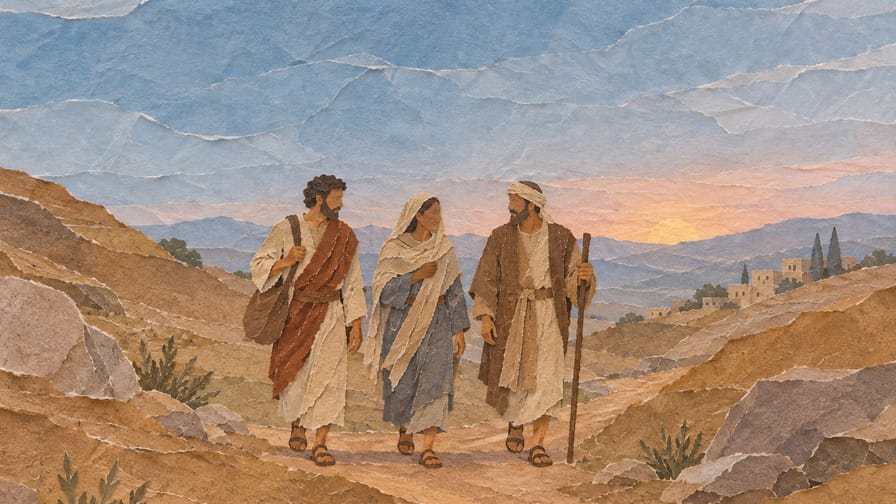
The Way in the Bible is the path of life a person walks, translated from the Hebrew derek and the Greek hodos. It can mean a literal road, but above all it names a manner of living: "the Lord knows the way of the righteous, but the way of the wicked will perish" (Psalm 1:6).
Jesus declared, "I am the Way, the Truth, and the Life" (John 14:6), and the first Christians were called followers of "the Way" (Acts 9:2).
1. Etymology and Roots in the Old Testament
In the Old Testament, the concept of the Way is predominantly conveyed by the Hebrew word derek (דֶּרֶךְ). Literally, derek means a road, a course, a path. However, its biblical use transcends this physical connotation, extending to encompass a way of life, conduct, a course of action, or even a destiny. This polysemy is crucial for understanding the depth of the term in Hebrew thought.
In biblical narratives, derek describes physical journeys, such as the exodus of Israel from Egypt, where God guides His people along the Way in the desert (Exodus 13:21). In these instances, the Way is not just a route, but a journey under divine providence, revealing God's faithfulness and direction.
In legal and prophetic literature, derek acquires an ethical and moral sense. The Law of Moses exhorts the people to "walk in all the ways that the Lord your God has commanded you" (Deuteronomy 5:33). Here, the Way of God refers to His commandments, statutes, and judgments, which constitute the standard of righteousness for the covenant life. To stray from this Way is to disobey and incur judgment, as the prophets warn (Isaiah 30:21).
The sapiential literature, notably Psalms and Proverbs, more explicitly elaborates the duality between the way of the righteous and the way of the wicked. Psalm 1:6 declares: "For the Lord knows the way of the righteous, but the way of the wicked will perish." This fundamental distinction establishes that there are only two ways in life, each with a distinct destiny, and the choice of one defines the individual's identity and eternal destiny. Proverbs frequently contrast the way of wisdom and life with the way of folly and death (Proverbs 4:18-19).
In Hebrew thought, the Way is not an abstraction but a lived experience. To walk in the Way of God means to live in conformity with His revealed will, seeking His justice and righteousness in all areas of life. It is a holistic concept that encompasses the totality of human existence. The progressive revelation in the Old Testament points to a future fulfillment, a more perfect Way that would be revealed, a promise of restoration and a clearer guide for sinful humanity, preparing the ground for the coming of the Messiah.
2. The Way in the New Testament and its Significance
In the New Testament, the primary Greek word for the Way is hodos (ὁδός), which, like derek, has a literal meaning of road or path, but is widely used in a metaphorical and theological sense. The transition from the Old to the New Testament reveals conceptual continuity, but also a profound Christocentric redefinition of what the Way of God means for humanity.
Lexically, hodos can denote a physical route, a journey, or even a method or manner of doing something. Theologically, however, in the New Testament, the term is elevated to a new dimension, becoming synonymous with truth, life, and, crucially, the very Person of Jesus Christ. This elevation is most evident in Jesus' seminal declaration in John 14:6: "I am the Way, the Truth, and the Life no one comes to the Father except through Me."
In the Gospels, Jesus not only teaches about the Way of righteousness but presents Himself as the embodiment of this Way. He is the fulfillment of all the Old Testament promises and exhortations regarding the Way of God. The parable of the two ways in Matthew 7:13-14, contrasting the wide way that leads to destruction with the narrow way that leads to life, gains its full meaning in light of Christ's exclusivity as the door and the Way.
Still in the Gospels, John the Baptist prepared the Way for the Lord, as prophesied in Isaiah 40:3 and quoted in Matthew 3:3, indicating that the coming of Jesus would inaugurate a new and definitive Way to salvation. This Way is accessible not through rituals or works of the law, but through faith in Christ.
In the book of Acts, early Christianity is frequently referred to as "the Way". In Acts 9:2, 19:9, 22:4, and 24:14, Luke describes the followers of Christ as those who belong "to the Way" or follow "this Way". This suggests that Christian faith was not just a set of beliefs, but a distinct way of life, a new ethic, and a new identity rooted in the person of Jesus Christ. They not only believed in a Way, but were the Way in their communal practice.
The epistles continue to develop this understanding. In 1 Corinthians 12:31, Paul speaks of "a still more excellent way", referring to love (agape) as the supreme virtue that should characterize the believer's life. Peter, in 2 Peter 2:2, warns against those who deviate from "the way of truth", reinforcing the idea that Christianity is the authentic Way of truth in contrast to false doctrines. Thus, the New Testament not only presents the Way but identifies it inseparably with Jesus Christ and the life of faith in Him, establishing continuity with the Old Testament while simultaneously fulfilling and transcending it.
3. The Way in Pauline Theology: The Basis of Salvation
Pauline theology, with its profound emphasis on the doctrine of salvation by grace through faith, sheds crucial light on the Way. Although Paul does not use the word Way with the same frequency as the Gospels or Acts in direct reference to Jesus, the underlying concept permeates his epistles, outlining God's unique Way for the justification, sanctification, and glorification of the believer. For Paul, the Way is intrinsically linked to the Gospel and the redemptive work of Christ.
The apostle repeatedly contrasts the way of the Law with the way of grace. In Romans and Galatians, he vehemently argues that salvation cannot be achieved by works of the Law or human merit, but only by faith in Jesus Christ. "For by grace you have been saved through faith and this is not from yourselves, it is the gift of God not by works, so that no one may boast" (Ephesians 2:8-9). This is God's exclusive and sovereign Way for the reconciliation of sinful humanity to Himself. Calvin, in his Institutes, emphasizes that justification by faith is the "main hinge on which religion turns," a divinely established Way that excludes any meritorious human contribution.
Within the ordo salutis (order of salvation), the Pauline Way unfolds in several stages. Justification is the forensic act by which God declares the sinner righteous based on the imputed righteousness of Christ, accessible solely through faith (Romans 3:23-24). This is the entry point into the Way of salvation. Without the work of Christ, there is no Way to righteousness before God. Luther vigorously defended this truth, affirming that justification by faith is the article upon which the church stands or falls, being the Way to peace with God.
Once justified, the believer is called to follow the Way of sanctification. In Romans 6:4, Paul exhorts: "Therefore we were buried with Him through baptism into death, that just as Christ was raised from the dead by the glory of the Father, even so we also should walk in newness of life." To walk in newness of life is the Way of progressive sanctification, a process of increasing conformity to the image of Christ, wrought by the Holy Spirit. It is not a Way of instant perfection, but of continuous growth in the grace and knowledge of our Lord and Savior (2 Peter 3:18).
Finally, the Way of salvation culminates in glorification, the final redemption of the body and the consummation of salvation in the presence of God. This is the ultimate destination of the Way that God has prepared for His elect (Romanos 8:30). The central soteriological implications of Pauline theology are clear: the Way to salvation is singular, exclusive to Christ, accessible by grace through faith, and results in a transformed life that seeks to honor God in all things. To deny this Way is to deny the Gospel itself.
4. Aspects and Types of the Way
The term Way, in its biblical richness, manifests in diverse facets and types that require theological distinction for a comprehensive understanding. These are not different "paths" to God, but different aspects of the one Way that God has established and which is embodied in Jesus Christ.
We can identify the Way of truth (Psalm 119:30, 2 Peter 2:2), which refers to conformity with divine revelation and the rejection of false doctrines. There is the Way of righteousness (Proverbs 12:28, Matthew 21:32), which denotes a life of moral and ethical uprightness, in obedience to God's commandments. The Way of life (Psalm 16:11, Acts 2:28) points to the abundant and eternal existence that is found only in Christ. And the Way of peace (Luke 1:79, Romans 3:17) describes reconciliation with God and with one's neighbor, which is the fruit of salvation.
A fundamental theological distinction is between the Way as the person of Christ and the Way as a way of life. Jesus is the objective and exclusive Way to the Father (John 14:6). No one can approach God except through Him. This is the Way of saving faith, a sovereign gift from God. In contrast, the Way as a way of life refers to the subsequent conduct of the believer, the "walking" in the Way that Christ is. This is the Way of faith that works and manifests itself in obedience, sanctification, and service. Saving faith (fides salvifica) differs from historical faith (fides historica), as the former involves a personal and transformative trust in Christ as the Way, while the latter is merely an intellectual assent.
Scripture, with its emphasis on God's sovereignty, shows that the Way of salvation is entirely a divine initiative. God, in His sovereign grace, elects, calls, regenerates, and justifies the sinner, enabling him to walk in the Way that He Himself has provided. Theologians such as Jonathan Edwards highlighted the beauty and excellence of this divinely ordained Way, which glorifies God at every stage.
It is vital to avoid doctrinal errors that distort the concept of the Way. Universalism, which claims that all "paths" lead to God, denies the exclusivity of Christ as the only Way, directly contradicting John 14:6 and Acts 4:12. Legalism, in turn, attempts to create a Way of salvation through human works, nullifying the grace of God and the sacrifice of Christ (Galatians 2:21). Antinomianism, on the other hand, distorts grace, suggesting that the Way of salvation dispenses with the need for obedience and holiness, ignoring the exhortation to walk in newness of life. The true understanding of the Way is Christocentric, gracious, and transformative.
5. The Way and the Practical Life of the Believer
The theological understanding of the Way is not merely academic it has profound and transformative implications for the practical life of the believer. Since Jesus Christ is the Way, the Christian life is, by definition, a continuous walk in Him and with Him. This implies personal responsibility and daily obedience that emanates from a heart regenerated by grace.
To walk in the Way of Christ means to live in conformity with His Word. Psalm 119:105 declares: "Your word is a lamp to my feet and a light to my path." Scripture is our infallible guide, illuminating every step and revealing the will of God. It also means to imitate Christ in His character and conduct. 1 John 2:6 states: "He who says he abides in Him ought himself also to walk just as He walked." This is the essence of sanctification, a process of conformity to the image of Jesus, empowered by the Holy Spirit.
Life in the Way is lived under the direction of the Holy Spirit. Paul exhorts in Galatians 5:16: "Walk in the Spirit, and you shall not fulfill the lust of the flesh." The Spirit enables the believer to produce the fruit of righteousness and to resist the temptations of sin, guiding him so that his conduct may be worthy of the Gospel. Obedience, therefore, is not a means to salvation, but an evidence and fruit of saving faith, a loving response to God's abundant grace.
The Way shapes the piety, worship, and service of the believer. Christian piety is the pursuit of a devout life, characterized by prayer, reading of the Word, and communion with God, all as part of walking in the Way. Worship, whether individual or corporate, is an expression of gratitude to God for having revealed and provided the Way. In John 4:24, Jesus teaches that "God is Spirit, and those who worship Him must worship in spirit and truth," a worship that reflects the reality of the Way that He is.
Christian service, in turn, is an extension of walking in the Way of Christ, who "did not come to be served, but to serve, and to give His life a ransom for many" (Mark 10:45). Serving one's neighbor, proclaiming the Gospel, and participating in God's mission in the world are practical manifestations of those who follow the Way.
For the contemporary church, the doctrine of the Way has crucial implications. The church is the community of those who walk in the Way, called to be a beacon of light and truth in a lost world. It must proclaim Christ's exclusive Way to salvation and disciple believers to persevere in it. Pastoral exhortations must always balance God's sovereignty in providing the Way with human responsibility to walk in it with faithfulness. Dr. Martyn Lloyd-Jones often emphasized the need for a practical Christian life that demonstrated the reality of faith, a walk consistent with the doctrine we profess.
In summary, the Way is a gracious gift from God in Christ, a call to obedience, and a journey of faith that will culminate in eternal glory. Authentic Christian life is a constant walk in this Way, depending on divine grace and seeking to glorify God in everything.