


Abinadab
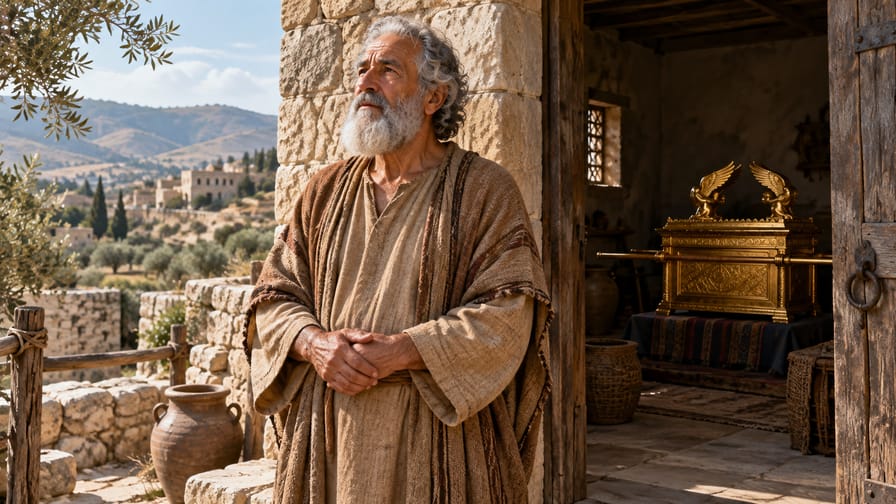
The figure of Abinadab appears in various passages of the Old Testament, designating at least four distinct individuals. However, the most prominent and theologically significant is Abinadab of Kiriath-Jearim, in whose house the Ark of the Covenant remained for a period of approximately twenty years after its return from Philistine territory. The following analysis will primarily focus on this Abinadab, also briefly addressing the other namesake characters for a complete and comprehensive understanding.
The story of Abinadab of Kiriath-Jearim is intrinsically linked to the narrative of the Ark of the Covenant, one of the most sacred symbols of God's presence and His covenant with Israel. His residence became a temporary sanctuary for the nation's holiest object, an event that reveals crucial aspects of Israel's spirituality in the transition between the turbulent period of the Judges and the beginning of the united monarchy under David. The study of Abinadab offers profound insights into divine holiness, the nature of faithful obedience, and God's sovereign providence in redemptive history.
1. Etymology and meaning of the name
The Hebrew name אֲבִינָדָב (ʾAvinadav) is a compound nominal construction, rich in meaning. It is formed by the union of two distinct and theologically resonant Hebrew roots. The first part, ʾav (אָב), is a fundamental term meaning "father." This root is frequently used to indicate biological paternity, ancestry, or even a figure of authority and provider.
The second part of the name derives from the root nadav (נָדַב), which carries the connotations of being "voluntary," "noble," "generous," or "willing." This root is frequently associated with voluntary offerings or a spirit of readiness and liberality in service to God or others, as seen in Exodus 35:29, where it refers to "every man and woman who of their own free will [nadav] brought an offering."
Combining these two roots, the most common and accepted meaning for Abinadab is "My father is noble," "My father is generous," "Father of nobility," or "Father is willing." This meaning suggests an expectation of elevated character or a description of the individual's ancestry. The nobility here can be both of lineage and of character, indicating a person of good reputation or high principles.
Although the name itself carries a positive connotation, implying virtues such as generosity and willingness, it does not offer a direct or exhaustive revelation about the specific character of each biblical Abinadab. The interpretation of their character and role should be primarily derived from their actions and the narrative context provided by the Scriptures, rather than an exclusive inference from the onomastic meaning.
There are no significant variations of the name in biblical languages, being consistently transliterated from Hebrew to the Greek of the Septuagint (Αμιναδαβ, Aminadab) and, subsequently, into other languages. The recurrence of the name in different contexts underlines its popularity and the possible desire of parents for their children to embody the qualities of nobility and generosity implicit in its meaning.
1.1 Other biblical characters with the same name
The Bible records the existence of at least three other individuals named Abinadab, which highlights the popularity of the name in ancient Israel and the need to carefully distinguish each figure in their specific context:
- Abinadab, the second son of Jesse, David's father. He is mentioned in 1 Samuel 16:8, when Samuel considers him as a potential king, but he is rejected by the Lord, who warns Samuel: "Do not look at his appearance or at the height of his stature, because I have rejected him" (1 Samuel 16:7). His mention also appears in 1 Samuel 17:13, in the context of David's battle against Goliath, where he and his older brothers were in Saul's army.
- Abinadab, one of the twelve governors or district officers who served King Solomon. He was married to Taphath, one of Solomon's daughters, and his jurisdiction covered the entire region of Dor (1 Kings 4:11). His appointment reflects the administrative organization of Solomon's united kingdom and the consolidation of royal power.
- Abinadab, a Levite mentioned in 1 Chronicles 15:18 as one of the gatekeepers of the tabernacle during David's second and successful transport of the Ark to Jerusalem. It is plausible that this is the same Abinadab of Kiriath-Jearim or, more probably, one of his descendants, given his family's continuous connection with the Ark.
For the purposes of this biblical-theological analysis, the main focus remains on Abinadab of Kiriath-Jearim, whose narrative concerning the Ark of the Covenant has the richest theological and historical implications.
2. Historical context and biblical narrative
The most significant Abinadab for biblical theology is the one from Kiriath-Jearim, whose story unfolds at the end of the period of the Judges and the beginning of the monarchy in Israel, approximately between the 11th and 10th centuries BCE. This was a time of great transition and turbulence for the nation of Israel, marked by profound political, social, and religious changes.
Politically, Israel was under Philistine oppression, a constant threat that undermined the nation's security and sovereignty. The charismatic and, at times, fragmented leadership of the judges was coming to an end, giving way to a popular and insistent demand for a human king, "like all the nations" (1 Samuel 8:5), which would culminate in the anointing of Saul and, subsequently, David.
Socially, the period was characterized by decentralization and, often, spiritual anarchy. The absence of a central authority and a lack of consistent obedience to God's Law led to a state where "everyone did what was right in their own eyes" (Judges 21:25). This era of disorder set the stage for the search for a new form of government.
Religiously, the nation was in sharp decline. The central sanctuary in Shiloh, where the Ark of the Covenant resided, had been corrupted by the wicked conduct of Eli's sons, Hophni and Phinehas (1 Samuel 2:12-17). The capture of the Ark by the Philistines (1 Samuel 4:10-11) was a dramatic sign of divine disapproval over Israel's conduct and its negligent priestly leadership.
2.1 The Ark of the Covenant in Abinadab's house
After Israel's catastrophic defeat at Ebenezer and the capture of the Ark of the Covenant by the Philistines, God powerfully demonstrated His sovereignty and holiness, even among the pagans. The Philistine cities that housed the Ark were afflicted by plagues and diseases, including tumors (1 Samuel 5:1-12). Recognizing the undeniable power of the God of Israel, the Philistines decided to return the Ark, sending it back on a new cart pulled by cows that had never been yoked.
The Ark arrived at Beth-Shemesh, a Levitical city. However, the irreverent curiosity of the men of Beth-Shemesh, who looked into the Ark, resulted in the death of many of them (1 Samuel 6:19). Fearful and perplexed by the manifestation of God's holiness, they cried out, "Who is able to stand before the Lord, this holy God? And to whom shall he go up from us?" (1 Samuel 6:20).
It was then that the inhabitants of Beth-Shemesh sent messengers to the residents of Kiriath-Jearim, asking them to come and take the Ark. The men of Kiriath-Jearim came up and took the Ark to the house of Abinadab, which was on a hill (1 Samuel 7:1). This event marked the beginning of a long period of custody of the Ark by Abinadab and his family, which lasted twenty years (1 Samuel 7:2).
During that time, his son Eleazar was consecrated to guard it. Eleazar's consecration (literally "separated" or "dedicated") suggests a recognition of the object's extreme holiness, even if its custody was not in a location designated by Mosaic worship, such as the Tabernacle. Kiriath-Jearim, whose name means "city of forests," was a Gibeonite city located on the border between the tribes of Judah and Benjamin, and not an official religious center.
2.2 David's attempt to transport the Ark
After the unification of the kingdom and the establishment of Jerusalem as capital, King David, driven by a sincere desire to bring God's presence to the center of his kingdom, decided to move the Ark from Abinadab's house to Jerusalem (2 Samuel 6:1-2 1 Chronicles 13:1-6). David gathered thirty thousand chosen men of Israel for this monumental task.
The Ark was placed on a new cart, a practice that, although it seemed modern and efficient, imitated the Philistine method and disregarded divine instructions. Abinadab's sons, Uzzah and Ahio, drove the cart (2 Samuel 6:3 1 Chronicles 13:7). Ahio went ahead of the cart, while Uzzah walked beside the Ark, playing a role of proximity and guard.
During the journey, when they came to the threshing floor of Nachon (or Chidon, in 1 Chronicles 13:9), the oxen stumbled, and the Ark swayed dangerously. Uzzah, in an act of good human intention but disobedience to explicit divine instructions, reached out his hand to steady the Ark. Immediately, "the anger of the Lord was kindled against Uzzah, and God struck him down there for his irreverence and he died there beside the ark of God" (2 Samuel 6:7).
This tragic event paralyzed David's attempt and caused great fear and consternation. David was angry and afraid, and the Ark was then taken to the house of Obed-Edom, the Gittite, where it remained for three months and prodigiously blessed his household (2 Samuel 6:8-11 1 Chronicles 13:11-14). Later, David learned the lesson of obedience, consulted the Law, and transported the Ark correctly, carried by the Levites of the family of Kohath on their shoulders, as the Law prescribed (2 Samuel 6:12-15 1 Chronicles 15:2-15).
3. Character and role in the biblical narrative
The character of Abinadab of Kiriath-Jearim is not explicitly detailed in the Scriptures, which is common for many secondary characters who serve specific narrative purposes. However, his actions and the narrative's context allow us to infer certain aspects of his person and his role in the history of the Ark of the Covenant.
The readiness of Abinadab to receive the Ark into his house, when the inhabitants of Beth-Shemesh were fearful and did not know what to do with it, suggests a willingness to take on a sacred responsibility. This initial act can be seen as a virtue, a sign of reverence and hospitality towards an object of immense holiness that others feared to touch.
The consecration of his son Eleazar to guard the Ark also indicates an awareness of the object's holiness and the need for special care and dedication (1 Samuel 7:1). This demonstrates that Abinadab did not treat the Ark lightly, but sought to provide a worthy guardianship, though not in accordance with the Levitical precepts of the Tabernacle.
On the other hand, the long period of twenty years in which the Ark remained in his house, without any documented effort by Abinadab or his family to restore it to an appropriate place of worship or to inquire of the Lord about its proper place, raises questions about the initiative and depth of his spiritual leadership. This prolonged "exile" of the Ark may reflect the widespread spiritual apathy of the time, where the nation as a whole neglected the centrality of God's presence.
3.1 The role of custodian of the Ark and its implications
Abinadab's primary role was that of temporary custodian of the Ark of the Covenant. His house, although not the Tabernacle or a Temple, became the de facto sanctuary for God's presence during a period of religious decline and instability in Israel. This custody, though not perfect from a ceremonial point of view, ensured the protection and preservation of the Ark until David could arrange its proper return to a center of worship.
The mention of his sons, Uzzah and Ahio, driving the cart that transported the Ark in David's first attempt (2 Samuel 6:3 1 Chronicles 13:7), indicates that Abinadab's family continued to have a role of proximity to the Ark. This suggests that the guardianship of the Ark may have become a family tradition, though not sanctioned by Mosaic Law, which designated the Kohathite Levites for this task.
The tragedy of Uzzah, however, casts a shadow over the way the Ark was being handled by Abinadab's family and by David. Mosaic Law was explicit about how the Ark was to be transported: it was to be carried by the Levites of the family of Kohath, using poles inserted into its rings, and no one, except the priests in certain circumstances, was to touch it on pain of death (Numbers 3:31 4:15 7:9). The use of a new cart, although it seemed reverent and efficient in human eyes, was a direct violation of the divine command.
Although Abinadab is not directly blamed for Uzzah's death, the fact that the Ark remained for so long in his house, and that his sons participated in an improper method of transport, highlights Israel's ignorance or neglect of divine laws, including Abinadab's family. David's zeal was well-intentioned, but it lacked informed obedience and consultation of God's Word. The story serves as a powerful reminder of the importance of strict obedience to divine precepts in worship.
4. Theological significance and typology
The story of Abinadab and the custody of the Ark of the Covenant in his house are rich in theological significance, especially from a conservative evangelical Protestant perspective. It illustrates fundamental truths about the holiness of God, the nature of obedience, and the progressive revelation of redemptive history, which culminates in Christ.
Abinadab's role in redemptive history is indirect but significant. His house served as a temporary repository for the Ark, which was the visible symbol of God's covenant with Israel and His glorious presence among them. This period of "exile" of the Ark from the Tabernacle of Shiloh reflects Israel's degraded spiritual state, characterized by apostasy, disorder, and the lack of an appropriate and respectful center of worship.
The main theological lesson drawn from the episode of Uzzah, which occurred while the Ark was under the custody of Abinadab's family, is the absolute holiness of God. The Lord is holy and demands to be approached and served on His own terms, not according to human convenience or logic. Uzzah's death was not an act of arbitrary cruelty, but an unequivocal demonstration that irreverence and disobedience to divine commands have serious consequences, even when human intentions may seem good (1 Samuel 6:7).
This event underscores the doctrine of biblical authority and unconditional obedience. God had clearly specified how the Ark was to be transported and cared for through Mosaic Law (Exodus 25:12-14 Numbers 4:15). The attempt by David and Abinadab's sons to innovate, using a cart as the Philistines had done (1 Samuel 6:7-8), demonstrated a failure to consult and obey divine Law, revealing a dependence on human logic instead of divine revelation.
4.1 Implications for worship and Christocentric typology
The story of the Ark in Abinadab's house, culminating in Uzzah's death, serves as a powerful reminder that service to God and worship must be performed according to His explicit precepts, and not according to human wisdom or convenience. It is a warning against undue familiarity with the sacred and presumption in matters of worship, emphasizing the need for reverence and awe.
From a typological and Christocentric point of view, the Ark of the Covenant is a type that points to the person and work of Jesus Christ. The Ark, with the mercy seat (kapporet) where the blood of atonement was sprinkled, represented God's presence and propitiation for sins. Christ is the incarnation of God's presence (John 1:14, "the Word became flesh and dwelt among us") and the final fulfillment of propitiation (Romans 3:25 Hebrews 9:11-12).
The demand for a holy and prescribed approach to the Ark prefigures the need for a correct approach to God through Christ in the New Testament. Although the ceremonial Law has been fulfilled in Christ, the requirement for holiness and reverence remains. Access to God is now by faith in Christ, the only mediator, but still with reverence and obedience to His Word (Hebrews 4:16 10:19-22 12:28-29).
The custody of the Ark in Abinadab's house, outside the Tabernacle, can be seen as a period of "hiding" or absence of God's glory from the center of national worship, reflecting Israel's degraded spiritual condition. The subsequent restoration of the Ark to a central place in Jerusalem, under David, represents a revival of worship and a step towards the establishment of the Messiah, who would bring the full presence of God permanently.
The story also connects with the theme of grace and judgment. God prodigiously blessed the house of Obed-Edom after Uzzah's tragedy (2 Samuel 6:11), showing that His presence, when approached correctly and with obedience, brings abundant blessing. The judgment on Uzzah serves to teach the seriousness of God's holiness, while the blessing on Obed-Edom demonstrates His grace and favor toward those who revere Him and obey His revealed will.
5. Biblical-theological legacy and canonical references
The figure of Abinadab, though not one of the main characters of the biblical narrative, plays a crucial role in the story of the Ark of the Covenant, one of the most important and instructive in the Old Testament. His main mentions occur in 1 Samuel 7:1-2, 2 Samuel 6:3-4, and 1 Chronicles 13:7. Subsequent references to other Abinadabs (1 Samuel 16:8 17:13 1 Kings 4:11 1 Chronicles 15:18) show that the name was common, but the one from Kiriath-Jearim stands out due to his intimate and prolonged connection with Israel's most sacred object.
There are no direct literary contributions attributed to Abinadab, nor explicit mentions of him in the New Testament. However, the event of the Ark in his house and, most notably, the tragic death of Uzzah, had a profound influence on biblical theology, particularly in understanding God's uncompromising holiness and the appropriate worship He demands from His people.
The story of the Ark under Abinadab's custody is frequently cited by evangelical theologians and commentators to illustrate fundamental principles of worship and service. It reinforces the doctrine of the sufficiency and authority of the Scriptures (sola Scriptura), for God had revealed His precise instructions for handling the Ark, and disobedience to these instructions resulted in divine judgment.
In the Jewish and Christian interpretative tradition throughout the centuries, Uzzah's death is a classic and solemn example of the need to strictly obey divine laws, especially concerning worship and sacred objects and rituals. It is a perennial reminder that God cannot be treated casually, irreverently, or according to human inventions and conveniences, but must be approached with fear and trembling.
5.1 Importance in Reformed and Evangelical theology
Reformed and conservative evangelical theology, with its emphasis on God's sovereignty and the necessity of reverence in all worship, finds in the experience of Abinadab and his family with the Ark fertile ground for crucial teachings. The story is frequently used to illustrate and defend the regulative principle of worship.
This theological principle asserts that God is to be worshiped only in the manner He has explicitly prescribed in His Word, rejecting forms of worship invented by man. This principle is derived from passages such as Leviticus 10:1-3 (concerning Nadab and Abihu, who offered "strange fire") and, prominently, from the very story of Uzzah's death.
The lesson is clear: worship is not a matter of subjective preference or human innovation, but of faithful and submissive obedience to divine revelation. The Ark, as the most potent symbol of God's presence in the Old Testament, demanded specific and sanctified treatment, and any deviation was a direct affront to His holiness and majesty.
Abinadab's story also contributes to the understanding of the canon by highlighting the continuing importance of Mosaic law and its application, even in periods of transition or under seemingly exceptional circumstances. It serves as a vital link between the revelation at Sinai and the era of the monarchy, showing that the divine principles of holiness and obedience remain constant and immutable.
In summary, Abinadab of Kiriath-Jearim is more than a mere name in a biblical genealogy he is a character whose home became the stage for an indelible lesson about the uncompromising nature of God. His story, and that of his family, serves as a perennial reminder of God's holiness, the importance of strict obedience to His Word, and the serious consequences of irreverence. Thus, although Abinadab is not a protagonist, his role as custodian of the Ark of the Covenant is fundamental to understanding Israel's religious transition and the eternal principles of true worship and service to a holy God, which continues to be a vital truth for the Protestant evangelical and Reformed faith.