


Kohath
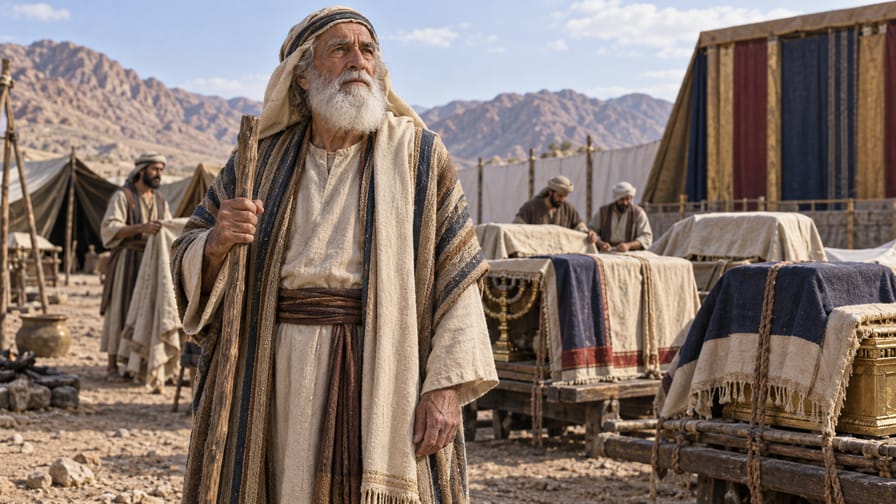
The figure of **Kohath** (in Hebrew, *Qehat* (קְהָת)) is one of the most significant in the Old Testament, not for his personal actions directly recorded, but for his genealogical position and the fundamental role his descendants played in the worship and life of Israel. As the second son of Levi, **Kohath** became the progenitor of one of the three great Levitical clans, to whom were entrusted the most sacred responsibilities related to the Tabernacle and, later, the Temple.
His importance lies in the lineage that proceeds from him, including prominent figures such as Moses and Aaron, and in the specific function of transporting the most sacred objects of the sanctuary, symbolizing God's holiness and proximity. This analysis will delve into the etymology of his name, his historical context, the implicit character and role of his lineage, his theological and typological significance, and his enduring legacy in biblical theology, from a conservative evangelical Protestant perspective.
1. Etymology and meaning of the name
The name **Kohath**, transliterated from the Hebrew *Qehat* (קְהָת), is of uncertain origin, but several etymological proposals have been presented by biblical scholars and linguists. The most commonly suggested root is *q-h-h*, which can mean "to gather," "to join," or "to assemble." This interpretation suggests that **Kohath** could mean "congregation" or "assembly," or perhaps "one who gathers."
Another etymological possibility relates the name to the idea of "obedience" or "submission." Although less common, this interpretation resonates with the role of his descendants, who were called to rigorous obedience in their priestly and Levitical functions. Regardless of the exact root, the meaning of "gathering" or "assembly" is often accepted and possesses significant symbolic resonance.
If the name **Kohath** means "assembly" or "gathering," it may prefigure the central role of his descendants in the organization and maintenance of Israel's worship, which was, in its essence, an assembly of God's people to worship Him. The Kohathites were responsible for moving the sacred objects of the Tabernacle, which were the focal point of God's presence among His gathered people.
In biblical languages, the name consistently appears as *Qehat* in Hebrew. There are no significant variations that alter its fundamental meaning. There are no other prominent biblical figures with the same name, which makes **Kohath**'s identity unique in his genealogical and functional context.
From a theological point of view, the significance of the name, if related to "gathering" or "assembling," underscores the corporate nature of Israel's faith and worship. The Kohathites, through their service, facilitated the gathering of the people around God's presence, mediated by the elements of the Tabernacle. This points to the importance of community and collective worship in the Mosaic faith.
2. Historical context and biblical narrative
2.1 Family origin and genealogy
**Kohath** is a figure from the patriarchal and Exodus periods, born in Egypt, probably before the intense enslavement of the Israelites. He is the second of Levi's three sons, who in turn was one of the twelve sons of Jacob (Israel). His brothers were Gershon and Merari (Genesis 46:11 Exodus 6:16 Numbers 3:17).
His life spanned the period when the Israelites were in Egypt, growing in number and becoming a great nation. The Bible records that **Kohath** lived 133 years (Exodus 6:18), which means he lived for a considerable part of the period of stay on Egyptian soil.
**Kohath**'s genealogy is of utmost importance, for from him descended Amram, Izhar, Hebron, and Uzziel (Exodus 6:18 Numbers 3:19). Amram, in turn, married Jochebed, his aunt (father's sister), and together they had three notable children: Aaron, Moses, and Miriam (Exodus 6:20 Numbers 26:59). Thus, **Kohath** is the grandfather of Moses and Aaron, the central leaders of the Exodus and the formation of the nation of Israel.
2.2 Key events and biblical passages
**Kohath**'s life itself is not marked by dramatic events or detailed personal actions in the Scriptures. He is primarily mentioned in genealogical lists, which establish his vital position in the Levitical lineage. The first mention occurs in Genesis 46:11, where he is listed as one of Levi's sons who went to Egypt with Jacob.
Key passages that mention **Kohath** and his descendants include Exodus 6:16-25, which details the genealogy of Levi and his sons, including **Kohath**, and traces the lineage to Moses and Aaron. Numbers 3 and 4 are particularly important, as they describe the organization of the Levites and the specific responsibilities of each clan, including the Kohathites.
In Numbers 3:27-31, it is established that the Kohathites were responsible for caring for the holiest part of the Tabernacle: the Ark of the Covenant, the Table of Showbread, the Menorah, the altars, the sanctuary utensils with which they ministered, the veil, and all its service. They were the guardians of the sacred objects that represented God's very presence.
Numbers 4:1-20 details the specific instructions for transporting these objects. After the dismantling of the Tabernacle, Aaron and his sons would cover the sacred objects, and then the Kohathites would carry them on their shoulders (Numbers 7:9). It is notable that they were not permitted to touch the objects directly or see them uncovered, on pain of death, highlighting the extreme holiness of these elements and the seriousness of their service (Numbers 4:15, 20).
The Kohathites are also mentioned in Numbers 10:21, where it is recorded that they marched in the middle of Israel's column, carrying the sanctuary. In Joshua 21, the cities designated to the Levites are listed, and the Kohathites received 23 cities, including cities of refuge, demonstrating their distribution throughout the land of Israel and their continuing importance.
2.3 Geography and relationships
The primary geography associated with **Kohath** is Egypt, where he was born and lived for many years. However, his relevance extends to the wilderness of Sinai and, later, to the land of Canaan, through his descendants. The Kohathites were an integral part of the organization of Israel's camp and march in the wilderness.
His most important relationships are with his father Levi, his brothers Gershon and Merari, and his sons, especially Amram, who gave rise to Moses and Aaron. This connection establishes **Kohath** as a crucial genealogical bridge between the tribe of Levi and the leaders of the Exodus and the priesthood, emphasizing his central position in Israel's redemptive history.
3. Character and role in the biblical narrative
The Bible does not offer details about **Kohath**'s personal character, as it does with figures such as Abraham, Moses, or David. He is an ancestral figure, whose importance lies less in his individual actions and more in his lineage and the role God assigned to his descendants. However, we can infer certain qualities from the legacy he left.
The fact that his lineage was chosen for the most sacred tasks of the Tabernacle suggests an implicit virtue of faithfulness and holiness in his family. The responsibility of carrying the Ark of the Covenant and other holy objects required an extraordinary degree of reverence, discipline, and obedience to divine law. Such qualities would be expected of the ancestors of such a blessed lineage.
The vocation of the Kohathites was unique and extremely exalted. They were the guardians of the symbols of God's presence, and their service was essential for the maintenance of worship and divine order in Israel. This role of "bearers of the sacred" is the primary function attributed to his descendants, and it reflects the importance God granted to this family.
There are no records of sins or moral failures attributed directly to **Kohath**. The biblical narrative presents him solely in his genealogical role and as the starting point for the lineage that would serve in the sanctuary. This contrasts with other biblical characters, whose lives are detailed with their virtues and flaws, indicating that **Kohath**'s function is more structural than narrative in terms of character development.
The role played by **Kohath**'s descendants was of paramount importance. They were Levites, not Aaronic priests, but they were closer to the priesthood than the Gershonites and Merarites. While Aaron and his sons performed the sacrificial service, the Kohathites were responsible for the custody and transport of the sacred elements that made this service possible.
This distinction underscores the hierarchy and divine order established in the Tabernacle. The Kohathites were essential intermediaries between God's holiness and the rest of the people, facilitating worship and the movement of the sanctuary. Their significant actions, though not directly of **Kohath**, are those of his sons and grandsons, who carried God's presence through the wilderness.
4. Theological significance and typology
The figure of **Kohath**, and more specifically the role of his descendants, is profoundly significant in redemptive history and the progressive revelation of God's will. His lineage is fundamental to the sacrificial and worship system of the Old Testament, which, in turn, points to the finished work of Jesus Christ.
The Kohathites were responsible for carrying the most sacred objects of the Tabernacle: the Ark of the Covenant, the Table of Showbread, the Menorah, and the altars. Each of these items had a profound symbolic meaning, representing God's presence, His provision, His light, and atonement for sins. By carrying them, the Kohathites were, in essence, carrying the symbols of God's relationship with His people.
This Levitical function serves as a prefiguration or Christocentric typology. The Ark of the Covenant, in particular, was the throne of God's presence, and its transport by the Kohathites, with all reverence and restrictions, points to Jesus Christ. Christ is the true bearer of God's presence, *Immanuel*, "God with us" (Matthew 1:23), who fully manifested the Father's glory (John 1:14).
The holiness required in the handling of sacred objects by the Kohathites, and the death penalty for touching them improperly (Numbers 4:15, 20), underscore God's impeccable holiness and the need for perfect mediation. This mediation is found in Christ, the perfect and sinless High Priest, who not only bore God's presence but is Himself the personification of divine holiness.
The Table of Showbread, with the bread, and the Menorah, with its light, prefigure Christ as the Bread of Life (John 6:35) and the Light of the World (John 8:12). The altars, where sacrifices were made, point to Christ as the perfect and definitive sacrifice for sins, who once for all removed guilt and separation between God and humanity (Hebrews 9:11-14).
Although **Kohath** is not directly cited in the New Testament, the Levitical system, of which his descendants were an integral part, is extensively discussed in the Epistle to the Hebrews. The author of Hebrews argues that the Levitical priesthood and the rituals of the Tabernacle were "a shadow of the good things to come" (Hebrews 10:1), and that Christ is the fulfillment and reality of all that they represented.
The connection of the Kohathites with central theological themes is undeniable. They teach us about God's holiness, the necessity of mediation, the importance of obedience in worship, and the seriousness of sin. Their service demonstrates that approaching God is only possible under divinely established conditions, which culminate in the grace and truth brought by Jesus Christ.
In summary, the lineage of **Kohath**, through its sacred service, is a powerful testimony to the progressive revelation of God and the preparation for the coming of the Messiah. The care and reverence with which they treated the symbols of God's presence serve as a perpetual reminder of the glory and holiness of Christ, who is the fulfillment of all the covenants, promises, and prophecies of the Old Testament.
5. Biblical-theological legacy and canonical references
**Kohath**'s legacy is vast and enduring, primarily through the prominence of his descendants in the history of Israel and in biblical theology. He is mentioned in various books of the Old Testament canon, including Genesis, Exodus, Numbers, Joshua, and 1 Chronicles, usually in genealogical contexts or in the description of Levitical responsibilities.
In 1 Chronicles 6:1-38, **Kohath**'s genealogy is again detailed, showing the continuity of his lineage and the importance of the Kohathites in the priesthood and in the service of the Temple during the monarchical period. Heman, one of the principal singers and musicians of the Temple in David's time, was a Kohathite (1 Chronicles 6:33).
Although **Kohath** did not directly contribute to literary works, the existence and service of his lineage are intrinsic to understanding significant parts of the Torah and the historical books. The laws and organization of the Tabernacle, detailed in Exodus and Numbers, fundamentally depend on the existence and functions of the Kohathites.
His influence on biblical theology is profound, especially in the doctrine of worship, holiness, and mediation. The Kohathites exemplify the separation required for divine service and the seriousness of approaching a holy God. This understanding is vital for Old Testament theology and finds its fullness in Christ in the New Testament.
In the Jewish interpretive tradition, the Kohathites are recognized as one of the most important Levitical families, with a distinct and sacred role. Their service of carrying the objects of the sanctuary was seen as an honor and a responsibility of great weight, reflecting the glory of the Torah and the divine presence.
Intertestamental literature and rabbinic writings continue to reference the Levitical organization and the importance of the different clans, maintaining the distinction of the Kohathites' role. Reverence for the Temple and its service, which was central to Jewish life, was intrinsically linked to the order established by God, including the duties of **Kohath**'s descendants.
In Reformed and evangelical theology, the figure of **Kohath** and the service of his descendants are often analyzed under a typological lens, emphasizing how the Old Testament points to Christ. The precision and holiness required in the service of the Kohathites are seen as shadows of the perfection and holiness of Jesus, the true Sanctuary and the definitive mediator.
**Kohath**'s importance for understanding the biblical canon lies in the fact that he is an essential genealogical and functional link for the structure of Israel's worship and the history of salvation. Without **Kohath**'s lineage, the organization of the Tabernacle and the succession of figures such as Moses and Aaron would be incomprehensible. He serves as a reminder of God's sovereignty in the choice and purpose of each lineage and individual in His redemptive plan.
Thus, the figure of **Kohath**, though discreet in terms of personal narrative, is a fundamental pillar in the theological and historical structure of the Old Testament. His legacy continues to teach about God's holiness, the necessity of mediation, the importance of ordered worship, and, above all, the glory of Jesus Christ, the fulfillment of all shadows and the bearer of true divine presence.