


Rachel
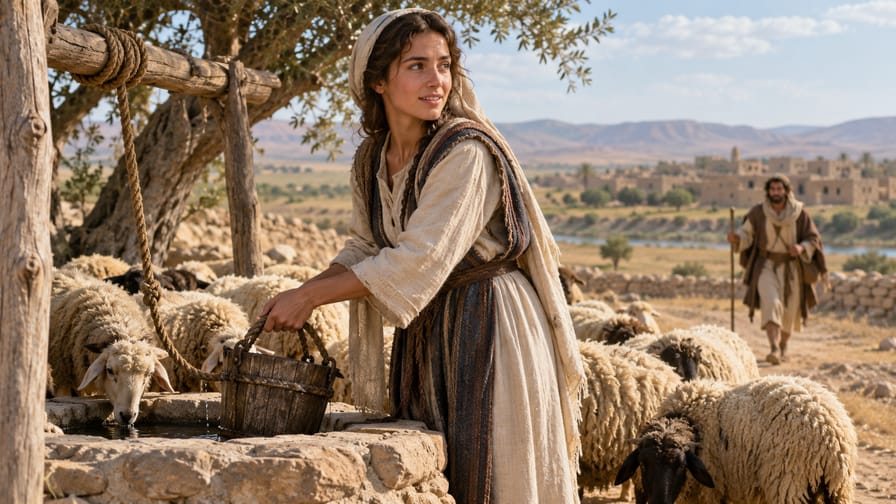
The figure of Rachel, one of the matriarchs of Israel, emerges in the Scriptures as a character of profound beauty, complexity, and theological significance. Her story, intrinsically linked to that of Jacob, her cousin and husband, and to the formation of the twelve tribes of Israel, is narrated primarily in the book of Genesis. An analysis of her life reveals not only personal aspects of love, rivalry, and suffering, but also eternal truths about divine sovereignty, God's faithfulness, and the fulfillment of His promises, all from a conservative evangelical Protestant perspective.
The narrative of Rachel is essential for understanding God's providence in the formation of the chosen people, even amidst human imperfections. Her journey, marked by an intense longing for children and the pain of loss, resonates through the generations, culminating in a prophetic foreshadowing in the New Testament. This study seeks to explore her onomastic significance, her history, her character, and her theological relevance in a format suitable for a biblical-theological dictionary.
1. Etymology and Meaning of the Name
The name Rachel, in Hebrew, is רָחֵל (Raḥel). Its etymological root and linguistic derivation point to the literal meaning of "ewe" or "lamb." This name is singular in its simplicity and expresses a connotation of docility, innocence, and beauty, characteristics frequently associated with sheep in the pastoral culture of the Ancient Near East.
The symbolic meaning of the name "ewe" can suggest Rachel's vulnerability and dependence, especially in her desire for children and her position in Laban's household and, subsequently, Jacob's. The ewe is also a sacrificial animal, which, though not directly applied to Rachel in terms of an atoning sacrifice, may symbolize the suffering and loss she experienced in her life.
There are no other prominent biblical figures who share the exact name of Rachel, which makes her identity even more unique and memorable in the biblical narrative. The singularity of the name reinforces the individuality of her story and her irreplaceable role in the patriarchal lineage.
The theological significance of the name "ewe" in the biblical context is rich. Sheep are frequently used as metaphors for the people of God, needing a shepherd (Psalm 23:1). Rachel, as an "ewe" in Jacob's flock (who was a shepherd), becomes a central figure in the formation of the "flock" of Israel. Her name, therefore, foreshadows the identity of the people who would descend from her.
Furthermore, the name may subtly allude to the purity and tenderness that Jacob saw in her from their first encounter, as Genesis 29:17 describes her as "beautiful in form and appearance." Rachel's beauty was an integral part of her attraction for Jacob, and her name, "ewe," may have reinforced this perception of delicacy.
2. Historical Context and Biblical Narrative
2.1 Historical Period and Context
Rachel's life unfolds in the patriarchal period, approximately between 2000 and 1500 B.C., according to traditional biblical chronology. This was a time of semi-nomadic societies, where the family and clan structure was the pillar of social and religious organization. Fertility and progeny were of paramount importance, viewed as divine blessings and a guarantee of continuity for the clan.
The political and social context of the era was characterized by the absence of centralized nation-states in the region, with life revolving around tribal chiefs and city-states. Religion was predominantly polytheistic, although Abraham's family had already been called to worship the one true God, Yahweh. Nevertheless, traces of pagan practices, such as the use of teraphim, could still be found, even in Laban's household.
2.2 Family Origin and Genealogy
Rachel was the daughter of Laban the Aramean and the younger sister of Leah. Her family resided in Haran, in the region of Paddan-Aram, in Mesopotamia. She was, therefore, Jacob's cousin, the son of Rebekah, Laban's sister (Genesis 28:5). This family connection was the reason for Jacob's journey to Haran, to find a wife from his own lineage, according to the instruction of his father Isaac (Genesis 28:1-2).
2.3 Major Life Events
The narrative of Rachel's life is rich in details and crucial events for the history of Israel:
- The Meeting with Jacob and Initial Love: Jacob arrived in Haran and found Rachel by the well, tending her father's sheep. It was love at first sight, and Jacob agreed to serve Laban for seven years to have her as his wife (Genesis 29:9-12, 18).
- Laban's Deception and the Marriage: After seven years, Laban deceived Jacob, giving him Leah, the older sister, on their wedding night. Jacob then served another seven years for Rachel, marrying her a week after Leah (Genesis 29:21-28).
- Sterility and Rivalry with Leah: While Leah was fertile and bore children for Jacob, Rachel remained barren for many years, which caused her great distress and jealousy of her sister (Genesis 29:31-30:1).
- The Giving of Bilhah and the Birth of Dan and Naphtali: In her affliction, Rachel gave her servant Bilhah to Jacob to bear children in her place, a common practice at the time. Bilhah bore Dan and Naphtali, whom Rachel considered her own children (Genesis 30:3-8).
- The Mandrakes Incident: In an episode of bargaining with Leah, Rachel acquired mandrakes in the hope that they would help her conceive. This event highlights her desperation and belief in superstitions of the time (Genesis 30:14-16).
- The Birth of Joseph: Finally, God remembered Rachel and opened her womb, and she conceived and bore Joseph, whose name means "may he add." This was a moment of great joy and gratitude for her (Genesis 30:22-24).
- The Flight from Laban and the Theft of the Teraphim: Jacob decided to return to the land of Canaan with his family. Before their departure, Rachel stole her father Laban's teraphim (household idols or family gods), hiding them in her camel's saddle when Laban searched for them (Genesis 31:19, 30-35).
- The Birth of Benjamin and Death: During the journey from Bethel to Ephrath (Bethlehem), Rachel went into difficult labor and gave birth to her second son, Ben-oni ("son of my sorrow"), whom Jacob renamed Benjamin ("son of the right hand"). Rachel died in childbirth and and was buried on the way to Ephrath, where Jacob set up a pillar over her tomb (Genesis 35:16-20).
2.4 Geography and Relationships with Other Characters
The main locations associated with Rachel are Haran, where Jacob found her and where she lived with his family for twenty years, and the road between Bethel and Ephrath (Bethlehem), where she died and was buried. Her tomb became a significant landmark, mentioned in 1 Samuel 10:2 and Jeremiah 31:15.
Her most important relationships were with Jacob, whom she loved deeply with her sister Leah, with whom she maintained a complex and painful rivalry and with her sons, Joseph and Benjamin, who became heads of important tribes of Israel. Her life was also shaped by her father Laban, whose cunning influenced the beginning of her marriage.
3. Character and Role in the Biblical Narrative
3.1 Character Analysis
Rachel's character is multifaceted, revealing human virtues and flaws. She is portrayed as a woman of great physical beauty (Genesis 29:17), who captivated Jacob at first sight. Her passion and devotion to Jacob are evident in her desire to be his sole wife and in her joy at conceiving children for him.
One of her most notable qualities is persistence. Her ardent desire for children, even in the face of prolonged barrenness, demonstrates a profound resilience and the importance that motherhood held for her in her culture. She did not give up praying and seeking the blessing of fertility, which was finally granted by God (Genesis 30:22).
However, the narrative also exposes her weaknesses and moral flaws. Her jealousy of Leah, expressed in her exclamation "Give me children, or I shall die!" (Genesis 30:1), reveals an impatience and envy that led her to desperate acts, such as giving her servant Bilhah to Jacob and bargaining for Leah's mandrakes. These episodes illustrate the tension and pain of her situation.
The theft of her father Laban's teraphim (Genesis 31:19) is another controversial aspect of her character. While some interpret the act as an attempt to secure family inheritance or even a way to defy her father's authority, others see in it a sign of attachment to idolatrous or superstitious practices, which would be a serious flaw from the perspective of Abrahamic monotheistic faith.
3.2 Role in the Narrative and Significant Actions
Rachel's role in the biblical narrative is crucial as one of the founding matriarchs of the twelve tribes of Israel. Although Leah bore most of Jacob's sons, Rachel's sons, Joseph and Benjamin, played prominent roles in the subsequent history of God's people. Joseph, in particular, was instrumental in preserving Jacob's family during the famine in Egypt (Genesis 45:7-8).
Her struggle against barrenness is a recurring theme in patriarchal history (Sarah, Rebekah), highlighting God's sovereignty in opening the womb and granting life. Rachel's pain and her eventual joy in the birth of Joseph and Benjamin emphasize divine intervention and the fulfillment of God's promises to multiply Jacob's descendants.
The episode of the teraphim, though morally ambiguous, also serves a narrative purpose, demonstrating the complexity of family relationships and the transition of Jacob's family from a pagan environment to the exclusive worship of Yahweh. Rachel's cunning in hiding Laban's idols underscores the tension between the two families and Jacob's determination to protect his own household.
Rachel's development throughout the narrative is that of a woman who, despite her flaws and sufferings, is deeply loved and central to the divine plan. Her premature death, in the childbirth of Benjamin, is a moment of great sadness for Jacob, but it also marks the end of one chapter and the beginning of another for the family, with the consolidation of the twelve tribes.
4. Theological Significance and Typology
4.1 Role in Redemptive History and Progressive Revelation
Rachel, as a matriarch, plays an indispensable role in redemptive history, being the mother of Joseph, the son who would become the savior of his family in Egypt, and Benjamin, who would give his name to one of the twelve tribes of Israel. Her life illustrates God's providence in securing Jacob's lineage, through which the Messiah would come.
Her barrenness and the subsequent birth of her children by divine intervention are an echo of God's pattern of using the impossible to manifest His glory and fulfill His promises, a recurring theme in the Bible (Genesis 18:14). This reinforces the doctrine of divine sovereignty over life and death, fertility and barrenness.
4.2 Foreshadowing or Christocentric Typology
The most notable typological connection of Rachel with Christ and the New Testament is found in Jeremiah's prophecy and its quotation by Matthew. Jeremiah 31:15 describes Rachel weeping for her children ("A voice is heard in Ramah, lamentation and bitter weeping, Rachel weeping for her children she refuses to be comforted for her children, because they are no more").
This passage, which originally referred to the exile of Israel and the loss of its descendants, is quoted by Matthew 2:18 to describe the lament of the mothers in Bethlehem and its vicinity after the massacre of the innocents by Herod, who sought to kill the newborn Jesus. Rachel, whose tomb was near Bethlehem, becomes a prophetic figure of the mother weeping for the loss of her children, connecting her suffering to the suffering that surrounded the birth of the Messiah.
This connection does not suggest that Rachel is a direct type of Christ, but rather that her lament and her geographical location become a prophetic point of reference for a crucial event in redemptive history. She becomes a symbol of maternal grief in the face of tragedy, pointing to the intensity of suffering that would accompany Christ's entrance into the world.
4.3 Connection with Central Theological Themes
Rachel's story addresses central theological themes such as faith and obedience, albeit with her flaws. Her life demonstrates God's grace in acting even through imperfect people, using their struggles and desires to fulfill His purposes. The rivalry between the sisters and the polygamy in Jacob's family are examples of the consequences of human sin, but God's faithfulness prevails above all.
Her story also highlights the importance of progeny in Old Testament theology, not merely as a cultural blessing, but as the means by which the Abrahamic covenant would be fulfilled. The promise that Jacob would be the father of a great nation is progressively realized through the children of Leah and Rachel, as well as their servants.
Rachel's struggle with barrenness also illustrates human dependence on divine blessing. Her experience is a testimony that life and fertility are gifts from God, and that He "remembered" her at the opportune time (Genesis 30:22), demonstrating His grace and power in answering the prayers and longings of His people.
5. Biblical-Theological Legacy and Canonical References
5.1 Mentions in Other Biblical Books
Beyond Genesis, Rachel is mentioned in other Old Testament passages, solidifying her place in Israel's memory. In Ruth 4:11, when Boaz marries Ruth, the elders and the people bless the union, saying: "May the Lord make the woman who comes into your house like Rachel and Leah, who together built up the house of Israel." This demonstrates the recognition of Rachel as one of the founding mothers of the nation.
Her tomb is an important point of reference. In 1 Samuel 10:2, Samuel tells Saul that he will find two men by Rachel's tomb in Zelzah, on the border of Benjamin. This indicates that the location of her burial was widely known and served as a geographical landmark and memorial for the people of Israel.
Jeremiah's prophecy, already mentioned, in Jeremiah 31:15, elevates Rachel to an enduring symbol of maternal mourning and hope of restoration for Israel, solidifying her presence in prophetic literature and the collective memory of the people.
5.2 Influence on Biblical Theology and Tradition
Rachel's story, as part of the patriarchal narrative, significantly influences biblical theology by exemplifying divine election and providence amidst human disorder. Jacob's family, with its rivalries, deceptions, and polygamy, was not a model of perfection, but God worked through it to fulfill His promises and establish the messianic lineage.
In Jewish interpretive tradition, Rachel is often viewed as a figure of suffering and sacrifice, especially due to her death in childbirth and her tomb being a place of pilgrimage and prayer. She is remembered as the mother who weeps for her children, a symbol of Israel's pain in exile and the hope of redemption.
In Reformed and evangelical theology, Rachel's story is analyzed with an emphasis on God's sovereignty. The way God opens and closes the womb, despite human plans and desires, is a testament to divine control over life. Her story also serves to illustrate that God uses imperfect people to accomplish His perfect purposes, and that divine grace operates amidst human flaws and sins.
Rachel's connection to the New Testament through Matthew 2:18 is of particular importance in evangelical theology, as it demonstrates the continuity and fulfillment of the Scriptures. Jeremiah's prophecy, rooted in Rachel's pain, finds its culmination in the lament of the mothers of Bethlehem, directly connecting Old Testament history to the birth of Jesus Christ and the history of salvation.
5.3 Importance for Understanding the Canon
Rachel's story is vital for understanding the biblical canon, as it contributes to the narrative of Israel's formation, the covenant people. Her sons, Joseph and Benjamin, are the patriarchs of tribes that play crucial roles throughout the Old Testament, with the tribe of Benjamin being the origin of figures such as King Saul and the apostle Paul.
Her life illustrates the challenges and blessings of family life in the patriarchal period and offers lessons on faith, patience, jealousy, and God's faithfulness. The inclusion of her struggles and imperfections in Scripture underscores the realistic nature of biblical revelation and the way God interacts with humanity in its totality.
In summary, Rachel is not merely a historical character, but a theological figure whose significance extends from the roots of Israel to the coming of the Messiah. Her story is a testament to God's sovereign grace, which weaves the threads of human history, with all its complexities and pains, to fulfill His eternal plan of redemption.