


Joseph
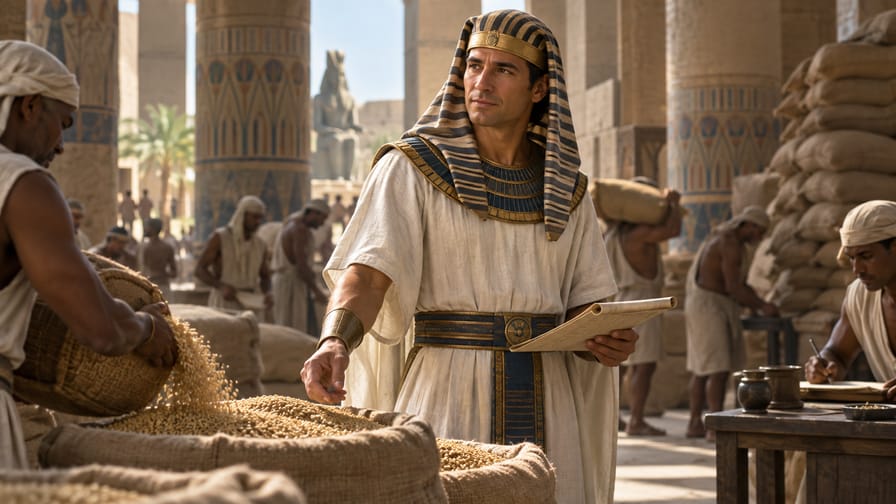
The figure of Joseph, one of the patriarchs of the Old Testament, emerges as one of the most complex and theologically rich in all of Scripture. His story, detailed in the book of Genesis, is a vivid testament to divine providence, God's faithfulness amidst adversity, and the sovereignty that transforms evil into good. From an evangelical Protestant perspective, Joseph is not only an example of character and faith but also a significant type of Christ, prefiguring crucial aspects of the Messiah's redemptive work.
The analysis of his life, from his youth in Canaan to his position of power in Egypt, reveals profound themes such as forgiveness, reconciliation, and the preservation of God's people. His narrative serves as an essential bridge between the patriarchal era and the emergence of Israel as a nation, setting the stage for the Exodus. This study will explore the etymology of his name, the historical context of his life, the richness of his character, his profound theological significance, and his enduring legacy in the biblical canon.
The story of Joseph is a pillar for understanding the history of salvation, demonstrating how God orchestrates human events, even the most painful ones, to fulfill His eternal purposes. The exegesis of Genesis, combined with theological reflection, allows us to appreciate the depth and continuous relevance of this remarkable biblical figure for contemporary Christian faith.
1. Etymology and meaning of the name
The name Joseph, in Hebrew Yosef (יוֹסֵף), is derived from the verbal root yasaf (יָסַף), which means "to add," "to increase," or "to augment." This meaning is explicitly articulated in the biblical narrative when Rachel, his mother, names him. In Genesis 30:24, she declares: "May the Lord add to me another son", after having given birth to Joseph. Thus, the name encapsulates Rachel's hope for more offspring.
The literal meaning of the name, "He adds" or "May He add," carries a profound theological symbolism. It points to divine intervention and God's provision. In the context of Joseph's life, the name prophetically anticipates not only the addition of a son to Jacob's family but also the addition of prosperity, wisdom, and salvation that God would bring through him, both for his family and for Egypt.
In the New Testament and the Septuagint (LXX), the name is transliterated into Greek as Iōsēph (Ἰωσήφ). This form is common for several other biblical characters. It is important to note that while there are other Josephs in the Bible (such as Jesus' earthly father, Matthew 1:16 and Joseph of Arimathea, Mark 15:43), the Joseph of the Old Testament is the most prominent and whose narrative is more extensive and detailed.
The theological significance of the name Joseph resides in its direct connection to God's action. It is not merely a descriptive name but a confession of Rachel's faith in God's ability to "add" and multiply. In Joseph's story, God indeed adds grace, deliverance, and a lineage that would be fundamental to the history of salvation, culminating in Christ. The name, therefore, is a reminder of active providence and divine sovereignty.
2. Historical context and biblical narrative
The life of Joseph unfolds in the patriarchal period of the Old Testament, which, according to biblical chronology and archaeological studies, is generally situated between the 19th and 17th centuries B.C. This period is marked by the semi-nomadic life of Israel's ancestors, such as Abraham, Isaac, and Jacob, in contrast to the urban and politically organized civilizations of Egypt and Mesopotamia. Joseph's narrative is crucial as it transitions the story of Jacob's family from Canaan to Egypt, setting the stage for the Exodus.
The political and social context of Joseph's time in Egypt is complex. Many scholars suggest that his rise to power may have occurred during the Hyksos period (approximately 1700-1550 B.C.), a dynasty of Asian origin that ruled parts of Egypt. This theory would explain the relative ease with which a foreigner like Joseph could ascend to such a high position, although other interpretations are also possible, placing him in the Middle Kingdom. The biblical narrative, however, focuses on divine intervention above any political particularity.
Joseph was the eleventh son of Jacob and the first son of his beloved wife Rachel (Genesis 30:22-24). His genealogy places him in the direct lineage of the Abrahamic promises, being one of the twelve patriarchs who would form the tribes of Israel. His story begins in Canaan, where he was Jacob's favorite son, evident in the gift of a coat of many colors (Genesis 37:3).
The narrative chronology of Joseph's life is rich in detail and key events. It begins with his prophetic dreams, which put him in conflict with his brothers (Genesis 37:5-11). The brothers' envy and hatred culminate in his sale as a slave to Ishmaelite merchants, who take him to Egypt (Genesis 37:28). In Egypt, Joseph is bought by Potiphar, an officer of Pharaoh, and serves faithfully in his house (Genesis 39:1-6).
His integrity is tested by the seduction of Potiphar's wife he resists, but is falsely accused and thrown into prison (Genesis 39:7-20). Even in prison, God's providence accompanies him, and he interprets the dreams of Pharaoh's cupbearer and baker (Genesis 40). Two years later, he is remembered to interpret Pharaoh's own dreams, which predict seven years of abundance followed by seven years of famine (Genesis 41:14-36).
His wisdom and discernment lead Pharaoh to elevate him to the position of vizier, the second most powerful man in Egypt (Genesis 41:37-45). During the years of abundance, Joseph stores grain, and during the famine, he manages the distribution, saving Egypt and neighboring nations. His brothers, without recognizing him, travel to Egypt in search of food, and through a series of events carefully orchestrated by Joseph, he tests them and eventually reveals himself to them (Genesis 42-45).
The reconciliation culminates in Jacob and his entire family moving to Egypt, settling in the fertile land of Goshen (Genesis 46-47). Joseph cares for his family until the death of his father Jacob, who blesses his sons and Joseph's sons, Manasseh and Ephraim (Genesis 48-49). Joseph's life ends with his death at 110 years old, but not before making his brothers swear that they would carry his bones back to the Promised Land when God visited them (Genesis 50:24-26), a remarkable act of faith that would be fulfilled in the Exodus (Exodus 13:19).
The geography of the narrative spans the pastoral regions of Canaan, such as Dothan (where he was sold, Genesis 37:17), and various locations in Egypt, including Potiphar's house, the prison, and Pharaoh's court, culminating in the region of Goshen, where the family of Israel prospered. Joseph's relationships with his father Jacob, his envious brothers, Potiphar, Potiphar's wife, and Pharaoh are crucial to the development of his story and to the revelation of divine providence in his life.
3. Character and role in the biblical narrative
Joseph's character is one of the most commendable and consistently righteous in all of Scripture, serving as a model of integrity, wisdom, and faithfulness to God. From his youth, he demonstrates a purity of heart and devotion to the Lord, characteristics that deepen and mature through the trials he faces. His story is a case study on how adversity can forge a godly character.
One of Joseph's most striking qualities is his integrity and moral purity. This is dramatically evidenced in his resistance to the seduction of Potiphar's wife. His refusal is based not merely on fear of human consequences but on the awareness that such an act would be a sin against God (Genesis 39:9). This faithfulness amidst temptation is a powerful testimony to his unwavering faith and his commitment to divine principles.
Wisdom is another prominent virtue. Although the ability to interpret dreams is a divine gift, the way Joseph uses it, and the counsel he gives to Pharaoh for managing the famine crisis, reveals remarkable practical intelligence and strategic insight (Genesis 41:33-36). He not only interprets but offers concrete solutions, demonstrating proactive and effective leadership.
Joseph's patience and perseverance are evident in his long journey of suffering. Sold as a slave, unjustly imprisoned, forgotten by those he helped, he neither rebels against God nor gives in to despair. Instead, he continues to serve with excellence wherever he is, trusting in divine sovereignty. His attitude in Genesis 50:20, "You intended to harm me, but God intended it for good", reveals a deep understanding of God's providence.
Joseph's capacity for forgiveness is perhaps the pinnacle of his character. After years of suffering caused by his brothers, he has the opportunity for revenge, but chooses the path of grace and reconciliation (Genesis 45:5-8 Genesis 50:19-21). His forgiveness is not superficial but grounded in a robust theology of God's sovereignty, seeing the divine hand behind his brothers' sinful actions for a greater purpose.
In the early narrative, Joseph may have exhibited a certain naiveté or even arrogance by sharing his prophetic dreams with his brothers, without considering the implications of his favored position (Genesis 37:5-11). However, this is a youthful flaw that transforms into maturity through suffering. No grave moral sins are documented in his adult life, making him one of the purest characters in Scripture.
Joseph's role in the biblical narrative is multifaceted: he is a beloved son, a faithful slave, a righteous prisoner, a divinely empowered dream interpreter, and finally, a powerful vizier. His primary calling, however, is to be the instrument of God's providence to preserve the lineage of Israel and, consequently, the messianic promise. He is the crucial link that ensures the survival of Jacob's family amidst the famine, allowing the nation of Israel to multiply in Egypt.
His significant actions include resistance to temptation, the interpretation of Pharaoh's dreams, the successful administration of Egypt during the famine, and the gracious reconciliation with his brothers. Each of these key decisions not only shaped his own destiny but also dramatically influenced the course of Israel's history, demonstrating the development of a character of profound faith and practical wisdom, fully submitted to God's purposes.
4. Theological significance and typology
The theological significance of Joseph is immense, as his story plays a fundamental role in God's redemptive history. He is the bridge between the patriarchal era and the emergence of Israel as a nation, ensuring the survival of the covenant lineage in a critical period. His life is a vivid demonstration of divine providence and God's sovereignty over all circumstances, even the most adverse and sinful.
The story of Joseph is one of the clearest examples of Christocentric typology in the Old Testament. He prefigures Christ in several remarkable ways:
- Beloved and hated son: Just as Joseph was his father's beloved son but hated by his brothers (Genesis 37:3-4), Jesus is the beloved Son of God (Matthew 3:17), but was rejected and hated by His own people (John 1:11).
- Sold for money: Joseph was sold for twenty shekels of silver (Genesis 37:28), prefiguring Jesus, who was betrayed and sold for thirty pieces of silver (Matthew 26:15).
- Innocent sufferer: Both suffered unjustly, Joseph in prison (Genesis 39:20) and Jesus on the cross, without any guilt.
- Exalted after suffering: Joseph was exalted from slave and prisoner to vizier of Egypt (Genesis 41:40). Similarly, Jesus was exalted to the right hand of the Father after His death and resurrection (Philippians 2:9-11 Acts 2:33).
- Savior of his people and the nations: Joseph saved his family and many nations from famine (Genesis 45:7). Jesus is the Savior of the world, offering eternal life to all who believe (John 3:16 Matthew 1:21).
- Forgiver: Joseph forgave his brothers who had wronged him (Genesis 50:19-21), reflecting Christ's forgiveness of those who crucified Him (Luke 23:34).
The Abrahamic covenant and God's promises are intrinsically linked to Joseph's story. While in Egypt, Jacob's family multiplies, fulfilling God's promise to Abraham about a vast posterity (Genesis 12:2 Genesis 46:3). Joseph's faith, expressed in his request for his bones to be carried back to the Promised Land (Genesis 50:24-25), is cited in Hebrews 11:22 as an example of faith in God's promise to Israel.
The New Testament references Joseph at crucial moments. Besides Hebrews 11:22, Stephen, in his speech before his martyrdom, recapitulates Joseph's story in Acts 7:9-16, highlighting the patriarchs' envy, Joseph's sale, and his subsequent exaltation and salvific role. These references reinforce Joseph's importance in the lineage of salvation history and in the progressive revelation of God.
Joseph's connection with central theological themes is profound. His story illustrates the doctrine of divine sovereignty, especially in the famous declaration "You intended to harm me, but God intended it for good to accomplish what is now being done, the saving of many lives" (Genesis 50:20). This underscores God's ability to use even human sin to fulfill His redemptive purposes. It also emphasizes God's grace and mercy, which rescues and restores.
Joseph's faith and obedience in the face of adversity are perennial lessons. He demonstrates that true faith manifests in perseverance and in the confidence that God is at work, even when circumstances seem to contradict His promises. His life is a testament to the wisdom that comes from God and the importance of just and compassionate administration.
5. Biblical-theological legacy and canonical references
Joseph's legacy in biblical theology is enduring and multifaceted. His story is one of the pillars supporting the Old Testament narrative, providing the explanation for Israel's presence in Egypt, an essential prelude to the book of Exodus and the formation of the nation. Without divine providence operating through Joseph, the covenant lineage could have been extinguished by famine, jeopardizing God's plan of redemption.
Beyond the extensive passages in Genesis, Joseph is mentioned in other biblical books, attesting to his importance. In the book of Psalms, Psalm 105:17-22 poetically summarizes his journey of suffering and exaltation, recognizing God's hand at every stage: "He sent a man before them, Joseph, who was sold as a slave. They bound his feet with shackles, and he was put in irons, till what he foretold came to pass, till the word of the Lord proved him true. The king sent and released him, the ruler of peoples set him free. He made him master of his household, ruler over all he possessed, to instruct his princes as he pleased and teach his elders wisdom."
In the New Testament, as already mentioned, Joseph is celebrated in Hebrews 11:22 as a hero of faith, whose faith in the promise of the land was manifested in his instructions concerning his bones. Stephen, in his sermon in Acts 7:9-16, uses Joseph's story to illustrate Israel's rejection of the prophets and subsequent divine salvation, drawing a parallel with the rejection of Jesus.
In the Jewish interpretive tradition, Joseph is revered as a tzaddik (צַדִּיק), a righteous one, and an example of integrity, wisdom, and forgiveness. He is often seen as a prototype of the suffering Messiah, although Jewish theology does not directly connect him to Jesus of Nazareth. In Christian tradition, especially in Reformed and evangelical theology, Joseph's Christocentric typology is widely emphasized, as he is one of the clearest "types" of Christ in the Old Testament.
Reformed and evangelical theology emphasizes Joseph's story as a powerful illustration of the doctrine of divine providence. God's sovereignty is undeniably demonstrated, as He orchestrates events, including human evil, to fulfill His salvific purposes. Joseph's confession in Genesis 50:20 is a key verse for understanding how God uses evil for good, a fundamental concept for understanding Christ's work on the cross.
Joseph's story also offers profound lessons on the role of suffering in character formation and preparation for service to God. His journey of unjust suffering, followed by exaltation, resonates with the pattern of Christ's life and serves as encouragement for believers facing trials. He is a model of faithfulness, forgiveness, and unwavering trust in God's fidelity, even in the darkest circumstances.
The importance of Joseph for understanding the biblical canon is that he unifies the patriarchal narratives with the history of the nation of Israel. He explains the migration to Egypt, the growth of the people, and consequently, the need for a deliverer, who would be Moses. His life is a vital link in the chain of God's progressive revelation, pointing to the greater Savior who would come, the Lord Jesus Christ.