


Laban
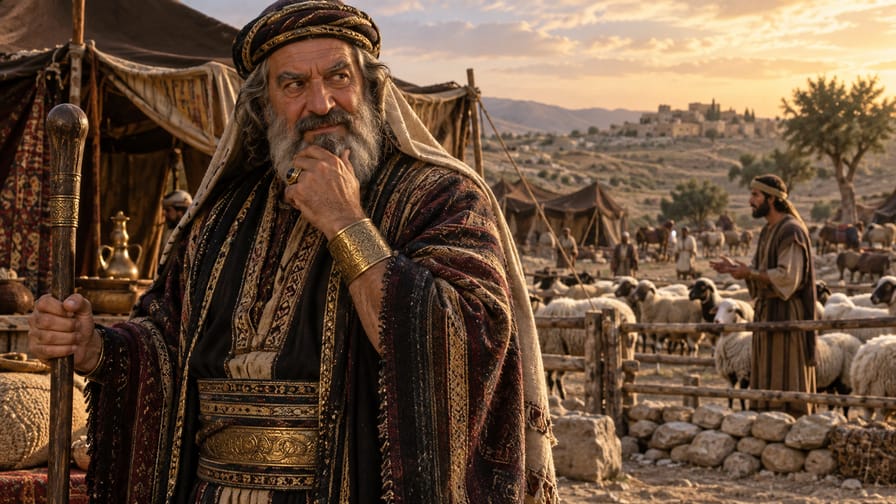
The figure of Laban (Hebrew: לָבָן, Laban Aramaic: לָבָן, Laban) is a central character in the book of Genesis, playing a crucial role in the life of Jacob and, by extension, in the formation of the twelve tribes of Israel. His story is intrinsically linked to the patriarchal narrative, revealing aspects of divine providence and the complexity of human relationships.
The analysis of Laban from a conservative evangelical Protestant perspective emphasizes God's sovereignty in using even the actions of flawed individuals to fulfill His redemptive purposes. His narrative offers lessons on human character, God's faithfulness, and the challenges of faith.
1. Etymology and meaning of the name
The name Laban (לָבָן, Laban) is of Hebrew and Aramaic origin, literally meaning "white". It is derived from the Semitic root L-B-N, which denotes the color white or something that is purified or whitened. This root is common in several Semitic languages.
Although the literal meaning is "white", the name does not seem to have a direct or consistent symbolic connotation with Laban's character in the biblical narrative. Instead of purity or innocence, Laban's story reveals a character marked by cunning and deception.
There are no other prominent biblical characters with the same name who play a significant role. Laban's uniqueness in the biblical canon directly associates him with the lineage of Aram and the story of Jacob, solidifying his identity.
The theological significance of the name, though not directly linked to his character, can be seen ironically. The "white" can contrast with his "dark" actions of manipulation and deceit, underscoring human fallibility and the inability to achieve moral purity by oneself.
In a broader sense, the dissonance between Laban's name and character serves as a reminder that appearances can be deceiving. Biblical revelation, however, penetrates beyond the surface, exposing the true nature of the human heart and the need for divine grace.
2. Historical context and biblical narrative
2.1. Period and geography
Laban lived during the Patriarchal Period, approximately between 2000 and 1500 BC, a time characterized by tribal and nomadic or semi-nomadic societies. His story unfolds primarily in Haran (Haran), a city in Mesopotamia, located in the region known as Paddan-Aram (Paddan-Aram) or Aram-Naharaim (Aram-Naharaim), which means "Aram of the two rivers".
This region was an important cultural and commercial center, where Aramaic culture was flourishing. The social and legal practices of the time, such as marriage by contract and the importance of family lineage, are evident in Laban's interactions with the biblical characters.
Jacob's journey from Beersheba to Haran (Genesis 28:10) and his return to Canaan (Genesis 31:17-18) delineate the central geography of Laban's story. The final encounter between Laban and Jacob occurs in Gilead, marking the border between their spheres of influence.
2.2. Genealogy and family origin
Laban was the son of Bethuel (Bethuel), grandson of Nahor (Nahor), Abraham's brother, and, therefore, Abraham's great-nephew (Genesis 22:20-23). He was the brother of Rebekah (Rebekah), who became the wife of Isaac (Isaac), Abraham's son (Genesis 24:29).
This family connection is crucial, as it establishes Laban as a close relative of the covenant lineage, although he was not an exclusive worshiper of the God of Abraham. His family, though linked to the patriarchs, maintained idolatrous practices, as evidenced by the teraphim (household idols) in his home (Genesis 31:19).
Laban's house in Haran served as a refuge for Jacob, who was fleeing the wrath of his brother Esau (Esau) (Genesis 27:43). This initial hospitality, however, would quickly transform into a relationship of exploitation and conflict.
2.3. Main events of life
Laban's first appearance occurs in Genesis 24, when Abraham's servant arrives in Haran to find a wife for Isaac. Laban, along with his father Bethuel, receives the servant and approves the marriage of his sister Rebekah to Isaac, demonstrating shrewdness and interest in the gifts offered (Genesis 24:29-31).
Years later, Laban becomes the host of Jacob, who seeks refuge and a wife among his daughters (Genesis 29:1-14). The narrative details the twenty years Jacob spends under Laban's dominion, a period marked by hard work and continuous deception.
Laban deceives Jacob, giving him Leah (Leah) instead of Rachel (Rachel) after seven years of work, justifying himself with the local custom of marrying the elder daughter first (Genesis 29:21-26). Jacob is forced to work another seven years for Rachel.
Subsequently, Laban continues to manipulate Jacob's wages, changing them ten times (Genesis 31:7, 41). God, however, repeatedly intervenes, blessing Jacob despite Laban's oppression, ensuring his prosperity.
The story culminates with Jacob's secret flight with his wives, children, and possessions, and Laban's subsequent pursuit. The final confrontation in Gilead results in a non-aggression pact, sealed by a heap of stones, the Galeed (Galeed) or Mizpah (Mizpah) (Genesis 31:22-55).
3. Character and role in the biblical narrative
3.1. Analysis of character and moral failings
Laban's character is predominantly negative, painted in the Scriptures as shrewd, manipulative, and selfish. He exhibits a notable lack of integrity, prioritizing his own material gain above justice or truth. His initial hospitality towards Jacob quickly transforms into exploitation.
Laban's actions reveal deep avarice. He takes advantage of Jacob's vulnerability, who is far from his family and devoid of resources, to extract as much work and wealth as possible. The repeated changing of Jacob's wages is clear proof of his dishonesty (Genesis 31:7).
In addition to greed, Laban proves to be a master of deception. The episode of Leah and Rachel's marriage is the most blatant example of his manipulation (Genesis 29:21-26). He uses local culture as a pretext for his fraud, exploiting Jacob's trust.
His connection with the teraphim (household idols) also points to a syncretic spirituality, distant from the monotheistic faith of Abraham and Jacob. Laban's possession of these idols suggests a reliance on pagan practices for protection and prosperity, contrasting with Jacob's trust in the living God (Genesis 31:19, 30).
Although Laban demonstrates some affection for his daughters and grandchildren when saying goodbye (Genesis 31:28), this affection seems subordinate to his selfish interests. He is concerned with his possessions and his reputation, and his final "blessings" have an ambiguous tone, mixing family concern with self-preservation.
3.2. Role in the biblical narrative
Laban plays the role of a human antagonist in Jacob's story, functioning as an obstacle and a catalyst for the patriarch's development. He is the instrument through which Jacob is tested, matured, and shaped by God.
His oppression forces Jacob to rely more intensely on divine providence. The difficulties imposed by Laban forge Jacob's character, teaching him patience, resilience, and the need to seek God amidst adversity (Genesis 31:42).
Paradoxically, Laban's actions are used by God to fulfill His promises to Jacob. The multiplication of Jacob's flock, despite Laban's fraud, is a testament to divine intervention on behalf of His servant (Genesis 30:25-43).
Furthermore, Laban is fundamental to the establishment of Jacob's family. Through Leah and Rachel, and their servants Zilpah (Zilpah) and Bilhah (Bilhah), the children are born who will become the twelve tribes of Israel. In this way, Laban, though unintentionally, contributes to the realization of the Abrahamic covenant.
The episode of Laban also serves to illustrate the complexity of family relationships and the tension between Aramaic culture and the growing patriarchal faith. His house is a microcosm of conflict and providence, where human will and divine plan intertwine.
4. Theological significance and typology
4.1. Role in redemptive history
Laban's story is a testament to God's unwavering sovereignty in redemptive history. Even amidst human manipulation and deception, God orchestrates events to fulfill His promises and advance His plan for the covenant lineage. Laban's oppression did not prevent the divine blessing upon Jacob.
God uses Laban's malevolence to shape Jacob, transforming the "supplanter" into a man more dependent on God and more mature in his faith. The difficulties in Haran were a crucible that refined Jacob's character, preparing him for his role as the father of the twelve tribes of Israel (Genesis 31:42).
Laban's narrative demonstrates God's faithfulness to His covenant with Abraham, Isaac, and Jacob (Genesis 28:13-15). Despite the adverse circumstances and Laban's iniquity, God protected Jacob and multiplied his descendants and possessions, ensuring the continuity of the messianic lineage.
The interaction with Laban also underscores the spiritual struggle that accompanies the life of faith. Jacob, a man of the covenant, is constantly confronted with the worldly and selfish mindset of his relative, a contrast that highlights the distinction between God's people and those who do not truly know Him.
Thus, Laban serves as an example of how God can use challenges and difficult people in our lives to strengthen us in faith and guide us towards His sovereign purposes. His presence in the narrative is essential for the development of salvation history.
4.2. Typology and theological connections
Directly, Laban is not a typological figure of Christ or of some positive redemptive aspect. On the contrary, he can be seen as a type of worldly or carnal opposition that God's people face, an obstacle that God permits and, ultimately, overcomes for the good of His elect.
In a broader sense, God's providence over Jacob, despite Laban's machinations, prefigures Christ's final victory over all evil and all opposition. Just as Jacob escapes and prospers under God's protective hand, the church, the new Israel, is assured of victory in Christ Jesus.
The story of Laban and Jacob also highlights central theological themes such as God's sovereign grace (God blesses Jacob despite his own flaws and Laban's oppression), election (Jacob is the chosen one, not Esau), and the importance of faith and patience.
Although there are no direct mentions of Laban in the New Testament, the principles of dealing with deception, divine providence, and trust in God amidst adversity are recurring themes (cf. Romans 8:28 Hebrews 11:8-10). Jacob's experience with Laban illustrates the truth that "all things work together for good for those who love God."
The presence of the teraphim in Laban's house and Rachel's reaction to stealing them (Genesis 31:19) can be seen as a reminder of the persistence of idolatry and the need for a radical separation from pagan practices, a theme that resonates throughout Scripture and is crucial for evangelical theology.
5. Biblical-theological legacy and canonical references
5.1. Influence on biblical theology
The figure of Laban, although not the main focus of his own narrative, is indispensable for understanding Jacob's development and, consequently, the formation of the people of Israel. His influence is indirect but profound in biblical theology.
Laban's story reinforces the doctrine of divine providence, showing how God uses people and circumstances, even the most adverse and sinful, to fulfill His designs. This is a pillar of Reformed and evangelical theology, which emphasizes God's sovereignty over all creation and history.
He serves as a moral and spiritual counterpoint to Jacob, highlighting the continuous struggle between flesh and spirit, and the need to trust in God's word rather than human cunning. Jacob's life under Laban is a microcosm of the exile and pilgrimage of God's people.
The narrative also contributes to covenant theology, illustrating how God remains faithful to His promises, even when His servants are in foreign lands and under oppression. God's blessing on Jacob in Haran is proof of His faithfulness to the Abrahamic covenant (Genesis 28:15).
Furthermore, the interactions between Laban and Jacob serve as a case study on the complexities of family relationships and work ethics. Laban's exploitation and Jacob's resilience offer lenses for discussing justice, integrity, and God's blessing on honest labor.
5.2. Treatment in interpretive tradition
In Jewish interpretive tradition, Laban is often portrayed negatively, being considered a deceptive Aramean and an oppressor of Jacob. He is seen as an obstacle that God helped Jacob overcome, and his malice is sometimes compared to that of other enemies of Israel.
In Christian theology, especially within the conservative evangelical Protestant stream, Laban is generally understood as an instrument in the hand of God. His story is used to illustrate divine sovereignty, the perseverance of faith, and the way God uses trials to sanctify His children.
Evangelical commentators like John Calvin and Matthew Henry, when addressing Laban's story, emphasize God's providence in protecting Jacob and fulfilling His promises, despite human malice. They view Jacob's experience in Haran as a period of divinely ordained training.
The figure of Laban, therefore, is not celebrated, but his presence in the canon is fundamental. He is a vivid reminder of the reality of human sin and selfishness, but, more importantly, of God's ability to transcend and redeem even the most difficult situations for His glorious purposes.
In summary, Laban is a biblical figure whose legacy lies not in his virtues, but in his role as a divinely permitted catalyst for Jacob's growth and for the advancement of salvation history. His story is a powerful lesson on God's sovereignty and the resilience of faith.