


Isaac
1. Etymology and Meaning of the Name
The figure of Isaac is one of the most prominent in the Pentateuch, occupying a central place in the patriarchal narrative of the Old Testament. His name, in Hebrew, is יִצְחָק (Yitsḥaq), derived from the verbal root צָחַק (tsaḥaq), which means "to laugh", "to smile", or "to play". This root can express both joy and celebration, as well as skepticism and mockery, a dualism that is reflected in the circumstances of his birth.
The literal meaning of the name Isaac is, therefore, "he laughs" or "laughter". This etymology is deeply connected to the events that preceded and accompanied his miraculous birth. When God announced to Abraham that Sarah, already advanced in age, would give birth to a son, Abraham "fell facedown he laughed" (Genesis 17:17), initially doubting the possibility.
Later, Sarah also laughed to herself when she heard the divine promise, thinking, "After I am worn out and my lord is old, will I now have this pleasure?" (Genesis 18:12). Sarah's laughter was an expression of incredulity, but God confronted her, asking, "Is anything too hard for the Lord?" (Genesis 18:14).
When Isaac finally was born, the laughter of incredulity transformed into laughter of joy and testimony. Sarah declared, "God has brought me laughter, and everyone who hears about this will laugh with me" (Genesis 21:6). Thus, the name Isaac encapsulates the powerful truth of God's faithfulness in fulfilling His promises, transforming human skepticism into divine celebration.
The choice of name was not accidental but divinely inspired, serving as a perpetual memorial to God's supernatural intervention. There are no other prominent biblical characters with the same name, which underlines the uniqueness of Isaac and the centrality of his story in the covenant lineage.
The theological significance of the name resides in demonstrating God's sovereignty over nature and time. He is capable of operating beyond human limitations, bringing life where there was barrenness and joy where there was doubt. The name Isaac is a testament to God's ability to "give life to the dead and call into being things that were not" (Romans 4:17), a fundamental truth for evangelical theology.
The laughter of Isaac, ultimately, echoes divine joy and the certainty of the fulfillment of God's promises, even against all human hope. He is the son of promise, born not of natural descent, nor of human decision or a husband’s will, but born of God (John 1:13), a principle that resonates with the doctrine of regeneration.
2. Historical Context and Biblical Narrative
2.1 Family Origin and Genealogy
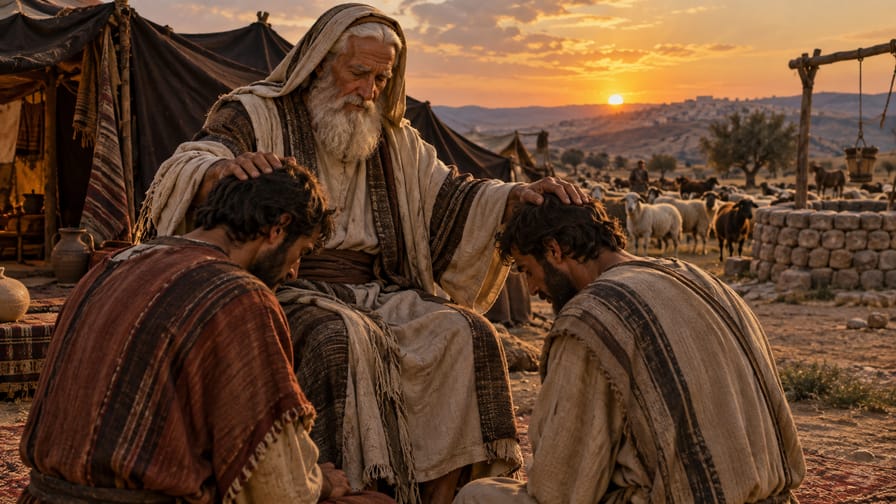
Isaac belongs to the patriarchal era, a period estimated between 2000 and 1800 B.C., characterized by a tribal and nomadic society. He is the son of Abraham and Sarah, the second of the three great patriarchs of Israel, and the direct heir to the Abrahamic covenant (Genesis 17:19). His genealogy is crucial, as he is the bridge between Abraham and Jacob, through whom the nation of Israel and, in the future, the Messiah, would come.
His birth is narrated in Genesis 21, an extraordinary event given the advanced age of his parents (Abraham at 100 years old and Sarah at 90). This miraculous birth not only fulfilled the divine promise but also established Isaac as the legitimate and chosen son of the covenant, distinguishing him from his older half-brother, Ishmael, born of Hagar (Genesis 16).
Isaac's life was lived in the regions of Canaan, especially around Beersheba, Gerar, and Hebron, reflecting the semi-nomadic lifestyle of the patriarchs. He settled in areas that offered resources for his flocks, such as water wells, a vital and often disputed resource in those times (Genesis 26:17-22).
2.2 Major Life Events
Isaac's life is marked by significant events that shaped salvation history. One of the most dramatic and theologically rich episodes is the sacrifice of Isaac, known as the Akedah ("binding") in Hebrew (Genesis 22:1-19). God tested Abraham's faith, commanding him to offer his only son, Isaac, as a sacrifice on Mount Moriah.
Abraham's obedience and Isaac's submission to this divine command are extraordinary acts of faith. The divine intervention, with the provision of a ram as a substitute, reaffirmed God's faithfulness and the promise of numerous descendants. This event is central to understanding Abraham's faith and the typology of Isaac.
After Sarah's death, Abraham sought a wife for Isaac among his relatives in Mesopotamia, preventing him from marrying a Canaanite woman. Abraham's servant, Eliezer, was sent and, guided by God, found Rebekah (Genesis 24), who became Isaac's wife, a marriage marked by divine providence and love.
Rebekah's barrenness for twenty years led Isaac to intercede with God, and she conceived the twins Esau and Jacob (Genesis 25:21-26). The biblical account highlights the struggle of the children in the womb and the divine prophecy about the two nations and the superiority of the younger over the elder, a theme of divine election that runs throughout Scripture.
Later, due to a famine in the land, Isaac moved to Gerar, in the land of the Philistines. There, he repeated his father Abraham's mistake, disguising Rebekah as his sister for fear of being killed because of her beauty (Genesis 26:6-11). This episode reveals a character flaw and the persistence of patterns of familial sin.
In Gerar, Isaac faced the envy of the Philistines for his prosperity and the dispute over water wells, but his peaceful attitude and willingness to yield resulted in a peace treaty with Abimelech, the Philistine king (Genesis 26:12-33). This period demonstrates his resilience and God's continuous blessing on his life.
The climax of Isaac's life as a patriarch occurs in the blessing of his sons. Already old and with failing eyesight, he intended to bless Esau, his firstborn son. However, through a deception orchestrated by Rebekah and Jacob, the latter received the birthright blessing (Genesis 27), an event with profound consequences for the history of Israel.
Isaac lived 180 years and was buried by his sons Esau and Jacob with his parents, Abraham and Sarah, in the cave of Machpelah, in Hebron (Genesis 35:28-29). His life, though less eventful than that of Abraham or Jacob, is fundamental as a link in the chain of divine promise and in the formation of the covenant people.
3. Character and Role in the Biblical Narrative
Isaac's character is often described as more passive and contemplative compared to the dynamic figures of his father, Abraham, and his son, Jacob. However, his life reveals remarkable spiritual qualities, as well as some human weaknesses. He is the patriarch who, for the most part, lived in the shadow of the promises made to his father, being the primary beneficiary and transmitter of these promises.
One of Isaac's most striking virtues is his obedience and submission to the divine will, dramatically exemplified in the Akedah. Although young, he did not resist his father when Abraham led him to the sacrifice (Genesis 22:9). This voluntary submission is a testament to his faith and trust in paternal authority and, ultimately, in God's providence.
Isaac also demonstrates deep spirituality and a life of prayer. The passage where he is found "meditating in the field" at evening, when Rebekah approaches to meet him, is notable (Genesis 24:63). This image suggests a man of reflection, with an inner life oriented towards God. His prayer for Rebekah's barrenness (Genesis 25:21) also underlines his dependence on God.
His peaceful nature is evident in his conduct in Gerar, where, instead of fighting for wells his servants had dug and which the Philistines disputed, he simply moved away and dug another (Genesis 26:17-22). This willingness to yield and avoid conflict led him to have peace with Abimelech, who recognized that Isaac was "blessed by the Lord" (Genesis 26:28-29).
However, the biblical narrative does not hide his flaws. The repetition of Abraham's deception, presenting Rebekah as his sister (Genesis 26:7), reveals a fear and lack of faith in divine protection, a weakness that demonstrates the fallible humanity of the patriarchs, despite their election and blessing.
Another significant flaw of Isaac is his favoritism for Esau, which led him to try to subvert the divine prophecy that the elder would serve the younger (Genesis 25:23). His intention to bless Esau, despite knowing God's will, reveals a weakness in spiritual perception and an attempt to impose his own will over divine designs (Genesis 27:1-4).
Despite his imperfections, Isaac's role in the biblical narrative is of utmost importance. He is not an innovator like Abraham, nor a struggler like Jacob, but a vital link. His primary calling was to inherit, preserve, and transmit the covenant promises. He is the son of promise, the bearer of the chosen seed, and through him the messianic lineage would continue.
His character development is subtle, evolving from a passive young man to a patriarch who, though flawed, continued to live under God's blessing and direction. He is the recipient of the blessings that God had promised to Abraham, and his life is a demonstration of God's faithfulness in keeping His word through the generations.
4. Theological Significance and Typology
The theological significance of Isaac is profound and multifaceted, serving as a crucial piece in the history of redemption and in the progressive revelation of God's plan. He is the son of promise par excellence, and his life prefigures central truths of the Christian faith, especially the work of Christ.
Firstly, Isaac's birth to elderly and barren parents (Genesis 21:1-7) highlights God's sovereignty and power to accomplish the impossible. This event is a reminder that salvation and the lineage of faith do not depend on human ability or strength, but on God's supernatural intervention. He is the "child of promise," a truth that the apostle Paul uses to illustrate the nature of the true descendants of Abraham – not by law or by flesh, but by faith and by promise (Galatians 4:28 Romans 9:7-9).
The Akedah, the event of Isaac's sacrifice on Mount Moriah (Genesis 22), is the high point of his typological significance. In this narrative, Isaac, Abraham's "only son" and beloved, is offered as a sacrifice, prefiguring the sacrifice of Jesus Christ. Both are only sons, beloved by their fathers, subjected to sacrificial death.
Isaac's obedience to the point of death is a type of Christ's obedience (Philippians 2:8). More significantly, the fact that God provided a substitute lamb for Isaac (Genesis 22:13) points directly to the "Lamb of God who takes away the sin of the world" (John 1:29), Jesus Christ, the definitive sacrificial substitute.
The author of Hebrews reinforces this typology by stating that Abraham "reasoned that God could even raise the dead, and, figuratively speaking, he did receive Isaac back from death" (Hebrews 11:19). Isaac's "figurative resurrection" prefigures the literal resurrection of Christ, demonstrating victory over death and the guarantee of divine promises.
The Abrahamic covenant, which God renews with Isaac (Genesis 26:3-4), is central to redemptive history. The promises of land, descendants, and blessing for all nations are transmitted through him. This transmission of the covenant is vital, as it establishes the continuity of the divine plan for the salvation of humanity through a specific lineage, culminating in Christ.
The story of Jacob and Esau, and Jacob's election over Esau, even before they were born (Genesis 25:23), is cited by Paul in Romans 9:10-13 to illustrate the doctrine of God's sovereign election. This episode underscores that God's choice is not based on human merits or works, but on His own will and purpose, a pillar of Reformed theology.
Isaac is, therefore, a symbol of faith and obedience, but also a recipient of grace and divine election. His life teaches about God's faithfulness in fulfilling His promises, His provision in crisis, and His ability to use imperfect individuals for His redemptive purposes. He is an indispensable link in the chain that leads to the incarnation of the Messiah.
5. Biblical-Theological Legacy and Canonical References
Isaac's legacy in biblical theology is immense, even though he is often seen as a more passive figure compared to Abraham and Jacob. His importance lies primarily in being the indispensable link in the transmission of the covenant promises and a significant type of Christ.
Isaac is mentioned in several genealogies of the Old and New Testaments, reaffirming his central position in the messianic lineage. He appears in the genealogy of Jesus in Matthew 1:2 and Luke 3:34, connecting the Messiah directly to the seed promised to Abraham.
The expression "God of Abraham, Isaac, and Jacob" is one of the most common designations for the Lord in the Old Testament (Exodus 3:6, Matthew 22:32). This phrase not only establishes the continuity of the covenant but also the identity of God as the living God who relates personally with His people through the generations. Jesus himself uses it to prove the resurrection of the dead.
In the New Testament, Isaac is consistently celebrated as a model of faith. The author of Hebrews includes him in the "gallery of faith" (Hebrews 11:17-20), highlighting Abraham's faith in offering him and Isaac's faith in blessing his sons. He is an example of faith that submits to God's will, even in the face of the inexplicable.
Paul, in Romans 9 and Galatians 4, uses the figure of Isaac to develop the doctrine of election and spiritual descent. Isaac, the son of promise, contrasts with Ishmael, the son born of the flesh, illustrating that true sonship to Abraham is not merely biological, but spiritual, through faith in Christ.
In the Jewish interpretive tradition, the Akedah of Isaac is a central theme, often seen as the meritorious act that intercedes for Israel and as a model of obedience. In Christian theology, this narrative is predominantly understood as a profound typology of Christ, God's only begotten Son offered for the redemption of humanity.
Reformed and conservative evangelical theology emphasizes God's sovereignty in Isaac's life. From his miraculous birth to the election of Jacob over Esau, God's hand is seen working to fulfill His purposes and promises, regardless of human weaknesses or choices.
Isaac's life, therefore, contributes significantly to understanding the biblical canon by demonstrating God's unwavering faithfulness in keeping His covenants. He is a testimony to divine grace that acts through imperfect individuals to carry forward the history of salvation, pointing to the definitive fulfillment in Jesus Christ.
His story highlights crucial theological themes such as obedience by faith, divine provision, sovereign election, and Christocentric typology. Isaac is not just a historical character, but a vehicle of God's revelation, whose life continues to teach and inspire faith in the God who laughs and fulfills His promises.