


Rebekah
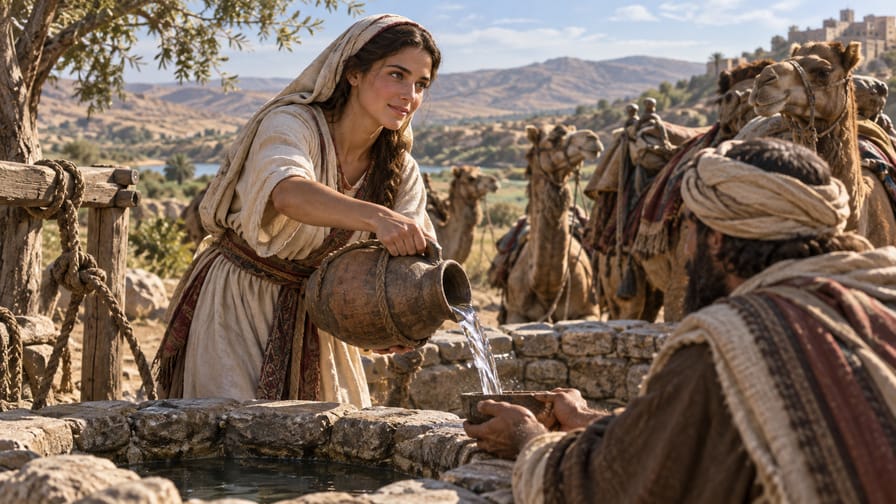
The figure of **Rebekah** (Hebrew: רִבְקָה, _Rivqah_) emerges in the Old Testament as one of the founding matriarchs of Israel, wife of Isaac and mother of Jacob and Esau. Her story, narrated primarily in the book of Genesis, is rich in details that reveal crucial aspects of divine providence, patriarchal faith, and the complexities of human nature. From an evangelical Protestant perspective, the analysis of **Rebekah** offers insights into the sovereignty of God, divine election, and the continuity of the Abrahamic covenant, fundamental elements for understanding the history of redemption that culminates in Christ.
Her life is intrinsically linked to the formation of the people of Israel and to the messianic lineage, making her a character of profound theological relevance. The biblical narrative presents her as a woman of multifaceted character, whose actions, both virtuous and flawed, were instrumentalized by divine will to fulfill eternal purposes. This in-depth study will explore the meaning of her name, her historical context, her character, her theological importance, and her legacy within the biblical canon.
1. Etymology and meaning of the name
The name **Rebekah**, in Hebrew _Rivqah_ (רִבְקָה), is of uncertain origin, but several etymological proposals have been presented by scholars of Semitic languages. The most commonly suggested root is one that means "to tie," "to bind," or "to fasten." This derivation could imply the idea of "she who ties" or "she who binds," possibly referring to her captivating beauty or her ability to unite.
Another interpretation relates the name to the Hebrew word for "rope" or "noose," perhaps indicating an ornament or a means of connection. Some suggest a connection with a root meaning "to fatten" or "to satisfy," which could imply "well-fed" or "fertile," reflecting prosperity or fertility, although this is less accepted. The theologian and Hebraist John Calvin, in his commentaries, does not delve into the etymology but focuses on the character's role in the narrative.
The symbolic meaning of the name, if linked to the idea of "tying" or "binding," can be viewed in several ways within the biblical context. It may allude to her function of "binding" or "uniting" Abraham's lineage through her marriage to Isaac, ensuring the continuity of the divine promise. It could also suggest her role in "tying" Isaac to her, or even "binding" Jacob to his prophetic destiny, albeit through questionable means.
There are no other prominent biblical characters named **Rebekah**, making her unique in her significance within the canon. The uniqueness of her name, combined with her prominence as a matriarch, reinforces her importance in the narrative of Israel's formation. Her name, therefore, may symbolically prefigure her central role in the consolidation of divine covenants.
The theological significance of the name, though not explicitly stated in Scripture, can be inferred from her life. If "to tie" or "to unite" is the primary meaning, **Rebekah's** name resonates with the theme of God's faithfulness in "binding" His promises to a specific lineage, even through flawed individuals. She is the essential "link" between Isaac and the next generation of the promise.
2. Historical context and biblical narrative
2.1 Family origin and genealogy
**Rebekah** emerges in the biblical scene during the patriarchal period, which spans approximately 2000-1800 B.C. This was a time of semi-nomadic societies, where family clans played a central role in the social, political, and religious structure. Lineage and family purity were of utmost importance for the preservation of identities and, in Abraham's case, for the continuity of the divine covenant.
She was the daughter of Bethuel, the Aramean, and granddaughter of Nahor, Abraham's brother (_Genesis 22:20-23_). Her family resided in Paddan Aram, a region in Mesopotamia, which was Abraham's ancestral land. This family connection was crucial, as Abraham desired Isaac to marry someone from his own kin, avoiding the daughters of the Canaanites who inhabited the promised land (_Genesis 24:3-4_).
2.2 Main events of her life
The life of **Rebekah** is detailed primarily in the book of Genesis. Her first appearance is in chapter 24, where Abraham's servant, Eliezer, is sent to find a wife for Isaac. The narrative describes divine providence guiding Eliezer to her at the well, where she demonstrates remarkable hospitality, offering water to him and his camels (_Genesis 24:15-20_). This act of kindness is interpreted by Eliezer as a sign from the Lord.
After the marriage proposal, **Rebekah** demonstrates courage and decision by readily agreeing to depart for an unknown land, responding "I will go" (_Genesis 24:58_). She travels with Eliezer and marries Isaac, who finds comfort in her after the death of his mother Sarah (_Genesis 24:62-67_). This marriage marks a crucial point in the continuity of the promised lineage.
For many years, **Rebekah** was barren, a common condition among biblical matriarchs, which underscores divine intervention in the procreation of the covenant lineage. Isaac prayed fervently to the Lord, and **Rebekah** conceived twins (_Genesis 25:21_). During her pregnancy, she felt a struggle within herself and consulted the Lord, who revealed to her that two nations were in her womb and that the older would serve the younger (_Genesis 25:22-23_).
The twins were born: Esau, the firstborn and hunter, and Jacob, the second, who was more attached to the tent. **Rebekah** developed a preference for Jacob, while Isaac loved Esau (_Genesis 25:28_). This family dynamic of favoritism would be the seed of future conflicts and a series of events that would test the faith and morality of those involved.
The most controversial point of her story is her active participation in the plot for Jacob to receive the blessing of primogeniture from Isaac, deceiving his blind father (_Genesis 27:1-29_). She instructed Jacob to disguise himself as Esau, prepared Isaac's favorite food, and dressed him in Esau's clothes. Although the divine purpose had already declared that the older would serve the younger, **Rebekah** opted for human and deceptive means to "help" God fulfill His promise.
The consequences of her actions were severe: Esau swore to kill Jacob, and **Rebekah** had to send her favorite son to Paddan Aram to escape her brother's wrath, losing Jacob's companionship for many years and possibly never seeing him again (_Genesis 27:42-45_). She passed away at some point, being buried in the cave of Machpelah, along with Abraham, Sarah, Isaac, and Leah (_Genesis 49:31_).
3. Character and role in the biblical narrative
**Rebekah's** character is a complex tapestry of virtues and flaws, revealing a strong and determined woman, yet also prone to manipulation. Her initial qualities, such as the hospitality shown to Eliezer (_Genesis 24:18-20_), which was an important cultural and religious value, and her readiness to leave her home to marry Isaac (_Genesis 24:58_), suggest remarkable faith and courage. She did not hesitate to embrace the divine call, even if it meant an uncertain future.
However, the narrative also exposes her weaknesses. Her preference for Jacob over Esau (_Genesis 25:28_) is a clear flaw, which disrupted family harmony and contradicted the principle of egalitarian love. This partiality, though perhaps motivated by divine prophecy (_Genesis 25:23_), led her to act in a questionable manner. The commentator Matthew Henry observes that family favoritism often sows discord.
**Rebekah's** most significant flaw lies in her deception and manipulation to ensure that Jacob received Isaac's blessing (_Genesis 27_). She did not fully trust in God's sovereignty to fulfill His own word, but felt the need to intervene through dishonest means. This action, though aligned with the ultimate divine purpose of blessing Jacob, was morally reprehensible and generated painful consequences for her family.
**Rebekah's** role in the biblical narrative is that of a foundational matriarch, co-heiress of the Abrahamic promise and mother of the patriarchs of Israel. She is the bridge between the generation of Abraham and Isaac and the generation that would give rise to the twelve tribes. Her calling was to bear and nurture the elect lineage, ensuring the continuity of the covenant. She was instrumental in the formation of Israel's identity as the chosen people.
Her actions, both virtuous and flawed, contributed to the development of the covenant narrative. The decision to send Jacob to Laban, though motivated by fear of Esau's vengeance, also served to lead him to his future wife and to the enrichment that would form the basis of his family (_Genesis 27:42-45_). Thus, even through her imperfections, God worked to fulfill His plans. The evangelical theologian John H. Walton highlights how God often operates through flawed people to achieve His purposes.
4. Theological significance and typology
**Rebekah's** theological significance is vast and multifaceted, with implications for redemptive history and progressive revelation. She plays a crucial role in the continuity of the Abrahamic covenant, being the woman chosen by God to bear the next generation of the promise. Her story illustrates divine providence in action, guiding Eliezer to find her and ensuring her marriage to Isaac, despite all odds (_Genesis 24_).
One of the most prominent theological aspects is the demonstration of God's sovereignty in election. The prophecy given to **Rebekah** concerning her sons — "two nations are in your womb... and the older shall serve the younger" (_Genesis 25:23_) — is a clear testimony to divine choice, regardless of human merit or birth order. This prophecy is quoted by Paul in _Romans 9:10-13_ to illustrate the doctrine of unconditional election, where God chooses whom He wills, "not by works but by him who calls".
**Rebekah's** story also raises questions about the relationship between divine sovereignty and human responsibility. Although Jacob's blessing was God's purpose, the means by which **Rebekah** and Jacob sought it were deceptive and morally questionable. This underscores the truth that the ends do not justify the means, and that God, though sovereign, does not approve of sin, even when He uses it to accomplish His plans.
In terms of Christocentric typology, **Rebekah** is not a direct typological figure of Christ, but her life and her role in the history of redemption point to the Messiah in indirect but significant ways. Her initial barrenness and the subsequent miraculous conception of twins, one of whom would be the father of the messianic lineage, prefigure other divine interventions in salvation history, such as the births of Samuel, John the Baptist, and, ultimately, Jesus Himself.
The assurance of the lineage through **Rebekah** is essential for the genealogy of Christ. The promise made to Abraham, that through his offspring all the families of the earth would be blessed (_Genesis 12:3_), passes through Isaac and, subsequently, through Jacob, **Rebekah's** favored son. Thus, she is a vital link in the chain leading to the coming of the Savior.
**Rebekah's** faith, though imperfect, is evident in her willingness to follow God's call in _Genesis 24_. Her decision to leave her family and homeland to marry Isaac, a man she had never seen, is an act of trust in divine providence. This initial act of faith places her among the matriarchs who contributed to the legacy of faith of the people of Israel.
**Rebekah's** story also serves as a reminder of God's grace, which operates through flawed people to accomplish His purposes. Despite her partiality and deception, God did not abandon His promise to Jacob, but fulfilled it. This highlights God's faithfulness to His covenant, which does not depend on human perfection, but on His own nature and promises.
5. Biblical-theological legacy and canonical references
**Rebekah's** legacy in biblical theology is deeply rooted in her position as one of the four matriarchs of Israel (Sarah, **Rebekah**, Rachel, and Leah). She is mentioned primarily in the book of Genesis, where her story unfolds in significant detail. Outside of Genesis, direct references to her are few but impactful, especially in the New Testament.
In _Romans 9:10-13_, the apostle Paul explicitly uses the story of **Rebekah** and her sons, Jacob and Esau, to illustrate the doctrine of divine election. He emphasizes that God chose Jacob even before they were born and had done anything good or bad, so that God's purpose according to election might stand. This passage is fundamental for Reformed theology, which emphasizes God's sovereignty in salvation and unconditional election.
Paul's reference to **Rebekah** solidifies her importance not only as a historical figure but as a theological example of God's elective grace. She demonstrates that God's choice is not based on human works or merits, but on His own sovereign will. This is a vital contribution to the understanding of the doctrine of grace in the Old and New Testaments.
Although **Rebekah** did not contribute canonical literature, her narrative is an essential component of Israel's foundational history. Her story influences biblical theology by showing how God's covenant is transmitted through specific generations, despite the weaknesses and sins of the individuals involved. This reinforces God's faithfulness to His promise.
In Jewish interpretive tradition, **Rebekah** is often viewed with a mixture of admiration and criticism. She is praised for her hospitality and intelligence, but is also questioned for her participation in deceiving Isaac. Some midrashim attempt to justify her actions, suggesting that she had superior prophetic knowledge about the true nature of her sons and God's will.
In Christian tradition, especially in Reformed and evangelical theology, **Rebekah** is often studied for her relationship with divine election. Theologians like John Calvin and Jonathan Edwards used her story to illustrate the sovereignty of God and the doctrine of predestination. She serves as a reminder that God fulfills His plans, even through imperfect means, and that His choice is independent of human will or efforts.
**Rebekah's** story is crucial for understanding the biblical canon, as she is an indispensable link in the messianic genealogy. Without her, the lineage leading to Jesus Christ would be interrupted. Her life, with its highs and lows, is a testament to God's faithfulness in preserving and fulfilling His promises, culminating in the coming of the Savior, the promised descendant of Abraham, Isaac, and Jacob.