


Uriel
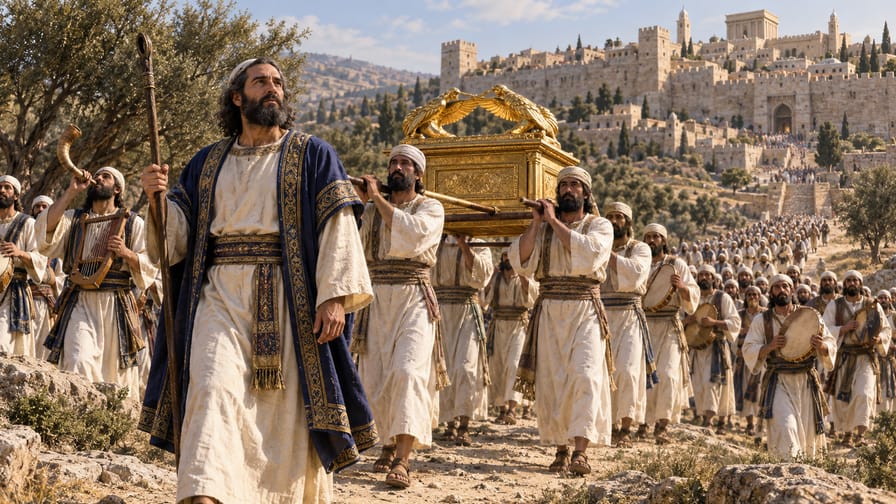
Uriel was a Levite of the clan of Kohath who served as chief of the Kohathites in the days of King David. The Chronicler lists him in the Kohathite genealogy as the son of Tahath (1 Chronicles 6:24) and later names him first among the Levitical leaders whom David summoned to bring the ark of the covenant up to Jerusalem (1 Chronicles 15:5, 11).
Scripture says very little about him. We have no words of his, no description of his personality and no account of his death. What we do have, however, is significant: at one of the great turning points in the history of Israel's worship, when the ark was finally carried to the city of David in the way God had commanded, Uriel stood at the head of 120 of his kinsmen and shared in that holy task.
His appearance is brief, but it belongs to a larger lesson that runs through 1 Chronicles 13 to 16: the presence of God is a gift to be received with joy, and it is also a holy reality to be approached on God's own terms.
1. Etymology and meaning of the name
The Hebrew name Uriel (אוּרִיאֵל, ʾÛrîʾēl) is formed from ʾûr, meaning light or flame, followed by the vowel i, usually understood as the possessive my, and ʾēl, God. The most widely accepted meaning is therefore God is my light, or my light is God. Some scholars prefer flame of God, since ʾûr can also refer to fire, but the sense of light is the more common reading.
The name belongs to a family of Hebrew names built on the same root, such as Uri and Uriah (Yahweh is my light). It expresses a confession found throughout the Old Testament, most famously in the words of David: the LORD is my light and my salvation (Psalm 27:1). Nothing in the text suggests that the name tells us anything about Uriel's personality; it is simply a statement of faith given at his birth.
It should be noted that later Jewish writings outside the Bible, such as 1 Enoch and 2 Esdras, use the name Uriel for an angel. That tradition is extrabiblical, has no place in the protestant canon and has nothing to do with the Levite of Chronicles.
2. Historical context and biblical narrative
2.1 Family origin and genealogy
Uriel descended from Levi through Kohath, the second son of Levi (Genesis 46:11; Exodus 6:16). Kohath's family was prominent: Moses and Aaron came from it through Amram (Exodus 6:18-20). The descendants of Aaron became the priests, while the other Kohathites served as Levites. In the wilderness the Kohathites received a solemn duty: after the priests had covered the most holy objects of the tabernacle, including the ark, the sons of Kohath were to carry them, and they were forbidden to touch the holy things, lest they die (Numbers 4:4-15). Because of this, they carried their load on their shoulders rather than on wagons (Numbers 7:9).
The genealogy in 1 Chronicles 6:22-24 traces one Kohathite line through Amminadab, Korah, Assir, Elkanah, Ebiasaph, Assir and Tahath, and then continues: Uriel his son, Uzziah his son and Shaul his son. The Chronicler does not state in so many words that the Uriel of this list is the same man who led the Kohathites under David, and the genealogies of Chronicles sometimes skip generations. Still, both passages place a Uriel at the head of the same clan in the same book, and the identification is natural and widely accepted.
2.2 Main events
The only event in which Uriel appears is the transfer of the ark to Jerusalem. David's first attempt had ended in tragedy. The ark was placed on a new cart, the oxen stumbled, Uzzah put out his hand to steady it, and God struck him down (1 Chronicles 13:7-10; 2 Samuel 6:3-7). Afraid, David left the ark in the house of Obed-edom for three months, and the LORD blessed that household (1 Chronicles 13:12-14).
When David tried again, he began by recognizing what had gone wrong: no one but the Levites was to carry the ark of God, because the LORD had chosen them for this service (1 Chronicles 15:2). He then gathered the sons of Aaron and the Levites, and the list is headed by the sons of Kohath: Uriel the chief, with 120 of his brothers (1 Chronicles 15:4-5). Five other chiefs followed, each with the men of his house.
David then called the priests Zadok and Abiathar together with six Levitical chiefs, Uriel being the first named, and told them that as heads of the fathers' houses of the Levites they must consecrate themselves and their brothers to bring up the ark. The reason was stated plainly: because they had not carried it the first time, the LORD had broken out against them, for they had not sought him according to the rule (1 Chronicles 15:11-13). The priests and Levites consecrated themselves, and the Levites carried the ark on their shoulders with the poles, as Moses had commanded according to the word of the LORD (1 Chronicles 15:14-15). God helped the Levites who carried it, sacrifices were offered, and the ark came up to Jerusalem with shouting, horns, trumpets and songs (1 Chronicles 15:26-28; 16:1). Uriel is not named again in these verses, but as chief of the Kohathites he was among those who took part.
3. Character and role in the biblical narrative
The text does not describe Uriel's inner life, so it would be a mistake to invent virtues for him. What can be said rests on what he is recorded as doing. He held the office of chief (śar) over a large group of Kohathites, which implies that he was recognized as a leader among his people. He was called by name by the king for a task of great importance, and he belonged to the group that obeyed David's call to consecrate themselves before handling the ark.
His role is also shaped by the story around him. He served at a moment of correction, when Israel's worship was being brought back into line with God's word after a painful failure. Uriel's clan was not inventing a new form of worship; it was returning to the pattern God had given through Moses. In that sense Uriel is a picture of faithful ordinary service: a man whose significance lies not in personal fame but in taking his place in the work God had assigned to his tribe.
4. Theological significance
4.1 Holiness and the manner of worship
The account in which Uriel appears teaches that sincerity alone does not make worship acceptable. David's first attempt was full of enthusiasm, but it ignored what God had said about how the ark was to be carried. The second attempt, in which Uriel took part, was marked by consecration and obedience. God's holiness is not a barrier invented by people; it is part of who he is, and he graciously told his people how they could draw near.
4.2 The presence of God among his people
The ark was the sign of God's presence in the midst of Israel, and bringing it to Jerusalem prepared the way for the temple. The New Testament shows that this presence reaches its fullness in Jesus Christ, the Word who became flesh and dwelt among us (John 1:14). Uriel himself is not presented as a type of Christ, and the text should not be forced to make him one. Yet the story he belongs to points forward: the careful, costly access of the old covenant gives way to the new and living way opened by the blood of Jesus, through which believers may draw near with confidence (Hebrews 10:19-22).
5. Legacy and canonical references
Uriel the Kohathite is mentioned only three times in the Bible. He appears in the genealogy of the Levites as the son of Tahath (1 Chronicles 6:24), as chief of the sons of Kohath with 120 of his brothers (1 Chronicles 15:5), and among the Levitical leaders summoned by David to consecrate themselves and bring up the ark (1 Chronicles 15:11). The parallel account in 2 Samuel 6 does not mention him by name.
He should not be confused with Uriel of Gibeah, whose daughter Micaiah (also called Maacah) was the mother of King Abijah of Judah (2 Chronicles 13:2). Nor should he be linked to the angel called Uriel in extrabiblical literature. His legacy is modest in length but real in substance: his name stands in the sacred record among those who helped bring the ark home in obedience to God's word.
6. Application for today
Uriel reminds us that God notices faithful service that the world easily forgets. Most believers will never be famous, yet the Lord knows their names and records their obedience. Being counted among those who carried out his will is honor enough.
His story also invites us to examine how we approach God. Enthusiasm, creativity and good intentions are gifts, but they are not a substitute for listening to what God has said. Consecration, humility and obedience to Scripture remain the right posture for worship, whether in private devotion or in the life of the church.
Finally, Uriel led others. He did not carry the ark alone; he stood at the head of 120 men. Christian leadership, at home, in the church or at work, means helping others take their place in God's work. And because Christ has opened the way into God's presence, we can come not with fear of being struck down but with gratitude and joy, like the people who brought the ark to Jerusalem with songs.