


Amram
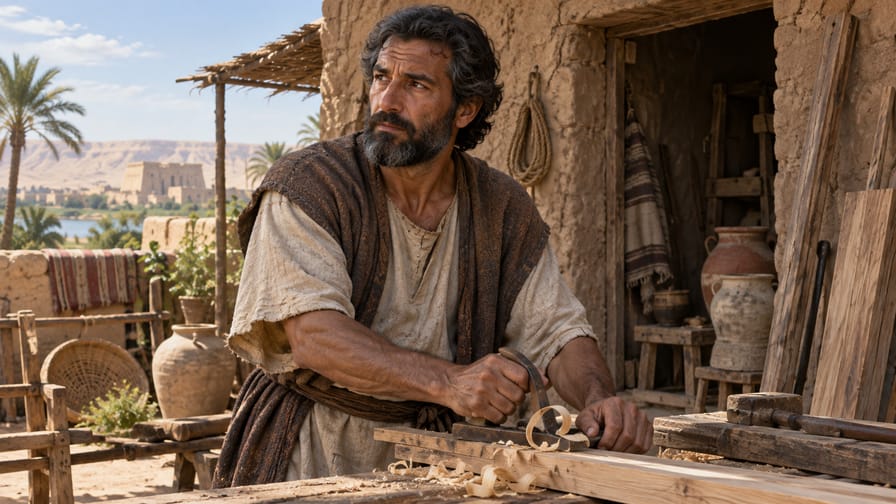
The figure of Amram, whose name in Hebrew is ʿAmram (עַמְרָם), plays a fundamental, though often underestimated, role in the biblical narrative of the Old Testament. He is primarily known as the father of Moses, Aaron, and Miriam, the three pillars of Israel's liberation from Egypt and the founding of the nation under the Mosaic covenant. His relevance lies not so much in his direct actions, but in his crucial genealogical role and the implicit faith that paved the way for the vocation of his children.
This analysis will seek to explore the depth of his significance, addressing his etymology, historical context, character, theological implications, and legacy, from a conservative evangelical Protestant perspective. An understanding of Amram is essential to appreciate divine providence in the preservation of a vital lineage for the history of salvation and the progressive revelation of God.
Despite not being an active protagonist in major narrated events, Amram's existence and faith are crucial for understanding the divine preparation for the Exodus. He represents a vital link in the chain of faith and obedience that would culminate in the liberation of Israel and the establishment of the Law. His life, though briefly described, is a testament to God's faithfulness and the importance of generations in the history of redemption.
An exegetical analysis of his figure allows us to observe how God works through ordinary individuals to accomplish extraordinary purposes. Amram's lineage, belonging to the tribe of Levi, was divinely destined to lead Israel spiritually, legally, and prophetically. The faith of his parents, as highlighted in Hebrews 11, is a reminder of the continuity of faith through generations.
Therefore, delving into the life of Amram is to delve into the roots of Israel's salvation history, understanding the foundations upon which the Sinaitic covenant was built. His story, though concise, offers rich lessons on providence, lineage, and faith in God's redemptive plan.
1. Etymology and meaning of the name
The name Amram derives from the Hebrew ʿAmram (עַמְרָם), which is a compound name. The first part, ʿam (עַם), means "people" or "nation." The second part, ram (רָם), can be interpreted as "exalted," "elevated," or "high."
Thus, the most common and accepted meaning for Amram is "exalted people" or "the people are exalted." Other interpretations suggest "the Most High is a relative" or "relative of the Exalted," implying a connection with God. This latter interpretation resonates with Jewish tradition, which often associates names including ram with God as the Exalted One.
The etymological root ram (רָם) appears in several other Hebrew words with the meaning of elevation, such as marom (מָרוֹם), which means "height" or "high place," and rum (רוּם), the verb "to raise" or "to exalt." This connotation of elevation is significant in the context of the people of Israel, who would be exalted among the nations as God's chosen people.
There are no significant variations of the name Amram in biblical languages, being consistently transliterated from the Hebrew ʿAmram. In some Greek versions of the Septuagint, it may appear as Amram (Αμραμ), maintaining the original sound.
There are no other prominent biblical figures with the name Amram. Although it is possible to find names with similar roots or phonetic components, the figure of Moses' father is the most prominent and the only one to whom the Bible attributes such genealogical relevance.
The theological significance of the name Amram, "exalted people," is profound in the context of the Exodus and the formation of Israel. He was a member of a family that, despite slavery and oppression in Egypt, was destined to be part of God's "exalted people." His children, Moses and Aaron, would be the instruments through whom God would exalt and deliver His people.
The name anticipates God's promise to Abraham that He would make him a great nation, a people who would be exalted and blessed to be a blessing to all the families of the earth (Genesis 12:2-3). Amram, therefore, is not merely a name, but a prophetic declaration about the destiny of his people and the role of his descendants in this divine destiny.
As John D. Barry notes in The Lexham Bible Dictionary, the choice of names in the Old Testament was often laden with meaning and purpose, reflecting the hopes of the parents or the expected destiny for the child. Amram's name, in this sense, aligns perfectly with the narrative of Israel's elevation from a servile condition to a sovereign nation under God's covenant.
2. Historical context and biblical narrative
Amram lived during the period of Israelite oppression in Egypt, a time of great suffering and slavery, approximately between 1500 and 1300 B.C., depending on the chronology of the Exodus adopted. This period is marked by the ascent of a "new king over Egypt, who did not know Joseph" (Exodus 1:8), leading to the intensification of servitude and the order to kill all newborn Hebrew boys.
The political and social context was one of Egyptian domination, with the Hebrews being used as slave labor for large construction projects, such as the store cities of Pithom and Raamses (Exodus 1:11). Religiously, the Israelites were immersed in a polytheistic environment, although monotheistic faith in Yahweh was maintained by some families, such as Amram's.
2.1 Family origin and genealogy
Amram belonged to the tribe of Levi, son of Kohath and grandson of Levi (Exodus 6:18). His genealogy is crucial, as the tribe of Levi was chosen by God for priestly service. He was the father of Moses, Aaron, and Miriam, and his wife was Jochebed, whom the Bible identifies as a "daughter of Levi" (Exodus 6:20) and Amram's "aunt" in the literal translation (Numbers 26:59).
The relationship of Amram with Jochebed, his aunt (father's sister) or first cousin, has been a subject of discussion. Although the later Mosaic Law prohibited marriage between uncles and nieces (Leviticus 18:12-13), this marriage occurred before the promulgation of the Torah at Sinai. This suggests that such unions were acceptable or tolerated at the time, or that the term "daughter of Levi" could be interpreted more broadly, meaning she was a descendant of the tribe of Levi, not necessarily a direct daughter of Levi.
The main events of Amram's life are briefly mentioned in genealogical passages. He lived 137 years (Exodus 6:20), which was considerable longevity for the post-diluvian era, yet still less than that of the earlier patriarchs. His life was spent in slavery in Egypt, witnessing the suffering of his people and the genocidal orders of Pharaoh.
The key biblical passages where Amram appears are:
- Exodus 6:18-20: Details his genealogy, his marriage to Jochebed, and their children.
- Numbers 3:19: Reaffirms his position as the father of Aaron, Moses, and Miriam.
- Numbers 26:58-59: Mentions his lineage and that of Jochebed, confirming the union and the offspring.
- 1 Chronicles 6:2-3 and 1 Chronicles 23:13: Present his genealogy in the priestly lineage.
- Hebrews 11:23: Although it does not explicitly name Amram, he is one of Moses' "parents" whose faith is praised for hiding the infant.
The geography related to Amram is Egypt, specifically the region of Goshen, where the Israelites dwelt. This area, fertile and strategic, was the birthplace of Levi's family and the setting for the childhood and youth of his children.
His relationships with other biblical figures are of utmost importance: he is the father of Moses, the deliverer and lawgiver Aaron, the high priest and Miriam, the prophetess. His offspring are central to the Exodus narrative and the formation of the nation of Israel. He is also connected to the patriarchal lineage through Levi, his grandfather, and the priestly lineage through Kohath, his father.
3. Character and role in the biblical narrative
Amram's character is not extensively detailed in the Scriptures, which tend to focus more on the actions and words of his children. However, what we can infer from biblical references reveals a man of faith and obedience, essential characteristics for the preservation of the lineage chosen by God.
The main evidence of his character lies in the faith he and Jochebed demonstrated by hiding Moses for three months, defying the pharaoh's order to kill the Hebrew boys (Exodus 2:2). Although Exodus does not name the parents in this verse, Hebrews 11:23 attributes this act of faith to Moses' "parents," implying Amram and Jochebed. This faith was a remarkable spiritual virtue, as it put their lives at risk out of obedience to God and love for their child.
The decision to hide Moses was not an impulsive act, but a demonstration of trust in divine providence, even in the face of a tyrannical decree. This faith is a testament to the conviction that God had a purpose for that child, a conviction that permeated Levi's family.
There are no sins, weaknesses, or moral failures specifically documented for Amram in the Bible. His description is that of a faithful link in the genealogy, fulfilling his role as father and husband within the divine plan. The absence of negative narratives about him reinforces the image of an upright man, or at least one who did not commit failures that would compromise his role in salvation history.
Amram's vocation and function can be understood as that of a family patriarch within the tribe of Levi. His primary role was to father and raise the future leaders of Israel. He was not a prophet, priest, or king, but a father who transmitted the faith of his ancestors and prepared the ground for the ministry of his children.
He played a crucial role in preserving the Levitical lineage, which would later be designated for the priesthood. Through his son Aaron, Amram is the direct ancestor of the entire priestly line of Israel, which grants him an indirect but fundamental priestly importance.
Amram's significant actions and key decisions, though not narrated in detail, include his marriage to Jochebed, which ensured the purity of the Levitical lineage, and the upbringing of his children in an environment of faith, despite Egyptian oppression. His life, marked by discretion, was an example of faithfulness in adverse circumstances.
The development of Amram's character throughout the narrative is not explicit, as he is not a character with his own narrative arc. His importance is static, but fundamental: he is the father. His "story" is told through his children, whose lives are the direct result of his existence and his implicit faith.
The absence of more details about Amram serves to highlight God's sovereignty, who can use individuals in seemingly secondary roles to fulfill His great purposes. The lineage is more important than Amram's individual actions, as it points to God's faithfulness in keeping His promises from generation to generation.
4. Theological significance and typology
The theological significance of Amram resides primarily in his role in redemptive history and the progressive revelation of God. He is a vital link in the genealogical chain that leads to the formation of the nation of Israel, the institution of the Levitical priesthood, and ultimately, the preparation for the coming of the Messiah.
His lineage, the tribe of Levi, was chosen for the service of the Tabernacle and, later, the Temple. Through his son Aaron, Amram is the ancestor of the high priesthood, a central institution for Israel's worship and atonement. This priesthood, with its rituals and sacrifices, prefigured the perfect and eternal priesthood of Jesus Christ (Hebrews 7:11-28).
The faith of Amram and Jochebed in hiding Moses (Hebrews 11:23) is an example of faith in a God who intervenes in history. This faith is part of the "cloud of witnesses" that points to the need to trust God, even when circumstances are desperate. It demonstrates that Israel's salvation began with individual acts of faith within families.
Although Amram is not a direct typological figure of Christ, his family and descendants have strong typological implications. Moses, his son, is a prophet and deliverer who prefigures Christ as the greater Prophet and the definitive Deliverer (Deuteronomy 18:15-19 Acts 3:22-23). Aaron, the high priest, is a type of the heavenly high priest, Jesus, who offers a perfect and eternal sacrifice (Hebrews 9:11-14).
Amram's Levitical lineage is a testament to God's covenant with Levi, a covenant of life and peace for priestly service (Malachi 2:4-5). Although this covenant was imperfect due to the sinful nature of human priests, it pointed to the perfection of the new covenant in Christ, where He Himself is the priest and the sacrifice.
There are no direct citations of Amram in the New Testament, but the mention of Moses' "parents" in Hebrews 11:23 is an indirect reference to his faith. This verse is crucial for understanding the spiritual dimension of Amram and Jochebed, elevating them to the pantheon of faith heroes.
Amram's connection with central theological themes is evident. His story, even if brief, illustrates divine providence, God's faithfulness to His promises (especially to Abraham), the importance of obedience by faith, and the role of families in the history of salvation. The preservation of Moses' life by his parents is a testament to God's grace operating through human faith.
The life of Amram and his family are an example of how God prepares His instruments long before His great acts of redemption. The faith of his parents, which defied Pharaoh's power, demonstrates that obedience to God is superior to obedience to any earthly authority that opposes His will (Acts 5:29).
Thus, the figure of Amram, though without great narrated deeds, is theologically rich. He is a reminder that every link in the genealogy of faith is important for the fulfillment of God's redemptive plan, culminating in Christ. He is a testament to divine sovereignty that chooses and empowers families for His eternal purposes.
5. Biblical-theological legacy and canonical references
Amram's legacy is predominantly biblical-theological, centered on his position as the progenitor of crucial figures in Israel's history. His mentions in other biblical books are primarily genealogical, solidifying his importance as the immediate patriarch of the priestly and prophetic lineage.
He is mentioned in Exodus 6:18-20, Numbers 3:19, and Numbers 26:58-59 as part of the Levitical genealogies, which establish the basis for Aaron's priesthood. In 1 Chronicles 6:2-3 and 1 Chronicles 23:13, his name appears again, reinforcing the legitimacy of the priestly line through Aaron and his descendants.
Amram is not the author of any biblical book, Psalm, or epistle. His literary contribution is indirect, through the lives and ministry of his children, who are central figures in the Torah and other historical and prophetic books of the Old Testament. His existence validates the origin of the Aaronic priesthood, essential for the legal and religious structure of Israel.
His influence on biblical theology is significant, especially in the Old Testament, by ensuring the continuity of the Levitical lineage and, more specifically, the house of Aaron. This lineage was the heart of the sacrificial system and the mediation between God and Israel, a theme that permeates Old Testament theology and is revisited in the New Testament, particularly in Hebrews, to contrast with the priesthood of Christ.
In Jewish interpretive tradition, Amram is revered as the father of Moses and Aaron. The Midrash and the Talmud expand on his piety and Jochebed's, emphasizing their resistance to Pharaoh's orders and their faith. They are seen as examples of parents who, through their faith, protected the future deliverer of Israel and the priestly lineage.
Amram's presence in intertestamental literature is not prominent, but his genealogy serves as a backdrop for understanding the historical continuity of the Jewish people. The importance of the priestly lineage was a relevant theme during the Second Temple period, and Amram was the foundational ancestor of that lineage.
In Reformed and evangelical theology, Amram is seen as an example of God's sovereign providence in the history of redemption. He is a reminder that God uses ordinary people in seemingly discreet roles to fulfill His grand plans. The emphasis falls on the faith of Amram and Jochebed, according to Hebrews 11:23, as a testament to the obedience that pleases God.
This evangelical perspective underlines that Amram's faith was not a faith in his own works, but a trust in the God who works miracles, even amidst oppression. He is part of the great narrative of faith that points to divine intervention and salvation through Christ.
Amram's importance for understanding the biblical canon is undeniable. His existence and lineage are the foundation for the institution of the priesthood, the leadership of Moses, and the prophecy of Miriam. Without Amram, the structure of the Mosaic covenant and the history of the Exodus, as we know them, would be inconceivable.
He is a testament to God's faithfulness in upholding His covenant with Abraham, Isaac, and Jacob, ensuring that the chosen people would be preserved and that the instruments of His will would be raised at the right time. Amram's story, in its conciseness, is a pillar of biblical theology, demonstrating the interconnectedness of generations in the grand narrative of redemption.