


Tahath
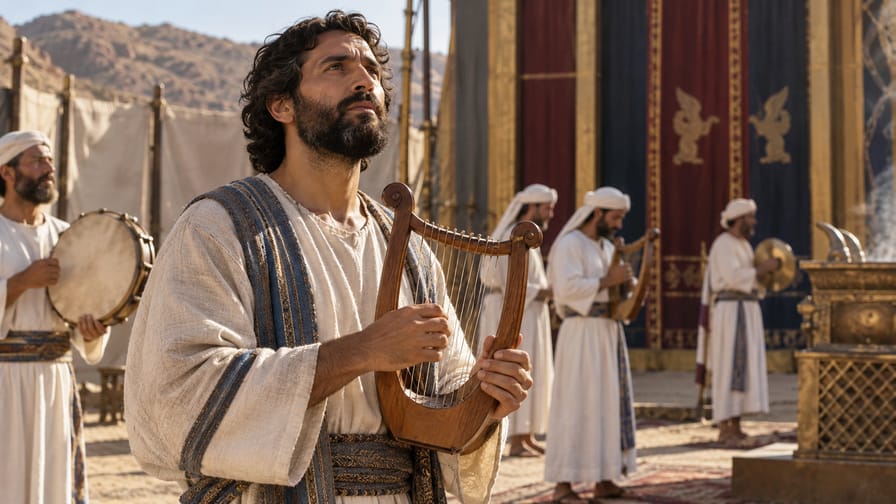
Tahath was a Levite of the clan of Kohath and a descendant of Korah, whose name appears in the genealogies of the Levites in 1 Chronicles (1 Chronicles 6:24, 37). He stands in the line that leads to the prophet Samuel and to Heman, the singer whom David set over the music in the house of the Lord.
The Bible says very little about him. He appears only as a name in two lists, with no recorded words, deeds or dates, and anything beyond that is conjecture. Even so, his place in the genealogy is meaningful, because it links Korah, the rebel of the wilderness, with a prophet who anointed kings and with a family of musicians whose songs are preserved in the Psalms.
This article presents honestly what can be known about Tahath, points out the difficulties the lists raise and shows what his modest place in Scripture can teach us today.
1. Etymology and meaning of the name
The Hebrew name Tachat (תַּחַת) is identical to a very common Hebrew word that means “below”, “under” or “in place of”. How that word came to be used as a personal name, and what sense the parents intended, is not known. Some have suggested meanings such as “lowly” or “substitute”, but these are conjectures, not established meanings.
It would be unwise to build a spiritual lesson on the idea of substitution, as if the name pointed to the sacrifice of Christ. The text makes no such connection, and a sound reading does not attach to a name more than Scripture says about it. The same name was borne by other people and even by a place in the Old Testament, which shows that it was not unusual. That is why the Levite must be distinguished from his namesakes.
2. Historical context and biblical narrative
2.1 Family origin and genealogy
Tahath belonged to the tribe of Levi through Kohath, Levi's second son (Exodus 6:16). The Kohathite clan was the one from which Moses and Aaron came (Exodus 6:18-20), and it also included Korah, son of Izhar (Exodus 6:21), the man who led the rebellion against Moses and Aaron in the wilderness (Numbers 16). The sons of Korah were Assir, Elkanah and Abiasaph (Exodus 6:24).
1 Chronicles gives Tahath's line twice. The first list descends from Kohath through Korah, Assir, Elkanah, Ebiasaph and Assir to Tahath, and continues with his son Uriel, then Uzziah and Shaul (1 Chronicles 6:22-24). The second list goes the other way, from Heman back to Levi, and there Tahath appears as the son of Assir, son of Ebiasaph, son of Korah, and as the father of Zephaniah (1 Chronicles 6:36-37). In the Hebrew text these verses are numbered 6:9 and 6:22.
The two lists agree that his father was Assir and that he descended from Korah through Ebiasaph. They differ in two points. The first list names Amminadab as the son of Kohath where the second has Izhar, and it names Uriel as the son of Tahath where the second has Zephaniah. Interpreters have proposed that Amminadab was another name of Izhar, and that Uriel and Zephaniah were either the same person under two names or two sons, with each list following a different branch. Neither explanation can be proved, and it is best to recognize that the Bible does not resolve the question.
2.2 Main events
No event in Tahath's life is recorded. We do not know where he lived, what he did or when exactly he lived. Counting generations in the lists would place him somewhere between the wilderness period and the time of the judges, but ancient genealogies sometimes skip generations, so any date is only an estimate.
What we do know is the service to which his clan was called. The Kohathites were responsible for the most holy things of the tabernacle: the ark, the table, the lampstand, the altars and the vessels of the sanctuary (Numbers 3:27-31). When the camp set out, they carried these objects on their shoulders, after the priests had covered them, and they were not to touch the holy things lest they die (Numbers 4:1-20). As a Kohathite, Tahath belonged to a family set apart for that reverent service.
His line also carries the memory of Korah's rebellion. Korah and his followers were judged by God (Numbers 16:31-35), but Scripture adds that the sons of Korah did not die (Numbers 26:11). Tahath descends from those survivors. Generations later his line produced Elkanah, the father of Samuel (1 Samuel 1:1, 19-20), and then Joel, the son of Samuel, and Heman, the son of Joel (1 Chronicles 6:33). 1 Samuel describes Elkanah as a man of the hill country of Ephraim, and Chronicles shows that the family was of Levitical descent; this fits the fact that Levites were given towns within the territory of Ephraim (Joshua 21:20-22).
3. Character and role in the biblical narrative
Scripture does not describe Tahath's character. There is no word of praise or blame, no deed, no prayer. A faithful study must say so clearly and resist the temptation to fill the gap with imagination.
His role is that of a link in a chain. In the genealogy of Heman, the Chronicler traces the ancestry of the chief singer of the Kohathites back through many generations to Levi and to Israel himself (1 Chronicles 6:33-38). Each name in that chain, Tahath's included, confirms that the musicians David appointed were legitimate Levites, descended from the family that God had set apart for his service.
4. Theological significance
4.1 Grace after judgment
The line in which Tahath stands is a quiet testimony to God's mercy. Korah's name was tied to one of the gravest rebellions of the wilderness, yet from his descendants came Samuel, the prophet who led Israel in repentance and anointed its first kings, and Heman, who served in worship before the ark. The titles of several psalms are connected with the sons of Korah (Psalms 42; 44-49; 84-85; 87-88). Tahath is one of the generations through which that story of grace passed.
4.2 Worship that passes from generation to generation
The Kohathites began by carrying the holy things through the wilderness. When David brought the ark to Jerusalem, he appointed men from the Levitical families to serve with song before the tabernacle until Solomon built the temple (1 Chronicles 6:31-32). Heman stood at the head of the Kohathite singers, with Asaph at his right hand and Ethan at his left (1 Chronicles 6:33, 39, 44), and his sons also served in the music of the house of God (1 Chronicles 25:1, 4-6). Through names like Tahath, Chronicles shows that worship is handed down from one generation to the next.
4.3 Why the genealogies matter
Chronicles was written for the community that returned from exile, and its lists reminded that people that they were connected to the history of God's promises and to legitimate worship. The Levitical service, faithful as it was, also pointed beyond itself to a better priesthood. The letter to the Hebrews shows that the Levitical priests were many because death prevented them from continuing, but Christ holds his priesthood permanently and always lives to intercede for his people (Hebrews 7:23-25).
5. Legacy and canonical references
Tahath the Levite is mentioned only in 1 Chronicles 6:24, as son of Assir and father of Uriel in the line of Kohath, and in 1 Chronicles 6:37, as son of Assir and father of Zephaniah in the genealogy of Heman the singer (6:9 and 6:22 in the Hebrew numbering). No other passage speaks of him, and this article has sought not to add to what those verses say.
Do not confuse him with the Tahath of the tribe of Ephraim listed among the descendants of Ephraim in 1 Chronicles 7:20, a verse that in fact mentions two men of that name. Nor should he be confused with Tahath, one of the places where Israel camped during the wilderness journey (Numbers 33:26-27).
6. Application for today
Tahath reminds us that most of God's servants are known to him rather than to history. His life left no recorded story, but it was part of a family through which God raised up a prophet and a leader of worship. Faithfulness in ordinary life, in transmitting the faith and in serving in hidden places, is never wasted in God's hands.
His line also brings hope to those who carry a painful family history. Tahath descended from Korah, whose name recalled rebellion, and yet his descendants served in God's presence with songs of praise. No inheritance of sin is stronger than the grace of God, who can turn a story of judgment into a story of worship.
Finally, Tahath invites us to read the Bible with honesty and humility. Where Scripture is silent, we should not invent. Where it presents difficulties, we can say so plainly and still trust the God who speaks through it. The genealogies remind us that God is faithful through the generations, and that in Christ we are part of a people called to worship him.