


Ishmael
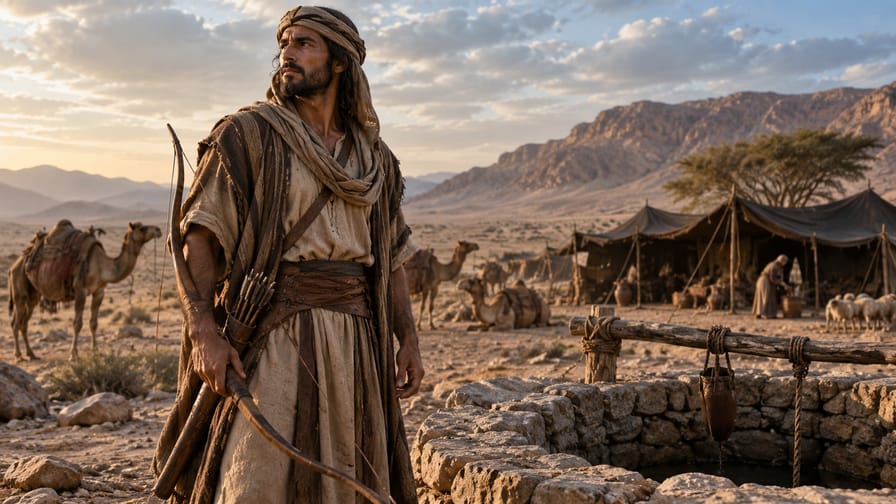
The figure of Ishmael, son of Abraham and Hagar, is one of the most significant and complex in the biblical canon, especially in the Old Testament. His story, though secondary to that of his half-brother Isaac, is crucial for understanding divine sovereignty, the nature of faith, and the consequences of human decisions in redemptive history. From a Protestant evangelical perspective, Ishmael serves as a theological counterpoint, illustrating the distinction between divine promise and human effort, and the ramifications of both in the history of nations and in Christocentric typology.
This study aims to deepen the analysis of Ishmael, exploring his onomastic significance, the historical context of his life, the development of his character, his theological relevance, and his legacy, as revealed in the Scriptures and interpreted by Reformed theology. The narrative of Ishmael is a vivid reminder of God's faithfulness, even toward those not directly in the main covenant lineage, and of how divine plans unfold despite human failings.
1. Etymology and Meaning of the Name
1.1 Original Name and Linguistic Derivation
The name Ishmael derives from the Hebrew Yishma'el (יִשְׁמָעֵאל). It is a theophoric name, common in Semitic culture, which combines the verb "to hear" or "to listen" (shama', שָׁמַע) with the noun "God" ('El, אֵל). The verbal form is in the third person singular, imperfect, meaning "He hears" or "God hears".
The etymological root shama' is profound and recurrent in the Scriptures, denoting not only physical hearing but also attention, understanding, and obedience. In Hebrew, "to hear" often implies "to obey" or "to heed". Thus, the name Ishmael carries the idea of a God who is not indifferent to the cry of His children.
1.2 Literal and Symbolic Meaning of the Name
Literally, Ishmael means "God hears" or "God listens." This meaning is prominently underscored in the biblical narrative of his birth. When Hagar, mother of Ishmael, fled from Sarai, the Angel of the Lord found her and told her: "The Lord has heard your affliction" (Genesis 16:11). The angel instructed Hagar to name her son Ishmael, in recognition of God's hearing of her suffering.
Symbolically, the name Ishmael represents the compassion and providence of God, even in circumstances arising from human disobedience or impatience. He is a testimony that God does not completely abandon those who, through His people, find themselves in need, even if they are not at the center of the promised covenant lineage. The name points to God's responsive and attentive nature.
1.3 Other Biblical Characters with the Same Name
Although Ishmael son of Abraham is the most prominent, the name appears in other biblical passages, indicating its popularity. There is an Ishmael, son of Azel, a descendant of King Saul (1 Chronicles 8:38 9:44). Another Ishmael was one of the military commanders who helped the high priest Jehoiada overthrow Athaliah and restore King Joash (2 Chronicles 23:1).
There is also an Ishmael, son of Nethaniah, who assassinated Gedaliah, the governor of Judah appointed by the Babylonians, after the fall of Jerusalem (2 Kings 25:23-25 Jeremiah 40:7-41:15). The existence of multiple characters with the same name underscores the importance of identifying the context to avoid confusion. However, none of them possess the same theological or historical relevance as Abraham's firstborn.
1.4 Theological Significance of the Name in the Biblical Context
The theological significance of the name Ishmael is multifaceted. Firstly, it highlights God's omniscience and mercy. God not only hears Hagar's cry in the desert but also promises blessings to Ishmael, demonstrating that His grace extends beyond the boundaries of the specific covenant with Abraham and Sarah (Genesis 16:10 21:17-18).
Secondly, the name serves as a reminder of the consequences of unbelief and the human attempt to "help" God fulfill His promises. Ishmael's birth was the result of a human plan (Abraham and Sarai) to obtain an heir, instead of waiting on the divine promise of a son through Sarai. The name "God hears" ironically contrasts with Abraham and Sarai's lack of "hearing" and obedience to God's original promise.
2. Historical Context and Biblical Narrative
2.1 Historical Period and General Context
The story of Ishmael unfolds in the patriarchal period, approximately between 2100 and 1800 B.C., according to traditional biblical chronology. This was a time of semi-nomadic societies in the Fertile Crescent, with family clans expanding and interacting with incipient city-states and regional empires. Life was characterized by dependence on the land, flocks, and divine provision.
The social and religious context was multicultural, with the worship of various deities being common. Abraham, however, was called by God to be the progenitor of a monotheistic nation, set apart from the idolatrous practices of his time. The narrative of Ishmael is embedded in this backdrop of a unique divine calling and the formation of a people for God.
2.2 Genealogy and Family Origin
Ishmael is Abraham's first son. His mother was Hagar, an Egyptian maidservant of Sarai, Abraham's wife. In an act of impatience and unbelief, Sarai suggested to Abraham that he have a child with Hagar, a common practice in Mesopotamia to ensure a legal heir in case of the principal wife's infertility (Genesis 16:1-3). Ishmael was born when Abraham was eighty-six years old (Genesis 16:16), thirteen years before Isaac's birth.
His genealogy is provided in Genesis 25:12-16, where his twelve sons are listed: Nebaioth, Kedar, Adbeel, Mibsam, Mishma, Dumah, Massa, Hadad, Tema, Jetur, Naphish, and Kedemah. These twelve princes formed the Ishmaelite tribes, which settled in a vast region, extending from Havilah to Shur, near Egypt, toward Asshur. This genealogy underscores the fulfillment of God's promise to make Ishmael a great nation.
2.3 Key Life Events and Key Biblical Passages
The life of Ishmael is marked by several significant events:
- Conception and birth: The result of Sarai and Abraham's attempt to help God fulfill His promise, leading to Sarai's mistreatment of Hagar and Hagar's flight. The Angel of the Lord finds Hagar in the wilderness, promises her a son, and names him Ishmael (Genesis 16:4-16).
- Covenant and promise: Before Isaac's birth, God reiterates His covenant with Abraham and promises to bless Ishmael, make him fruitful and multiply him greatly, and that he would be the father of twelve princes and become a great nation. However, God makes it clear that His covenant would be established with Isaac (Genesis 17:18-21).
- The mocking and expulsion: After Isaac's birth, Ishmael, around sixteen years old, is seen "mocking" or "scoffing" at Isaac during a weaning feast. Sarah sees this and demands that Abraham cast out Hagar and Ishmael. God instructs Abraham to heed Sarah's request, reaffirming His promise to make Ishmael a nation (Genesis 21:8-14).
- Provision in the wilderness: Hagar and Ishmael are cast out and wander in the wilderness of Beersheba. When the water runs out and Ishmael is about to die, God hears the boy's cry, opens Hagar's eyes to a well of water, and reaffirms His promise that He would make him a great nation. Ishmael grows up in the wilderness of Paran and becomes an archer (Genesis 21:15-21).
- Death of Abraham: Ishmael and Isaac reunite to bury their father, Abraham, demonstrating a moment of reconciliation or, at minimum, peaceful coexistence after years of separation (Genesis 25:9).
- Death of Ishmael: Ishmael lived one hundred and thirty-seven years and was gathered to his people, indicating a peaceful death (Genesis 25:17-18).
2.4 Geography and Relationships with Other Characters
The life of Ishmael extended across several regions of the Near East. Born in Canaan, in Abraham's tent (likely near Hebron), he was expelled to the wilderness of Beersheba and subsequently settled in the wilderness of Paran (Genesis 21:21), a vast desert region south of Canaan, extending towards Sinai and Arabia. His descendants, the Ishmaelites, dwelled from Havilah to Shur, which is opposite Egypt, in the direction of Asshur (Genesis 25:18), an area encompassing much of the Arabian Peninsula.
His most prominent relationships were with Abraham, his father Hagar, his mother Sarai/Sarah, his stepmother and Isaac, his half-brother. Although there was conflict and separation, God maintained His promise to bless Ishmael and make him the progenitor of a great nation. The Ishmaelites, his descendants, are mentioned elsewhere in the Bible, such as when Joseph's brothers sold him to Ishmaelite merchants (Genesis 37:25-28), demonstrating the formation of a distinct and influential people.
3. Character and Role in the Biblical Narrative
3.1 Character Analysis as Revealed in the Scriptures
Ishmael's character is presented concisely yet impactfully in the Scriptures. Even before his birth, the Angel of the Lord prophesied about him: "He will be a wild donkey of a man his hand will be against everyone and everyone's hand against him, and he will live in hostility toward all his brothers" (Genesis 16:12). This description portrays him as untamable, independent, and prone to conflict. The image of the "wild donkey" (pere' adam, פֶּרֶא אָדָם) evokes a life of untamed freedom, but also of constant tension and hostility.
The biblical narrative does not detail many specific virtues of Ishmael. He is more often seen as a product of his environment and the circumstances of his birth. His action of "mocking" or "scoffing" at Isaac (Genesis 21:9), which led to his expulsion, is a significant moral failing. The Hebrew term tsahaq (צָחַק) can mean to play, to laugh, but also to mock, ridicule, or even to have sexual relations (as in Genesis 39:14, where it is used for Joseph's "playing" with Potiphar's wife). In the context of Galatians 4:29, Paul interprets this action as persecution, indicating a malicious or hostile intent on Ishmael's part against Isaac, the son of the promise.
3.2 Specific Calling and Function
Ishmael's calling, though not one of direct leadership of the covenant people, is to be the progenitor of a great nation. God promised that Ishmael would be the father of twelve princes and that from him He would make a great nation (Genesis 17:20 21:13, 18). His function in the biblical narrative is, therefore, that of a character who, though not the heir of the main promise, receives divine blessings and fulfills a role in the diversity of nations.
He becomes an archer, a man of the wilderness, and his descendants are known for their skill in combat and their nomadic life (Genesis 21:20-21). This function as the progenitor of a distinct nation is central to understanding his place in salvation history and in the divine providence that encompasses all humanity, not just the covenant people.
3.3 Significant Actions and Key Decisions
Ishmael's actions are more reactive than proactive, shaped by his parents' decisions and divine intervention. His "mocking" of Isaac is the most notable action directly attributed to him, triggering the crisis that led to his expulsion. Nevertheless, his survival and growth in the wilderness, with God's help, demonstrate resilience and divine protection.
His mother's decision to find him a wife from the land of Egypt (Genesis 21:21) is also significant, as it establishes his lineage and his future cultural connections outside the sphere of Canaan. The reunion with Isaac to bury Abraham (Genesis 25:9) is a moment of importance, suggesting that, despite past tensions, there was a recognition of common fatherhood and, perhaps, a period of peace or mutual respect.
4. Theological Significance and Typology
4.1 Role in Redemptive History and Progressive Revelation
Ishmael's role in redemptive history is complex and multifaceted. He represents the human attempt to achieve divine promise through carnal means, contrasting with the patience and faith required to await God's miraculous provision. His birth is a reminder of the persistence of unbelief even in faithful hearts like Abraham's, and of the consequences of straying from the divine plan.
Nevertheless, Ishmael also reveals the universal grace of God. Although not the son of the covenant promise, God hears his cry, protects him, and blesses him abundantly, fulfilling His word to make him a great nation (Genesis 21:17-18). This demonstrates that, while salvation is particular and through the line of Isaac/Christ, God's providence and mercy extend to all peoples.
4.2 Prefiguration or Christocentric Typology
In Protestant evangelical theology, the figure of Ishmael is classically interpreted by Paul in Galatians 4:21-31 as a typology that contrasts the "slavery of the law" with the "freedom of grace." Paul uses the allegory of Hagar and Sarah to illustrate the difference between the attempt at justification by works of the law (represented by Hagar and Ishmael, born according to the flesh) and justification by faith in God's promise (represented by Sarah and Isaac, born by the power of the Spirit).
In this interpretation, Ishmael typifies those who seek salvation through their own efforts or the observance of the law, without genuine faith in the promise of Christ. Isaac, in turn, prefigures the children of the promise, born of the Spirit, who receive salvation as a gift of divine grace. The "persecution" of Ishmael against Isaac (Galatians 4:29) is seen as a parallel to the persecution that believers in Christ (children of the promise) face from those who rely on their own works.
4.3 Related Covenants, Promises, and Prophecies
God made specific promises to Abraham concerning Ishmael. In Genesis 17:20, God says: "As for Ishmael, I have blessed him I will make him fruitful and will multiply him greatly. He will be the father of twelve princes, and I will make him into a great nation." This promise is reiterated in Genesis 21:13 and 21:18. It is crucial to note that these are promises of physical blessing and nation-building, distinct from the promise of the messianic covenant which would be established through Isaac (Genesis 17:19, 21).
The prophecy about Ishmael as a "wild donkey" (Genesis 16:12) is also significant, describing his nature and the relationship of his descendants with other peoples. This prophecy has historically been associated with the independent and often bellicose nature of the Arab peoples, traditionally seen as descendants of Ishmael.
4.4 Connection to Central Theological Themes
The story of Ishmael connects to various central theological themes. It illustrates the sovereignty of God, who can use and bless even the ramifications of flawed human plans. It demonstrates God's faithfulness to His promises, both those of the covenant and those of general blessing. It is a testimony to the contrast between the flesh and the Spirit, a central theme in Pauline soteriology.
The narrative also addresses God's grace, which extends to Hagar and Ishmael in their helplessness, and the importance of patience and faith in awaiting the fulfillment of divine promises. The expulsion of Ishmael and Hagar, though painful, is seen as necessary for the purity of the promise's lineage and to prevent confusion between the son of the flesh and the son of the promise.
5. Biblical-Theological Legacy and Canonical References
5.1 Mentions of the Character in Other Biblical Books
Besides the book of Genesis, Ishmael and his descendants, the Ishmaelites, are mentioned in other parts of the Old Testament. The most notable is the sale of Joseph to Ishmaelite merchants (or Midianites, terms that appear to be used interchangeably in Genesis 37:25-28). This shows that the Ishmaelites became an established people involved in trans-desert trade, fulfilling the prophecy of their multiplication.
The genealogies in 1 Chronicles 1:28-31 list Abraham's sons, distinguishing Isaac and Ishmael, and then enumerate Ishmael's sons, reinforcing his importance as the progenitor of a distinct lineage. Psalm 83:6 mentions "the tents of Edom and the Ishmaelites" among Israel's enemies, indicating a relationship of conflict that echoes the prophecy of Genesis 16:12.
5.2 Influence on Biblical Theology and Interpretive Tradition
Ishmael's influence on biblical theology is profound, primarily through Pauline interpretation in Galatians 4. For Reformed and evangelical theology, the distinction between Ishmael and Isaac is fundamental to understanding the nature of salvation by grace through faith, in contrast to the attempt at justification by works of the law. Ishmael becomes the archetype of religion based on human effort, while Isaac is the type of the believer who receives the promise by faith.
In the Jewish tradition, Ishmael is seen as the ancestor of the Arab peoples, and his rivalry with Isaac is often interpreted as the origin of the historical tension between Jews and Arabs. Although Christian theology does not endorse a simplistic interpretation that all Arabs are exclusive descendants of Ishmael, the genealogical connection and the prophesied tension are acknowledged.
5.3 Treatment of the Character in Reformed and Evangelical Theology
Reformed and evangelical theology emphasizes the story of Ishmael as an illustration of divine sovereignty and the distinction between the covenant of grace and the covenant of works. Commentators such as John Calvin and Matthew Henry, following Paul's exegesis, highlight Ishmael as an example of the consequences of unbelief and the attempt to "help" God.
The expulsion of Ishmael is seen not as an act of divine cruelty, but as a theological necessity to preserve the purity of the messianic promise's lineage. The blessing of Ishmael, on the other hand, is a testimony to God's mercy that extends beyond the specific covenant, demonstrating that God is the Creator and Sustainer of all humanity, even those not directly in the lineage of salvation.
5.4 Importance of the Character for Understanding the Canon
The story of Ishmael is vital for understanding the biblical canon for several reasons. It establishes a fundamental contrast that resonates throughout all of Scripture: the tension between what is born of the flesh and what is born of the Spirit. This dichotomy is central to New Testament theology, especially in the Pauline epistles.
Furthermore, the narrative of Ishmael helps explain the origin and identity of nations neighboring Israel, offering a backdrop for subsequent political and cultural interactions. It solidifies the idea that God is faithful to His promises, even when human means to achieve them are flawed, and that His providence and grace extend in surprising ways, preparing the ground for the full revelation of grace in Christ Jesus.