


Hagar
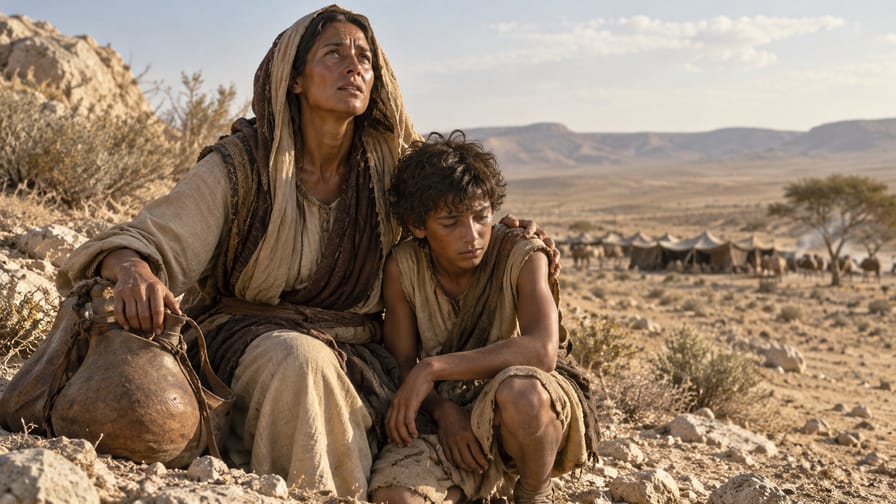
The figure of Hagar emerges in the Hebrew Scriptures as a character of profound theological and historical significance, whose life is intrinsically interwoven with the patriarchal narratives of Genesis. Her story, though secondary to that of Sarah and Abraham, is crucial for understanding divine providence, human intervention in God's promise, and the distinction between the covenants of law and grace, as interpreted by Paul in the New Testament.
From an Egyptian slave to the mother of a nation, Hagar's trajectory is marked by suffering, exclusion, and, paradoxically, by the direct revelation of God. The conservative evangelical Protestant perspective values her narrative not merely as a historical account, but as a framework for lessons on divine sovereignty, the nature of faith, the consequences of unbelief, and God's abundant grace even for those outside the main line of the Abrahamic promise.
This analysis will seek to explore the etymology of her name, the historical context of her life, her character and role in the biblical narrative, her profound theological and typological significance, and her enduring legacy in the Scriptures and in Christian theology, always anchored in biblical authority and careful exegesis.
1. Etymology and meaning of the name
The name Hagar, in Hebrew Hagar (הָגָר), is of uncertain origin, but it is generally accepted to have Egyptian roots, reflecting her nationality. One of the most prominent etymologies connects the name to the Egyptian term hgr, which can mean "to flee" or "fugitive." This meaning powerfully resonates with the central events of her life, in which she is depicted fleeing from Sarah twice.
Another possible derivation, though less consensual, may be from the Hebrew hagar (חָגַר), which means "to gird" or "to tie," perhaps alluding to her condition as a servant or her readiness for service. However, the interpretation of "fugitive" or "foreigner" is the most widely accepted by biblical commentators, given its coherence with her life story.
The literal meaning of "fugitive" or "foreigner" acquires profound symbolism in the narrative. Hagar is a foreigner in Canaan, a servant in a patriarchal home, and, ultimately, a woman who flees into the desert, seeking refuge. Her name prefigures and describes her existential experience and her role in biblical history.
There are no other biblical characters named Hagar. She is unique in her appearance and in the theological significance she acquires, especially in Pauline interpretation. The absence of homonyms highlights her individuality in the sacred narrative.
The theological significance of the name lies in the way it underscores divine providence. Even in her flight and condition as a foreigner, Hagar is seen and cared for by God. Her name, which evokes her marginalization and suffering, also points to God's grace that reaches the disadvantaged, as recorded in Genesis 16:7-13, where the Angel of the Lord finds her.
Hagar's name, therefore, is not merely an identifier, but a prophetic reflection of her journey and of divine attention upon her. It highlights the condition of alienation and God's subsequent intervention, recurring themes in biblical theology of grace and mercy towards the vulnerable.
2. Historical context and biblical narrative
2.1 Family origin and genealogy
Hagar's story is embedded in the patriarchal period, which, according to biblical chronology, extends approximately from 2100 to 1800 B.C. She is introduced in Genesis 16:1 as an Egyptian servant of Sarai, Abram's wife. Her Egyptian origin is significant, as Abram and Sarai had recently returned from Egypt, where Sarai had been taken into Pharaoh's harem (Genesis 12:10-20).
It is probable that Hagar joined Abram and Sarai's entourage as part of the possessions Pharaoh gave them in compensation for Sarai, before the truth about her identity was revealed. Her condition as a servant placed her in a position of vulnerability and dependence within the patriarchal family structure of the time.
2.2 Main events of her life
Hagar's narrative unfolds in two main episodes in the book of Genesis. The first occurs in Genesis 16, where Sarai's barrenness leads her to offer Hagar to Abram as a concubine, a common practice in the ancient Near East to secure heirs, as evidenced in the Nuzi texts.
After conceiving a son by Abram, Hagar began to despise Sarai (Genesis 16:4), who, in turn, severely afflicted Hagar. This tension resulted in Hagar's first flight into the Desert of Shur (Genesis 16:6). There, she has a theophanic encounter with the Angel of the Lord, who commands her to return and promises that her descendants will be numerous and that she will bear a son named Ishmael, "because the Lord has heard your affliction" (Genesis 16:7-12).
In response, Hagar names God *El-Roi* (אֵל רֳאִי), "the God who sees me," and the well where the encounter occurred as Beer-lahai-roi (בְּאֵר לַחַי רֹאִי), "the well of the Living One who sees me" (Genesis 16:13-14). She obeys the divine command and returns, giving birth to Ishmael when Abram was eighty-six years old (Genesis 16:15-16).
The second episode occurs approximately fourteen years later, in Genesis 21, after the birth of Isaac, the son of promise. During Isaac's weaning feast, Sarah sees Ishmael "mocking" (Genesis 21:9). The Hebrew term *mtsaheq* (מְצַחֵק) can mean mocking, playing, or even persecuting, and is the same root as the name Isaac (*Yitsḥaq*, יִצְחָק), "he laughs."
This action by Ishmael provokes Sarah to demand that Abraham expel Hagar and Ishmael (Genesis 21:10). Although Abraham was distressed, God instructed him to obey Sarah, assuring him that Ishmael would also become a great nation because he was Abraham's descendant (Genesis 21:12-13). Thus, Hagar and Ishmael are again sent into the desert, this time to the Desert of Beersheba (Genesis 21:14).
When the water runs out, Hagar, in despair, places Ishmael under a bush and moves away so as not to see her son die. God, once again, hears the boy's cry and opens Hagar's eyes so that she sees a well of water, saving them (Genesis 21:15-19). Ishmael grows up, becomes an archer, and marries an Egyptian woman (Genesis 21:20-21), fulfilling God's promise to Hagar.
The geography of Hagar's story encompasses Canaan, where she served, and the deserts of Shur and Beersheba, which were the settings for her flights and divine encounters. These arid and inhospitable locations underscore her vulnerability and God's miraculous intervention in her life.
3. Character and role in the biblical narrative
Hagar's character is multifaceted and is revealed through her actions and interactions in the biblical narrative. Initially, she is presented as an Egyptian servant, whose condition imposed submission. However, her conception of Ishmael elevates her socially, and she reacts with contempt toward Sarai, her barren mistress (Genesis 16:4).
This attitude reveals a common human weakness: pride derived from a new position or favor. Sarai's response, which afflicts her, and Hagar's subsequent flight, demonstrate her vulnerability and her search for relief from suffering, albeit autonomously.
A crucial aspect of her character is her faith and obedience to the Angel of the Lord in her first flight. Instead of continuing her flight, she obeys the command to return to Sarai, demonstrating submission to the divine will, even if difficult (Genesis 16:9).
Her naming of God as *El-Roi*, "the God who sees me," and the well as Beer-lahai-roi, "the well of the Living One who sees me," is a testament to her personal experience with divine providence and care. She is the only person in the Old Testament who gives a name to God, revealing a profound perception of His presence and attention.
In the second expulsion, in Genesis 21, Hagar's despair is palpable. She weeps bitterly upon seeing her son near death, expressing profound maternal love. Her inability to act and her surrender to human lament underscore her dependence on God in the midst of crisis.
Her role in the biblical narrative is complex. She is an instrument in God's hands, albeit through human impatience, to bear Ishmael, who becomes the father of a great nation. She is not the mother of the son of promise, but the mother of a son who receives secondary promises from God.
Hagar also serves as a dramatic contrast to Sarah, illustrating the consequences of unbelief and the attempt to "help" God fulfill His promises through human means. Her story underscores the difference between flesh and spirit, law and grace, as Paul would later develop.
Hagar's actions, such as her flight, her obedient return, the birth of Ishmael, and her miraculous sustenance in the desert, are crucial for the development of the patriarchal plot. She is a character who, despite her condition as a servant and her marginalization, experiences God's direct grace, becoming a testament to the universality of divine care.
Hagar's development in the narrative transforms her from a passive and submissive figure into a woman who interacts directly with God, receives promises, and names God Himself. Her journey is a powerful example of God's compassion for the oppressed and those on the margins, a truth valued in evangelical theology.
4. Theological significance and typology
Hagar's theological significance is multifaceted, serving as an inflection point in redemptive history and progressive revelation. Her story highlights the tension between divine patience and human impatience, and the consequences of trying to fulfill God's promises through carnal means, rather than trusting in His providence.
The narrative of Hagar and Ishmael is fundamentally a story about the consequences of sin and lack of faith. Sarai's decision to offer Hagar to Abram was an attempt to circumvent barrenness and God's promise of an heir, resulting in conflict and pain for all involved (Genesis 16:2).
Hagar's most profound and impactful theological contribution to Christian theology is found in Paul's typological interpretation in Galatians 4:21-31. Here, Paul uses the story of Hagar and Sarah as an allegory to illustrate the distinction between the old covenant of law and the new covenant of grace.
For Paul, Hagar represents the covenant of Mount Sinai, which bears children for slavery, corresponding to earthly Jerusalem. This Jerusalem, under the law, remains in slavery with its children. Ishmael, Hagar's son, is born "according to the flesh" (Galatians 4:23), symbolizing those who seek righteousness through the works of the law.
In contrast, Sarah represents the heavenly Jerusalem, the mother of all believers, who are born "through the promise" (Galatians 4:23), symbolizing the new covenant of grace and freedom in Christ. Isaac, Sarah's son, is born "by the Spirit" (Galatians 4:29), representing those who receive salvation by faith in Christ, not by works.
This Pauline typology is crucial for evangelical Protestant theology, as it reinforces the doctrine of justification by faith alone (*sola fide*) and the believer's freedom from the slavery of the law. The expulsion of Hagar and Ishmael is interpreted as a theological imperative: "Cast out the slave woman and her son" (Galatians 4:30), meaning that the law cannot coexist with grace as a means of salvation.
Although Hagar is not directly linked to messianic promises in the primary Christocentric sense, her story indirectly points to Christ by highlighting the failure of the law and the need for grace. Divine intervention in her life, even outside the lineage of the promise, demonstrates God's mercy that extends to all, prefiguring the universally available grace in Christ.
The figure of Hagar, therefore, serves as a vivid reminder of God's sovereignty that can use even human errors to fulfill His purposes, and, more significantly, as a powerful allegory for the fundamental truth of the Gospel: the freedom of grace in contrast to the slavery of the law.
5. Biblical-theological legacy and canonical references
Hagar's biblical-theological legacy is profound and enduring, although her explicit presence in the canon is primarily limited to the books of Genesis and Galatians. She is neither the author of biblical books nor a central figure in direct prophecies, but her story serves as a powerful didactic and theological resource.
Beyond the narratives in Genesis 16 and 21, and the allegory in Galatians 4, Hagar is not extensively mentioned in other biblical books. However, the lineage of Ishmael, Hagar's son, is reiterated in Genesis 25:12-18, where the twelve Ishmaelite princes are listed, fulfilling the divine promise that Ishmael would become a great nation.
Her influence on biblical theology is most strongly felt through Pauline interpretation. Paul's allegory in Galatians is one of the most important passages for understanding the relationship between law and grace, the Old and New Testaments, and the nature of true Christian freedom. Hagar, as a symbol of the Sinai covenant, is indispensable for this understanding.
In the Jewish interpretive tradition, Hagar is often viewed with a mixture of sympathy and criticism. Some Midrashim explore her personality and her role in Abraham's life, while others see her as an example of the dangers of mixing the sacred lineage with foreign elements. Her story is also fundamental to the identity of the Arab peoples, who trace their ancestry to Ishmael.
In Reformed and evangelical theology, the treatment of Hagar is predominantly shaped by the exegesis of Galatians 4. She is seen as a type of the covenant of law, which, though divinely instituted, cannot offer the salvation and freedom that come by grace in Christ. Commentators like John Calvin and Martin Luther emphasized the clear distinction Paul makes between the two covenants represented by Hagar and Sarah.
Hagar's story also highlights the doctrine of providence and God's common grace. Even as a foreign slave and the mother of a son outside the lineage of the messianic promise, God sees her, hears her, and provides for her, demonstrating His universal compassion. This teaches that God's care extends to all human beings, regardless of their position in salvation history.
Hagar's importance for understanding the canon lies in her ability to illustrate crucial theological principles: God's sovereignty over human plans, the nature of faith and unbelief, the consequences of sin, and the fundamental distinction between justification by works of the law and justification by grace through faith. Her story is a vivid testimony to God's grace that "sees" and "hears" the afflicted, and to the superiority of the new covenant in Christ.