


Arab
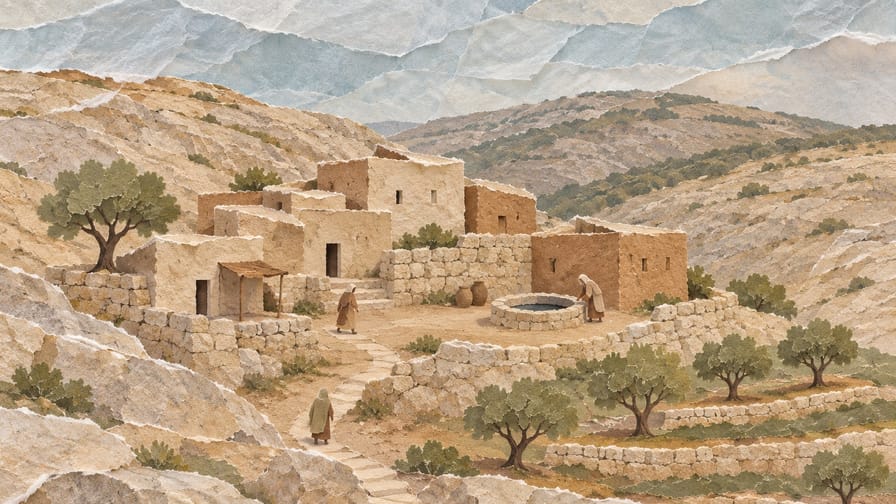
Arab was a small town in the hill country of Judah, named only once in the Bible, in the list of cities given to the tribe of Judah, alongside Dumah and Eshean (Joshua 15:52). It is usually identified with Khirbet er-Rabiyeh, a ruin southwest of Hebron, on the edge where the plateau gives way to drier land.
Nothing else is told about it. Its place in the allotment shows the care with which the land promised to Abraham (Genesis 15:18) was divided, town by town, among the tribes.
1. Etymology and meaning of the name
The Hebrew name of Arab in Joshua 15:52 is אֲרַב, beginning with aleph (א). It must not be confused with the different root ערב, beginning with ayin (ע), associated with words for evening or mixture.
Strong’s concordance connects the place name with ארב, “to lie in wait,” and gives the sense “ambush.” Joshua 15:52 itself does not explain the name or recount an ambush at this town.
The name alone does not establish a western location, desert conditions, a trading role, or an encounter between peoples. The secure biblical information is its inclusion among the towns allotted to Judah.
There are no significant variations of the name Arabe throughout biblical history, as it is mentioned only once. However, the presence of place names in genealogical or geographical lists in the Old Testament is a testament to the precision of biblical records and the importance of each locality in the narrative of Israel's formation. The significance of the name, even if not fully decipherable, points to the intrinsic connection between the name and the identity or characteristic of the place in the cultural and religious context of ancient Israel.
The inclusion of Arabe in the list of Joshua 15:52, alongside Dumah and Eshean, demonstrates the exhaustive nature of the land division records, where every settlement, however small, was duly named and allocated. The etymology, though speculative, reinforces the idea that biblical toponymy often reflects the landscape, function, or history of the place, providing valuable clues for biblical geographers and theologians seeking to understand the setting of divine revelation.
2. Geographical location and physical characteristics
Arabe is specifically listed in Joshua 15:52 as one of the cities belonging to the mountainous region (or plateau) of Judah. This area is characterized by its rugged topography, composed of limestone hills, deep valleys (wadis), and rocky slopes. The "mountain" region (Hebrew: הָהָר, hahár) of Judah extends from Jerusalem in the north to the Negev in the south, and from Bethlehem and Hebron in the east, to the lowlands of the Shephelah in the west.
Arab has been tentatively identified with Khirbet er-Rabiyeh, southwest of Hebron. This is a proposed identification, not a location established by Joshua 15:52 itself. The biblical list places the town in the hill country allotted to Judah.
The climate of the region is semi-arid, with cold, wet winters and hot, dry summers. Precipitation is irregular, making dryland farming challenging and reliance on cisterns and wells for water supply a necessity. Natural resources are limited, consisting mainly of pastures for flocks and terraced olive trees and vineyards. The local economy in antiquity would have been predominantly agro-pastoral, with some production of olive oil and wine.
The proximity of Arabe to other important ancient cities, such as Hebron (one of the oldest cities in Canaan and a vital center of Judah), Debir (a Levitical city, also known as Kiriath-Sepher), and Ziph and Maon (associated with the life of David), places it in a strategic regional context. Although Arabe was not a large city, its location within the network of settlements helped define the boundaries and occupation of the tribe of Judah. Joshua 21:15 lists Debir among the Levitical cities; Hebron is designated as a city of refuge in Joshua 20:7 and 21:13.
Trade routes and access roads in the mountainous region were typically winding paths that followed the valleys and hill ridges. Arabe, being in this area, would have been connected to these secondary paths that linked smaller settlements to larger centers. Archaeological data from the Hebron region and southern Judah reveal the presence of small fortified settlements and rural villages that flourished during the Iron Age, corroborating the existence of communities like Arabe during the period of the Israelite monarchy and post-conquest.
3. History and biblical context
Arab appears in Joshua 15:52 among the towns assigned to Judah in the hill country. The passage places it within the account of the division of the land, but supplies no absolute date for the settlement or its occupation. Assigning its occupation specifically to the thirteenth or twelfth century BC requires evidence beyond this verse.
The political and administrative context of the time was that of a tribal federation under the leadership of Joshua, responsible for implementing the divine will in the distribution of the land. The inclusion of Arabe in this detailed list of cities, which includes Dumah and Eshean, demonstrates the meticulousness with which the inheritance of each tribe was defined. This precision underlines the seriousness and sacredness of the land promise made by God to Abraham (Genesis 12:7, Genesis 15:18) and his descendants.
The strategic, military, or commercial importance of Arabe is not highlighted in the Bible, suggesting that it was likely a small village or rural settlement. Nevertheless, even smaller cities played a vital role in consolidating the Israelite presence in the land and in demarcating tribal boundaries. Each locality, however insignificant it might seem, contributed to the totality of Judah's possession, the tribe from which the Davidic lineage and, ultimately, the Messiah would come.
There are no specific biblical events or biblical characters directly associated with Arabe. Its mention is purely geographical and administrative, serving to complete the record of Judah's inheritance. This does not diminish its relevance, but rather contextualizes it as part of a larger picture of God's faithfulness in fulfilling His promises. The absence of dramatic narratives surrounding Arabe highlights the comprehensive nature of divine providence, which extends even to the most obscure corners of the Promised Land.
The historical development of Arabe, therefore, is implicit in the development of the tribe of Judah. After the conquest, the mountainous region of Judah became the heart of the tribe's territory, which would later become the southern kingdom. Although Arabe is not mentioned in later accounts, its initial existence as part of Judah's inheritance signifies its contribution to the formation of ancient Israel and to the territorial basis of the kingdom of Judah. Its history is the history of a community that silently inhabited the land God had promised.
4. Theological significance and redemptive events
Although Arabe is not the stage for dramatic events or direct revelations in the biblical narrative, its mere inclusion in the list of Joshua 15:52 confers upon it a profound theological significance. Its existence attests to God's faithfulness in fulfilling His covenant promises, specifically the land promise made to Abraham in Genesis 12:7 and reiterated throughout the Pentateuch. The detailed division of the land, including obscure places like Arabe, demonstrates the meticulousness of divine sovereignty.
Arabe's role in redemptive history lies in its contribution to the founding of the theocratic Israel in the Promised Land. The possession of the land was a central element of the Mosaic covenant and a prerequisite for the establishment of God's people as a nation. The inheritance of Judah, to which Arabe belonged, was particularly significant, for from this tribe would come the royal lineage of David (2 Samuel 7:12-16) and, ultimately, the Messiah, Jesus Christ (Matthew 1:1-17).
There are no specific salvific or prophetic events that occurred in Arabe, nor direct connections with the life and ministry of Jesus or apostolic events. Nevertheless, its presence in the list of Judah's inheritance symbolizes the integrity of God's promise and plan. Every city, great or small, contributed to the totality of the land that God had sworn to give to His children. This reinforces the doctrine of divine providence, where God governs over all details, even those that seem insignificant in human eyes.
From a theological standpoint, Arabe can be seen as a reminder of the comprehensiveness of God's grace. Just as God cares for every individual, He also cares for every piece of land He designated for His people. The inclusion of Arabe in the Bible validates the historicity and geography of the conquest narrative, reinforcing confidence in the inerrancy and authority of the Scriptures. The precision of biblical records, even in their most meticulous details, points to the trustworthiness of the Word of God.
While Scripture attaches no direct typological or allegorical symbolism to Arabe, its existence reminds us that God's sovereignty extends to all places and times. The land promised to Israel is a type of the spiritual inheritance that believers receive in Christ – the "land" of spiritual blessings and eternal life (Ephesians 1:3, Colossians 1:12). Thus, Arabe, as part of this physical land, points to the greater reality of the heavenly inheritance guaranteed by the redemptive work of Jesus Christ.
5. Biblical-theological legacy and canonical references
Arabe's biblical-theological legacy is notable precisely for its singular mention and the context in which it appears. The locality is referenced only once in the entire biblical canon, in Joshua 15:52, as part of the list of cities in the mountainous region of the tribe of Judah. This rarity of mention does not make it less important rather, it underscores the specific intention and purpose of this record: to document the exact extent of Judah's inheritance, as determined by God.
The frequency and contexts of biblical references to Arabe are, therefore, limited to a single verse that details the territorial demarcation. This verse is crucial for scholars of biblical geography, as it allows for the reconstruction of tribal boundaries and the identification of ancient settlements. The development of Arabe's role throughout the canon does not expand beyond this initial reference, but its existence serves as a foundation for understanding the territorial basis of the Kingdom of Judah, which would become the birthplace of the Messiah.
There is no evidence that Arabe is mentioned in intertestamental literature or in ancient extra-biblical sources, which is common for localities of lesser prominence. This reinforces the idea that it was a modest-sized settlement, but still an integral part of the divine map. The absence of mentions in later periods suggests that the village may have declined in importance or been abandoned, like many other small communities throughout history.
In the history of the church, Arabe does not receive specific or in-depth treatment due to its sole mention. However, its value lies in its contribution to the overall credibility of the Scriptures. The geographical precision and detail of the city lists in Joshua are often cited by Christian apologists as evidence of the Bible's historicity and the faithfulness of its records, contrasting with mythologies of other ancient cultures that lack such specificity.
Arabe's relevance for understanding biblical geography is undeniable. It helps archaeologists and geographers map ancient Judah, confirming the existence of Israelite settlements in the Iron Age. Arabe represents a microcosm of the land promise, a tangible reminder of God's sovereignty over the territory and the destiny of His people. Its inclusion in the Word of God, even if brief, is a testimony to the comprehensiveness of the divine redemptive plan, encompassing everything from great empires to the smallest villages of the Promised Land.