


Asshur
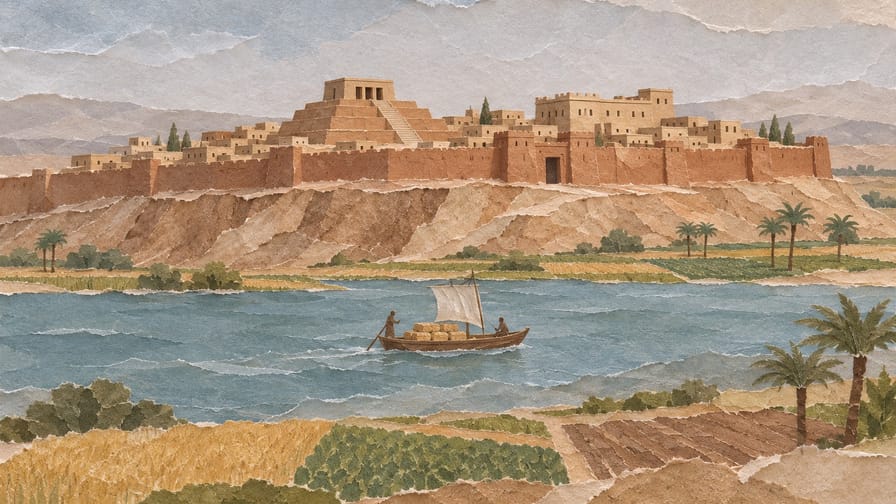
Asshur, Hebrew Ashshur, is the name of a son of Shem in Genesis 10:22 and is also used for Assyria and its people. Genesis 10:11 is translated either with Asshur as the subject or with Assyria as the destination; it does not list the city of Asshur among the cities built there.
Isaiah calls Asshur “the rod of My anger,” the instrument God used to discipline Israel (Isaiah 10:5), yet its pride brought its own judgment in the fall of Nineveh (Nahum 3:1-7).
1. Etymology and Meaning of the Name
The name Asshur derives from the Hebrew אַשּׁוּר (Ashshur), a transliteration of the Akkadian name Aššur. This term possesses a semantic richness that extends beyond a simple geographical designation. It is primarily associated with the son of Shem, grandson of Noah, as recorded in Genesis 10:22, indicating a patriarchal origin for the people and the land.
Asshur also names the ancient Assyrian capital. However, Genesis 10:11 does not list that city among those built. Translations differ: some take Asshur as the person who went out and built Nineveh and the other cities; others understand Nimrod as going into Assyria and building them. These are distinct readings, not two descriptions of the same subject.
Significantly, Asshur was also the name of the principal deity of the Assyrian pantheon. This god was the personification of the nation itself, its king, and its military destiny. The intimate link between the god, the city, and the empire demonstrates the theocratic nature of the Assyrian monarchy, where the king was seen as the earthly representative of Asshur.
The etymological root, although not entirely clear, suggests something like "step" or "ascent," which may have connotations of leadership or conquest. However, the primary significance of the name lies in its ability to encapsulate the identity of a people, their land, and their principal deity, making it a symbol of power and dominion in the Ancient Near East.
The Hebrew name Ashshur can refer to Assyria and its people, but it is also a personal name: Genesis 10:22 lists Asshur among the sons of Shem. The meaning must therefore be determined from the context rather than treating every occurrence as the name of a nation.
In the cultural and religious context, the figure of Asshur as god-king-nation was central to Assyrian identity. This contrasted drastically with Israel's monotheistic faith, where the Lord God (Yahweh) was the sole Sovereign and was not conflated with the land or the people of Israel, but governed them.
2. Geographical Location and Physical Characteristics
The city of Asshur (modern Qal'at Sherqat) was strategically located on the western bank of the Tigris River, in what is today northern Iraq. Situated approximately 100 km south of Mosul, ancient Nineveh, Asshur occupied an elevated position on a sandstone cliff that overlooked the Tigris plain. This location provided formidable natural defense.
The surrounding region is characterized by a fertile plain, irrigated by the waters of the Tigris and its tributaries. The climate is semi-arid, with hot, dry summers and cool, rainy winters, allowing for the cultivation of cereals, especially wheat and barley, which was the basis of the Assyrian economy. Proximity to the Tigris River was vital for transport, agriculture, and water supply.
Asshur was at a crossroads of important trade routes that connected Mesopotamia to the north, to Anatolia and the Levant, and to the east, to Media and Elam. Its position in the heart of Assyria, before the shift of capitals to Nimrud (Calah), Khorsabad (Dur-Sharrukin), and Nineveh, afforded it unparalleled strategic importance as a political and religious center.
The region's natural resources included clay for bricks, stone for construction, and abundant water. The city was protected by imposing walls and contained temples dedicated to Asshur and other deities, palaces, and administrative buildings. Archaeological excavations, especially those conducted by German teams in the early 20th century, revealed a vast amount of information about its architecture, art, and history.
The topography of the area, with rolling hills and the river plain, facilitated both agriculture and military movement. The fertility of the land and control of trade routes allowed Asshur to develop from a modest city-state into the center of one of the largest empires of the ancient world, dominating vast territorial expanses.
The ancient city of Asshur is today a UNESCO World Heritage Site, recognized for its historical and archaeological importance as the first capital of the Assyrian Empire. The remains include the Temple of Asshur, the Ziggurat, the Old Palace, and the city walls, testaments to the grandeur and power that once emanated from this site.
3. History and Biblical Context
The history of the city of Asshur reaches back to the third millennium BCE, as its archaeological remains attest. Genesis 10:11 does not describe the founding of this city: it lists Nineveh, Rehoboth-Ir and Calah. The archaeological chronology of Asshur should therefore not be presented as a date supplied by that verse.
In the second millennium BCE, Asshur was an important city-state and commercial center, involved in trade routes for tin and textiles. The Old Assyrian Empire (c. 1900-1364 BCE) saw the city as its core. In the Middle Assyrian period (c. 1363-912 BCE), Assyria emerged as a significant regional power, expanding its control beyond its immediate borders.
However, it was in the Neo-Assyrian period (c. 911-612 BCE) that Assyria became the dominant empire of the Ancient Near East, with Asshur maintaining its religious and ceremonial status, even after the political capital was transferred to Nimrud, Khorsabad, and finally, Nineveh. This is the period in which Assyria interacted most directly and dramatically with Israel and Judah, as narrated in various prophetic and historical books.
Key biblical events associated with Assyria include the military intervention of Tiglath-Pileser III (Pul) against the Northern Kingdom of Israel, mentioned in 2 Kings 15:19, 29. He deported populations from the northern tribes, employing the Assyrian policy of mass deportation to dismantle resistance.
Second Kings 17:3 names Shalmaneser in the campaign against Israel. Verse 6 attributes the capture of Samaria and the deportation to the king of Assyria without naming Sargon. Sargon II also claimed the conquest in his inscriptions; the precise division of responsibility between the two reigns is debated. This marked the end of the Kingdom of Israel and the fulfillment of many prophecies of judgment.
Later, Sennacherib, king of Assyria, invaded Judah during the reign of Hezekiah (2 Kings 18-19 Isaiah 36-37). He besieged Jerusalem, but, by divine intervention, his army was miraculously destroyed, and Sennacherib returned humiliated to Nineveh, where he was assassinated (2 Kings 19:35-37). This event is a powerful testimony to God's faithfulness to His people and His sovereignty over empires.
Prophets like Isaiah, Hosea, Amos, and Nahum made many references to Assyria. Isaiah describes it as "the rod of My anger" (Isaiah 10:5), an instrument in God's hands to discipline Israel. Hosea warns Israel against relying on Assyria instead of on God (Hosea 5:13 8:9). Nahum, in turn, prophesies the destruction of Nineveh, the Assyrian capital, for its cruelty and idolatry (Nahum 1:1 3:1-7).
The Assyrian Empire suffered a decisive blow in 612 BCE, when Nineveh was destroyed by a coalition of Babylonians and Medes, fulfilling the prophecies of Nahum and Zephaniah (Zephaniah 2:13-15). Assyrian resistance continued after Nineveh’s fall, with its final phase at Harran ending in 609 BCE. The city of Asshur also suffered a significant decline, although it was briefly reoccupied in later periods. Its history, therefore, is a cycle of rise and fall, demonstrating the transience of human power in the face of divine eternity.
4. Theological Significance and Redemptive Events
The theological significance of Asshur and the Assyrian Empire is profound, underscoring God's sovereignty over history and nations. Assyria is portrayed in the Bible not merely as a pagan and oppressive nation, but as a direct instrument of divine providence in Israel's redemptive history.
God used Asshur as "the rod of His anger" to discipline Israel for its idolatry and disobedience to the covenant (Isaiah 10:5-6). The fall of the Northern Kingdom to Assyria (2 Kings 17:6-18) is presented as God's righteous judgment upon a people who abandoned the Lord, worshipped idols, and refused to listen to the prophets. This event demonstrates the seriousness of God's covenant and the certainty of His warnings.
However, Assyria, in its arrogance, exceeded the limits that God had imposed upon it. It boasted of its own strength and did not acknowledge the Lord as the true power behind its conquests (Isaiah 10:7-15). This led to the prophecy of its own judgment and destruction, which was realized with the fall of Nineveh (Nahum 3:1-7 Zephaniah 2:13-15).
This cycle of Assyria's use and judgment illustrates a fundamental theological principle: God rules over all nations, using them for His purposes, but also holds them accountable for their own wickedness. The fall of Asshur and its empire serves as a vivid reminder that no earthly power can resist the will of God, and that human pride inevitably leads to ruin.
Although Asshur is not directly linked to the life and ministry of Jesus Christ, Assyria provides a crucial backdrop for understanding the history of Israel, which would culminate in the coming of the Messiah. The destruction of the Northern Kingdom by the Assyrians shaped Judah's identity and messianic expectation, as the promise of a Davidic king who would gather all the tribes of Israel gained even greater weight after the dispersion.
Prophecies like that of Micah (Micah 5:5-6) foresee a "shepherd" who would deliver Israel "from Assyria," although this prophecy is more likely to be eschatological, pointing to the final deliverance of God's people through the Messiah. The figure of the Messiah, the Good Shepherd, is the antitype of the Assyrian oppressor, bringing true peace and security.
The theological symbolism of Asshur lies in being the archetype of the oppressive pagan empire, which defies God and persecutes His people. Its defeat, therefore, represents God's ultimate victory over all forces of evil and the guarantee of divine protection for those who trust in Him. It is a reminder of divine justice that, though slow, is certain.
The history of Asshur illustrates God's providence, which extends His sovereign control over events and nations, causing even the actions of the wicked to serve His redemptive purposes. The fall of Assyria is a testament to God's faithfulness to His covenant and His promise of judgment upon ungodliness.
5. Biblical-Theological Legacy and Canonical References
Mentions of Asshur and Assyria permeate much of the Old Testament, from the early historical books to the Major and Minor Prophets. The frequency and context of these references demonstrate Assyria's centrality as a political and theological force in the history of Israel and Judah, shaping their faith and understanding of God's governance.
In the Pentateuch, the first mention in Genesis 10:11 establishes Asshur as part of the genealogy of post-diluvian nations and Nimrod's expansion. In Numbers 24:22-24, Balaam's prophecy already alludes to Israel's future oppression by "Asshur" and its eventual destruction, demonstrating that God's plan for the region was already in motion centuries before Assyrian ascendancy.
The books of 2 Kings and 2 Chronicles detail the military and political interactions, culminating in the fall of Samaria (2 Kings 17) and Sennacherib's invasion of Judah (2 Kings 18-19 2 Chronicles 32). These are crucial historical accounts that confirm divine intervention in history, protecting Jerusalem and punishing Assyrian arrogance.
The prophets dedicate considerable attention to Assyria. Isaiah describes it as a divine instrument (Isaiah 7:17 10:5) and prophesies its ruin (Isaiah 14:24-27). Hosea (Hosea 5:13 8:9 11:5) and Amos (Amos 1:3-5) mention it as a threat and an imminent judgment. Micah (Micah 5:5-6) foresees Israel's deliverance from Assyria, and Nahum (Nahum 1-3) and Zephaniah (Zephaniah 2:13-15) prophesy its total destruction.
Ezra 4:2 recalls Esarhaddon, king of Assyria, as responsible for bringing settlers to the region. Ezra 4:9-10 mentions people of several origins settled in Samaria; they should not all be described as ethnically Assyrian. These passages show the enduring effects of imperial resettlement on the region’s population.
In intertestamental and extra-biblical literature, the memory of Assyria and its cruelty remains. Historians like Herodotus and Diodorus Siculus describe Assyria and the fall of Nineveh, often echoing the tone of the biblical prophets. Assyria's impact on the geopolitics and culture of the Ancient Near East was immense and lasting.
The history of Asshur is a vivid illustration of God's sovereignty over history. The rise and fall of Assyria demonstrate that God uses pagan nations for His purposes, disciplining His people and judging the iniquity of oppressors. Assyrian history reinforces the conviction that God is the Lord of history, and that all earthly kingdoms are transient before His eternal kingdom.
The relevance of Asshur for understanding biblical geography is undeniable, as Assyria defines one of the main geographical regions of the biblical world. Understanding its location, trade routes, and territorial extent is essential for contextualizing biblical narratives, prophecies, and the movements of peoples. The study of Asshur, therefore, is not merely an exercise in ancient history, but a vital tool for deepening faith and understanding the Scriptures.