


Arabia
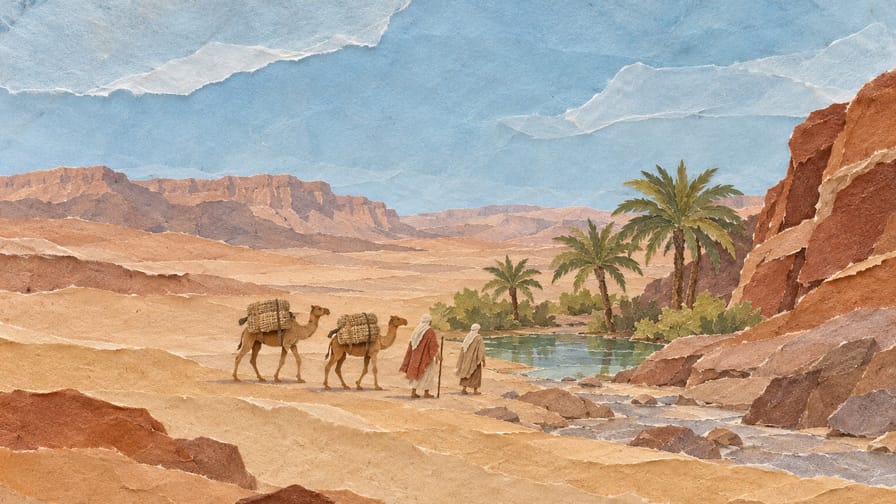
Arabia is the vast desert peninsula between the Red Sea and the Persian Gulf, home to the tribes descended from Ishmael (Genesis 25:12-16) and to trading peoples such as Sheba, whose queen visited Solomon with gold and spices (1 Kings 10:1-10). The prophets addressed oracles to its tribes, among them Dedan and Kedar (Isaiah 21:13-17).
In the New Testament, Arabs heard the apostles at Pentecost (Acts 2:11), and Paul withdrew to Arabia after his conversion before returning to Damascus (Galatians 1:17). He also places Mount Sinai “in Arabia” (Galatians 4:25).
1. Etymology and Meaning of the Name
The name Arabia, in its most known form, derives from the Greek Arabia (Ἀραβία), a term used in the New Testament, as in Galatians 1:17. In the Old Testament, the region is frequently referred to by Hebrew terms such as ‘Arav (עֲרָב) or ‘Aravi (עֲרָבִי), which designate both the land and its inhabitants. The Semitic root ‘arav has multiple meanings.
Among the possible etymological derivations, ‘arav can mean "desert" or "steppe," referring to the vast arid expanse that characterizes much of the peninsula. Another interpretation suggests "mixed" or "western," perhaps indicating the mixture of peoples or their location west of the great Mesopotamian civilizations. The term may also be related to "sunset" or "evening," pointing to the westward direction.
The word ‘Arav (עֲרָב) appears in passages such as 2 Chronicles 9:14 and Isaiah 21:13, referring to a region or the peoples who inhabited it. The "kings of Arabia" are mentioned as tributaries or allies, indicating a recognized political or geographical entity. This Hebrew designation encompassed a vast and diverse area, without fixed boundaries like those of a modern country.
Variations of the name and related terms include "Lands of the East" or "Children of the East," which frequently referred to the nomadic and semi-nomadic tribes of the Arabian Peninsula, such as the Kenites, Amalekites, and Midianites. These designations highlight the tribal nature and the pastoral economy prevalent in the region throughout biblical history.
The significance of the name in cultural and religious context lies in its association with the desert, a place of trial, purification, and encounter with God in the biblical narrative. For Israel, the desert of Arabia was the setting for their pilgrimage and the revelation of the Law at Mount Sinai, a central concept in Mosaic and prophetic theology.
2. Geographical Location and Physical Characteristics
Biblical Arabia encompasses the vast Arabian Peninsula, extending over 3 million square kilometers, bounded by the Red Sea to the west, the Persian Gulf to the east, the Indian Ocean (Arabian Sea) to the south, and the lands of Syria and Mesopotamia to the north. This immense region is predominantly desert, characterized by vast expanses of sand and rock.
The topography of the peninsula is marked by elevated plateaus in the interior, such as the Nefud and Rub' al Khali plateaus, which are some of the largest sand deserts in the world. Along the western coast, the mountain ranges of Hejaz and Asir rise abruptly from the Red Sea, creating a dramatic contrast with the coastal lowlands and the arid interior.
The climate of Arabia is largely hyper-arid, with extreme temperatures and scarce and irregular precipitation. Oases, formed by underground water sources or seasonal rivers (wadis), are vital points of life and settlement, sustaining communities and allowing limited agriculture. Cities like Dedan, Tema, and Saba (Sheba) prospered along oasis routes.
The proximity of Arabia to the civilizations of the Fertile Crescent (Egypt, Canaan, Syria, and Mesopotamia) made it a strategic corridor for trade. Ancient trade routes, such as the Incense Route, traversed the peninsula, connecting southern Arabia (modern Yemen) with the Mediterranean, transporting spices, frankincense, myrrh, and other precious goods.
The natural resources of biblical Arabia were primarily those associated with the desert and trade. Frankincense and myrrh, valuable aromatic resins, were produced in southern Arabia and exported to the ancient world, as evidenced in Isaiah 60:6 and Jeremiah 6:20. Furthermore, the region was known for its camels, essential for transporting goods across the desert.
Archaeology has revealed the existence of prosperous kingdoms and cities in ancient Arabia, such as the Nabataeans, who built Petra (although Petra is more on the northwestern edge of the peninsula, its culture had Arabian roots), the Minaeans, the Sabaeans (kingdom of Sheba), and the Dedanites. Excavations at sites like Dedan (modern Al-Ula) and Tema (Tayma) confirm the wealth and complexity of these Arabian societies, mentioned in Isaiah 21:13-15 and Ezekiel 27:20-22.
3. History and Biblical Context
The history of Arabia in the Bible dates back to the patriarchs, with the descendants of Ishmael (son of Abraham and Hagar) and Esau (son of Isaac) settling in various parts of the peninsula. Ishmael is described as living in the Desert of Paran (Genesis 21:21), an area extending into northwestern Arabia. His twelve sons gave rise to Arabian tribes that populated the region (Genesis 25:12-16).
The Edomites, descendants of Esau, occupied the mountainous region south of the Dead Sea, which can be considered the western border of Arabia (Genesis 36:8-9). Other tribes mentioned, such as the Midianites, Kenites, and Amalekites, also had strong ties to the Arabian Peninsula, frequently interacting with Israel, sometimes as enemies, other times as allies or neighbors (Judges 6:1-6).
During the period of the Exodus, the people of Israel wandered for forty years in a desert that, for the most part, bordered or extended through Arabia, including the Desert of Sinai and Paran. Mount Sinai (or Horeb), where God revealed the Law to Moses, is traditionally located on the Sinai Peninsula, but some theories suggest a more easterly location, in Arabia itself, as in Galatians 4:25, which associates Mount Sinai with "Arabia."
During the monarchical period, Arabia was known primarily as a source of commercial wealth. The Queen of Sheba (a kingdom in southern Arabia, modern Yemen) visited King Solomon, attracted by his wisdom and riches, bringing with her gold, spices, and precious stones (1 Kings 10:1-10 2 Chronicles 9:1-9). This event underscores Arabia's importance as a center of trade and wealth.
The Old Testament prophets frequently directed oracles against the tribes and kingdoms of Arabia, such as the Dedanites, Tema'ites, and Kedarites, predicting divine judgments upon them. Isaiah 21:13-17 and Jeremiah 25:23-24 are examples of these prophecies, which reflect the continuous interaction between Israel and its Arabian neighbors. These passages also demonstrate God's sovereignty over all nations.
In the intertestamental and Roman periods, Arabia saw the rise of the Nabataean kingdom, with its capital in Petra. Although the Nabataeans are not directly mentioned in the canonical Bible, they controlled major trade routes and were a significant power in the region. The presence of an ethnarch of King Aretas (Nabataean king) in Damascus is noted by Paul in 2 Corinthians 11:32, indicating Arabian influence in Syria.
Galatians 1:17 records Paul’s journey to Arabia and return to Damascus. It does not specify where he stayed in Arabia or what he did there; a retreat devoted to study and reflection is an interpretation, not an explicit statement of the passage.
4. Theological Significance and Redemptive Events
Arabia, with its desert character and history as a refuge, plays a significant role in redemptive history and the progressive revelation of God. The desert, often associated with Arabia, is a place of trial and divine discipline for Israel. It is there that God miraculously provides (manna, water from the rock) and forges the identity of His people, preparing them for the Promised Land (Deuteronomy 8:2-3).
The location of Mount Sinai in Arabia (or in its vicinity) is of paramount theological importance. There, God established His covenant with Israel, delivering the Torah and revealing His holy character. This event is the core of Old Testament faith and prefigures the new covenant in Christ. Sinai in Arabia is, therefore, a place of direct and powerful encounter between God and His people, as affirmed in Exodus 19:16-19.
The visit of the Queen of Sheba to Solomon, originating from southern Arabia, is interpreted by Jesus as a testimony to Solomon's superior wisdom, and by extension, a foreshadowing of the even greater wisdom of Christ. Jesus states that the Queen of Sheba will rise up at the judgment to condemn those who reject divine wisdom, for she traveled from "the ends of the earth" to hear Solomon (Matthew 12:42 Luke 11:31). This elevates Arabia to an eschatological context.
Paul affirms that he received the gospel through revelation of Jesus Christ (Galatians 1:11-12). His account of going to Arabia does not identify that region as the place where he received this revelation or describe a course of instruction there.
The episode can prompt reflection on dependence on God and preparation for ministry. Such devotional application should be distinguished from a historical description of Paul’s activities in Arabia, which the passage does not supply.
In a typological sense, Arabia, as the desert of the Exodus, represents the place where the flesh is broken and dependence on God is forged. It is an environment of purification where human illusions are dispelled and divine truth becomes clear. This resonates with the experience of many believers who find spiritual clarity in moments of isolation or trial, away from the distractions of the world.
The prophecy of Isaiah 60:6-7, which speaks of camels of Midian and Ephah, people from Sheba bringing gold and frankincense, and the flocks of Kedar and rams of Nebaioth, is often interpreted as a messianic image of the coming of the Gentiles to worship the Lord. Although the main focus is Jerusalem, the mention of Arabian tribes demonstrates the universal scope of salvation, reaching even the peoples of the desert and their resources.
5. Biblical-Theological Legacy and Canonical References
Arabia is mentioned in various canonical passages, evidencing its relevance throughout biblical history. In the Pentateuch, the region is the setting for Israel's pilgrimage and the Mosaic revelation (Exodus 3:1 Numbers 10:12). Historical books, such as 2 Chronicles 9:14, refer to the "kings of Arabia" as regional powers, while Nehemiah 2:19 mentions Geshem, the Arab, as an adversary of Nehemiah.
In the prophetic books, Arabia and its tribes are frequently the object of divine oracles, demonstrating God's sovereignty over all nations. Isaiah 21:13-17 prophesies about the fall of Kedar, while Jeremiah 25:23-24 and Ezekiel 27:21 mention the Arabian peoples in contexts of judgment and commerce, respectively. These references underscore the continuous interaction between Israel and Arabia.
The book of Job, although its dating is debated, is set in the "land of Uz," which many scholars locate in Arabia or on its borders, perhaps in the area of Edom or east of the Jordan. The mention of Sabaeans and Chaldeans attacking Job's possessions (Job 1:15, 17) reinforces the connection with the peoples of Arabia, making the region the backdrop for biblical reflection on suffering and divine sovereignty.
In the New Testament, references to Arabia are scarcer, but of great theological impact. The most prominent is in Galatians 1:17, where Paul recounts his journey to Arabia after his conversion. This passage is fundamental for understanding the divine origin of Paul's apostolic authority. The other mention, in Galatians 4:25, compares the covenant of the Law of Sinai with Hagar and "Arabia," establishing a theological contrast between the slavery of the Law and the freedom of grace.
Intertestamental and extra-biblical literature, such as the writings of Josephus and other Roman historians, frequently mention the Nabataeans and other Arabian peoples, confirming their political and commercial importance. The presence of "Arabs" at Pentecost (Acts 2:11) indicates the dispersion of Jews and proselytes throughout Arabia, who came to Jerusalem for the feasts, showing the breadth of the gospel message from its inception.
Arabia matters not only for its geographical and historical role but also for its theological significance. The desert of Arabia is the place of trial and encounter with God, a recurring theme that resonates with the spiritual journey of the believer. Paul's experience in Arabia is seen as a model of consecration and a testimony to God's direct revelation to His servants.
Understanding the biblical geography of Arabia is crucial for contextualizing events such as the Exodus and Paul's ministry. It helps us to appreciate the vastness of the biblical world and God's sovereignty that extends over all lands and peoples. Arabia, therefore, is not merely a point on the map, but a stage for divine action in the history of redemption.