


民数记
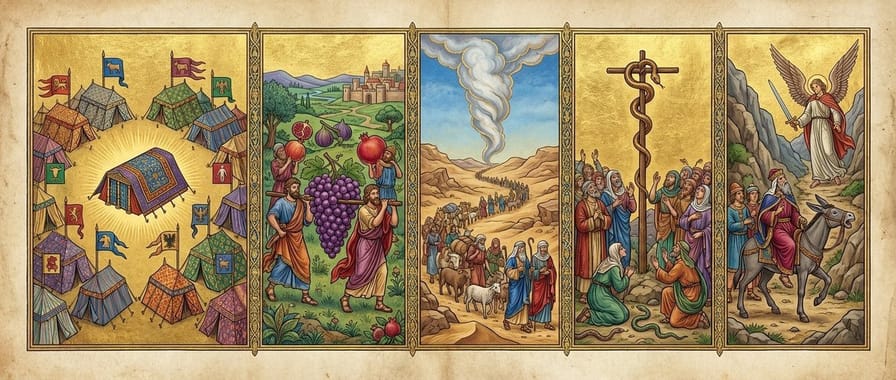
Illustration of the Book of Numbers, one of the 39 books of the Old Testament (Nano Banana Pro).
The book of Numbers, often perceived as a compendium of censuses and arid laws, reveals itself, under deeper scrutiny, as a rich and complex theological narrative, fundamental for understanding the history of redemption. As an integral part of the Pentateuch, or Torah, it serves as a crucial bridge between the liberation from Egypt (Exodus) and the preparation for entry into the Promised Land (Deuteronomy and Joshua).
Its importance transcends the mere chronology of desert events; it is a vivid testament to God's sovereignty, covenant faithfulness, and persistent human depravity. This introduction aims to unfold the layers of Numbers, offering a comprehensive, scholarly analysis firmly rooted in the conservative evangelical Protestant perspective.
Our goal is not only to illuminate the inherent truths of this book but also to establish a structural model for the analysis of any biblical book. We will address its historical context, traditional authorship, literary structure, central theological themes, canonical relevance, and the hermeneutical challenges it presents, always with an eye toward its Christocentric relevance and its application for the contemporary church.
In each section, we will seek to defend the inerrancy and authority of Scripture, critically confronting modern objections and reaffirming the traditional view that has sustained evangelical faith throughout the centuries. May this journey through Numbers deepen our admiration for the Word of God and the wisdom of its divine author.
1. Historical Context, Dating, and Authorship
Understanding the historical context, dating, and authorship of any biblical book is a fundamental pillar for a robust and faithful hermeneutic. In the case of Numbers, as with the entire Pentateuch, Judeo-Christian tradition has consistently attributed its authorship to Moses. This position, although challenged by branches of modern higher criticism, remains the most consistent with the internal evidence of Scripture itself and with the historical testimony of faith.
1.1 Mosaic Authorship and Internal Evidence
The defense of the Mosaic authorship of Numbers rests on a solid foundation. The Pentateuch itself presents Moses as the principal writer and compiler of its laws and narratives. In Numbers 33:2, we read: "Moses recorded their journeys stage by stage, according to the command of the Lord." This explicit declaration, combined with other passages such as Exodus 17:14, Exodus 24:4, Exodus 34:27, and Deuteronomy 31:9, 22, 24, unequivocally points to Moses as the principal author.
The demonstrated familiarity with the geography of the desert, Egyptian customs, and the complexities of nomadic life during a forty-year journey (such as the manna, quails, water from the rock, and poisonous serpents) suggests an author who personally experienced these events. The precision of the details, from the organization of the tribal camp to the minutiae of Levitical laws and the narratives of rebellions, reflects the perspective of a leader who was at the center of the Israelite experience in the desert.
Beyond the internal evidence, the New Testament reinforces Mosaic authorship. Jesus Christ, the very Lord of Scripture, referred to the "Law of Moses" (Luke 24:44) and cited passages from the Pentateuch as coming from Moses (John 5:46-47). Apostles such as Paul (Romans 10:5) and Peter (Acts 3:22) also attested to Mosaic authorship. This apostolic confirmation and that of Christ Himself is of decisive weight for evangelical theology, which upholds the inerrancy and authority of the Word of God.
1.2 Dating and Context of the Writing Period
Accepting Mosaic authorship, the dating of Numbers aligns with the period of the Exodus and Israel's wilderness wanderings. Biblical chronology, according to conservative tradition, places the Exodus around 1446 B.C. The book of Numbers covers a period of approximately 39 years, beginning in the second year after the departure from Egypt (Numbers 1:1) and ending in the plains of Moab, shortly before entry into Canaan (Numbers 36:13), around 1406 B.C.
Moses, therefore, would have compiled and wrote much of this material during or at the end of the wilderness journey, documenting the events and laws as they occurred or were revealed. The book is a contemporary record, not a later reflection from centuries afterward, which lends great weight to its historicity and authenticity.
1.3 Political, Social, and Cultural Context of the Ancient Near East
The book of Numbers unfolds in the setting of the Ancient Near East, a world of empires, city-states, and nomadic peoples. Israel, a newly liberated nation, was in transit, seeking to establish its identity and relationship with God amidst diverse cultures and regional powers.
Politically, Israel's journey brought them into contact with peoples such as the Amalekites (Numbers 13:29), Edomites (Numbers 20:14-21), Moabites and Midianites (Numbers 22-25), and the Amorites (Numbers 21:21-35). These interactions often involved conflicts, negotiations, and, unfortunately, pagan influences that challenged the holiness and exclusivity of worship to Yahweh.
Socially, the book details the tribal organization of Israel, the structure of the camp around the Tabernacle, the priestly and Levitical hierarchy, and the laws that governed communal life. This organization was not merely functional but theologically laden, reflecting divine order and the presence of God at the center of His people. Culturally, although Israel was developing its own theocratic identity, there were remnants of Egyptian culture and the constant temptation to conform to the pagan customs of neighboring nations, as exemplified in the incident at Peor (Numbers 25).
1.4 Response to Higher Criticism and Academic Skepticism
Modern higher criticism has raised objections to the Mosaic authorship and historicity of Numbers, proposing theories such as the Documentary Hypothesis (JEDP), which fragments the Pentateuch into various sources and dates them centuries after Moses. Such criticisms often question the possibility of a large-scale exodus, the population figures (the "numbers" of the book), and the internal consistency of the narrative.
The conservative evangelical perspective, however, responds to these criticisms with a defense of the unity and integrity of the text. The supposed "discrepancies" and "anachronisms" are often explained through a deeper understanding of literary genre, textual transmission, and the nature of divine revelation. Small later additions or edits (such as the note about Cush in Numbers 12:3 or the description of Moses' death in Deuteronomy 34) by inspired scribes do not invalidate the fundamental Mosaic authorship.
As for the large population figures, while representing a logistical and hermeneutical challenge, various solutions have been proposed, from interpreting "thousand" (eleph) as a military unit or clan, to the literal acceptance of God's supernatural intervention. The rejection of the historicity of Numbers, ultimately, implies rejecting the testimony of Jesus Himself and the apostles, which is unacceptable for the evangelical faith that values biblical inerrancy and the authority of Scripture.
2. Structure, Division, and Main Content
The structure of the book of Numbers is complex and reflects Israel's journey both geographically and spiritually. It is not merely a historical record; it is a theologically organized narrative that interweaves travel accounts, laws, censuses, and poetry. Its literary organization can be seen as a reflection of life in the wilderness: moments of order and expectation, followed by periods of crisis, grumbling, and judgment, culminating in a new phase of preparation.
2.1 Literary Organization: Narrative, Legislation, and Poetry
Numbers is a book of mixed genre. Predominantly narrative, it tells the story of Israel's pilgrimage from Sinai to the plains of Moab. However, this narrative is frequently interrupted by detailed legislative sections, which include ritual, civil, and moral laws. The censuses (which give the book its name) and genealogical lists are also prominent, emphasizing tribal organization and responsibility.
Furthermore, the book contains notable poetic passages, such as the blessings of Balaam (Numbers 23-24) and the war songs (Numbers 21:14-15, 27-30). This literary diversity serves to enrich the theological message, using different forms to communicate God's faithfulness and human disobedience.
2.2 Main Divisions and Their Characteristics
The book of Numbers can be divided into three main sections, corresponding to the three phases of Israel's journey in the wilderness:
2.2.1 Preparation at Sinai (Chapters 1-10:10):
- This section begins with a census of the first generation of men fit for war, with the purpose of organizing the people for the march and the conquest of the land.
- Establishment of order and holiness in the camp, with the organization of the tribes around the Tabernacle and the designation of the Levites for priestly service.
- Additional laws concerning purity, offerings, and vows (such as the Nazirite vow), which underscore the importance of holiness in God's presence.
- The celebration of the Passover and the cloud of glory guiding the people, indicating God's continuous presence.
- The sounding of the trumpets to gather the people and begin the journey.
2.2.2 Journey from Sinai to Kadesh and the Failure of the First Generation (Chapters 10:11-20:21):
- This is the most dramatic section, marked by a series of grumblings, rebellions, and divine judgments.
- Complaints about food (manna and quails), the rebellion of Miriam and Aaron against Moses, and the incident of the spies at Kadesh-Barnea, which results in the condemnation of 40 years of wilderness wandering for the first generation.
- The rebellion of Korah, Dathan, and Abiram, who challenge the authority of Moses and Aaron, resulting in severe judgment.
- The incident of Aaron's budding staff, confirming his divine choice for the priesthood.
- The deaths of Miriam and Aaron, and Moses' sin at Meribah, which prevents him from entering the Promised Land.
2.2.3 Journey from Kadesh to the Plains of Moab and Preparation of the Second Generation (Chapters 20:22-36):
- This section focuses on the new generation, who are about to inherit the Promised Land.
- New conflicts with the Canaanites, Edomites, and Ammonites.
- The incident of the bronze serpent, a crucial typological event.
- The oracles of Balaam, a prophet paid to curse Israel, but who is forced by God to bless them and prophesy about the Messiah.
- The sin at Peor, where Israel becomes involved with Moabite idolatry and immorality, resulting in a plague.
- A second census, this time of the new generation, which demonstrates God's faithfulness in preserving His people.
- Laws concerning inheritance, cities of refuge, and land boundaries, preparing the people for life in Canaan.
2.3 Narrative Flow and Synthetic Outline of Content
The narrative flow of Numbers is cyclical, with a repetitive pattern of grumbling, rebellion, judgment, and the continuing grace of God. It begins with order and promise, descends into the chaos and despair of the wilderness, and then rises again with the hope of entering the Promised Land for the new generation.
Synthetic Outline:
- Chapters 1-4: Censuses and organization of Israel and the Levites at Sinai.
- Chapters 5-6: Laws of purity and Nazirite vows.
- Chapters 7-9: Offerings of the princes and consecration of the Levites.
- Chapter 10: The departure from Sinai.
- Chapters 11-12: The first grumblings and the rebellion of Miriam and Aaron.
- Chapters 13-14: The spies at Kadesh and the condemnation of the first generation.
- Chapters 15-19: Additional laws and Korah's rebellion.
- Chapters 20-21: Deaths of Miriam and Aaron, Moses' sin, the bronze serpent.
- Chapters 22-24: Balaam and his prophecies.
- Chapter 25: The sin at Peor.
- Chapters 26-27: Second census and laws of inheritance.
- Chapters 28-30: Laws of offerings and vows.
- Chapters 31-36: War against Midian, division of the land, cities of refuge, and laws of inheritance for the daughters of Zelophehad.
3. Central Theological Themes and Purpose
The book of Numbers is a theological goldmine, replete with profound truths about the character of God, human nature, and the plan of redemption. Far from being merely a historical record, it is a divine instruction that reveals eternal principles. For the Reformed evangelical perspective, the themes present here resonate with covenant theology and divine sovereignty.
3.1 The Sovereignty and Faithfulness of God
One of the most prominent themes in Numbers is the unshakeable sovereignty of God. Despite Israel's constant grumbling and rebellion, God remains in absolute control. He guides His people with the cloud by day and the pillar of fire by night (Numbers 9:15-23), provides manna and quails (Numbers 11), and protects them from their enemies, transforming curses into blessings through Balaam (Numbers 23-24). This faithfulness of God is not conditioned by human obedience, but founded on His own character and His covenant with Abraham (Genesis 12:1-3).
Despite judging sin, God always acts within His redemptive purpose. The 40-year wilderness wandering, though a judgment, was also a time of purification and training, preparing a new generation to inherit the promise. The grace of God is evident in His patience and continuous provision, even when His people deserved annihilation. He is the God who fulfills His promises, even when His people fail repeatedly.
3.2 Human Depravity and the Need for Holiness
Numbers offers a somber and realistic portrait of human depravity. From the complaints about food and water (Numbers 11:4-6), through the rebellion of Miriam and Aaron (Numbers 12), the panic and unbelief of the spies (Numbers 13-14), the insurrection of Korah (Numbers 16), to the immorality at Peor (Numbers 25), the book is a testament to the innate inclination of the human heart toward sin. With each new crisis, Israel demonstrates a short memory and a hardened heart, preferring the slavery of Egypt to freedom under the sovereignty of Yahweh.
This constant human failure underscores the imperative need for holiness. The laws of purity, the rituals of sacrifice, and the organization of the camp around the Tabernacle were not mere formalities; they were divine means for Israel to reflect God's holiness in their midst and keep themselves separate from pagan practices. God's presence demanded a purified people, and Israel's inability to maintain this holiness resulted in judgment. This theme resonates deeply with the Reformed doctrine of total depravity and the necessity of regenerating grace.
3.3 Leadership and Divine Mediation
Moses' role as leader and mediator is central in Numbers. He is the prophet, priest, and king of Israel, chosen by God to guide the people. His patience, intercession, and faithfulness (despite his own sin at Meribah) are exemplary. The narrative highlights the heavy responsibility of leadership and the need for leaders to be faithful to God's voice.
Korah's rebellion (Numbers 16) is a vivid reminder of the need to respect divinely instituted authority and the clear distinction between leadership roles (prophetic, priestly, and Levitical). Aaron and his sons are consecrated for the priesthood, acting as mediators between God and the people through the sacrificial system. This structure of leadership and mediation points, typologically, to the supreme mediator, Jesus Christ.
3.4 Worship and the Presence of God
The Tabernacle, with its detailed structure and rituals, is the theological heart of Israel's life in the wilderness. It represents the immanent presence of God in the midst of His people. The laws of purity and the sacrificial offerings, detailed in Numbers, ensure that this presence can be maintained without God's holiness consuming a sinful people. Every aspect of worship, from the organization of the camp to the duties of the Levites, is designed to emphasize God's holiness and the need for reverence and obedience in His presence.
The book demonstrates that God's presence is both a blessing and a responsibility. The cloud that guides the people is a visible sign of His proximity, but the violation of the laws of holiness results in judgment (e.g., fire from the Lord in Numbers 11:1). This theme anticipates the truth that, in Christ, God's presence is fully realized, and purification to enter His presence is definitive through His sacrifice.
3.5 The Primary Purpose of the Book for the Original Audience
The primary purpose of Numbers for the original audience — the second generation of Israelites in the plains of Moab, about to enter Canaan — was multifaceted. Firstly, it served as a historical record of the errors of the previous generation, a solemn warning against unbelief and disobedience. The story of the first generation was a clear lesson: rebellion brings severe consequences and delays or prevents the inheritance of the promise.
Secondly, the book was a reaffirmation of God's faithfulness and sovereignty. Despite Israel's failures, God had fulfilled His word to preserve a remnant and bring them to the brink of the Promised Land. It served to instill confidence in God's ability to guide and enable them for the conquest. Finally, Numbers provided the laws and the necessary structure for life in Canaan, reinforcing Israel's identity as a holy people, set apart for Yahweh, and ready to live in obedience in the land that would be given to them. It was a call to faith, obedience, and perseverance.
4. Relevance and Canonical Connections
The book of Numbers is not an isolated theological island; it is intrinsically linked to the entire biblical narrative, functioning as a vital link in the history of redemption. Its importance transcends the Old Testament, finding echo and fulfillment in the New Testament, particularly in the person and work of Jesus Christ. A Christocentric reading of Numbers reveals its profound relevance for the contemporary church.
4.1 Importance of the Book within the Complete Canon
Within the Pentateuch, Numbers fills the gap between the formation of the nation in Exodus/Leviticus and the reaffirmation of the covenant in Deuteronomy, before the conquest in Joshua. It demonstrates the reality of life under the covenant: the blessings of obedience and the curses of disobedience. Without Numbers, the experience of Israel in the wilderness, with its crucial lessons of faith and failure, would be incomplete.
The book establishes precedents for the theology of judgment and grace, the nature of divinely instituted leadership, and the importance of holiness. It is a reminder that the journey of faith is arduous, but God's faithfulness is constant. The events and characters of Numbers are frequently referenced in other books of the Old Testament, such as in the Psalms (e.g., Psalm 78, Psalm 95, Psalm 106), which meditate on Israel's rebellion in the wilderness and God's patience.
4.2 Typological Connections with Christ (Christocentric Reading)
The conservative evangelical perspective emphasizes a Christocentric reading of Scripture, and Numbers is rich in typologies that point to Jesus Christ:
- The bronze serpent (Numbers 21:4-9): When Israel was bitten by venomous serpents, God instructed Moses to lift up a bronze serpent in the wilderness. Those who looked at it were healed. Jesus, in John 3:14-15, declares: "Just as Moses lifted up the serpent in the wilderness, so must the Son of Man be lifted up, that everyone who believes in him may not perish but have eternal life." The bronze serpent is a clear type of the crucified Christ, the only means of salvation for sinful humanity.
- The rock that gave water (Numbers 20:2-13): At Meribah, Moses struck the rock for water to come out of it. The Apostle Paul interprets this event typologically in 1 Corinthians 10:4, stating that "the rock was Christ." Christ is the source of living water that satisfies the spiritual thirst of His people.
- The manna (Numbers 11): The bread from heaven that sustained Israel in the wilderness is a type of the "bread of life," who is Jesus Christ. In John 6, Jesus presents Himself as the true manna that came down from heaven, offering eternal life to those who eat Him by faith.
- The High Priest: Aaron, with his sacred garments and his role as mediator, prefigures the supreme High Priest, Jesus Christ (Hebrews 4:14-16). Christ, with His perfect sacrifice, entered the true heavenly sanctuary, offering definitive atonement for the sins of His people.
- The prophet like Moses: Deuteronomy 18:15, a prophecy about a prophet like Moses, is widely understood as a reference to Jesus (Acts 3:22). Moses was a mediator of the old covenant; Christ is the mediator of the new and superior covenant (Hebrews 8:6).
- Balaam and the star of Jacob (Numbers 24:17): Balaam's prophecy about a "star" that would come out of Jacob and a "scepter" that would rise from Israel is a clear messianic prophecy, pointing to the reign and glory of Christ.
4.3 Fulfillments in the New Testament
The New Testament not only uses typologies from Numbers but also makes direct citations and allusions to its events as warnings and examples for believers. The Epistle to the Hebrews (Hebrews 3:7-4:11) uses Israel's unbelief in the wilderness, which prevented them from entering God's "rest," as a solemn warning for Christians not to harden their hearts and fall into unbelief.
Paul, in 1 Corinthians 10:1-13, revisits the events of Numbers (the cloud, the sea, the manna, the water from the rock, idolatry, immorality, grumbling, and the serpents) as examples and warnings for the church in Corinth, emphasizing that these things were written "for our admonition." He draws lessons about temptation, God's faithfulness in providing a way of escape, and the need to avoid the sins that led to Israel's downfall.
The mention of the Israelites who "fell in the wilderness" (Hebrews 3:17) is a clear allusion to the judgment described in Numbers, serving as a reminder of the seriousness of disobedience and unbelief, even for those who were rescued by God.
4.4 Citations and Allusions in Other Biblical Books
Beyond the New Testament, Numbers is referenced in other parts of Scripture. Nehemiah, in his confessional prayer (Nehemiah 9:19-22), recalls God's provision in the wilderness, including the pillar of cloud and fire, the manna, and the water, events narrated in Numbers. Historical Psalms, such as Psalm 78, 105, and 106, recount the story of the wilderness wandering, highlighting God's patience and Israel's rebellion, drawing lessons for future generations.
Balaam's prophecy in Numbers 24:17 about the "star of Jacob" finds echo in Revelation 22:16, where Jesus calls Himself the "root and the offspring of David, the bright morning star," confirming the messianic interpretation of the prophecy.
4.5 Relevance for the Contemporary Church
For the contemporary church, Numbers offers timeless lessons. It serves as a mirror for the human condition, revealing the persistence of sin and the continuing need for grace. The story of Israel in the wilderness is a paradigm of the Christian journey: an exodus from the slavery of sin, a pilgrimage through present life with its temptations and challenges, and the expectation of a future inheritance.
The book warns us against grumbling, unbelief, and disobedience. It reminds us that, although we are saved by grace through faith, holiness and obedience are expected from those who belong to God. It also encourages us with God's unwavering faithfulness, who sustains His people even in their deepest failures, and reminds us of the importance of godly leadership and the centrality of worship and God's presence in our lives.
In summary, Numbers teaches us about the need for perseverance in faith, the seriousness of sin, and the glory of salvation in Christ, who is the fulfillment of all the typologies and promises of the wilderness.
5. Hermeneutical Challenges and Critical Issues
The interpretation of Numbers, like that of any Old Testament book, presents specific challenges that require a careful and faithful hermeneutical approach. The conservative evangelical perspective seeks to address these issues with integrity, defending the inerrancy and authority of Scripture, while recognizing the complexity of the text and the need for in-depth study.
5.1 Specific Interpretive Difficulties of the Book
One of the most notable difficulties in Numbers lies in the large numbers mentioned in the censuses (Chapters 1 and 26). The idea of a population of over 600,000 men fit for war, implying a total of 2 to 3 million people, raises logistical questions about sustainability in the wilderness, the speed of march, and organizational capacity. Some scholars suggest that "thousand" (Hebrew: eleph) may mean a military unit, a clan, or a family, reducing the numbers to a more manageable scale. However, evangelical tradition generally accepts the numbers literally, attributing their feasibility to God's supernatural intervention, who miraculously sustained Israel during the pilgrimage.
Another difficulty is the nature of divine judgments, which may seem severe to the modern mind. The destruction of Korah's rebels (Numbers 16), the plagues, and the annihilation of enemy peoples (Numbers 21, 31) raise ethical questions. It is crucial to interpret these events in the context of God's holiness, His covenant with Israel, and His sovereignty as judge of all the earth. These judgments were direct responses to persistent rebellion against His authority and holiness, and often served to protect the purity and existence of the people through whom redemption would come.
5.2 Questions of Literary Genre and Cultural Context
The mixed genre of Numbers (historical narrative, legislation, poetry, censuses) requires a reading sensitive to the particularities of each section. The laws, for example, must be understood within the context of the old covenant and the culture of the Ancient Near East. Not all civil or ritual laws are directly applicable to Christians today, but all reveal eternal principles about God's character and the holiness He expects from His people.
The cultural context of the Ancient Near East is vital for understanding certain practices and prohibitions. For example, the law of jealousy (Numbers 5:11-31), which may seem strange, must be viewed in the context of a patriarchal society and the importance of lineage. Similarly, the wars of conquest must be understood in light of the divine mandate to remove idolatrous peoples from the Promised Land to preserve Israel's purity and the messianic line.
5.3 Apparent Ethical or Theological Problems
In addition to divine judgments, other ethical questions may arise, such as the treatment of women (e.g., laws of inheritance in Numbers 27 and 36, the Nazirite vow for women in Numbers 6). It is important to note that, although some of these laws may seem restrictive by modern standards, they often represented an advancement compared to neighboring cultures and provided protections for women in their context. The evolution of inheritance laws for the daughters of Zelophehad (Numbers 27:1-11; 36:1-12) demonstrates God's flexibility and justice within His own legal system.
The question of divine intervention in events such as the earth opening to swallow Korah and his followers (Numbers 16) or the plague that struck Israel after the sin at Peor (Numbers 25) challenges a naturalistic worldview. For evangelical faith, these are direct acts of a sovereign God who acts in history to fulfill His purposes and demonstrate His holiness and justice.
5.4 Faithful Evangelical Response to Skeptical Criticisms
The evangelical response to skeptical criticisms concerning Numbers (and the Pentateuch in general) is multifaceted. Regarding Mosaic authorship, the internal and external testimony of Scripture is reaffirmed, defending the fundamental unity of the Pentateuch against the fragmentation of the Documentary Hypothesis. Alleged inconsistencies are often explained as stylistic variations, different theological emphases, or summaries, rather than as evidence of multiple independent sources.
As for the historicity of the events, the evangelical position affirms the veracity of the accounts. While recognizing that the Bible is not a modern history textbook, it is a reliable historical record of God's action in history. Miracles and divine interventions are not seen as problems, but as demonstrations of God's sovereignty and His ability to transcend the natural laws He Himself established. Biblical faith accepts the supernatural as an integral part of God's revelation.
Criticisms regarding the morality of God are answered by contextualizing divine judgments within covenant theology and God's holiness. God, as the creator and sustainer of all things, has the right and justice to judge sin. His judgments, though severe, are always just and serve a greater purpose in the history of redemption. It is essential to avoid ethical anachronisms, judging the actions of God and His people by modern moral standards that do not consider the original cultural and theological context.
5.5 Hermeneutical Principles for Correct Interpretation
To interpret Numbers correctly, evangelical hermeneutics suggests the following principles:
- Historical-Grammatical Reading: Understanding the text in its original context, considering grammar, vocabulary, literary genre, and historical-cultural background. Asking: "What did the text mean to its original audience?"
- Theological Reading: Recognizing that Numbers is part of a larger narrative of redemption. Integrating its themes with systematic theology and biblical theology, understanding how it contributes to the progressive revelation of God.
- Christocentric Reading: Seeking the typological and prophetic connections with Jesus Christ. How does this book point to the person and work of the Messiah? How do the events and characters of Numbers find their fulfillment in Christ?
- Reading of Inerrancy and Authority: Approaching the text as the inspired, infallible, and authoritative Word of God, trusting in its truth and transformative power.
- Application: Drawing lessons and principles that are relevant for the life of the church and the believer today, always filtering through the lens of the New Testament and the finished work of Christ. The application must be faithful to the original meaning of the text and consistent with complete biblical theology.
By applying these principles, the contemporary church can uncover the theological riches of Numbers, finding in it not just an ancient record of a wilderness journey, but a powerful demonstration of God's faithfulness, human depravity, and the anticipation of redemptive grace that would come in Jesus Christ.