


帖撒罗尼迦后书
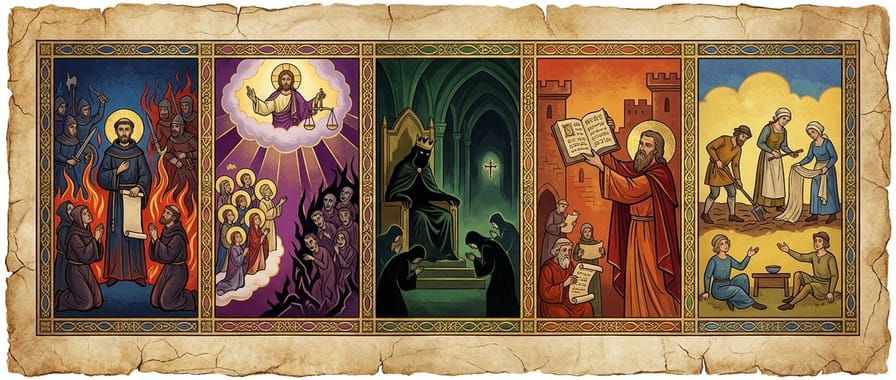
Illustration of the Book of 2 Thessalonians, one of the 27 books of the New Testament (Nano Banana Pro).
The Holy Bible, in its entirety and in each of its parts, is the inspired, inerrant, and authoritative Word of God, according to the **conservative evangelical Protestant perspective**. Each book, though written by human authors in specific historical contexts, carries the divine voice, revealing God's will for humanity and outlining the grand plan of redemption centered in Jesus Christ. Approaching any biblical book, therefore, demands profound reverence, a commitment to careful exegesis, and submission to its supreme authority.
As we turn to the Second Epistle to the Thessalonians, we are invited to delve into a text that, though concise, is of immense theological and pastoral richness. Written by the Apostle Paul, this epistle offers clarity amidst confusion, encouragement in the face of persecution, and practical instruction for Christian living. Far from being a mere repetition of his first letter, 2 Thessalonians addresses urgent issues that arose in the young community of faith in Thessalonica, particularly concerning eschatology and Christian ethics.
This introduction aims to provide a comprehensive and scholarly model framework for the analysis of any biblical book, applying it specifically and in detail to 2 Thessalonians. We will adopt a methodology that prioritizes **traditional authorship**, the **historicity** of events, and **biblical inerrancy**, while engaging with hermeneutical complexities and modern academic criticisms from a **Reformed and Christocentric perspective**. Through this analysis, we will seek not only to understand the original context and doctrinal content of 2 Thessalonians but also to discern its perennial relevance for the Church of Christ in all ages.
The following structure is designed to be a robust guide, allowing the reader to explore the depth of each book of the Bible in a systematic and theologically informed manner. It covers everything from the historical background and authorship, through literary structure and theological themes, to canonical connections and interpretive challenges. Ultimately, it is hoped that this introduction will not only illuminate 2 Thessalonians but also equip the Bible student to approach the Scriptures with greater discernment and faithfulness.
1. Historical Context, Dating, and Authorship
The Second Epistle to the Thessalonians, like all Scripture, did not arise in a vacuum but was produced within a specific historical, social, and cultural context. Understanding these elements is fundamental for faithful exegesis and relevant application. The **conservative evangelical perspective** firmly upholds traditional Pauline authorship, early dating, and the historicity of the events described, in contrast to certain higher-critical approaches that question these foundations.
1.1 Pauline Authorship and Evidence
The authorship of the Second Epistle to the Thessalonians is attributed to Paul, the apostle to the Gentiles, together with Silvanus (Silas) and Timothy, as explicitly stated in the greeting (2 Thessalonians 1:1). This is the majority and traditional position in the Church throughout the centuries. The evidence supporting Pauline authorship is robust, both internal and external.
Internally, the epistle exhibits striking characteristics of Paul's style and theology. The vocabulary and phrase constructions are consistent with other Pauline letters. The pastoral concern for believers, the emphasis on perseverance amidst persecution, the exhortation to holiness, and the eschatological instruction find clear parallels in 1 Thessalonians and other epistles. Furthermore, the letter contains an autograph signature from Paul (2 Thessalonians 3:17), which he uses to authenticate his letters and distinguish them from forgeries – an issue that, as we will see, was particularly relevant to this community. This signature serves as strong evidence against objections to authorship.
Externally, the evidence is equally convincing. The epistle was widely accepted as genuinely Pauline from the earliest centuries of the Church. Church Fathers such as Polycarp, Justin Martyr, Irenaeus, Clement of Alexandria, and Tertullian cited or alluded to 2 Thessalonians, recognizing it as apostolic Scripture. Marcion's Canon (c. 140 AD), though heretical in its foundations, included 2 Thessalonians, demonstrating its early acceptance. The absence of any significant doubt about its authorship in the early centuries is powerful testimony to its legitimacy.
Modern criticisms of Pauline authorship, often based on supposed differences in vocabulary, style, or eschatological theology compared to 1 Thessalonians or other Pauline letters, are, from a **conservative perspective**, insufficient to overturn the overwhelming evidence. Variations can be easily explained by the change in purpose and the specific circumstances that motivated the writing of the second letter. Paul was responding to new and urgent issues, which would naturally lead to adjustments in tone and emphasis. The idea that eschatological differences are so great as to deny Pauline authorship fails to consider the progressive nature of revelation and the apostle's ability to refine and clarify his teachings according to pastoral need.
1.2 Dating and Context of Writing
The Second Epistle to the Thessalonians was written soon after the First Epistle, probably within a period of months. The most accepted dating, consistent with the Pauline chronology in Acts, places the writing between 50 and 51 AD, during Paul's Second Missionary Journey, while he was in Corinth (Acts 18:1-17). This makes 2 Thessalonians one of Paul's earliest epistles, along with 1 Thessalonians and Galatians.
The immediate context of writing is crucial. After sending 1 Thessalonians, Paul received new, worrying news about the church in Thessalonica. Although the first letter had been well-received and had produced encouragement, it also generated new questions and misunderstandings. Three main problems seem to have arisen or intensified:
- Intensified persecution: Believers continued to suffer severe persecution for their faith, leading to discouragement and questioning of divine justice (2 Thessalonians 1:4-10).
- Eschatological confusion: There was a mistaken belief, possibly fueled by a forged letter claiming to be from Paul (2 Thessalonians 2:2), that the "Day of the Lord" had already arrived. This caused great panic and disorder.
- Idleness: Some believers, misinterpreting teachings about Christ's imminent return and the confusion about the Day of the Lord, had abandoned their daily responsibilities and become freeloaders in the community (2 Thessalonians 3:6-12).
Paul writes 2 Thessalonians to directly address these three issues. He seeks to comfort the persecuted, correct erroneous eschatological doctrine, and restore order and discipline among the idle. The apostle, with his **pastoral wisdom** and **apostolic authority**, intervenes to protect the young community of faith from misinformation and harmful conduct.
1.3 Political, Social, and Cultural Context of the Greco-Roman World
The church in Thessalonica was situated in a prominent port city in the Roman province of Macedonia, a vibrant and strategic metropolis on the Via Egnatia, the main east-west route of the Roman Empire. As a free city, Thessalonica enjoyed certain privileges, but its population was a melting pot of Greek, Roman, and Jewish cultures.
The political and social context was one of Roman domination, but with strong Hellenistic influence. Emperor worship was a growing practice and a test of loyalty to the State. The Christians' refusal to participate in these practices, along with their religious exclusivity and their loyalty to "another king, Jesus" (Acts 17:7), made them suspect and often targets of persecution. The Jews of the local synagogue, who had already incited opposition against Paul on his first visit (Acts 17:5-9), continued to be a source of hostility.
Greco-Roman culture, with its values of honor, social status, and work, also played a role. The idea that some believers were living in idleness, at the expense of others, was not only a Christian ethical failing but also a social disgrace in a culture that valued contribution to the community. Preaching the Gospel in such an environment demanded courage and resilience, and the Christian community in Thessalonica, composed primarily of recently converted Gentiles, demonstrated remarkable faithfulness despite adversities. Paul's letter is, therefore, a testament to the power of the Gospel to transform lives and sustain faith amidst a hostile world.
2. Structure, Division, and Main Content
The Second Epistle to the Thessalonians, though brief, is carefully structured, reflecting Paul's clear purpose in addressing the urgent concerns of the church. As an apostolic letter, it follows a common epistolary format, but with a precise theological and pastoral organization that guides the reader through its arguments and exhortations.
2.1 Literary Organization and Division
The letter can be divided into three main sections, each roughly corresponding to a chapter, addressing the problems of persecution, eschatology, and idleness, respectively. This structure is typical of Pauline epistles, which usually begin with greetings and thanksgivings, progress to the doctrinal body, and conclude with ethical exhortations and blessings.
The general structure is as follows:
- 1. Greeting (2 Thessalonians 1:1-2): The standard opening of a Pauline letter, identifying the sender (Paul, Silvanus, and Timothy) and the recipients (the church in Thessalonica), followed by a blessing of grace and peace.
- 2. Thanksgiving and Encouragement in Persecution (2 Thessalonians 1:3-12): Paul expresses gratitude for the Thessalonians' growing faith and love, despite persecution. He comforts them with the promise of divine justice at Christ's return, which will bring relief to the faithful and retribution to the wicked.
- 3. Eschatological Instruction on the Day of the Lord (2 Thessalonians 2:1-17): This is the most theologically dense section. Paul corrects the misunderstanding that the Day of the Lord had already arrived, explaining the events that must precede it: the apostasy and the revelation of the "man of lawlessness." He encourages believers to stand firm in the received truth.
- 4. Final Exhortations and Instructions (2 Thessalonians 3:1-16): Paul makes requests for prayer, expresses confidence in the Lord, and, crucially, addresses the problem of idleness. He instructs the church to discipline those who refuse to work, reaffirming the principle that work is an essential part of Christian life.
- 5. Final Blessing and Personal Greeting (2 Thessalonians 3:17-18): Paul concludes with a blessing and a personal greeting, including his autograph signature as proof of authenticity.
2.2 Narrative or Argumentative Flow
The flow of 2 Thessalonians is primarily argumentative and didactic. Paul is not telling a story, but rather responding to specific problems with **doctrinal instruction** and **ethical exhortation**.
The letter begins with the reaffirmation of a strong pastoral bond, commending the Thessalonians' faith and love. This commendation serves as a basis for the corrections that will follow, showing that Paul's exhortations come from a place of genuine love and concern. The section on persecution (Chapter 1) sets the stage for divine justice, preparing the ground for the eschatological discussion. If God is just and will repay the persecutors, then the Day of the Lord cannot have arrived yet, for they are still suffering.
The transition to Chapter 2 is smooth, with Paul directly addressing the confusion about the Day of the Lord. He dismantles the idea that the Day had already arrived, providing clear criteria for its coming, namely, the apostasy and the revelation of the "man of lawlessness." This doctrinal clarification is vital for calming panic and reaffirming Christian hope.
Finally, Chapter 3 connects eschatological theology with practical ethics. A correct understanding of Christ's coming should not lead to irresponsibility but rather to perseverance and diligent work. Idleness is presented as a misrepresentation of the Gospel message and a threat to the health of the community. Paul concludes with an appeal for discipline and peace, reinforcing the authority of his instructions.
2.3 Synthetic Outline of Content
- I. Greeting and Thanksgiving (1:1-12)
- A. Senders and Recipients (1:1-2)
- B. Thanksgiving for Faith and Love (1:3-4)
- C. Comfort and Justice at Christ's Return (1:5-10)
- D. Prayer for Believers (1:11-12)
- II. Eschatological Clarification (2:1-17)
- A. The Day of the Lord Has Not Arrived (2:1-2)
- B. Preceding Events: The Apostasy and the Man of Lawlessness (2:3-12)
- C. Exhortation to Steadfastness and God's Election (2:13-15)
- D. Prayer for Comfort and Strengthening (2:16-17)
- III. Final Exhortations and Instructions (3:1-18)
- A. Request for Prayer (3:1-2)
- B. Confidence in God's Faithfulness (3:3-5)
- C. Warning Against Idleness (3:6-12)
- D. Exhortation to Perseverance and Discipline (3:13-15)
- E. Blessing of Peace and Personal Greeting (3:16-18)
This outline reveals Paul's logical progression, who first comforts and praises, then doctrinally corrects, and finally ethically exhorts. The letter is an excellent example of how theology (what we believe) should inform and shape practice (how we live).
3. Central Theological Themes and Purpose
The Second Epistle to the Thessalonians, despite its brevity, is a rich source of theological teaching, addressing crucial issues that continue to resonate in the contemporary church. From a **Protestant evangelical perspective**, the letter's central themes are deeply rooted in the sovereignty of God, the centrality of Christ, and human responsibility.
3.1 Eschatology and the Day of the Lord
This is, without doubt, the most prominent theme and the primary reason for the letter's writing. Paul seeks to correct a serious misunderstanding: the belief that the "Day of the Lord" had already arrived (2 Thessalonians 2:2). This confusion, possibly fueled by false letters or teachings, was causing panic and disorder in the community.
Paul clarifies that the Day of the Lord, which will culminate in the second coming of Christ (the parousia), will not come until two crucial events occur: the "apostasy" (a great rebellion or religious falling away) and the revelation of the "man of lawlessness," also known as the "son of destruction" (2 Thessalonians 2:3). This "man of lawlessness" is an eschatological figure who will oppose everything divine, exalt himself above God, and sit in the temple of God, proclaiming himself to be God (2 Thessalonians 2:4). He will operate with satanic power, performing deceptive signs and wonders to delude those who perish because they did not love the truth (2 Thessalonians 2:9-10).
The apostle also mentions a "restrainer" (2 Thessalonians 2:6-7) who, at present, hinders the full manifestation of the man of lawlessness. The exact identity of the restrainer has been a subject of theological debate (Holy Spirit, Roman government, angels), but the central point is that God has sovereign control over history and final events. Christ's coming, when it occurs, will be a glorious and unmistakable event, in which He will destroy the man of lawlessness with the breath of His mouth and annihilate him by the splendor of His coming (2 Thessalonians 2:8). Paul's eschatology here is, therefore, an eschatology of **hope** and **divine justice**, not of panic.
3.2 God's Sovereignty and Divine Justice
Amidst the persecution the Thessalonians were suffering, Paul reaffirms **God's sovereignty** over history and the destiny of humanity, and the certainty of His **divine justice**. God is not indifferent to the suffering of His people; He is a righteous judge who will repay each one according to their deeds.
Paul assures that the persecution believers face is evidence of God's righteous judgment, so that they may be considered worthy of the Kingdom of God (2 Thessalonians 1:5). At Christ's return, the persecuted will receive relief, while the persecutors, "those who do not know God and do not obey the gospel of our Lord Jesus" (2 Thessalonians 1:8), will suffer the penalty of eternal destruction, cut off from the presence of the Lord and the glory of His might (2 Thessalonians 1:9).
This doctrine of **divine retribution** is not merely a threat but a source of comfort for the afflicted and a demonstration of God's moral perfection. God's justice is also manifest in His **election** and **grace**: He chose the Thessalonians from the beginning for salvation, through sanctification by the Spirit and belief in the truth (2 Thessalonians 2:13). God's sovereignty guarantees the perseverance of the saints and the fulfillment of His purposes, even in the face of evil and opposition.
3.3 Sanctification and Ethical Responsibility
Eschatological theology and the doctrine of divine justice do not lead to passivity but rather to **sanctification** and **ethical responsibility**. Paul dedicates a significant part of the letter to exhorting the Thessalonians to live in a manner worthy of their calling, combating idleness.
The problem of idleness (2 Thessalonians 3:6-12) is central. Some believers, perhaps due to a mistaken understanding of the imminence of Christ's return, had stopped working, living at the community's expense and causing disorder. Paul severely warns them, establishing a clear principle: "If anyone is unwilling to work, neither should he eat" (2 Thessalonians 3:10). He recalls his own example of diligent work while he was among them (2 Thessalonians 3:7-9), demonstrating that honest work is a testimony to the Gospel and a way of not being a burden to anyone.
This exhortation is not just about physical labor but about an ethics of responsible and productive living. Faith in Christ is not an excuse for irresponsibility but the motivation for a life of service, discipline, and contribution to the community. **Progressive sanctification** is a process that involves the transformation of daily conduct, reflecting the character of Christ in all spheres of life. The letter, therefore, connects future hope with present responsibility, emphasizing that waiting for the Lord's coming should be active and productive.
3.4 Primary Purpose of the Book
The primary purpose of 2 Thessalonians is multifaceted, but clearly focused on three interrelated objectives:
- Correct eschatological confusion: Paul urgently desired to clarify misunderstandings about the Day of the Lord, calming panic and refuting false teachings that claimed Christ's coming had already occurred or was imminent in a way that justified irresponsibility.
- Comfort and encourage persecuted believers: The church was suffering intensely. Paul seeks to strengthen their faith, reminding them of God's justice and the future glory that awaits them, assuring them that their suffering was not in vain.
- Exhort to perseverance in faith and ethical conduct: Combat idleness and disorder, encouraging believers to live in a manner worthy of the Gospel, working diligently and maintaining discipline in the community.
In essence, 2 Thessalonians is a letter of **doctrinal correction**, **pastoral comfort**, and **practical exhortation**, aiming to stabilize a young church amidst external and internal challenges.
4. Relevance and Canonical Connections
The Second Epistle to the Thessalonians, though one of the shortest books in the Pauline canon, possesses lasting canonical and theological relevance. It is not an isolated island but is intrinsically connected to other parts of Scripture, reinforcing major themes of **biblical theology** and offering crucial insights for the church of all ages.
4.1 Importance of the Book within the Complete Canon
Within the New Testament canon, 2 Thessalonians plays a vital role in the development of **Pauline eschatology**. Although 1 Thessalonians introduces the doctrine of Christ's second coming, it is in 2 Thessalonians that Paul offers additional details and essential corrections to prevent speculation and panic. Without this letter, our understanding of the events preceding the parousia – the apostasy and the revelation of the man of lawlessness – would be significantly poorer. It serves as a necessary counterpoint to extremist or naive interpretations of eschatology.
Beyond eschatology, the letter reinforces the importance of **Christian ethics** and **ecclesiastical discipline**. The exhortation against idleness and the instruction on how to deal with undisciplined members are timeless principles for the health and witness of the church. It demonstrates that genuine faith is manifested in works and in a lifestyle that honors God and contributes to the well-being of the community. The letter also underscores the authority of the **apostolic word** as a standard for Christian truth and conduct.
4.2 Typological Connections with Christ and Christocentric Reading
Although 2 Thessalonians does not contain explicit Old Testament typologies, its reading is profoundly **Christocentric**. The focal point of the letter's eschatological hope is the glorious return of Jesus Christ. It is He who will come with His mighty angels in blazing fire (2 Thessalonians 1:7), to inflict vengeance on those who do not know God and on those who do not obey the gospel (2 Thessalonians 1:8). It is He who will come to be glorified in His saints and marveled at among all who believe (2 Thessalonians 1:10).
Furthermore, the "man of lawlessness" is destroyed "by the breath of the Lord Jesus' mouth and annihilated by the splendor of His coming" (2 Thessalonians 2:8). Christ is the victorious sovereign over all forces of evil and rebellion. The salvation of believers is "through sanctification by the Spirit and belief in the truth" (2 Thessalonians 2:13), and they are called to obtain the glory of our Lord Jesus Christ (2 Thessalonians 2:14). The final blessing of peace comes from the "Lord of peace" (2 Thessalonians 3:16).
Therefore, the letter not only points to Christ as the center of eschatology but also as the source of all grace, peace, comfort, and strength for present Christian life. **Christocentric faith** is the foundation of perseverance amidst persecution and hope in the face of tribulation.
4.3 New Testament Fulfillments and Allusions
2 Thessalonians, being part of the New Testament itself, does not contain "fulfillments" of Old Testament prophecies in the same sense as the Gospels, but it does make allusions and develops themes that have roots in the Old Testament and are echoed in other parts of the NT.
The figure of the "man of lawlessness" (2 Thessalonians 2:3) has clear parallels with Daniel's prophecies of the "little horn" (Daniel 7:8, 24-25; 8:9-12) and the "king who will do as he pleases" in Daniel 11:36-39, as well as with the "beast" from the book of Revelation (Revelation 13). The idea of an "apostasy" before the final events also finds resonance in other NT passages that warn about false teachings and the abandonment of faith in the last days (1 Timothy 4:1; 2 Timothy 3:1-5; Jude 1:17-19).
The warnings against idleness in 2 Thessalonians 3:6-12 complement and expand upon Paul's teachings in 1 Thessalonians 4:11-12 and align with the work ethic found in Old Testament Proverbs (e.g., Proverbs 6:6-11). The letter is cited or alluded to in later writings, demonstrating its continuing authority. For example, the emphasis on perseverance in the face of persecution and the expectation of divine justice resonate with the general message of encouragement for the early Church.
4.4 Relevance for the Contemporary Church
The relevance of 2 Thessalonians for the contemporary church is notable and multifaceted:
- Steadfastness in eschatological truth: In an era of rampant speculation, conspiracy theories, and eschatological panic, the letter offers a crucial reminder of the need for discernment and faithfulness to biblical revelation. It warns us against gullibility and the acceptance of false teachings, encouraging us to "stand firm and hold to the traditions that you were taught" (2 Thessalonians 2:15).
- Comfort in persecution: In many parts of the world, Christians continue to suffer severe persecution. 2 Thessalonians offers a powerful message of encouragement, reminding them of God's justice and future glory, assuring them that their suffering is not in vain and that God will reward them.
- Work ethic and responsibility: The exhortation against idleness continues to be a challenge for the modern church. In a society that often values pleasure over duty or fosters dependency, Paul's letter reaffirms the dignity of work and the responsibility of each believer to contribute to their sustenance and to the good of the community. It combats a mentality of "entitlement" without effort.
- God's sovereignty over evil: In a world where evil seems to prevail, 2 Thessalonians reminds us that God is sovereign. He not only restrains evil but will also judge it in His perfect justice. This offers a solid foundation for **theocentric confidence**, even when circumstances seem grim.
- Authority of the Word of God: The letter, with its defense of apostolic authenticity and its warning against forgeries, reinforces the importance of the **inerrancy** and **authority** of Scripture as the only infallible rule of faith and practice.
Thus, 2 Thessalonians remains a prophetic and pastoral voice, guiding believers to live with hope, responsibility, and discernment as they await the glorious return of their Lord.
5. Hermeneutical Challenges and Critical Issues
The Second Epistle to the Thessalonians, like any ancient and inspired text, presents its own hermeneutical challenges. Faithful interpretation requires not only knowledge of Greek and the historical context but also a commitment to **biblical inerrancy** and an approach that seeks to understand the author's original intention for their original audience, under the guidance of the Holy Spirit.
5.1 Specific Interpretive Difficulties of the Book
The main interpretive difficulties in 2 Thessalonians focus on chapter 2, which deals with eschatology:
- The identity of the "man of lawlessness" (2 Thessalonians 2:3-12): This is, perhaps, the most debated question. Who or what is this figure?
- Pre-Reformation perspective: Many identified him with the Antichrist.
- Historical perspective: Some reformers identified him with the Papacy or the papal system, or with other anti-Christian movements throughout history.
- Futurist perspective: The most common view today in conservative evangelical theology is that he is a specific individual, yet to be revealed, who will emerge in the last days before Christ's second coming, as the final Antichrist. He will be a political and religious figure who will demand worship and oppose God.
- Preterist perspective: Some suggest that he was Nero or Caligula, or the Jewish high priest. However, Paul's description seems to point to a figure of eschatological proportions that has not yet fully manifested.
The **conservative evangelical perspective** tends to favor the futurist interpretation, viewing the "man of lawlessness" as the final and culminating manifestation of the antichrist spirit that is already at work in the world (1 John 4:3), but who will be fully revealed only before the parousia.
- The identity of the "restrainer" (2 Thessalonians 2:6-7): Equally enigmatic. Who or what is preventing the full manifestation of the man of lawlessness?
- The Holy Spirit: Many see the Holy Spirit as the restrainer, acting through the Church to contain evil.
- The Roman Empire/Human government: Others argue that it was the power of the Roman State that maintained order and prevented chaos. This view has been extended to human governments in general, which, by their nature, impose some order.
- Archangel Michael or angelic forces: Some suggest it is an angelic figure who restrains evil, based on passages like Daniel 10.
- The Church: The Church, being the body of Christ and indwelt by the Holy Spirit, acts as a salt and light that restrains the world's corruption.
The **Reformed perspective** often leans towards the view of the Holy Spirit (possibly acting through the Church) or human government as divine instruments of restraint, recognizing God's sovereignty in controlling time and circumstances. The crucial point is that God has a plan and a timetable, and He is in control.
- The "apostasy" (2 Thessalonians 2:3): Does it refer to a specific "falling away" or a widespread apostasy from the faith?
Most evangelical interpreters understand it to refer to a great and widespread rebellion against the Christian faith and the truth of God that will occur before Christ's return. It is not just an individual falling away, but a large-scale movement of abandonment of faith.
- The nature of the Lord's coming: Implication for the debate about the rapture (pre-, mid-, or post-tribulationist).
Paul states that the Day of the Lord will not come before the apostasy and the revelation of the man of lawlessness. This has implications for rapture theories. The **evangelical perspective** embraces diverse views on the rapture, but all agree that Christ's coming is a future and glorious event. 2 Thessalonians serves to temper excessive enthusiasm for an "imminence" that disregards preceding signs, but maintains the expectation of Christ's coming as the blessed hope.
5.2 Questions of Literary Genre and Cultural Context
As an epistle, 2 Thessalonians must be interpreted as a personal and pastoral communication from Paul to a specific church. The rules for interpreting letters include:
- Identify sender, recipients, and purpose.
- Recognize the situational nature of the letter: Paul is responding to concrete problems and not writing a systematic treatise. This explains why he does not exhaustively detail every eschatological point, but focuses on what was relevant to the Thessalonians' confusion.
- Understand apostolic authority: Paul speaks with the authority of an apostle of Christ, and his instructions are normative for the church.
The Greco-Roman cultural context, as discussed previously, is vital for understanding persecution and the issue of idleness. The social shame associated with lack of work and the threat of disorder in the community were real concerns that Paul directly addressed.
5.3 Faithful Evangelical Response to Skeptical Criticisms
Skeptical criticisms, often associated with higher criticism, challenge Pauline authorship, biblical inerrancy, and the historicity of certain events. A **faithful evangelical response** to these criticisms is based on:
- Affirmation of inerrancy and inspiration: The Bible is the unerring Word of God in its original manuscripts. This means that issues raised by criticism must be approached with the presupposition that Scripture is true and consistent.
- Defense of traditional authorship: As already argued, the internal and external evidence for Pauline authorship is strong and outweighs objections based on stylistic variations or vocabulary, which can be explained by changes in context and purpose.
- Theological coherence: Although 2 Thessalonians presents specific eschatological details, its theology is consistent with the rest of the Pauline corpus and broader biblical theology, especially in its emphasis on God's sovereignty, divine justice, and the centrality of Christ.
- Interpretation of genre: Criticisms that view eschatological descriptions as "mythological" or "incoherent" fail to appreciate the apocalyptic and prophetic genre of the passage, which uses symbolic language to describe future realities, but with a clear didactic purpose.
The evangelical approach does not ignore difficulties but confronts them with a hermeneutic committed to the authority of Scripture and the pursuit of historical and theological truth.
5.4 Hermeneutical Principles for Correct Interpretation
To correctly interpret 2 Thessalonians, the following hermeneutical principles should be applied:
- Historical-grammatical interpretation: Understanding the meaning of words in their grammatical and historical-cultural context. What did the text mean to the original audience?
- Immediate and canonical context: Interpreting difficult passages (especially eschatological ones) in light of the broader context of the letter, the Pauline corpus, and the complete biblical canon. Let Scripture interpret Scripture.
- Principle of unity and coherence: Recognizing that the Bible is a cohesive unity, and that the doctrines presented in 2 Thessalonians are consistent with general biblical theology.
- Recognition of literary genre: Understanding that the letter is an epistle, and its prophetic sections (chapter 2) should be interpreted with due consideration for the use of symbolic and imagery language.
- Hermeneutical humility: Recognizing that, in complex eschatological passages, there may be different legitimate interpretations among faithful believers. The focus should be on the central message of hope and warning, and not on the dogmatization of secondary details.
- Theocentric and Christocentric application: Interpretation should always point to the glory of God and the centrality of Jesus Christ as Lord of history and salvation.
By following these principles, the Bible student can approach 2 Thessalonians with confidence, drawing out its rich message for personal and Church edification.