


耶利米书
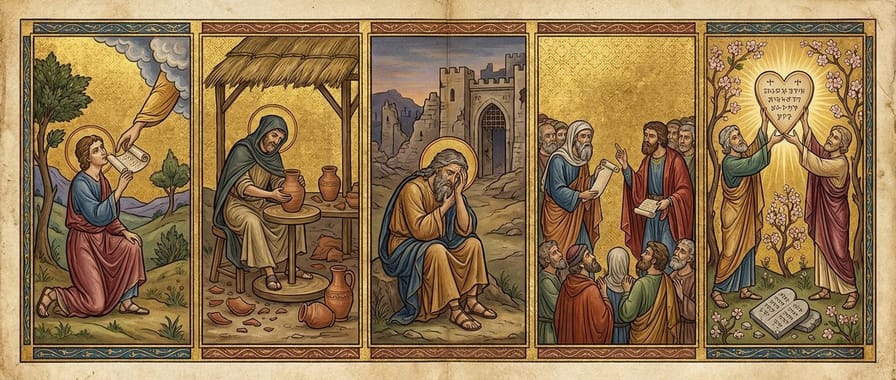
Illustration of the Book of Jeremiah, one of the 39 books of the Old Testament (Nano Banana Pro).
The present introduction aims to offer a comprehensive and scholarly analysis of the prophetic book of Jeremiah, grounded in a conservative evangelical Protestant perspective. The intention is not only to unveil the theological and historical riches of this vital Old Testament text, but also to establish a structural model of analysis that can be applied to any book of the Holy Bible. By approaching Jeremiah with academic rigor and theological devotion, we seek to highlight its inerrancy, its historical relevance, and its profound Christocentric resonance, essential elements for a full understanding of the Scriptures.
The book of Jeremiah emerges from a period of unprecedented turbulence and crisis in Judah's history, serving as a prophetic echo of God's voice amidst apostasy and moral decline. Its message, although primarily directed to a specific people at a determined time, transcends temporal and cultural barriers, offering eternal principles about divine sovereignty, the nature of human sin, God's justice, and the unwavering promise of restoration through a New Covenant. The complexity of the book, with its alternations between oracles of judgment, the prophet's personal laments, and biographical narratives, demands a careful and multifaceted approach.
In this introduction, we will defend traditional positions of authorship and dating, responding to the criticisms of modern higher criticism based on internal and external evidence, and reaffirming the integrity and authority of the biblical text. We will explore Jeremiah's unique literary structure, its central theological themes that align with Reformed systematic theology, and its canonical connections that culminate in the person and work of Jesus Christ. Finally, we will address the inherent hermeneutical challenges of the text, offering principles for a faithful and relevant interpretation for the contemporary church. May this journey through the book of Jeremiah enrich our understanding of God's Word and deepen our faith in the Lord of history.
1. Historical Context, Dating, and Authorship
The book of Jeremiah cannot be fully understood without a deep immersion in the turbulent historical setting of the late seventh and early sixth centuries B.C. The prophet Jeremiah was called by God at a critical moment, to be the divine voice amidst a nation in irreversible decline. This period was marked by intense geopolitical changes in the Ancient Near East, culminating in the fall of the Kingdom of Judah and the Babylonian exile, events that profoundly shaped Jeremiah's message and ministry.
1.1 The Period of Writing and the Geopolitical Landscape
Jeremiah's prophetic ministry spanned over forty years, beginning in the thirteenth year of the reign of Josiah (approximately 627/626 B.C.) and continuing through the reigns of Jehoiakim, Jehoiachin, and Zedekiah, until the fall of Jerusalem in 586 B.C. and, subsequently, among the exiles in Egypt. This vast temporal scope gives the book a unique perspective on the collapse of a nation and the execution of divine judgment.
At the beginning of Jeremiah's ministry, the once-dominant Assyrian Empire was in rapid decline. In 612 B.C., Nineveh, the Assyrian capital, fell to a Medo-Babylonian coalition, marking the end of an era. This rise of Babylonian power, under Nabopolassar and, later, Nebuchadnezzar II, and the concomitant rivalry with Egypt, created an environment of instability and uncertainty for Judah, which found itself squeezed between these two world powers.
The Battle of Carchemish, in 605 B.C., in which Babylon decisively defeated Egypt, sealed Judah's fate, as it became a vassal state of Babylon. Judah's subsequent rebellions, instigated by pro-Egypt factions, led to the three main exiles: in 605 B.C. (including Daniel), 597 B.C. (including Ezekiel and King Jehoiachin), and, finally, 586 B.C., with the destruction of Jerusalem and the Temple.
1.2 Traditional Authorship and the Role of Baruch
Conservative evangelical tradition upholds Jeremiah's authorship for the book that bears his name. Although the prophet did not physically write every word with his own hand, the book repeatedly attests that Jeremiah dictated his prophecies to Baruch, son of Neriah, his scribe and loyal companion. Jeremiah 36:4 and Jeremiah 45:1 are crucial passages that confirm this collaboration, indicating that Baruch recorded Jeremiah's words on scrolls.
The composition process, therefore, was not monolithic, but involved the prophet dictating, Baruch writing, and, in some cases, editing or organizing the material. The destruction of the first scroll of prophecies by King Jehoiakim (Jeremiah 36:23) and the subsequent rewriting and addition of "many similar words" (Jeremiah 36:32) demonstrate a dynamic process of authorship and redaction under divine inspiration.
This perspective recognizes the human hand in the organization and transmission of the text, but safeguards its prophetic and, ultimately, divine origin. The essential unity of the book is maintained, as it reflects the voice and coherent message of a single prophet, even if compiled and edited over time by him and his associates, under the guidance of the Holy Spirit. The presence of third-person narrative sections does not contradict Jeremiah's authorship, as it is common in ancient texts for the author to refer to himself in this way or for a scribe to compile and organize the material.
1.3 Response to Higher Critical Challenges
Modern higher criticism often questions the unity of the book of Jeremiah, suggesting multiple authors, extensive post-exilic redaction, and even the existence of a "Deuteronomist" who would have influenced or edited the text. The differences between the Masoretic Text (MT) and the Septuagint (LXX), where the LXX is about one-eighth shorter and presents a different order of prophecies against the nations, are often cited as evidence of a complex and fragmented composition process.
However, a faithful evangelical response argues that such variations do not compromise the inerrancy and essential authorship of Jeremiah. The differences between MT and LXX are better understood as textual or recensional variations, common in the transmission of ancient texts, where the MT is generally considered closer to the original Hebrew text. The complexity of the book can be attributed to Jeremiah's long ministry and the compilation process by Baruch, who may have organized the material thematically rather than strictly chronologically, a common practice in prophetic literature.
Conservative scholarship points to the theological and stylistic consistency of the book, the intimate familiarity with the historical period, and Jeremiah's distinctive prophetic voice that permeates the entire text. The idea of a "Deuteronomist" editor is speculative and lacks a solid basis for denying prophetic authorship. The discovery of seals belonging to Baruch and Gemariah (son of Shaphan, a royal scribe) in archaeological excavations, while not directly proving biblical authorship, corroborates the existence of these individuals and the writing environment described in the book, strengthening the credibility of the biblical narrative.
2. Structure, Division, and Main Content
The book of Jeremiah, although at times appearing disorganized due to its non-linear structure and alternation between different literary genres, possesses an internal cohesion that reflects the prophet's multifaceted message. Its organization, though not strictly chronological, is theologically directed, revealing God's purpose in judgment and restoration.
2.1 Literary Organization and Genres
Jeremiah is predominantly a prophetic book, but it integrates a rich tapestry of literary genres that enrich its message. We find in it:
- Oracles of Judgment and Salvation: Divine declarations about Judah's sin and impending consequences, as well as promises of a future hope.
- Laments and Confessions: The famous "confessions of Jeremiah," where the prophet expresses his anguish, frustration, and questions to God in the face of the rejection of his message and his own suffering.
- Biographical Narratives: Sections that recount events from Jeremiah's life, his interactions with kings, priests, and the people, and the challenges of his ministry. These are often written in the third person.
- Parables and Symbols: Symbolic acts (the ruined belt, the potter's jar, the yoke) and parables that illustrate God's message vividly and memorably.
- Prayers: Supplications and intercessions of the prophet on behalf of his people, even when judgment is inevitable.
This diversity of genres contributes to the book's density and depth, allowing the divine message to be conveyed in various ways, appealing to both the reason and emotion of readers.
2.2 Main Divisions and Narrative Flow
While there is no absolute consensus on a single linear structure for Jeremiah, most commentators identify thematic and content divisions that help navigate the book. A common structure, reflecting the flow of the message and events, can be outlined as follows:
- The Call and Commission of the Prophet (Chapter 1): Introduction to the prophet, his divine calling, and the nature of his message, which is both to uproot and tear down, and to build and plant.
- Prophecies Against Judah and Jerusalem (Chapters 2-25): This is the largest section of the book, containing oracles of judgment that denounce the idolatry, social injustice, and apostasy of the people. Jeremiah cries out for repentance, warning of the inevitability of Babylonian judgment. The prophet's "confessions" are also interwoven into this section.
- Biographical Narratives and Jeremiah's Suffering (Chapters 26-45): This section focuses more on Jeremiah's life and ministry, detailing his interactions with the kings of Judah, his imprisonment, the destruction of Jerusalem, and his fate after the fall of the city. It includes the episode of the burned scroll and the letters to the exiles.
- Prophecies Against the Nations (Chapters 46-51): Oracles of judgment against Judah's neighboring nations (Egypt, Philistia, Moab, Ammon, Edom, Damascus, Elam) and, prominently, against Babylon. These prophecies demonstrate God's sovereignty over all history and over all peoples.
- Historical Appendix (Chapter 52): A historical summary of the fall of Jerusalem and the exile, which serves as a confirmation of the fulfillment of Jeremiah's prophecies and is almost identical to 2 Kings 25.
This flow, though thematic and sometimes anachronistic, allows the reader to follow the progression of the message from judgment to its fulfillment, and the subsequent promise of restoration that points to a future of hope.
2.3 Synthetic Outline of Content
To facilitate understanding the vast scope of the book of Jeremiah, a synthetic outline can be helpful:
- Part I: The Call and the Denunciation of Sin (Chapters 1-25)
- 1:1-19: Jeremiah's call and commission.
- 2:1-6:30: Judah's sins and the threat of the "enemy from the North."
- 7:1-10:25: The Temple Sermon and idolatry.
- 11:1-13:27: Breaking the covenant and symbolic acts.
- 14:1-17:27: The drought, false prophecies, and the deceitful heart.
- 18:1-20:18: The potter and the jar, and Jeremiah's confessions.
- 21:1-24:10: Prophecies against the kings and the baskets of figs.
- 25:1-38: Seventy years of captivity and the cup of wrath.
- Part II: The Prophet Amidst Crisis and the Promise of Restoration (Chapters 26-45)
- 26:1-24: Jeremiah threatened with death.
- 27:1-29:32: The Babylonian yoke and the letter to the exiles.
- 30:1-33:26: The "Book of Consolation" and the New Covenant.
- 34:1-35:19: The release of slaves and the Rechabites.
- 36:1-32: Jeremiah's scroll burned.
- 37:1-38:28: Jeremiah's imprisonment and the fall of Jerusalem.
- 39:1-40:6: The destruction of Jerusalem and Jeremiah's fate.
- 40:7-45:5: Jeremiah in Egypt and the message to Baruch.
- Part III: Judgment on the Nations (Chapters 46-51)
- 46:1-49:39: Oracles against Egypt, Philistia, Moab, Ammon, Edom, Damascus, Kedar, Hazor, and Elam.
- 50:1-51:64: The oracle against Babylon.
- Part IV: Historical Appendix (Chapter 52)
- 52:1-34: The fall of Jerusalem and Jehoiachin's exile.
This outline demonstrates the breadth of Jeremiah's message, spanning from the denunciation of sin to the promise of a future hope that transcends present judgment.
3. Central Theological Themes and Purpose
The book of Jeremiah is a theological treasure, filled with profound truths about the nature of God, the human condition, and the divine plan for redemption. Its message, though contextualized in Judah's crisis, offers timeless insights that resonate with Reformed systematic theology and are of vital importance for the Christian faith.
3.1 God's Sovereignty and Human Depravity
One of the most prominent themes in Jeremiah is God's sovereignty over history and nations. God is portrayed as the Potter who has power over the clay (Jeremiah 18:1-12), shaping and reshaping the destinies of individuals and peoples according to His will. He raises empires like Babylon to be instruments of His judgment (Jeremiah 25:9), and also brings them down. This view of divine sovereignty is a pillar of Reformed theology, which affirms God's absolute authority over all things, without diminishing human responsibility.
In direct contrast to divine majesty, Jeremiah exposes the depth of human depravity. The heart is described as "deceitful above all things and desperately wicked" (Jeremiah 17:9). Judah is portrayed as an unfaithful wife who prostituted herself with other gods (Jeremiah 2:20-25), and a people who refuse to repent, even in the face of clear warnings. This description of the radical corruption of the human heart is fundamental to the Reformed doctrine of original sin and man's inability to save himself by his own merits, needing God's sovereign grace for salvation.
3.2 Divine Judgment and Covenant Faithfulness
The imminence and inevitability of divine judgment are constant in Jeremiah's message. The prophet is the herald of God's wrath against Judah's persistent sin. Judgment is not arbitrary, but a just consequence of the breaking of the Mosaic covenant. God had promised blessings for obedience and curses for disobedience (Deuteronomy 28), and Jeremiah proclaims the fulfillment of the latter. Babylon is not just a political enemy, but God's "hammer" (Jeremiah 50:23), the instrument of His justice to purify His people.
However, even amidst the most severe judgment, God's faithfulness to His covenant and His promises of restoration shines through. Judgment is not an end, but a means to a greater purpose. God promises that, after the seventy years of Babylonian captivity, He will restore His people (Jeremiah 29:10-14). This promise of restoration, despite Israel's unfaithfulness, underscores the unwavering nature of God's covenantal love, a central theme in Reformed theology of grace and election.
3.3 The New Covenant and Messianic Hope
The apex of Jeremiah's theological message, and one of his greatest legacies to the biblical canon, is the prophecy of the New Covenant in Jeremiah 31:31-34. This future covenant contrasts with the old Mosaic covenant, which was broken by Israel. The New Covenant will be different in its nature:
- It will be an internal covenant, written on hearts, not on tablets of stone.
- It will result in an intimate and universal knowledge of God, where "all will know Me."
- It will involve the complete forgiveness of sin: "I will remember their sins no more."
This prophecy is fundamentally Christocentric. It points to the work of Jesus Christ, who, through His sacrifice on the cross, established the New Covenant (Luke 22:20). The Holy Spirit, poured out at Pentecost, is the one who writes God's law on the hearts of believers, enabling them to obey and to know God in a personal and transformative way. Reformed theology views the New Covenant as the consummation of the Covenant of Grace, progressively revealed throughout salvation history, and fulfilled in Christ.
Beyond the New Covenant, Jeremiah also offers promises of a coming Messiah. He prophesies about a "Righteous Branch" from the lineage of David, who will reign with wisdom and justice (Jeremiah 23:5-6; Jeremiah 33:15-16). This Branch is Jesus Christ, the true King and Priest, who would bring justice and salvation to His people. The Messianic hope in Jeremiah is a light amidst the darkness of judgment, a reminder that God's redemptive plan is infallible and will culminate in the coming of His Anointed One.
3.4 The Primary Purpose of the Book
The primary purpose of the book of Jeremiah for the original audience was threefold:
- To confront Judah with its sin and call for repentance: Jeremiah tirelessly exposed the idolatry, injustice, and hypocrisy of the people, calling them to return to the Lord before it was too late.
- To warn about impending judgment and the inevitability of exile: The prophet was sent to prepare the people for the destruction of Jerusalem and the Babylonian captivity, explaining that these events were not accidental, but God's righteous judgment.
- To offer hope of restoration and future redemption: Even amidst the most severe warnings, Jeremiah conveyed God's promises of a return from exile and, more significantly, of a New Covenant that would transform hearts and establish an eternal relationship with God.
In summary, Jeremiah is a book that balances the seriousness of divine judgment with the depth of God's mercy, pointing to the need for a transformed heart and the hope found only in God's faithfulness and His provision of a new covenant.
4. Relevance and Canonical Connections
The importance of the book of Jeremiah within the biblical canon goes far beyond its historical value as a record of Judah's end. It acts as a crucial bridge between the covenants, deepening the understanding of sin and grace, and, preeminently, foreshadowing the person and work of Jesus Christ. Its message resonates powerfully with New Testament theology and continues to be profoundly relevant for the contemporary church.
4.1 Importance within the Canon and Christocentric Typology
Jeremiah is one of the "major prophets" and holds a central place in understanding Old Testament theology, especially regarding judgment, exile, and Messianic hope. He deepens the understanding of the nature of the Mosaic covenant and Israel's failure to uphold it, preparing the ground for the need for a superior covenant. His message provides the historical and theological backdrop for understanding the post-exilic books and the Messianic expectation that permeated Second Temple Judaism.
From a Christocentric perspective, Jeremiah is rich in typology. The prophet himself, known as the "weeping prophet," typifies Christ in His suffering and rejection. Jeremiah is called to preach an unpopular message, face persecution, and be a living sign of God's judgment, just as Jesus would be rejected by His own people and suffer for the truth He proclaimed. Jeremiah's anguish in the streets of Jerusalem echoes Jesus' lament over the city (Luke 19:41-44).
More directly, the promise of the "Righteous Branch" from the lineage of David (Jeremiah 23:5-6; Jeremiah 33:15-16) is a clear Messianic prophecy, fulfilled in Jesus Christ. He is the righteous King who will reign with wisdom, justice, and righteousness, bringing salvation and security to His people. His coming is the culmination of the hope for a divine and perfect government.
4.2 New Testament Fulfillments and Allusions
The most explicit and significant connection of Jeremiah to the New Testament is the prophecy of the New Covenant in Jeremiah 31:31-34. This passage is extensively quoted and explained in Hebrews 8:8-12 and Hebrews 10:16-17, where the author of Hebrews argues that the New Covenant, established by Christ through His sacrifice, is superior to the Old Covenant. Jesus is the Mediator of this superior covenant, which provides forgiveness of sins and an inner transformation, where the law of God is written on the hearts of believers.
Jesus Himself refers to the "new covenant in My blood" (Luke 22:20) during the Last Supper, directly linking His sacrificial death to Jeremiah's prophecy. Paul also alludes to this inner transformation in 2 Corinthians 3:6, contrasting the "letter" that kills with the "Spirit" that gives life, echoing the idea of the law written on hearts.
Other allusions to Jeremiah in the New Testament include:
- Matthew 2:17-18 quotes Jeremiah 31:15 ("A voice was heard in Ramah, weeping and loud lamentation, Rachel weeping for her children and refusing to be comforted...") in reference to Herod's massacre of the innocents.
- Matthew 27:9-10 makes a complex allusion to Jeremiah 32:6-15 (purchase of the field) and Zechariah 11:12-13 (thirty pieces of silver) in relation to Judas's betrayal and the purchase of the potter's field. Although Matthew attributes it to Jeremiah, it is a fusion of prophetic texts that highlights the fulfillment of prophecy in Christ's passion.
- The language about the "hardened heart" and the need for a new heart, though also present in Ezekiel, finds an echo in Pauline theology of regeneration and new birth (Romans 2:29; Colossians 2:11-12).
These connections demonstrate that Jeremiah is not an isolated book, but an integral part of God's redemptive narrative, consistently pointing to its consummation in Christ.
4.3 Relevance for the Contemporary Church
Jeremiah's message, despite its antiquity, remains surprisingly relevant for the contemporary church.
- The persistence of sin and the need for repentance: Jeremiah's denunciation of idolatry, social injustice, and superficial religiosity in Judah serves as a mirror for the church and society today. The warning against self-sufficiency and religious presumption is a constant reminder of the need for genuine repentance and a living faith.
- God's sovereignty over history: In a world that often seems chaotic and out of control, Jeremiah reaffirms God's sovereignty over nations and historical events. He reminds us that God is on the throne, ruling with justice and purpose, even amidst crises and sufferings. This offers comfort and encouragement to believers.
- The centrality of the New Covenant: Understanding the New Covenant in Jeremiah deepens the appreciation of Christ's work and the gospel. The contemporary church is the New Covenant community, and its life should be shaped by the law written on hearts and by an intimate knowledge of God through the Holy Spirit.
- The call to radical discipleship: Jeremiah's life, marked by suffering, rejection, and unwavering faithfulness to God, is a model of radical discipleship. He challenges us to remain faithful to God's Word, even when unpopular, and to embrace the cost of following Christ in a hostile world.
- The importance of prophetic preaching: Jeremiah reminds us of the need for courageous and prophetic preaching that confronts sin, calls for repentance, and proclaims the hope of the gospel, without diluting the truth to please listeners.
Thus, the book of Jeremiah is not merely a historical monument, but a living voice that continues to speak to the church, exhorting it to faithfulness and pointing it to the glory of its Redeemer.
5. Hermeneutical Challenges and Critical Issues
The interpretation of the book of Jeremiah, like that of many other prophetic Old Testament texts, presents a series of hermeneutical challenges and has been the subject of various critical issues throughout the history of biblical scholarship. A faithful evangelical approach must acknowledge these difficulties, but also provide robust answers that uphold the inerrancy and authority of the Scriptures.
5.1 Specific Interpretational Difficulties of the Book
Several inherent characteristics of Jeremiah can make its interpretation complex:
- Non-chronological structure: The book does not follow a strictly linear order of events or prophecies. Oracles from different periods and biographical narratives are often interspersed, which requires the reader to make an effort to reconstruct the historical context of each section. Effective hermeneutics should prioritize the thematic and theological organization of the book, recognizing that chronology may be secondary to the author/editor's purpose.
- Multiple layers of text and textual variations: The existence of two main ancient versions, the Hebrew Masoretic Text (MT) and the Greek Septuagint (LXX), with significant differences in length (LXX is shorter) and order of some sections (especially the prophecies against the nations), raises questions about the original text. The conservative evangelical position generally prioritizes the MT as the most trustworthy source, while recognizing that variations in the LXX are important for textual study but do not compromise the central doctrines of faith. These variations are understood as part of the transmission and copying process, not as evidence of multiple authors or late redaction undermining Jeremiah's authorship.
- Literary genre and figurative language: Jeremiah uses a rich variety of genres, including lyrical poetry (laments), narrative prose, oracles, and symbolic acts. Distinguishing and correctly interpreting each genre is crucial. Prophetic language is often metaphorical and symbolic (the broken jar, the ruined belt, the yoke), requiring care not to literalize what is figurative, nor spiritualize what is historically concrete.
- The issue of the "false prophet": Jeremiah had to contend with many false prophets who proclaimed "peace, peace" when there was no peace. Distinguishing Jeremiah's voice from that of his opponents, and understanding the biblical criteria for discerning a true prophet (fulfillment of prophecy, conformity to God's law, production of fruit) is an important challenge for the reader.
5.2 Apparent Ethical or Theological Problems
Some aspects of the book can raise ethical or theological questions for the modern reader:
- The severity of divine judgment: The graphic description of the destruction of Jerusalem, of famine, sword, and exile, and God's apparent "intransigence" in forgiving Judah (Jeremiah 7:16; Jeremiah 15:1) can be difficult to reconcile with the image of a loving God. The evangelical response emphasizes that God's judgment is always just, preceded by centuries of patience, warning, and mercy. Judgment is a manifestation of God's holiness and the seriousness of sin, and serves the purpose of purifying and restoring a faithful remnant.
- Jeremiah's "confessions": The prophet's complaints to God, his desire for vengeance against his enemies (Jeremiah 11:20; Jeremiah 17:18; Jeremiah 18:21-23), and his deep anguish may seem problematic to some. However, these "confessions" are authentic expressions of the pain and frustration of a faithful servant of God in a context of extreme adversity. They are not endorsed as ethical commands, but as an honest record of human struggle. They teach us that it is permissible to express our emotions to God, even in anger or despair, within a framework of submission to His sovereignty.
- The issue of free will and predestination: Passages like Jeremiah 13:23 ("Can the Ethiopian change his skin or the leopard his spots? Then also you can do good who are accustomed to doing evil.") seem to suggest a human inability to change. Reformed theology interprets this in light of total depravity, which affirms that sin has completely corrupted the human will, rendering it incapable of choosing God on its own without the enabling grace of the Holy Spirit. This does not deny human responsibility, but highlights the need for divine grace.
5.3 Faithful Evangelical Response and Hermeneutical Principles
To address these challenges, the conservative evangelical perspective adopts the following hermeneutical principles:
- Biblical authority and inerrancy: It is affirmed that the Bible, in its original text, is the inspired Word of God, without error in all that it affirms. Textual or interpretational difficulties are viewed as challenges for human understanding, not as failures of Scripture.
- Historical-grammatical-theological hermeneutics:
- Historical: Interpreting the text within its original historical and cultural context, understanding the political, social, and religious circumstances of Jeremiah's time.
- Grammatical: Paying attention to the grammar, syntax, and vocabulary of the original Hebrew, as well as the literary genres employed.
- Theological: Interpreting Jeremiah in light of comprehensive biblical theology and progressive revelation, culminating in Christ. This means reading Jeremiah as part of the grand narrative of redemption, seeing its prophecies of the New Covenant and the Messiah as pointing to Jesus.
- Prioritization of the Masoretic Text: While the study of the Septuagint is valuable, the MT is generally considered the most reliable basis for interpreting Jeremiah, being the Hebrew text transmitted by the Jews.
- Recognition of prophetic authorship and inspired redaction: Jeremiah's authorship (with Baruch's help) is defended, recognizing that the compilation and editing process was guided by the Holy Spirit, resulting in a cohesive and divinely inspired text, even if not strictly chronological.
- Christocentric application: Jeremiah's message should be read and applied through the lens of the gospel. The New Covenant, the Righteous Branch, and the prophet's suffering find their full fulfillment and meaning in Jesus Christ. God's justice revealed in Judah's judgment is also the justice that required Christ's sacrifice for our sins, and God's mercy is the same that offers salvation through Him.
By applying these principles, the church can extract the theological richness of Jeremiah, honoring the integrity of God's Word and applying its transformative truths to contemporary life, always with an eye toward Christ, the fulfillment of all prophecy.