


Simeon
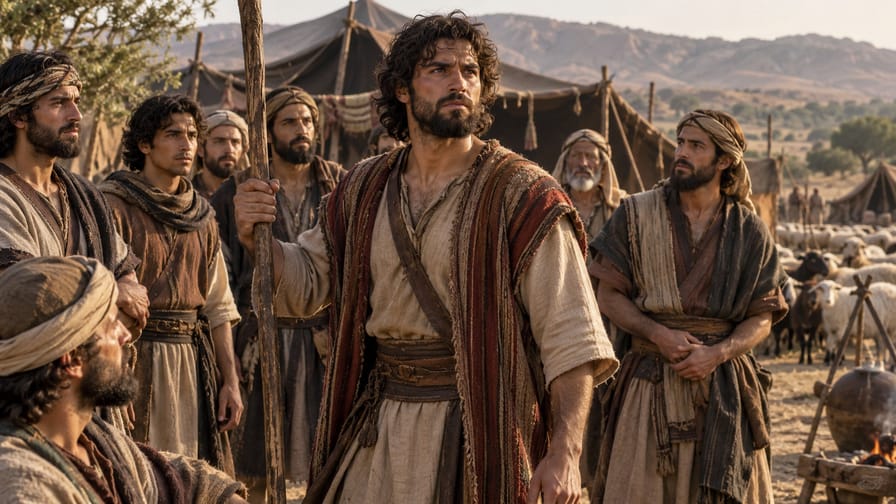
Simeon was the second son of Jacob and Leah, born in Paddan-aram while Jacob was serving his uncle Laban (Genesis 29:33). He became the ancestor of the tribe that bears his name, one of the twelve tribes of Israel, and his name runs through the Bible from the troubled household of Jacob to the allotment of the land under Joshua and the sealed tribes of Revelation.
Scripture does not give Simeon a long biography, but the scenes it records are vivid: the massacre at Shechem together with his brother Levi, the time he spent bound in Egypt as a hostage while his brothers went home to fetch Benjamin, and the hard words Jacob spoke over him on his deathbed. Together they form the portrait of a man whose zeal turned into cruelty, and of a tribe that carried the consequences for generations.
Studying Simeon shows how God keeps his promises through flawed people. The patriarch is never presented as a model of virtue, yet his name was never erased from the tribes of Israel, and his descendants received a place in the inheritance and among the people God calls his own.
1. Etymology and meaning of the name
The Hebrew name is Shim'on (שִׁמְעוֹן), formed from the verb shama' (שָׁמַע), “to hear”. The Bible itself explains it: at his birth Leah said, “Because the LORD has heard that I am hated, he has given me this son also” (Genesis 29:33). The name is usually understood as “hearing” or “one who hears”, pointing to the God who heard. In Greek, in the Septuagint and in the New Testament, the form is Symeōn (Συμεών), which is why the same name reappears in the Gospels.
The name is a small confession of faith. Leah lived in a marriage where she felt unloved, since Jacob loved Rachel more (Genesis 29:30-31). In naming her second son she did not hide her pain, but she acknowledged that the Lord had seen it. Every time the boy's name was spoken, it recalled that God listens to the cry of those who are rejected.
2. Historical context and biblical narrative
2.1 Family origin and genealogy
Simeon belonged to the family of promise: son of Jacob, grandson of Isaac and great-grandson of Abraham. His mother Leah was Laban's older daughter, and his full brothers were Reuben, Levi, Judah, Issachar and Zebulun, with a sister named Dinah (Genesis 29:31-35; 30:17-21). He grew up in the region of Haran and came with the whole household to Canaan when Jacob returned to the land of his fathers (Genesis 31).
When the family went down to Egypt, the names of Simeon's sons were recorded: Jemuel, Jamin, Ohad, Jachin, Zohar and Shaul, the last described as the son of a Canaanite woman (Genesis 46:10; Exodus 6:15). Later lists give five names with slightly different forms, such as Nemuel for Jemuel and Zerah for Zohar, and without Ohad (Numbers 26:12-13; 1 Chronicles 4:24). Variations of this kind are common in ancient genealogies. From these sons came the clans of the tribe of Simeon.
2.2 Main events
The best-known episode is told in Genesis 34. Shechem, son of Hamor, the prince of the region, seized Dinah and violated her. Jacob's sons answered his request for marriage with deceit, demanding that every male of the city be circumcised. On the third day, while the men were still in pain, Simeon and Levi, Dinah's brothers, took their swords, entered the city and killed all the males, including Hamor and Shechem (Genesis 34:25-26). The other brothers then plundered the city. Jacob rebuked the two, saying they had brought trouble on him and made him odious to the inhabitants of the land (Genesis 34:30). Their only reply was a question: “Should he treat our sister like a prostitute?” (Genesis 34:31).
Years later, during the great famine, ten of the brothers went down to Egypt to buy grain and stood before Joseph without recognizing him. Joseph accused them of being spies and demanded that they bring their youngest brother. In their distress they confessed to one another their guilt for what they had done to Joseph (Genesis 42:21-22). Joseph turned aside and wept, then took Simeon from among them and bound him before their eyes (Genesis 42:24). The text does not say why Simeon was chosen. Some interpreters suggest a connection with his violence at Shechem or with a leading role in the betrayal of Joseph, but that is only a hypothesis, and Genesis is silent on it. Back home, Jacob lamented, “Joseph is no more, and Simeon is no more” (Genesis 42:36). Simeon remained in Egypt until the brothers returned with Benjamin, and he was then brought out to them (Genesis 43:23). Later he went down to Egypt with the whole family (Genesis 46:8-10).
At the end of his life Jacob gathered his sons and spoke over each one. For Simeon and Levi the words are severe: their swords were weapons of violence, and Jacob did not want his soul to join their council. “Cursed be their anger, for it is fierce, and their wrath, for it is cruel! I will divide them in Jacob and scatter them in Israel” (Genesis 49:5-7). Notice that the curse falls on their anger, not on their persons.
3. Character and role in the biblical narrative
What Scripture shows of Simeon comes almost entirely from his actions, not from his words. At Shechem he acted out of loyalty to his sister, and the outrage against Dinah was real and grievous. But his reaction joined deceit with disproportionate violence: the covenant sign of circumcision was used as a trap, and an entire city paid for the crime of one man. The text leaves open the tension between the brothers' protest and Jacob's rebuke, but Genesis 49 makes the final verdict clear: that anger was cruel.
In Egypt, Simeon appears in a passive role. He was bound, kept apart and, for a time, left behind, while the story moved toward the reconciliation of the family. Genesis records no words of his during that period, and it would be speculation to describe what he felt. What the text does show is that his confinement became part of the process by which God brought the brothers to face their past and led Joseph to reveal himself.
4. Theological significance
4.1 Jacob's word fulfilled
The history of the tribe shows the fulfillment of the words “I will scatter them in Israel”. In the first census in the wilderness Simeon numbered 59,300 fighting men (Numbers 1:22-23); in the second, after the plague that followed the sin at Baal-peor, only 22,200 remained, the largest decline among the tribes (Numbers 26:14). Zimri, the Israelite struck down in that episode, was a leader of a father's house among the Simeonites (Numbers 25:14). In the blessing of Moses, Simeon is not mentioned by name (Deuteronomy 33). When the land was divided, Simeon received no separate territory but towns within the inheritance of Judah, such as Beersheba, because Judah's portion was too large for it (Joshua 19:1-9). The Chronicler notes that these were their cities until the reign of David (1 Chronicles 4:31).
4.2 The same judgment, different outcomes
Levi received the same sentence of scattering, but in his case it became a blessing: at the golden calf the Levites stood on the Lord's side (Exodus 32:26-29) and later received towns throughout Israel as the priestly tribe (Joshua 21). Simeon's scattering took the form of absorption into Judah. The contrast teaches that God's judgment is real, but that the story of a family is not sealed by a single failure.
4.3 Grace that does not erase the name
Even diminished, Simeon never disappeared from the people of God. Simeonites fought beside Judah in the conquest (Judges 1:3, 17), joined David at Hebron (1 Chronicles 12:25) and went over to King Asa when they saw that the Lord was with him (2 Chronicles 15:9). In Ezekiel's vision Simeon has a portion in the restored land and a gate in the city (Ezekiel 48:24-25, 33), and in Revelation twelve thousand are sealed from the tribe of Simeon (Revelation 7:7). This faithfulness points to the gospel: in Christ, people marked by violence and failure are received and given a permanent place among God's people.
5. Legacy and canonical references
Simeon's birth is recorded in Genesis 29:33, and he appears in the list of Jacob's sons in Genesis 35:23. His part in the Shechem episode is in Genesis 34:25-31, his time as a hostage in Genesis 42:24, 36 and 43:14, 23, and his descendants in Genesis 46:10 and Exodus 6:15. Jacob's words about him are in Genesis 49:5-7. The tribe appears in the wilderness lists (Numbers 1:6, 22-23; 2:12-13; 13:5; 26:12-14; 34:20), among those who would stand on Mount Gerizim to bless the people (Deuteronomy 27:12), in the division of the land (Joshua 19:1-9), in the conquest (Judges 1:3, 17) and in the genealogies of Chronicles (1 Chronicles 2:1; 4:24-43; 12:25). It is mentioned in the days of Asa and Josiah (2 Chronicles 15:9; 34:6), in Ezekiel's vision (Ezekiel 48:24-25, 33) and in Revelation 7:7.
Do not confuse the patriarch with Simeon, the righteous and devout man of Jerusalem who was waiting for the consolation of Israel and took the child Jesus in his arms in the temple, blessing God with the song known as the Nunc Dimittis (Luke 2:25-35). That Simeon lived many centuries later and shares nothing with the son of Jacob but the name. The New Testament also mentions other men called Simeon (Luke 3:30; Acts 13:1).
6. Application for today
Simeon's story starts with a name that means God hears. Before any failure of the son, there was a mother's cry that reached the Lord. That reminds us that God sees the pain of people who feel rejected in their own home, and that he answers.
At the same time, Shechem warns that a just cause does not justify every means. Indignation at evil can be right, but when it turns into revenge, deceit and cruelty, it becomes sin as well. Jacob's word, “cursed be their anger”, invites us to examine what we do with our anger. Scripture's counsel is “Be angry and do not sin” (Ephesians 4:26), and vengeance belongs to the Lord (Romans 12:19).
Finally, the tribe of Simeon shows that consequences are real, yet grace is greater. Even reduced and scattered, Simeon still has its name among the sealed in Revelation. In Christ, no past is too dark to be redeemed. Whoever comes to him in repentance finds not only forgiveness, but also a place among the people of God.