


Leah
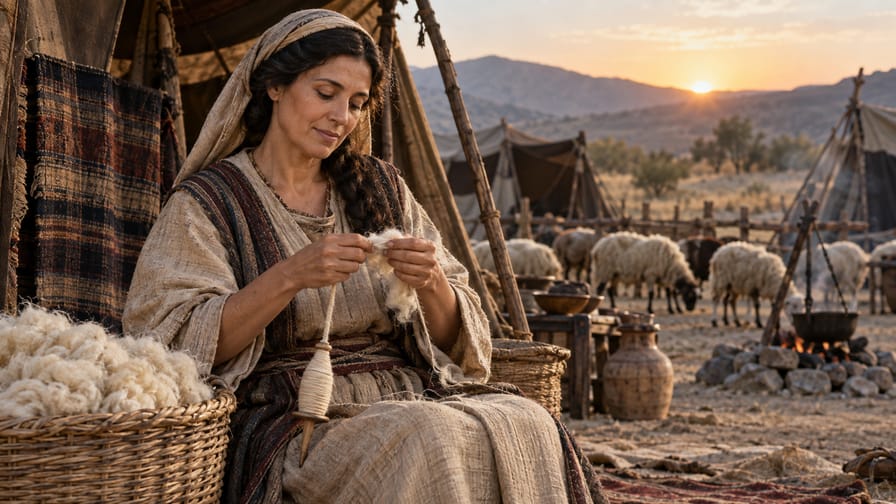
1. Etymology and Meaning of the Name
The name Leah, in Hebrew, is לֵאָה (Le'ah). Its exact etymology is debated among scholars, but the main suggestions point to two distinct meanings, both with theological resonance in the context of her biblical narrative.
A common derivation associates Le'ah with the Hebrew root meaning "weary," "exhausted," or "weak." This meaning seems to reflect Leah's condition in her life, especially at the beginning of her marriage to Jacob, where she was the less loved wife and constantly sought her husband's affection, as narrated in Genesis 29:30-32.
Another etymological interpretation suggests a connection with the Akkadian word littu, meaning "wild cow" or "gazelle." This meaning could allude to fertility, strength, or natural beauty, characteristics that, although perhaps not attributed to Leah to the same degree as to Rachel in terms of physical beauty (Genesis 29:17), were manifest in her remarkable ability to bear children for Jacob.
There are no other prominent biblical figures who share the name Leah, making her a unique character in the canon with this designation. Variations of the name are minimal in biblical languages, maintaining the original Hebrew form.
Theologically, the meaning "weary" or "exhausted" emphasizes God's sovereignty, who, even amidst pain and human scorn, exalts the humble and the disadvantaged. The fertility associated with the "wild cow" points to the divine blessing of offspring, essential for the fulfillment of the Abrahamic covenant and for the formation of the twelve tribes of Israel, according to the Protestant evangelical perspective.
2. Historical Context and Biblical Narrative
2.1 Family Origin and Genealogy
Leah is a central figure in the patriarchal period of Israel's history, approximately between 2000 and 1800 B.C. She was the elder daughter of Laban, Rebekah's brother, and thus Jacob's first cousin. Her younger sister was Rachel, whom Jacob loved and desired to marry.
The social and religious context of the time was marked by practices such as polygamy, arranged marriages, and the importance of offspring for the perpetuation of the family and tribal lineage. Descendants were seen as a divine blessing and a sign of favor, especially in the fulfillment of the promises made to Abraham.
Leah's narrative unfolds primarily in Genesis 29 through Genesis 35. She lived in Paddan Aram (Haran), her father Laban's land in Mesopotamia, before moving to Canaan with Jacob and his family.
2.2 Key Life Events
Leah's story begins with Jacob's arrival in Haran, fleeing from his brother Esau (Genesis 28:10-15). Jacob fell in love with Rachel, Leah's younger sister, and agreed to work seven years for Laban in exchange for her hand (Genesis 29:18).
However, Laban deceived Jacob, giving Leah to him on the wedding night, justifying that it was not customary to give the younger daughter before the firstborn (Genesis 29:23-26). Jacob, displeased, was forced to work another seven years for Rachel, resulting in a polygamous marriage with two sisters.
The biblical narrative highlights Jacob's lack of love for Leah compared to Rachel: "Jacob loved Rachel more than Leah" (Genesis 29:30). God, however, saw Leah's affliction and "made her fertile," while Rachel remained barren for a time (Genesis 29:31).
Leah bore six sons for Jacob: Reuben, Simeon, Levi, Judah, Issachar, and Zebulun (Genesis 29:32-35 30:17-20). She also had a daughter, Dinah (Genesis 30:21). The names Leah gave her children reflect her hopes, sorrows, and, crucially, her faith in divine intervention in her life.
The rivalry between Leah and Rachel is a recurring theme, with both competing for Jacob's attention and seeking to bear him children, using their servants Zilpah and Bilhah for this purpose (Genesis 30:1-13). The story of the mandrakes (Genesis 30:14-16) illustrates this intense competition.
Despite the initial marriage by deception and Jacob's lack of love, Leah remained one of Israel's foundational matriarchs. She is mentioned as having been buried in the cave of Machpelah, along with Jacob, Abraham, Sarah, Isaac, and Rebekah, a place of great importance to the patriarchal family (Genesis 49:31).
3. Character and Role in Biblical Narrative
Leah's character is multifaceted, revealing a woman who, though disadvantaged in marital love, demonstrates remarkable resilience, faith, and a deep connection with God. The Scriptures portray her as a woman with "tender eyes" (Genesis 29:17), an expression that may indicate weak eyes or, interpreted by some, gentle and kind eyes, contrasting with Rachel's physical beauty.
Her primary virtue is the faith expressed in the naming of her children. In each name, Leah recognizes God's hand at work in her life, transforming her pain and rejection into blessings and purpose. She sees fertility as a sign of divine favor, even when her husband did not love her as he loved Rachel (Genesis 29:31-35).
For example, upon giving birth to Reuben, she exclaims: "The Lord has seen my affliction surely now my husband will love me" (Genesis 29:32). With Simeon, she acknowledges that God "heard that I was unloved" (Genesis 29:33). When Levi was born, Leah hoped that Jacob "now my husband will become attached to me" (Genesis 29:34).
The culmination of her faith and gratitude occurs with the birth of Judah, whose name means "praise." Leah declares: "Now I will praise the Lord" (Genesis 29:35). This is a significant turning point, as she transcends the search for Jacob's love and focuses her gratitude and praise directly to God. This act of praise is a testament to her spiritual maturity.
Although the Bible does not document serious moral failures of Leah, her participation in the competition for children and for mandrakes with Rachel (Genesis 30:14-16) reveals the human dimension of her struggles and desires, typical of her cultural context and the complexity of her family situation.
Leah's role in the biblical narrative is fundamental as a matriarch of the nation of Israel. She is the mother of six of the twelve tribes, including Levi, the priestly tribe, and Judah, the royal tribe from which the Messiah would come. Her calling, though not prophetic or priestly in a formal sense, is that of a founding mother, whose descendants would shape redemptive history.
The development of her character shows a progression from a woman scorned and anxious for human love to a woman who finds solace and purpose in praising God, accepting her condition and trusting in divine providence. Her decision to be buried with the patriarchs in Machpelah solidifies her place as one of the mothers of Israel, a final recognition of her importance (Genesis 49:31).
4. Theological Significance and Typology
Leah's theological significance is profound, especially within the Protestant evangelical perspective, which emphasizes God's sovereignty and redemptive history. Her life illustrates divine election and grace that operates in imperfect and painful circumstances, shaping the course of salvation.
Leah plays a crucial role in redemptive history as the mother of the messianic lineage. Her son Judah is the direct ancestor of David and, subsequently, of Jesus Christ (Matthew 1:2-16 Luke 3:33-34). This is the most significant Christocentric prefiguration associated with Leah.
The promise of the seed who would crush the serpent's head (Genesis 3:15) and the promise of a great nation to Abraham (Genesis 12:2) are partially fulfilled through Leah's descendants. God's choice to use the "less loved" to bear the royal and priestly lineage demonstrates sovereign grace that is not based on human merit or preference, but on divine will.
Leah's story resonates with central theological themes such as God's providence, election, and grace. God sees the affliction of the oppressed and the rejected, and He acts on their behalf. The fact that Leah, and not the beloved Rachel, bore Judah and Levi, underscores that God's plans are not thwarted by human failures or cultural preference.
Her life also teaches about faith amidst suffering and adversity. Leah's journey, from a desperate search for love and recognition to sincere praise of God (with the birth of Judah), is a testament to a faith that matures and finds its source in God, not in circumstances or human favor.
The narrative of Leah, therefore, is not merely a family story, but a vital link in the chain of the progressive revelation of salvation. She points to Christ by being the mother of Judah, prefiguring the coming of the Messianic King, who would also be despised and rejected by men, but exalted by God.
Leah's presence in Christ's genealogy (implicitly, through Judah) validates her position as one of the matriarchs of faith, an instrument chosen by God to fulfill His promises and prepare the way for the Redeemer.
5. Biblical-Theological Legacy and Canonical References
Leah's legacy is immense and enduring in biblical theology. She is fundamentally recognized as one of the four matriarchs of Israel, alongside Sarah, Rebekah, and Rachel. Her story is primarily told in Genesis, especially in chapters 29 to 35, which detail her life and the formation of Jacob's family.
Her influence extends throughout the Old Testament, for she is the mother of six of the twelve tribes of Israel, including the tribes of Judah and Levi, which are central to Israel's history. Judah is the tribe of royalty, from which the kings of Israel would come, culminating in David and, finally, the Messiah. Levi is the tribe of the priesthood, responsible for service in the Tabernacle and, later, in the Temple.
In Ruth 4:11-12, in the context of Boaz and Ruth's blessing, Leah is explicitly mentioned along with Rachel as one of the women who "built up the house of Israel." This reference in the book of Ruth, which also traces David's lineage, reiterates Leah's importance in the founding of the nation and the messianic lineage.
In Reformed and evangelical theology, Leah's story is often used to illustrate God's sovereignty in election and grace. She demonstrates that God chooses and blesses those who are less favored in human eyes, using them for His redemptive purposes. Her life is a testament to God's faithfulness in fulfilling His promises, even through difficult circumstances and complex relationships.
Jewish and Christian interpretive tradition has always recognized Leah as a pious figure, despite her struggles. Her burial in the cave of Machpelah (Genesis 49:31), alongside the other patriarchs and matriarchs, is a symbol of her elevated status and her integral participation in the covenant promises.
For the understanding of the canon, Leah is not just a character she is a genealogical and theological pillar. Her narrative is indispensable for tracing the origins of the tribes of Israel and, most crucially, for establishing the lineage of Judah, from which the promised Messiah would come. Without Leah, the history of salvation, as revealed in the Scriptures, would be incomplete.
She represents the truth that God works through the imperfect and the unexpected to accomplish His perfect plans, and that faith and praise can arise even in the most adverse conditions, pointing to the redemptive grace that culminates in Christ.