


Seraiah
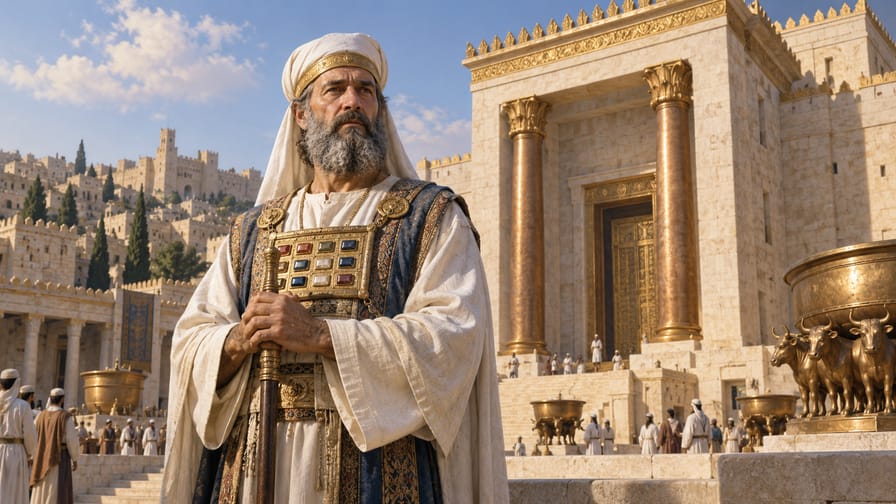
Seraiah was the chief priest of Jerusalem when the city fell to the Babylonians in 586 BC. After the temple of Solomon had been burned, Nebuzaradan, the captain of the guard, took him with other leaders of Judah to Riblah, where King Nebuchadnezzar had them put to death (2 Kings 25:18-21; Jeremiah 52:24-27).
He is therefore the last high priest named in Scripture as serving in the first temple. His death marks the end of an era: with him, the priestly ministry in Solomon’s house came to a violent close, and the text immediately adds, “So Judah was taken into exile out of its land” (2 Kings 25:21).
Yet the story of Seraiah does not end in Riblah. The genealogies record that his son Jehozadak went into exile (1 Chronicles 6:14-15), that his grandson Joshua became high priest after the return, and that Ezra the scribe descended from him (Ezra 7:1). Through a man who died under judgment, God preserved a line that would serve in the restoration.
1. Etymology and meaning of the name
The Hebrew name Seraiah (שְׂרָיָה, Serayah, also written Serayahu) combines a verbal element with Yah, a short form of the divine name YHWH. The meaning is not completely certain. Many relate it to the verb sarah, “to strive, to persist,” the same root used in the explanation of the name Israel (Genesis 32:28), which would give “the LORD has striven” or “the LORD persists.” Others relate it to sar, “prince, ruler,” with the sense “the LORD is prince” or “the LORD rules.” Both proposals are possible, and it is honest to leave the question open.
The name was common in Israel, and several men in the Old Testament carried it. Because of this, the texts identify this Seraiah by his office, “the chief priest” (kohen harosh), and by his place in the priestly genealogy.
2. Historical context and biblical narrative
2.1 Family origin and genealogy
Seraiah belonged to the priestly line of Aaron through Eleazar and Zadok. The list of 1 Chronicles 6:1-15 (5:27-41 in the Hebrew numbering) traces this line down to him: “Shallum fathered Hilkiah, Hilkiah fathered Azariah, Azariah fathered Seraiah, Seraiah fathered Jehozadak” (1 Chronicles 6:13-14). The same sequence appears in the ancestry of Ezra (Ezra 7:1-5). Biblical genealogies sometimes skip generations, but as the lists stand, Seraiah was the grandson of Hilkiah, the high priest who found the Book of the Law in the temple during the reign of Josiah (2 Kings 22:8).
His son Jehozadak “went into exile when the LORD sent Judah and Jerusalem into exile by the hand of Nebuchadnezzar” (1 Chronicles 6:15). Jehozadak’s son Joshua (also called Jeshua) returned from Babylon and served as high priest alongside Zerubbabel (Ezra 3:2; Haggai 1:1; Zechariah 3:1). Ezra, who arrived in Jerusalem generations later, is called “the son of Seraiah” (Ezra 7:1). Since Ezra came in the seventh year of Artaxerxes (Ezra 7:7-8), well over a century after Seraiah’s death, “son” here must mean descendant, as often in Hebrew genealogies. The exact number of generations between them is not given.
This Seraiah should not be confused with others of the same name, such as David’s secretary (2 Samuel 8:17), Seraiah the son of Azriel, sent to arrest Baruch and Jeremiah (Jeremiah 36:26), or Seraiah the son of Neriah, the quartermaster who carried Jeremiah’s scroll against Babylon (Jeremiah 51:59-64).
2.2 Main events
Scripture records nothing about Seraiah’s ministry before the final days of Jerusalem. He served in the reign of Zedekiah, the last king of Judah, who rebelled against Babylon (2 Kings 24:20). Nebuchadnezzar besieged the city, famine struck, the wall was breached, and Zedekiah was captured, taken to Riblah, forced to watch the execution of his sons and then blinded (2 Kings 25:1-7).
A month later Nebuzaradan burned the house of the LORD, the king’s house and the houses of Jerusalem, and broke down its walls (2 Kings 25:8-10). The bronze pillars and vessels of the temple were carried away (2 Kings 25:13-17). Then Nebuzaradan took Seraiah the chief priest, Zephaniah the second priest and the three keepers of the threshold, together with a military officer, several of the king’s counselors, the secretary who mustered the people for war and sixty men of the land (2 Kings 25:18-19; Jeremiah 52:24-25, which speaks of seven counselors instead of five). He brought them to the king of Babylon at Riblah, in the land of Hamath, and there the king struck them down and put them to death (2 Kings 25:20-21; Jeremiah 52:26-27).
The text does not explain why these men in particular were executed. The most common interpretation is that Nebuchadnezzar was eliminating the leadership of a rebellious city, religious, political and military, but this is an inference from the list, not a statement of the narrative.
3. Character and role in the biblical narrative
Scripture says nothing about Seraiah’s personal faith or conduct. We do not know whether he supported Jeremiah or opposed him, and we should not invent either picture. The prophets of that time denounced the priests as a group (Jeremiah 6:13; Jeremiah 23:11), and the Chronicler summarizes the period by saying that the leading priests and the people multiplied unfaithfulness and defiled the house of the LORD (2 Chronicles 36:14). But these are general judgments; the text never names Seraiah as guilty of a specific sin.
His role in the narrative is representative. As chief priest, he stood at the head of the worship of Israel in the house that God had chosen for his name. His arrest and execution, immediately after the burning of the temple, show that the judgment announced by the prophets had reached the very center of Israel’s religious life. The priest who should have stood between God and the people could not avert the catastrophe, and he himself fell under it.
4. Theological significance
4.1 Judgment that begins at the sanctuary
The fall of Jerusalem was not merely a political event. The prophets interpreted it as God’s judgment on a covenant people who had persisted in idolatry and injustice (2 Kings 24:3-4; 2 Chronicles 36:15-16). In Ezekiel’s vision the command is given, “begin at my sanctuary” (Ezekiel 9:6), and Lamentations says that the Lord, in his anger, “spurned king and priest” (Lamentations 2:6). The death of the chief priest at Riblah is a sober illustration of that truth, which the New Testament also affirms: judgment begins at the household of God (1 Peter 4:17).
4.2 Priests who could not continue
The Letter to the Hebrews observes that the Levitical priests were many in number because they were prevented by death from continuing in office (Hebrews 7:23). Seraiah is an unusually vivid example: his ministry was cut off by the sword of a foreign king. By contrast, Jesus “holds his priesthood permanently, because he continues forever,” and “always lives to make intercession” for those who draw near to God through him (Hebrews 7:24-25). Seraiah’s end reminds us that no earthly priest could guarantee the people’s access to God; only the eternal High Priest can.
4.3 Faithfulness beyond judgment
The line of Seraiah did not disappear. His descendant Joshua served as high priest in the rebuilt temple, and in Zechariah’s vision he is called “a brand plucked from the fire,” cleansed and clothed with pure garments by the Lord (Zechariah 3:1-5). A crown was later placed on Joshua’s head as a sign pointing to the coming Branch, who would build the temple of the LORD and be a priest on his throne (Zechariah 6:11-13). Ezra, another descendant, led a renewal centered on the Word of God (Ezra 7:10; Nehemiah 8:1-8). Judgment was real, but it was not God’s last word.
5. Legacy and canonical references
Seraiah the chief priest is mentioned in four passages. 2 Kings 25:18-21 records his arrest by Nebuzaradan and his death at Riblah. Jeremiah 52:24-27 gives a parallel account with small differences in the list of those executed. 1 Chronicles 6:14 (5:40 in Hebrew) places him in the high-priestly genealogy as son of Azariah and father of Jehozadak. Ezra 7:1 names him as the ancestor of Ezra.
A priest called “Seraiah the son of Hilkiah,” leader of the house of God, appears in the list of those living in Jerusalem after the exile (Nehemiah 11:11). Because the names follow the same family line, some think the verse refers to a later priest bearing the family name, or to the priestly house descended from him; the parallel list in 1 Chronicles 9:11 reads Azariah at that point. The relation to our Seraiah is uncertain and should not be pressed.
His legacy, then, is double: he is remembered as the chief priest who fell with Jerusalem, and as the ancestor of priests and a scribe whom God used to rebuild the worship and instruction of his people.
6. Application for today
First, Seraiah’s story warns us that religious position is no protection against the consequences of collective unfaithfulness. Holding an office, belonging to a church or bearing a respected name does not replace a living, obedient faith. God takes seriously the sin of his own people.
Second, his death directs our eyes to Christ. Every human mediator eventually fails, dies or is removed. The believer’s hope rests on the High Priest who cannot be taken away, who entered the true sanctuary with his own blood and secured an eternal redemption (Hebrews 9:11-12).
Third, the survival of Seraiah’s line encourages those who live through loss. Jehozadak went into exile carrying the memory of a father killed at Riblah, yet God raised up Joshua and, later, Ezra from that same family. What seems to end in ruin may, in God’s providence, become the seed of restoration (Romans 8:28).
Finally, we can pray for our spiritual leaders and for ourselves, that we may be found faithful before the day of trial comes, remembering that God disciplines his children for their good, so that they may share his holiness (Hebrews 12:10).