


Artaxerxes
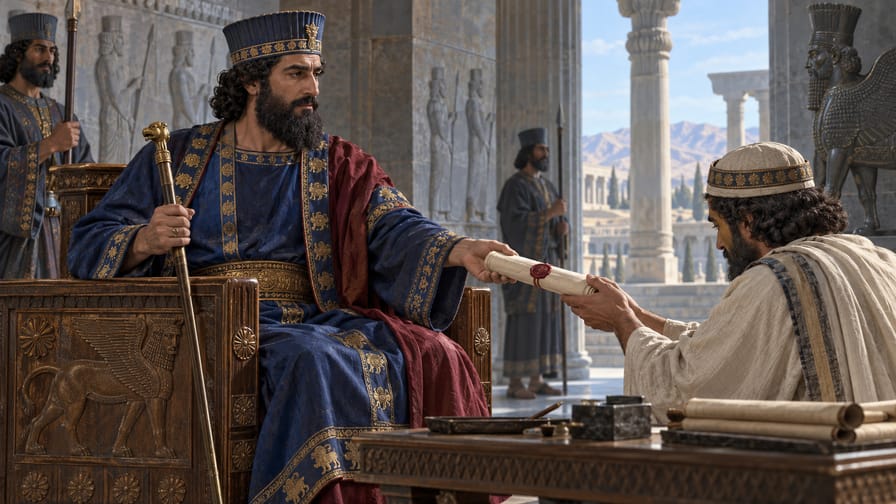
The figure of Artaxerxes, a Persian monarch, emerges in the Hebrew Scriptures as a crucial character in Israel's post-exilic history. His presence in the books of Ezra and Nehemiah is not that of a worshiper of Yahweh, but that of a pagan ruler who, through divine providence, played an instrumental role in the restoration of the Jewish people after the Babylonian captivity. His theological relevance lies not in his own spiritual character, but in how God used him to fulfill His promises and prepare the stage for the coming of the Messiah.
This analysis will seek to explore the etymology of his name, the historical context of his reign, his character as revealed in the Scriptures, his theological and typological significance, and his biblical-theological legacy from a conservative evangelical Protestant perspective, emphasizing God's sovereignty over history and nations.
1. Etymology and Meaning of the Name
The name Artaxerxes is the Greek form (Ἀρταξέρξης, Artaxérxēs) of the Old Persian name Artakhshathra. In the Hebrew and Aramaic Scriptures, it appears transliterated as אַרְתַּחְשַׁשְׁתָּא (Artachshashta) or אַרְתַּחְשַׁסְתְּא (Artachshasta), especially in Ezra 4:7 and Nehemiah 2:1.
The etymological root of the name is Persian, deriving from arta, which means "truth" or "righteousness" (a central concept in Zoroastrianism), and khshathra, which means "kingdom" or "empire". Thus, the literal meaning of Artaxerxes is "he whose empire is based on truth" or "righteous ruler".
This designation reflects an ideal of Persian royalty, where justice and order were seen as pillars of government. While the meaning of the name does not automatically confer virtue upon the king, it establishes a contrast or an expectation. In the biblical context, the name can serve as a subtle reminder of God's sovereignty, who can use even a pagan ruler who calls himself "righteous" to fulfill His purposes of true justice and redemption.
There are no other biblical characters with this exact name. However, "Artaxerxes" was a dynastic name, used by several kings of the Achaemenid Empire. The most prominent in the biblical narratives is Artaxerxes I Longimanus, though there is debate about the identity of the Artaxerxes in Ezra 4.
The theological significance of the name, for a Hebrew audience, would not reside so much in its intrinsic meaning, but in the way God employed it. The fact that a pagan king with a name evoking "justice" was the instrument for the restoration of Jerusalem and worship demonstrates that true justice and governance come from Yahweh, who "removes kings and establishes kings" (Daniel 2:21), using even the powerful of the world for His redemptive ends.
Divine providence manifests itself in the control of kings and empires, making their decisions, even if motivated by political or personal interests, serve God's eternal plan. The name, therefore, points to divine irony: a pagan king, self-proclaimed "righteous ruler", is moved by the true God to restore justice and order among His chosen people, Israel.
2. Historical Context and Biblical Narrative
2.1. Historical Period and Political Context
The Artaxerxes most significantly mentioned in the Scriptures is generally identified as Artaxerxes I Longimanus, who reigned over the vast Achaemenid Persian Empire from 465 to 424 BC. This period is crucial for the history of the Jewish people, as it is situated in the post-exilic era, when the Jews had already returned from the Babylonian captivity under the decrees of Cyrus and Darius, but were still in the process of rebuilding their nation, temple, and walls of Jerusalem.
The political context was that of a Persian empire at its zenith, with vast territorial control, but also with internal and external challenges. The Persian administration was known for its organization and, in many cases, for a policy of religious and cultural tolerance towards the dominated peoples, which facilitated the Jewish return and reconstruction.
2.2. Key Life Events and Biblical Passages
Artaxerxes' presence in the biblical narrative is central to the restoration of Jerusalem. He appears at two distinct moments in the books of Ezra and Nehemiah, which may refer to different phases of his reign or, in one case, to a different monarch.
Firstly, in Ezra 4:7-24, a king named Artaxerxes is persuaded by Samaritan officials and other adversaries to issue a decree that halted the reconstruction of the temple and walls of Jerusalem. This event is dated by some scholars as prior to the reign of Artaxerxes I, possibly referring to Xerxes I (Ahasuerus), while others see it as an initial and hostile phase of Artaxerxes I's own reign.
The most prominent narrative positively associated with Artaxerxes I occurs later. In the seventh year of his reign (458 BC), he issued a decree that allowed Ezra, a scribe and priest, to return to Jerusalem with authority to teach the Law of God, establish judges and magistrates, and beautify the temple (Ezra 7:1-26). This decree was notable for its generosity, granting Ezra vast financial resources and imperial authority.
Subsequently, in the twentieth year of his reign (445 BC), Artaxerxes I granted Nehemiah, his cupbearer, permission to return to Jerusalem and rebuild the city walls (Nehemiah 2:1-8). This decision was crucial, as the reconstruction of the walls symbolized the restoration of security and autonomy for the Jewish community, allowing Jerusalem to become a fortified city and a center for God's people.
2.3. Geography and Relationships with Other Characters
Interactions with Artaxerxes primarily occurred in the Persian capital, Susa (Nehemiah 1:1), and in Babylon, from where Ezra departed (Ezra 7:9). Decisions made in these capitals had a direct impact on Jerusalem, the holy city of the Jews.
His relationships with biblical characters are with Ezra and Nehemiah. He entrusted Ezra with the mission to restore the law and worship, and Nehemiah with the task of rebuilding the walls. Nehemiah's narrative highlights Nehemiah's closeness to the king, serving as his cupbearer, which gave him significant access and influence (Nehemiah 1:11 2:1). This personal relationship was fundamental for obtaining the royal decrees and the necessary resources for the work in Jerusalem.
Artaxerxes' wife is mentioned in Nehemiah 2:6, present during the dialogue with Nehemiah, suggesting a possible influence of the queen on the king's decisions. Although not explicitly named, the presence of a queen consort is notable, especially if we consider the possible connection with Queen Esther, though most scholars identify Ahasuerus (Xerxes I) as the king of Esther, not Artaxerxes I.
3. Character and Role in the Biblical Narrative
3.1. Analysis of Character as Revealed in the Scriptures
Artaxerxes' character, as revealed in the Scriptures, is complex and multifaceted, reflecting the dynamic of a pagan monarch in a vast empire. Initially, he proves susceptible to political manipulation and opposition. In Ezra 4:17-22, he is easily convinced by the adversaries of the Jews, such as Rehum and Shimshai, to issue a decree that halted the reconstruction of Jerusalem. This reveals a concern for the stability of the empire and a willingness to act based on partial or biased information.
However, at later points, Artaxerxes exhibits remarkable benevolence and openness towards the Jews and their leaders. His treatment of Ezra (Ezra 7) and Nehemiah (Nehemiah 2) reveals a ruler who not only grants permission but also provides significant resources, protection, and legal authority. He appears to have been influenced by the integrity and wisdom of these men of God, as well as by a perception of the divine hand upon them, as acknowledged by Ezra: "the hand of the Lord my God was upon me" (Ezra 7:28).
3.2. Virtues, Weaknesses, and Key Decisions
Among his qualities, we can highlight the ability to listen and respond to petitions, a certain magnanimity and, crucially, a willingness to delegate authority and trust his subjects, even if from a different culture and religion. The trust placed in Nehemiah, his cupbearer, for such a vital mission, demonstrates loyalty and insight in recognizing competence.
His primary weakness, initially, was a lack of discernment to see through the false accusations of the Jews' adversaries. However, he seems to have overcome this weakness or to have been persuaded by more convincing arguments, perhaps through the influence of Ezra or Nehemiah, who presented their causes with prayer and wisdom (Nehemiah 1:4-11 2:4).
Artaxerxes' key decisions were the decrees that allowed Ezra and Nehemiah to carry out their missions. The decree of Ezra 7 not only allowed Ezra to go to Jerusalem but also authorized him to enforce the law of God and the king, and to receive contributions for the temple. The decree of Nehemiah 2 to rebuild the walls of Jerusalem was equally transformative, providing timber, military protection, and governmental authority to Nehemiah.
3.3. Role in the Biblical Narrative and Character Development
Artaxerxes' role in the biblical narrative is fundamentally that of an instrument of divine providence. He is not a character who undergoes personal spiritual development towards faith in Yahweh. Instead, his development is seen in the change of his policies towards the Jews, from a state of opposition or indifference to one of active support.
He was not a prophet, priest, or king of Israel, but a pagan monarch whose throne was used by God to fulfill His redemptive plans. His function was political and administrative, but his actions had profound theological implications, allowing for the restoration of worship, law, and the security of the Jewish community, essential elements for the preservation of the messianic lineage and the preparation for the coming of Christ.
The narrative of Ezra and Nehemiah emphasizes that "the good hand of his God was upon him" (Ezra 7:9) and that "the king granted him all that he requested, because the good hand of his God was upon him" (Ezra 7:6). This underscores that Artaxerxes' favorable decisions were not merely political or personal, but divinely orchestrated, confirming God's sovereignty over the hearts of kings (Proverbs 21:1).
4. Theological Significance and Typology
4.1. Role in Redemptive History and Progressive Revelation
Artaxerxes' theological significance primarily lies in his role as an instrument of divine sovereignty in Israel's redemptive history. Although not a believer in Yahweh, his actions were crucial for the progressive revelation of God's plan. His reign marked a vital period for the post-exilic restoration, allowing for the rebuilding of the temple, the reintroduction of the Law, and, most significantly, the fortification of Jerusalem.
The permission granted by Artaxerxes to Ezra and Nehemiah was essential for the preservation of Jewish identity and for preparing the community for the coming of the Messiah. The restoration of the city and worship was a prerequisite for the fulfillment of messianic prophecies, which required an established Jewish setting for the incarnation of Christ.
4.2. Prefiguration or Christocentric Typology
Artaxerxes is not typologically a direct prefigure of Christ in the sense of being a moral or spiritual model. He is a pagan king who acts under God's providence. However, his actions can be seen as an indirect prefiguration of God's universal sovereignty, which is fully manifested in Christ. Just as Artaxerxes, a powerful king, was used to restore the city of God, Christ, the King of kings, would come to restore the true people of God and build the new spiritual Jerusalem.
In a broader sense, the way God operates through a secular ruler to restore His people points to Christ's supreme authority over all kingdoms and powers (Colossians 1:16). The story of Artaxerxes demonstrates that "the king's heart is a stream of water in the hand of the Lord he turns it wherever he will" (Proverbs 21:1), a truth that finds its culmination in the redemptive work of Christ, who subjects everything to His dominion.
4.3. Covenants, Promises, and Related Prophecies
Artaxerxes' decree to rebuild Jerusalem is of particular importance for Daniel's prophecy of seventy weeks. In Daniel 9:25, the prophecy mentions that "from the going out of the word to restore and rebuild Jerusalem to the Messiah, the Prince, there shall be seven weeks and sixty-two weeks". Most conservative evangelical commentators, such as John Walvoord and J. Dwight Pentecost, identify Artaxerxes' decree to Nehemiah (445 BC, Nehemiah 2:1-8) as the starting point for this prophecy.
This interpretation is crucial for eschatological chronology and understanding prophetic fulfillment in Christ. Artaxerxes' decree, therefore, is not merely a historical event, but a divinely ordained prophetic landmark that points directly to the coming of the Messiah.
4.4. Connection with Central Theological Themes
The narrative of Artaxerxes reinforces central theological themes such as God's sovereignty, covenant faithfulness, and divine providence. God fulfills His promises of restoration to Israel, even using a pagan king as His agent (Isaiah 44:28 45:13). God's grace is evident in moving the heart of a foreign monarch to bless His people, demonstrating that salvation and restoration are exclusive works of Yahweh.
The story also illustrates the concept of "common grace", where God extends His goodness and control over all creation, including secular rulers, to maintain order and, in certain cases, to advance His broader redemptive purposes. Artaxerxes' actions, though not motivated by faith, served God's purposes, ensuring preparation for the New Testament setting.
5. Biblical-Theological Legacy and Canonical References
5.1. Mentions in Other Biblical Books and Literary Contributions
Mentions of Artaxerxes are confined to the books of Ezra and Nehemiah, where his figure is central to the narrative of the post-exilic restoration. He is not the author of any biblical book or canonical portions. His contribution is historical and theological, through the actions God moved him to perform, which were recorded by Ezra and Nehemiah, who were inspired by the Holy Spirit.
Artaxerxes' absence in other biblical books outside the Persian period is expected, given his specific and historical role. His relevance is intrinsically linked to that crucial period in Israel's history, serving as a backdrop for God's faithfulness among the nations.
5.2. Influence on Biblical Theology and Interpretive Tradition
The figure of Artaxerxes exerts significant influence on biblical theology, particularly with regard to the doctrine of divine providence and God's sovereignty over history. He is a vivid testimony of how God uses secular rulers, even pagan ones, to fulfill His redemptive and prophetic purposes. This perspective is fundamental to Reformed and evangelical theology, which emphasizes God's absolute sovereignty over all things.
In Jewish and Christian interpretive tradition, Artaxerxes is often discussed in connection with the prophecy of Daniel 9, his decree being a starting point for the counting of the seventy weeks. This makes him a key character for the study of prophetic chronology and eschatology. Commentators such as C.F. Keil and Franz Delitzsch, in their work Commentary on the Old Testament, highlight the historical and prophetic accuracy of these events.
5.3. Treatment in Reformed and Evangelical Theology
In Reformed and evangelical theology, Artaxerxes is often presented as a clear example of God's sovereign providence. John Calvin, in his commentaries, often emphasizes how God governs kings and empires for His own purposes. The case of Artaxerxes illustrates that God's will prevails, even when human instruments do not know Him or have no spiritual intentions.
This perspective reinforces trust in God's faithfulness to His covenant promises, regardless of political circumstances or the nature of human rulers. The story of Artaxerxes serves as a powerful illustration that God is in control of history, orchestrating events for the glory of His name and for the salvation of His people, culminating in the work of Christ.
5.4. Importance of the Character for Understanding the Canon
Artaxerxes' importance for understanding the biblical canon lies in his vital role as a bridge between the captivity and the intertestamental era, and in the preparation for the New Testament. The books of Ezra and Nehemiah, in which he is prominent, are essential for understanding how the Jewish community was re-established in its land, with its law and its temple, crucial elements for the setting of the coming of Jesus Christ.
Without Artaxerxes' decrees, the restoration of Jerusalem and the preservation of Judaism would have been significantly more challenging, and the fulfillment of prophecies like that of Daniel 9 would have been less clear. Thus, Artaxerxes, a pagan king, is a testament to the inspiration and inerrancy of the Scriptures, which narrate not only the history of Israel but God's redemptive plan for all humanity, which unfolds through historical events controlled by Him.