


Jashub
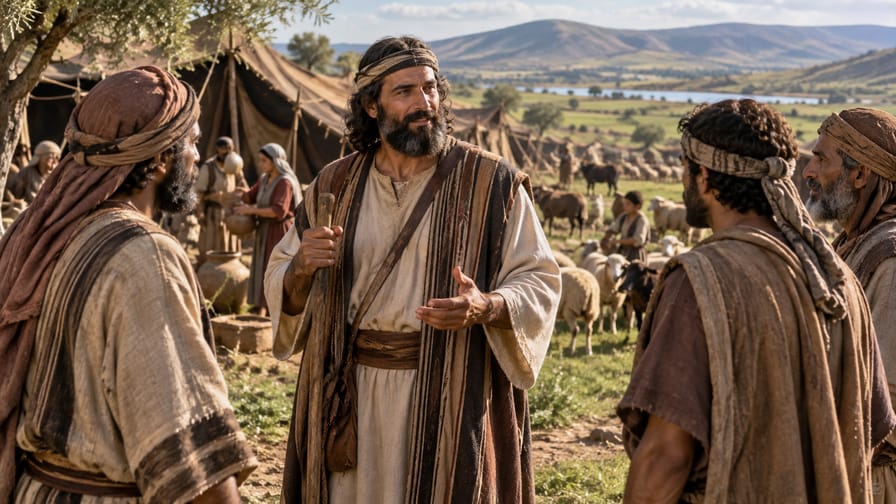
The figure of Jasube (also spelled Jasub in some translations) is a biblical character who, although not a protagonist of major narratives, holds a significant place in the genealogies of the Old Testament. His importance lies primarily in his function as a link in the genealogical chain of the nation of Israel, contributing to the formation of one of the twelve tribes.
From an evangelical Protestant perspective, the analysis of Jasube transcends the mere listing of names, revealing aspects of divine sovereignty, God's faithfulness to His promises, and the meticulous preservation of the lineage that would culminate in the Messiah. Even seemingly minor figures in the biblical canon are an integral part of God's redemptive plan.
This study seeks to deepen the understanding of Jasube, exploring his etymology, historical context, the inferred character of his existence, his theological significance, and the legacy that, even though discreet, contributes to the richness of biblical revelation.
1. Etymology and meaning of the name
The name Jasube, in Hebrew, is יָשׁוּב (Yashuv), a verbal form that denotes a sense of "return" or "repentance." The primary etymological root is שׁוּב (shuv), which means "to return," "to turn back," "to restore," or "to repent."
Literally, the name Yashuv can be interpreted as "he will return" or "may he return." This root is fundamental in Old Testament theology, frequently expressing God's call to His people to turn back to Him in repentance and obedience, as seen in prophets like Jeremiah and Ezekiel.
The meaning of Jasube's name, therefore, carries a profound theological connotation, even if there are no specific narratives associating the character with acts of return or repentance. Names in Hebrew culture often held a prophetic meaning or a declaration about the person or the parents' hope.
Although there are no other prominent biblical characters with the exact name Jasube (Yashuv), the root shuv is omnipresent in names and concepts. For example, the concept of teshuvah (תְּשׁוּבָה), which means "return" or "repentance," is central to both Jewish and Christian faith, and derives from the same root.
The theological significance of the name lies in its connection to the theme of restoration and repentance, which are pillars of God's covenant with Israel. The idea of "return" is intrinsic to the history of God's people, who frequently strayed and were called to turn back to the Lord, as in Isaiah 55:7: "Let the wicked forsake his way, and the unrighteous man his thoughts let him return to the Lord, that he may have compassion on him and to our God, for he will abundantly pardon."
Thus, the name Jasube, in itself, can be seen as a perennial reminder of the need for continuous return to God, a central theme in prophetic messaging and, subsequently, in the gospel of Christ.
2. Historical context and biblical narrative
Jasube is presented in the Scriptures as one of the four sons of Issachar, who in turn was the ninth son of Jacob and the fifth son of Leah (Genesis 30:18). His existence is situated in the patriarchal period, which spans approximately the 18th to 16th centuries BCE, and his genealogical mentions extend to the period of the Exodus and the early monarchy of Israel.
The political, social, and religious context of the era in which Jasube would have lived is that of the formation of the twelve tribes of Israel. Jacob and his family settled in Egypt around 1876 BCE (according to Ussher's chronology, or around the 17th century BCE in other estimates), where they remained for about 430 years (Exodus 12:40). It is during this period of population growth that clans formed and consolidated.
The key biblical passages where Jasube is explicitly mentioned are few, but significant in their genealogical context:
- Genesis 46:13: "The sons of Issachar: Tola, Puah, Job, and Shimron." (Some translations render Job, or Iob, instead of Jasube, reflecting textual variants or synonyms. The Septuagint, for example, has Iasoub).
- Numbers 26:24: "The sons of Issachar according to their clans: of Tola, the clan of the Tolaites of Puvah, the clan of the Puvahites of Jasube, the clan of the Jasubites of Shimron, the clan of the Shimronites." (This is the clearest mention and establishes Jasube as the patriarch of a clan).
- 1 Chronicles 7:1: "The sons of Issachar: Tola, Puah, Jasube, and Shimron, four." (Confirms his position among the sons of Issachar).
The discrepancy in Genesis 46:13, where some versions present "Job" or "Iob" instead of Jasube, is a point of textual interest. However, the confirmation in Numbers 26:24 and 1 Chronicles 7:1 solidifies Jasube's identity as one of Issachar's sons and progenitor of one of the tribe's clans.
The geography related to Jasube is, initially, Egypt, where Jacob's family settled (Genesis 46:26-27). His descendants, the Jasubites, participated in the Exodus from Egypt and the journey through the wilderness, eventually settling in the land of Canaan, in the territorial portion assigned to the tribe of Issachar, generally located in the plain of Jezreel, a fertile and strategic region (Joshua 19:17-23).
His most important relationships are with his father Issachar, his grandfather Jacob, and his brothers Tola, Puah, and Shimron. Jasube's existence is fundamental for the formation of the tribe of Issachar, which became one of the twelve tribes of Israel, with a specific role in the nation and in the fulfillment of divine promises.
3. Character and role in the biblical narrative
Given the scarcity of direct narrative information about Jasube, the analysis of his character and role must be made by inference and by the context of his genealogical position. The Scriptures do not record specific actions, decisions, or qualities attributed to him, nor sins or failures.
His main "role" in the biblical narrative is that of progenitor. As one of Issachar's sons, Jasube was a vital link in the continuity of Jacob's lineage, contributing to the formation of one of the clans that would comprise the tribe of Issachar. The mention of "Jasubites" in Numbers 26:24 attests to his importance as an ancestor of a numerous family within the tribe.
From the perspective of Reformed and evangelical theology, the absence of a detailed biography for Jasube does not diminish his relevance but rather redefines it. He represents the myriad of faithful individuals who, without great recorded deeds, fulfilled their role in the divine plan. His life, presumably, was one of obedience to God's commandments and participation in family and tribal life, ensuring posterity.
The fact that his name is preserved in the genealogies is, in itself, a testament to his significance for the history of Israel. Biblical genealogies are not mere lists they serve to establish identities, inheritances, rights, and, crucially, the messianic lineage. Jasube, by siring his descendants, contributed to the preservation of God's people through whom the Messiah would come.
It can be inferred that Jasube, as part of Jacob's family, was a recipient of the divine promises made to the patriarchs. His existence is a demonstration of God's faithfulness in multiplying the descendants of Abraham, Isaac, and Jacob (Genesis 12:2 Genesis 26:4 Genesis 35:11). He was an instrument in divine providence for the establishment of the twelve tribes.
In summary, Jasube's character, though not explicitly stated, is implicit in his function. He was a man who fulfilled the command to be fruitful and multiply, contributing to the formation of God's chosen nation. His life, though not detailed, was an essential part of redemptive history.
4. Theological significance and typology
Jasube's theological significance, though indirect, is profound and multifaceted from an evangelical Protestant perspective. He is inserted into redemptive history as a link in the chain of divine promise, whose existence is fundamental for the progressive revelation of the plan of salvation.
Firstly, Jasube is part of the lineage that would lead to the incarnation of Jesus Christ. Every name in the biblical genealogies, however obscure, is a testament to God's faithfulness in preserving the descendants of Abraham, through whom all the families of the earth would be blessed (Genesis 12:3). The tribe of Issachar, to which Jasube belongs, is listed among the twelve tribes of Israel, which are the collective body of God's chosen nation.
The Christocentric typology for Jasube manifests corporately and conceptually. He represents the continuity of the covenant people, historical Israel, which is the environment where God's revelation developed and where the Messiah was born. Although he is not a direct type of Christ in his actions, his existence points to God's meticulous providence in preparing the way for the Savior.
Jasube's name, "he will return" or "repentance," can be seen as a prefiguration of the central theme of the message of Christ and the prophets. The gospel of Jesus is a call to repentance (Matthew 4:17) and to return to God. Christ Himself is the one who makes the definitive return possible, restoring the broken relationship between God and humanity through His death and resurrection.
Although Jasube is not cited in the New Testament, the importance of genealogies and tribal identity is confirmed. For example, in Revelation 7:7, the tribe of Issachar is mentioned among the 144,000 sealed, demonstrating the continuing relevance of the tribes of Israel in God's eschatological plan. Jasube's existence, as an ancestor, guarantees the identity of one of these clans.
Jasube's life, insofar as it contributed to the formation of the tribe of Issachar, connects to central theological themes such as God's faithfulness to His covenant, divine sovereignty in choosing and preserving a people, and the importance of genealogical obedience for the fulfillment of promises. He is a reminder that God uses ordinary people for His extraordinary purposes, and that each individual has a place in the grand drama of redemption.
In summary, Jasube, in his narrative obscurity, is a testament to divine providence that weaves the tapestry of redemptive history, setting the stage for the coming of Christ and the offer of salvation to all who repent and return to God.
5. Biblical-theological legacy and canonical references
Jasube's legacy in biblical theology is subtle, but deeply rooted in the importance of genealogies and God's faithfulness to His covenant. His canonical mentions are restricted to genealogical lists, specifically in Genesis 46:13, Numbers 26:24, and 1 Chronicles 7:1. These passages, though not narrative, are crucial for the structure and authenticity of Israel's history.
His main contribution is the formation of the clan of the Jasubites within the tribe of Issachar. This lineage is essential for understanding Israel's tribal organization and for the distribution of land in Canaan. The existence of the Jasubites confirms God's promise to multiply Jacob's descendants and establish them as a great nation (Genesis 46:3).
In biblical theology, the inclusion of Jasube and other genealogical characters reinforces the doctrine of the historicity of the Scriptures. The Bible is not a book of myths, but of historical records, however concise, that detail the lineage of God's people and, ultimately, of the Messiah. This genealogical precision is vital for the credibility of Christ's incarnation (Matthew 1:1-17 Luke 3:23-38).
Jewish and Christian interpretive tradition, though not focusing on Jasube individually, immensely values the integrity of genealogies. In Judaism, tribal identity was fundamental for land inheritance and for priestly service. In Christian tradition, genealogies are seen as proof of Jesus' humanity and His connection to the Davidic and Abrahamic lineage.
In intertestamental literature, there are no direct mentions of Jasube, as this literature tends to focus on more prominent figures or specific historical events. However, the importance of tribal identity and genealogical continuity persists, as evidenced in texts discussing the restoration of Israel and messianic hope.
In Reformed and evangelical theology, the treatment of Jasube aligns with the view of God's sovereignty over history and His faithfulness to covenants. Even the less prominent individuals in the biblical narrative are seen as part of the divine plan. Jasube's life, though without details, serves to illustrate that God uses every element, great or small, to accomplish His redemptive purposes.
Jasube's importance for understanding the canon lies in his contribution to the completeness of the Scriptures. He demonstrates that God's Word is detailed and comprehensive, including not only the great heroes of faith but also those who served in more discreet, yet equally essential, roles. He is a reminder of God's work through generations, culminating in the fullness of time in Christ Jesus (Galatians 4:4).