


Moses
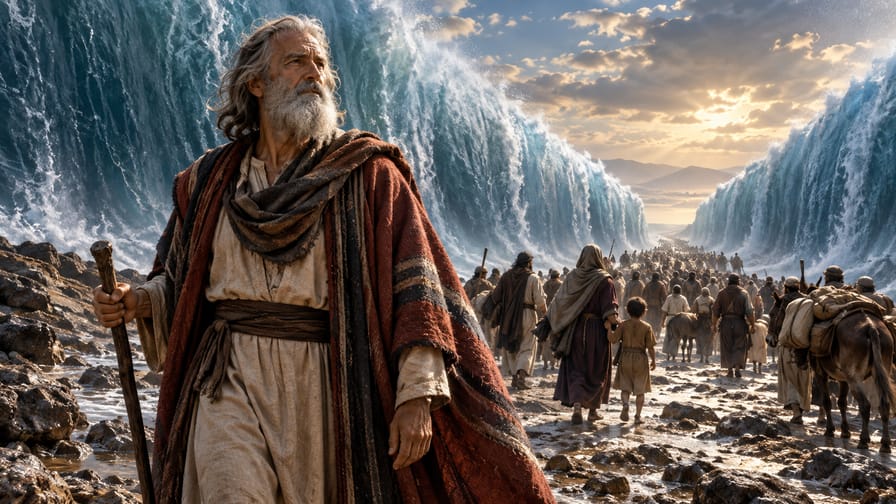
1. Etymology and Meaning of the Name
The name Moses (Hebrew: מֹשֶׁה, Mosheh) is one of the most significant in the Old Testament, carrying a profound symbolism that reflects his history and vocation. Although it is a Hebrew name in the biblical context, its most probable etymology points to an Egyptian origin, which is consistent with his birth and upbringing narrative.
The most accepted etymological derivation for Mosheh comes from the Egyptian msy or mesu, which means "son of" or "born of". This term is common in Pharaonic names such as Thutmose (Thutmose, "born of Thoth") or Ramesses (Ramose, "born of Ra"). The presence of the divine prefix was often omitted in Egyptian names when the context was clear, or for simplification.
However, the Bible, in Exodus 2:10, offers a popular Hebrew etymology for the name of Moses. Pharaoh's daughter named him, saying, "I drew him out of the water" (מִן־הַמַּיִם מְשִׁיתִהוּ, min-hammayim meshitihú). The Hebrew root משה (m-sh-h), "to draw out" or "to pull out," is here associated with the name, creating a play on words that highlights his miraculous origin and his destiny as a deliverer.
This dual meaning — "born of" (Egyptian) and "drawn out of the water" (Hebrew) — is theologically rich. The Egyptian meaning underscores his upbringing and formation in the Pharaonic court, preparing him for leadership. The Hebrew meaning, in turn, emphasizes divine providence and his role as the one who would draw Israel out of the "water" of slavery, a prefiguration of salvation.
There are no other prominent biblical figures with the exact same name as Moses, which underscores his uniqueness and the singularity of his mission in the history of Israel. The name, therefore, is not merely an identification, but a programmatic declaration of his life and divine purpose.
2. Historical Context and Biblical Narrative
2.1 Historical Period and Context
The life of Moses unfolds in one of the most crucial periods of ancient history, approximately between the 15th and 13th centuries BC, with most conservative evangelical scholars favoring a dating of the Exodus around 1446 BC (based on 1 Kings 6:1). This period is marked by Egyptian domination in the Near East.
Egypt was a political, social, and religious superpower, with a highly developed civilization, but also deeply idolatrous and oppressive. The Israelites, descendants of Jacob, had multiplied and become a demographic threat, leading to their enslavement under a pharaoh who "did not know Joseph" (Exodus 1:8).
The narrative of Moses begins in a context of genocide, where Pharaoh ordered the death of all newborn Hebrew males (Exodus 1:22). This brutal oppression sets the stage for divine intervention and the emergence of Moses as the chosen deliverer.
2.2 Family Origin and Life Events
Moses was born of the tribe of Levi, son of Amram and Jochebed (Exodus 6:20), at a time of intense persecution. His mother hid him for three months and, to save him, placed him in a basket of papyrus in the Nile River, where he was found by Pharaoh's daughter (Exodus 2:3-6).
Raised in the Egyptian court as a prince, Moses was educated in all the wisdom of the Egyptians (Acts 7:22). At forty years old, he intervened on behalf of an oppressed Hebrew, killing an Egyptian, and was forced to flee to Midian (Exodus 2:11-15), where he spent another forty years as a shepherd, marrying Zipporah, daughter of Jethro (Exodus 2:21).
At eighty years old, on Mount Horeb (Sinai), Moses had his transformative encounter with God in the burning bush (Exodus 3:1-6). There, God revealed his name YHWH (Lord) and commissioned him to deliver Israel from Egyptian bondage.
Back in Egypt, with his brother Aaron as spokesman, Moses confronted Pharaoh, resulting in the ten divine plagues that culminated in the Passover and the Exodus of Israel (Exodus 7-12). The crossing of the Red Sea (Exodus 14) marked the definitive liberation and the beginning of the journey in the wilderness.
On Mount Sinai, Moses received the Law of God, including the Ten Commandments, and mediated the Mosaic Covenant between God and Israel (Exodus 19-24). He supervised the construction of the Tabernacle and instituted the Levitical priesthood, establishing the foundations for the worship and theocratic life of Israel.
For forty years in the wilderness, Moses led the people, facing their grumbling and rebellion (Numbers 14:1-4), as well as internal and external challenges. He repeatedly interceded for Israel, averting divine wrath (Exodus 32:11-14 Numbers 14:13-20).
Despite his faithfulness, Moses sinned at Meribah by striking the rock instead of speaking to it, dishonoring God before the people (Numbers 20:7-12). For this reason, he was denied entry into the Promised Land. Before his death, on Mount Nebo, he blessed the tribes and delivered his final discourses, recorded in Deuteronomy (Deuteronomy 34:1-5).
The geography of his life encompassed Egypt (Nile region and Goshen), Midian (Arabian peninsula), the Sinai wilderness, and the region of Moab, on the border with the Promised Land. His relationships with Aaron, Miriam, Jethro, Zipporah, Pharaoh, and Joshua were fundamental to the narrative.
3. Character and Role in the Biblical Narrative
3.1 Character Virtues and Weaknesses
Moses' character is complex and multifaceted, transparently revealed in the Scriptures. One of his most notable qualities was humility. Numbers 12:3 describes him as "the humblest man on the face of the earth," a fundamental characteristic for someone who would be God's mediator.
He demonstrated unwavering faith and exemplary obedience to God's call, even in the face of his own insecurities and the people's resistance (Exodus 4:10-13). His perseverance and patience were repeatedly tested by the unbelief and grumbling of Israel in the wilderness.
Moses was a compassionate leader and a tireless intercessor for his people. In moments of great divine wrath, he stood in the gap, pleading with God to forgive Israel, even asking to have his name blotted out of the book of life on their behalf (Exodus 32:32).
Despite his virtues, Moses also exhibited human weaknesses. His initial reluctance to accept God's call (Exodus 4:13) reveals a lack of self-confidence. His anger, though often justified by the people's rebellion, led him to act impulsively at Meribah (Numbers 20:10-11).
In this episode, he disobeyed God's command to "speak" to the rock, striking it twice with his staff, and took God's glory for himself ("Must we bring water for you out of this rock?", Numbers 20:10). This act of impatience and distrust cost him entry into the Promised Land.
3.2 Vocation and Specific Role
Moses' vocation was unique. He was the instrument chosen by God to be the deliverer of Israel from Egyptian bondage, the lawgiver who received and transmitted the divine Law, and the mediator of the Old Covenant at Sinai. His role was multifaceted:
- Prophet: God spoke with him "face to face, as a man speaks with his friend" (Exodus 33:11), and Moses transmitted the divine word to the people. He is considered the greatest prophet of the Old Testament (Deuteronomy 34:10).
- Leader and Deliverer: He led Israel out of Egypt and through the wilderness, organizing them as a theocratic nation under God's Law.
- Mediator of the Covenant: He was the agent through whom the Mosaic Covenant was established, with its laws and statutes, which defined Israel's identity and relationship with YHWH.
- Intercessor: He constantly pleaded with God on behalf of the people, demonstrating a deep concern for Israel's spiritual and physical well-being.
Moses' significant actions, such as the confrontation with Pharaoh, the leading of the Exodus, the giving of the Law, and the construction of the Tabernacle, shaped Israel's identity and their understanding of God. His development as a character shows a transformation from a hesitant man to a courageous and faithful leader, though with his human failings.
4. Theological Significance and Typology
4.1 Role in Redemptive History and Christocentric Typology
Moses occupies a central place in God's redemptive history, serving as the primary agent of divine revelation and the formation of Israel as the covenant people. His life and ministry are a turning point, marking the beginning of the nation of Israel and the giving of the Law, which would prepare the way for the coming of the Messiah.
The figure of Moses is one of the richest in Christocentric typology in the Old Testament. He foreshadows Jesus Christ in several crucial ways:
- Deliverer: Just as Moses delivered Israel from slavery in Egypt, Jesus Christ delivers His people from the bondage of sin and death (John 8:34-36 Romans 6:6).
- Mediator: Moses mediated the Old Covenant between God and Israel (Galatians 3:19). Jesus Christ is the mediator of a New and superior Covenant, sealed with His own blood (Hebrews 8:6 Hebrews 9:15 1 Timothy 2:5).
- Prophet: In Deuteronomy 18:15-18, Moses prophesied about a "prophet like me" whom God would raise up. The New Testament explicitly identifies Jesus as the fulfillment of this prophecy (Acts 3:22-23 Acts 7:37). Jesus is the supreme prophet who fully reveals the will of God.
- Lawgiver: Although Moses delivered the Law, Jesus did not come to abolish it, but to fulfill it and interpret it in its fullness (Matthew 5:17). He is the author of a superior law, the "law of Christ" (Galatians 6:2), which is written on hearts.
- Provider of Bread: Moses was the instrument for God to provide manna in the wilderness (Exodus 16). Jesus declared Himself the "Bread of Life" who came down from heaven, superior to manna, and who gives life to the world (John 6:32-35).
The Mosaic Covenant, mediated by Moses, although not a means of salvation, revealed God's holiness and human sinfulness, pointing to the need for a Savior. The Law of Moses served as a "guardian" or "tutor" to lead to Christ (Galatians 3:24), preparing the people for the grace that would come through Him.
Moses' faith is highlighted in Hebrews 11:23-29, where he is praised for choosing to suffer with the people of God instead of enjoying the fleeting pleasures of sin, "considering the reproach of Christ greater wealth than the treasures of Egypt." This demonstrates that Old Testament faith was already focused on the coming Messiah.
Reformed and evangelical theology emphasizes that the Mosaic Law, though holy and just, could not justify the sinner (Romans 3:20). It served to reveal sin and the need for grace. Moses' obedience, though imperfect, foreshadowed the perfect obedience of Christ, who fulfilled all the requirements of the Law.
The Transfiguration of Jesus, where Moses and Elijah appeared with Christ (Matthew 17:1-8), symbolizes the union of the Law (represented by Moses) and the Prophets (represented by Elijah) testifying to Jesus' glory as the fulfillment of all Scripture.
5. Biblical-Theological Legacy and Canonical References
5.1 Literary Contributions and Influence on the Canon
Moses' legacy is immense and permeates the entire biblical canon. He is traditionally considered the author of the Pentateuch (Genesis, Exodus, Leviticus, Numbers, and Deuteronomy), the first five books of the Bible, also known as the Torah. This Mosaic authorship is widely accepted in conservative evangelical theology, founded on various biblical passages (e.g., Exodus 17:14 Exodus 24:4 Deuteronomy 31:9 John 5:46-47).
In addition to the Pentateuch, Psalm 90 is attributed to Moses, demonstrating his wisdom and profound understanding of human transience and God's eternity. His literary contribution is the foundation for Israel's faith and law, establishing the foundations of the history of creation, the fall, the Abrahamic covenant, and the formation of the chosen nation.
Moses' influence on biblical theology is incalculable. The "Book of Moses" (Mark 12:26) is constantly cited and referenced throughout the Old and New Testaments. The theme of the Exodus, central to the Mosaic narrative, becomes a paradigm for salvation and liberation throughout Scripture, culminating in the "new Exodus" wrought by Christ.
He is mentioned in various historical books (Joshua, Judges, Samuel, Kings, Chronicles), prophetic books (Isaiah, Jeremiah, Ezekiel, Hosea, Micah, Malachi), and poetic books (Psalms). The prophets frequently appealed to the people to return to the Law of Moses (Malachi 4:4).
5.2 Presence in Tradition and Evangelical Theology
In the New Testament, Moses is referenced over 80 times, by both Jesus and the apostles. Jesus frequently appealed to Moses' authority to validate His own teachings and messianic claims (John 5:46). The Law of Moses is the backdrop for understanding God's righteousness and the need for grace.
In Romans 10:4, Paul affirms that "Christ is the end of the law for righteousness to everyone who believes," which does not mean abolition, but fulfillment and the goal to which the Law, mediated by Moses, pointed. Conservative evangelical theology understands the Mosaic Law in its three functions: the civil function (for the nation of Israel), the ceremonial function (pointing to Christ), and the moral function (reflecting God's character, still valid for believers as a guide).
Jewish tradition venerates Moses as the greatest of the prophets and the giver of the Torah. In intertestamental literature, works like the "Assumption of Moses" and the "Testaments of the Twelve Patriarchs" expand and glorify his figure, reflecting his continued importance.
In Reformed and evangelical theology, Moses is seen as a pillar of God's progressive revelation. His life and ministry are crucial for understanding the nature of the covenant, God's holiness, human sinfulness, and the need for a Redeemer. He is a powerful testimony to divine sovereignty in choosing and empowering His servants, even with their imperfections.
Moses' importance for understanding the canon lies in his function as the foundation of Old Testament revelation. Without the books of Moses, the history of salvation, the identity of Israel, the nature of the Law, and the prefiguration of Christ would be incomprehensible. He remains a giant of faith, whose legacy unequivocally points to Jesus Christ, the greatest Deliverer, Lawgiver, and Mediator.