


Mahalath
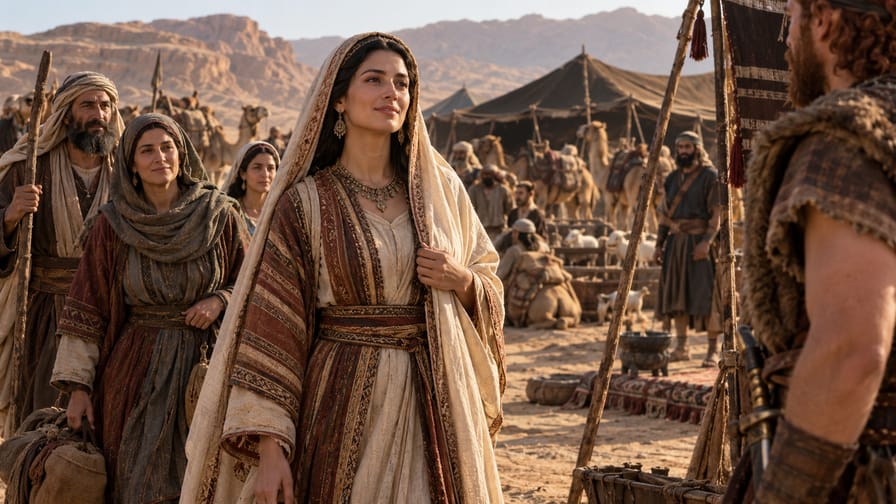
Mahalath is one of the quieter figures in the patriarchal narratives of Genesis. She was a daughter of Ishmael, the son of Abraham, and the sister of Nebaioth, Ishmael's firstborn. Scripture introduces her in a single verse: after seeing that the Canaanite women displeased his father Isaac, Esau went to Ishmael and took Mahalath as his wife, in addition to the wives he already had (Genesis 28:9).
The Bible records no words spoken by Mahalath and no action of her own. Everything we know about her comes from a genealogical note and from the motive the narrator attributes to Esau. Even so, her name stands at a significant crossroads: the moment when Jacob departs for Paddan-aram with his father's blessing and Esau, the brother who lost the blessing, tries to repair his standing in the family.
A textual question also accompanies her. In the list of Esau's wives in Genesis 36:3, the daughter of Ishmael and sister of Nebaioth is called Basemath, not Mahalath. This article explains why most interpreters understand both names to refer to the same woman, and why the question should be handled with care.
1. Etymology and meaning of the name
The Hebrew name is Maḥalat (מָחֲלַת). Its meaning is uncertain. The same form appears in the headings of Psalm 53 and Psalm 88 (according to Mahalath), where it seems to be a musical or liturgical term whose exact sense is no longer known. Some scholars relate the word to a root meaning to dance, or to an instrument such as a flute or lyre; others connect it with the root ḥlh, which can mean to be weak or to be sick; still others propose a sense like pleasant or gentle. None of these explanations can be proven, and it is wiser to say that the meaning of the name is not known with certainty than to build a spiritual lesson on a conjectural etymology.
The name Basemath (בָּשְׂמַת, Basemat), used in Genesis 36:3, is clearer: it derives from bośem, spice or fragrance, and is usually rendered fragrant. It was a common enough name that another of Esau's wives, the daughter of Elon the Hittite, bears it in Genesis 26:34, and a daughter of Solomon also bore it (1 Kings 4:15).
2. Historical context and biblical narrative
2.1 Family origin and genealogy
Mahalath belonged to the line of Ishmael, the son of Abraham by Hagar, the Egyptian servant of Sarah (Genesis 16:15). God had promised that Ishmael would become a great nation and father twelve princes (Genesis 17:20), and Genesis 25:12-16 lists those sons, beginning with Nebaioth, the firstborn. Mahalath is the only daughter of Ishmael named in Scripture. The text identifies her by her father and by her brother Nebaioth, which may suggest that Nebaioth, as firstborn, was already the head of the clan.
That detail fits the chronology. According to the ages given in Genesis, Ishmael died at one hundred and thirty-seven (Genesis 25:17), and by the reckoning of many commentators this happened before, or close to, the time Esau took Mahalath. If so, the phrase Esau went to Ishmael would mean that he went to Ishmael's people rather than to Ishmael in person. This is an inference from the numbers in Genesis, not an explicit statement of the text.
By this marriage Mahalath became the wife of her cousin: Esau was the son of Isaac, and Isaac and Ishmael were both sons of Abraham. The union brought together two branches of Abraham's family that stood outside the line of the covenant promise, which God had declared would continue through Isaac and then through Jacob (Genesis 17:19-21; 21:12; 25:23).
2.2 Main events
The context of Genesis 28:6-9 is decisive. Esau had married two Hittite women, Judith and Basemath, and these marriages made life bitter for Isaac and Rebekah (Genesis 26:34-35). Rebekah said she was weary of her life because of the Hittite women (Genesis 27:46). Isaac then blessed Jacob, charged him not to take a wife from the daughters of Canaan, and sent him to Paddan-aram to marry within the family of Laban (Genesis 28:1-5).
Esau saw all this. He saw that Isaac had blessed Jacob, that he had sent him away with the command not to marry a Canaanite, and that Jacob had obeyed. He realized that the Canaanite women did not please his father, and so he went to Ishmael and took Mahalath besides the wives he had (Genesis 28:6-9). The text does not say whether Mahalath consented, what she thought, or how she was received in Isaac's household.
Later, Genesis 36 lists the wives of Esau and their descendants. There the daughter of Ishmael and sister of Nebaioth bears a son named Reuel (Genesis 36:4; 36:10), and Reuel's sons, Nahath, Zerah, Shammah and Mizzah, became chiefs among the Edomites (Genesis 36:13; 36:17). If Mahalath and Basemath are the same woman, as most interpreters hold, she is an ancestress of several Edomite clans.
The names of Esau's wives differ between Genesis 26:34, 28:9 and 36:2-3. In chapter 26 the wives are Judith, daughter of Beeri the Hittite, and Basemath, daughter of Elon the Hittite; in chapter 28, Mahalath, daughter of Ishmael; in chapter 36, Adah, daughter of Elon the Hittite, Oholibamah, daughter of Anah, and Basemath, daughter of Ishmael and sister of Nebaioth. The description daughter of Ishmael, sister of Nebaioth is the same in 28:9 and 36:3, which strongly suggests that one person is in view.
Several explanations have been offered. The most common is that women in the ancient Near East could bear more than one name, or receive a new name at marriage, just as the patriarchs themselves received new names. Another suggests that the lists come from different records and that names were exchanged in transmission. Some ancient witnesses, such as the Samaritan Pentateuch, read Mahalath in Genesis 36, which shows that the difference was already noticed in antiquity. None of these explanations is stated in the text itself, and it is honest to admit that we do not know exactly why two names are used. What is clear is that the Bible presents one daughter of Ishmael as wife of Esau, and nothing in these passages requires two different women.
3. Character and role in the biblical narrative
Because Mahalath does not speak or act in the narrative, any description of her personality would be invention. The text passes no moral judgment on her. She appears as the object of a decision made by Esau, as was common in marriages of that time, and her role in the story is to illustrate Esau's reaction to the blessing given to Jacob.
That reaction is revealing. Esau understood that his parents disapproved of the Canaanite marriages, but his response was partial. He did not part from the Hittite wives; he added another. He sought a bride within Abraham's family, but from the line that God had explicitly set aside from the covenant inheritance. The gesture looks like an attempt to regain favor through an external adjustment, without the repentance and faith that marked the heirs of the promise. The letter to the Hebrews later describes Esau as one who sold his birthright for a single meal and afterward found no chance to repent, though he sought the blessing with tears (Hebrews 12:16-17).
Mahalath herself should not be judged by her husband's motives. She was a descendant of Abraham, a daughter of a people to whom God had also shown mercy (Genesis 21:17-20), and her presence in the genealogy reminds us that the families outside the chosen line were not forgotten by the God who rules the nations.
4. Theological significance
4.1 The line of promise and the other branches
Genesis follows a pattern of divine choice: Isaac rather than Ishmael, Jacob rather than Esau. The marriage of Mahalath and Esau joins two branches of the family that received real blessings, such as numerous descendants, land and princes, but not the covenant promise through which all the families of the earth would be blessed (Genesis 12:3; 28:14). Paul uses both contrasts to show that God's saving purpose rests on his free grace and not on birth or human effort (Romans 9:6-13), where he cites Malachi 1:2-3.
4.2 Obedience of the heart and external correction
Esau's marriage to Mahalath is a narrative lesson about the difference between pleasing people and turning to God. Esau watched what pleased his father and imitated it partially, but the text never shows him seeking the Lord. Jacob, for all his failures, goes out under the promise and meets God at Bethel in the very next scene (Genesis 28:10-22). The juxtaposition is deliberate: one brother adjusts his behavior to regain approval, while the other receives a revelation of grace he did not earn.
5. Legacy and canonical references
Mahalath, daughter of Ishmael, is named explicitly only in Genesis 28:9. If she is identified with Basemath, daughter of Ishmael and sister of Nebaioth, she also appears in Genesis 36:3, 36:4, 36:10, 36:13 and 36:17, which record her son Reuel and the grandsons who became chiefs of Edom. 1 Chronicles 1:35 and 1:37 list Reuel and his sons among the descendants of Esau without naming his mother. The wider context of her marriage includes Genesis 26:34-35, 27:46 and 28:1-8.
She should not be confused with another Mahalath, daughter of Jerimoth the son of David, who became a wife of King Rehoboam (2 Chronicles 11:18).
6. Application for today
The brief story of Mahalath invites us to examine our own motives. It is possible to notice what pleases others, even what pleases godly parents, and to make external changes without ever surrendering the heart to God. Esau fixed the appearance of the problem and kept its root. The gospel calls for something deeper: repentance and faith in the God who justifies the ungodly, not a strategy for regaining approval.
Mahalath also reminds us that Scripture is full of people whose voices were not recorded, especially women whose lives were shaped by the decisions of others. The God of Abraham heard Hagar in the wilderness (Genesis 16:13) and the cry of the boy Ishmael (Genesis 21:17). The same God sees those whose stories fit in a single verse. In Christ, the promise made to Abraham reaches those who were once far off, so that everyone who believes, whatever their family line, becomes a child of Abraham by faith (Galatians 3:7-9; Ephesians 2:13).