


Belshazzar
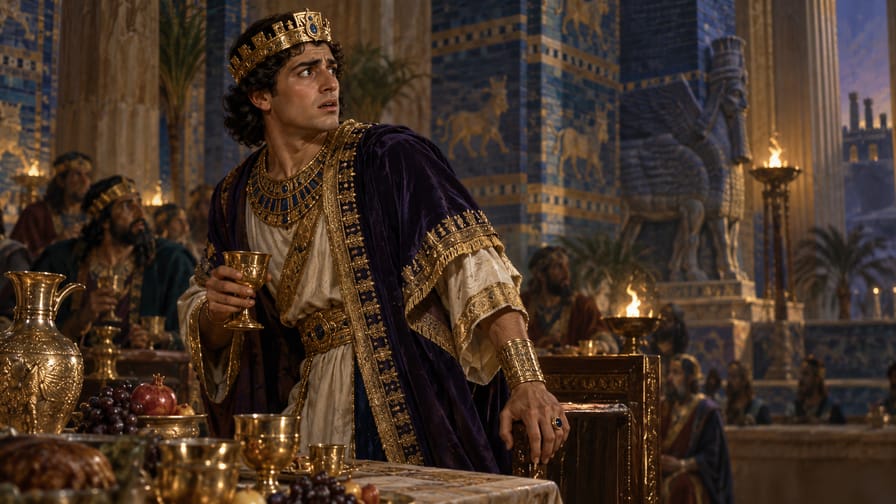
The figure of Belshazzar (also known as Baltasar) emerges in the Hebrew Scriptures as the last king of Babylon, whose brief and fateful appearance in the book of Daniel marks the dramatic end of an empire. His story is a powerful testimony to divine sovereignty over nations and the inevitability of judgment against human impiety and arrogance.
From a Protestant evangelical perspective, the narrative of Belshazzar transcends mere historical chronicle, serving as a vivid illustration of fundamental theological principles. It highlights the authority of Scripture, the accuracy of prophecy, and God's constant presence in salvation history, even amidst pagan empires.
This analysis will seek to explore the etymology of his name, the historical context and biblical narrative of his rise and fall, the evaluation of his character and role, his theological significance, and finally, his enduring legacy in the canon and in Reformed theology.
1. Etymology and meaning of the name
The name Belshazzar, more commonly transliterated as Baltasar in Portuguese, derives from the Babylonian Aramaic בֵּלְשַׁאצַּר (Bēlšaʾṣṣar), as found in the Masoretic Text of Daniel 5. This name is a theophoric form, common in ancient Mesopotamia, which invokes a protective deity.
The etymological root of the name combines the element Bēl (Bel), which is a contraction of Baʿal ("Lord" or "Master"), often used to refer to the god Marduk, the principal deity of the Babylonian pantheon, and the element šaʾ-uṣṣur, which means "protect the king" or "protect his life."
Therefore, the literal meaning of Belshazzar is "Bel, protect the king" or "Bel, protect his life." This name reflects his royal family's devotion to the Babylonian deity Marduk, contrasting sharply with Daniel's monotheistic faith and the God of Israel.
There are no other prominent biblical figures with the same name. Although Daniel's name was changed to Belteshazzar (בֵּלְטְשַׁאצַּר, Bēltəšaʾṣṣar) in Daniel 1:7, there is a clear orthographic and phonetic distinction. Daniel's name invokes the "prince of Bel," while Belshazzar's is a plea for protection for the king himself.
The theological significance of Belshazzar's name, within the biblical context, is profound. It symbolizes reliance on idolatry and the protection of false gods, who, ultimately, prove powerless before the sovereign God of Israel. His name is an ironic echo of his own destruction, for Bel did not protect him on the night the kingdom fell.
This onomastic choice underscores the central conflict of the book of Daniel: the supremacy of the one true God over all pagan deities and earthly kingdoms. Belshazzar's name is thus a declaration of his religious and ideological identity, which would be challenged and unmasked by the prophetic power of Yahweh.
2. Historical context and biblical narrative
The story of Belshazzar is set in the final period of the Neo-Babylonian Empire, specifically on the night of October 12, 539 BC, when the city of Babylon fell to the Medo-Persian armies. This event is narrated with dramatic detail in chapter 5 of the book of Daniel.
The political context of the time was one of great instability for Babylon. King Nabonidus, Belshazzar's father, had spent most of his reign in Arabia, leaving Belshazzar as co-regent in Babylon. The city was under imminent threat from the Persians, led by Cyrus the Great, who had already conquered much of the Middle East.
The biblical narrative in Daniel 5 presents Belshazzar as "son" of Nebuchadnezzar (Daniel 5:2, 11, 13, 18). Although historically Belshazzar was the son of Nabonidus, the term "son" (bar in Aramaic) in the ancient Near East could mean "descendant," "successor," or "heir," not limited to a direct biological relationship. This is an explanation widely accepted by evangelical commentators to reconcile the biblical record with extrabiblical evidence.
The main events of Belshazzar's life are concentrated into a single night, as described in Daniel 5. He organized a great feast for a thousand of his nobles, his wives, and concubines, in an act of ostentation and perhaps defiance in the face of the imminent Persian threat. During this feast, in an act of extreme impiety, Belshazzar ordered that the sacred vessels, taken from the Temple in Jerusalem by Nebuchadnezzar, be brought to be used in his profane banquet (Daniel 5:2).
While drinking wine and praising the "gods of gold, and of silver, of bronze, of iron, of wood, and of stone" (Daniel 5:4), a mysterious hand appeared and began to write on the palace wall. This event terrified Belshazzar, who summoned his wise men and astrologers to interpret the writing, but none were able (Daniel 5:5-8).
The queen mother (likely Nabonidus's mother, or Belshazzar's grandmother) suggested calling Daniel, who had served Nebuchadnezzar. Daniel was brought in and, after rebuking Belshazzar for his arrogance and for not having learned from Nebuchadnezzar's humiliation (Daniel 5:22-23), he interpreted the writing: Mene, Mene, Tekel, and Parsin.
Daniel's interpretation was an announcement of divine judgment: "Mene: God has numbered your kingdom and brought it to an end. Tekel: You have been weighed in the balances and found wanting. Peres: Your kingdom has been divided and given to the Medes and Persians" (Daniel 5:26-28). Despite the terrible news, Belshazzar kept his promise and clothed Daniel in purple, placed a gold chain around his neck, and proclaimed him the third ruler in the kingdom (Daniel 5:29).
Nevertheless, the prophecy was fulfilled that very night. "That very night Belshazzar, the king of the Chaldeans, was slain" (Daniel 5:30). Darius the Mede (identified by some as Cyrus, or one of his generals) received the kingdom, marking the end of the Neo-Babylonian Empire and the beginning of Medo-Persian hegemony, as foretold in the prophecies of Daniel and Isaiah.
The main geography of the narrative is the city of Babylon, the capital of the empire, with its impressive walls and palaces, a symbol of earthly power and idolatry. The fall of Babylon under Belshazzar is a crucial event that connects the history of Israel to the history of the great world powers, showing God's hand in all of them.
3. Character and role in the biblical narrative
The character of Belshazzar, as revealed in Daniel 5, is marked by flagrant arrogance, impiety, and a notable lack of wisdom, especially in contrast to his predecessor Nebuchadnezzar, whose history of humiliation and recognition of divine sovereignty should have served as a lesson.
His main moral failing is the impiety manifested in his decision to use the sacred vessels of the Temple in Jerusalem for an idolatrous and profane banquet (Daniel 5:2-4). This act was not merely a disrespect to the Jews or to a foreign temple, but a direct blasphemy against the God of Israel, Yahweh, whom Nebuchadnezzar had eventually recognized as the "Most High" (Daniel 4:34-37).
Belshazzar demonstrated profound spiritual blindness. Daniel directly rebukes him for "not having humbled your heart, though you knew all this" (Daniel 5:22), referring to Nebuchadnezzar's experience. He ignored the lessons of history and persisted in his rebellion against God, exalting himself against the "Lord of heaven" (Daniel 5:23).
Despite his initial fear before the writing on the wall (Daniel 5:6), his reaction was not one of repentance or a sincere search for Daniel's God, but rather of superstition and despair. He sought the human wisdom of his magicians, enchanters, and astrologers, who proved powerless, before being forced to turn to Daniel.
Belshazzar's role in the biblical narrative is, therefore, that of an anti-hero, a vivid example of the condemnation awaiting those who defy God and persist in idolatry and arrogance. He serves as the catalyst for the manifestation of divine judgment upon Babylon and as a dramatic contrast to Daniel's faithfulness.
His significant actions are the organization of the blasphemous feast and his subsequent inability to decipher the divine message. The decision to profane the vessels of the Temple is the last straw that precipitates judgment, demonstrating his utter disregard for the holiness and power of the God of Israel.
There is no character development for Belshazzar throughout the narrative his story is a sudden and fatal climax. He is presented as a king who, in his ignorance and depravity, seals the fate of his own empire. His death is the consummation of divine judgment and the end of an era of oppression for God's people.
4. Theological significance and typology
The story of Belshazzar possesses a multifaceted and profound theological significance, especially from the Protestant evangelical perspective, which emphasizes the sovereignty of God and the authority of Scripture.
Firstly, the narrative of Belshazzar is a powerful demonstration of divine sovereignty over human kingdoms. Even amidst a pagan empire, God is in absolute control of history, determining the rise and fall of kings and nations (Daniel 2:21 4:17). The fall of Babylon was not a mere geopolitical accident, but the fulfillment of God's divine plan, predicted centuries earlier by prophets like Isaiah (Isaiah 13-14, 47) and Jeremiah (Jeremiah 50-51).
Secondly, the story of Belshazzar illustrates the consequences of sin and impiety. His arrogance, idolatry, and, above all, his blasphemy against the God of Israel by profaning the sacred vessels of the Temple, are severely judged. He is an archetype of human pride that refuses to acknowledge divine authority, even in the face of clear evidence (Daniel 5:22-23). The message on the wall – "You have been weighed in the balances and found wanting" (Daniel 5:27) – resonates as a timeless warning against self-exaltation and rebellion against God.
Although Belshazzar is not a direct typological figure of Christ, the event of the fall of Babylon under his reign has a profound typological significance, pointing to God's final judgment on all ungodliness and on the "worldly system" that opposes Him. The New Testament, particularly the book of Revelation, uses the fall of historical Babylon as a type for the fall of "Babylon the Great," which symbolizes the global system of rebellion against God, idolatry, and the persecution of the saints (Revelation 17-18).
The destruction of Babylon in Belshazzar's time prefigures God's eschatological judgment on evil and the establishment of His eternal Kingdom. The passage in Revelation 18:2, "Fallen, fallen is Babylon the great," echoes the fall of Belshazzar's Babylon, serving as a reminder that all human pride and power, when in opposition to God, are destined for ruin.
The narrative also emphasizes the reliability of God's Word and the accuracy of prophecies. Daniel, God's prophet, not only interprets the divine message but also announces the imminent fulfillment of judgment. This reinforces the evangelical belief in the inerrancy and infallibility of the Bible as the inspired revelation of God.
The story of Belshazzar, therefore, is deeply connected to central theological themes such as divine judgment, the holiness of God, God's faithfulness to His promises (even amidst Israel's exile), and the demand for obedience and humility before the Creator. It serves as a powerful teaching on the futility of idolatry and the inevitability of accountability before the Lord of heaven.
5. Biblical-theological legacy and canonical references
The legacy of Belshazzar in biblical theology is primarily consolidated in the book of Daniel, where his story serves as a crucial turning point in the narrative of the Babylonian exile and the rise of empires. He is a figure who, though briefly mentioned, has a disproportionate impact on the demonstration of divine attributes.
Outside of Daniel 5, there are no direct mentions of Belshazzar in other canonical books of the Old or New Testament. His relevance, however, transcends mere textual appearance, as the event of his fall is a prophetic fulfillment and a landmark in salvation history.
His story contributes significantly to biblical theology, especially concerning the Theology of History and Divine Sovereignty. It demonstrates that God is the Lord of history, controlling the destinies of nations and fulfilling His purposes through them, even if these nations are pagan and hostile to His people. This theme is central to the book of Daniel and echoes throughout all Scripture.
In Jewish and Christian interpretive tradition, Belshazzar is consistently viewed as an example of impiety and arrogance that leads to ruin. His story is a cautionary tale about the danger of despising God and His laws. The fall of Babylon under Belshazzar is a point of reference for divine judgment upon earthly kingdoms.
The question of the relationship between Belshazzar and Nebuchadnezzar (son versus grandson/successor) has been a point of discussion, but the discovery of extrabiblical evidence, such as the Nabonidus Chronicle and the Cyrus Cylinder, which confirm Nabonidus as the last king of Babylon and Belshazzar as his son and co-regent, has solidified the historical accuracy of the biblical account, under the interpretation that "son" can mean "descendant" or "successor." Theologians like Gleason Archer and Kenneth Kitchen have vigorously defended the historicity of Daniel and the accuracy of its descriptions.
In Reformed and evangelical theology, the narrative of Belshazzar is often used to illustrate the doctrine of God's providence. It emphasizes that God not only created the world but actively sustains and governs it, intervening in human history to fulfill His plans. The fall of Babylon is irrefutable testimony that "the Most High rules the kingdom of men and gives it to whom he will" (Daniel 4:17, 25, 32 5:21).
The story of Belshazzar is crucial for understanding the canon, as it fills an important historical gap, detailing the transition from the Babylonian Empire to the Medo-Persian, an event prophesied by Daniel in his visions of the statues and beasts (Daniel 2, 7). This transition is fundamental for the development of redemptive history, setting the stage for the return of the Jews from exile and the reconstruction of the Temple.
Thus, the figure of Belshazzar, though short-lived, is a theological pillar that upholds the truth of divine sovereignty, the certainty of judgment for the wicked, and God's faithfulness in fulfilling His prophecies—essential elements for the Protestant evangelical faith.