


Cyrus
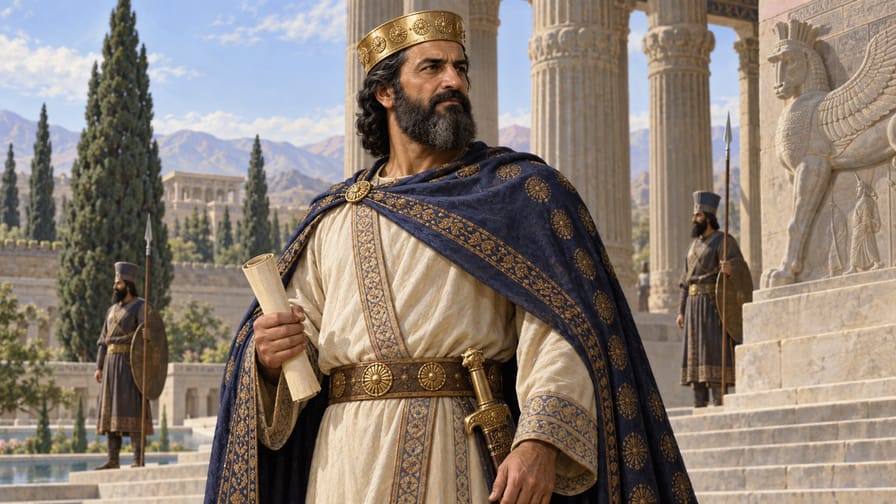
Cyrus the Great is a prominent and singular figure in the Holy Scriptures, recognized as the founder of the Persian Empire and a divinely chosen instrument for the return of the Jewish exiles to their homeland. His mention in the Bible not only attests to his historical importance but also reveals profound aspects of God's sovereignty over nations and the fulfillment of His prophetic promises. The analysis of Cyrus transcends mere historical record, offering rich theological perspectives on divine providence, messianic typology, and the history of redemption.
This in-depth study will seek to explore the figure of Cyrus from an evangelical Protestant perspective, emphasizing biblical authority and exegetical precision. We will address his etymology, the complex historical context of his rise, his character and role in the biblical narrative, and his profound theological significance for understanding God's work in the Old Testament and its relevance for the progressive revelation that culminates in Christ.
1. Etymology and meaning of the name
The name Cyrus, in Hebrew, is transliterated as Koresh (כּוֹרֶשׁ), as it appears in books such as Isaiah, Ezra, and Daniel. This Hebrew form is an adaptation of the original Persian name, Kūruš, which became Kyros (Κῦρος) in Greek, from which we derive the Portuguese form.
The exact etymology of the name Kūruš is a subject of debate among scholars. Some theories suggest a connection with the Persian word for "sun" (khur), implying a meaning like "sun-like" or "the sun". Other proposals link the name to roots meaning "throne" or "young man".
However, none of these etymological derivations possess an inherent theological or direct prophetic meaning in the biblical context. The importance of the name Cyrus in the Bible does not lie in its intrinsic literal meaning, but rather in the individual who bore it and, crucially, in the divine purpose God designated for him.
There are no other prominent biblical figures who share the name Cyrus. The uniqueness of his name, associated with his historical and prophetic figure, reinforces the specificity of his calling and the precision of the divine prophecy that named him even before his birth.
The theological significance of the name Cyrus in the biblical context is, therefore, indirect. It is derived from the sovereignty of God who not only knew the man who would become the liberator of Israel but also named him hundreds of years before he appeared on the world stage. This demonstrates divine prescience and God's absolute control over human history.
Although the name itself does not carry an explicit theological weight, the fact that God named him in Isaiah 44:28 and Isaiah 45:1, long before his existence, is a powerful demonstration of the inspiration and inerrancy of the Scriptures. It is a testament to God's ability to reveal future events with astonishing accuracy, validating faith in the prophetic Word.
2. Historical context and biblical narrative
Cyrus the Great rose to power in the 6th century B.C., a period of intense geopolitical change in the Ancient Near East. His reign extended from approximately 559 to 530 B.C., marking the transition from Babylonian to Persian dominance and establishing the vast Achaemenid Empire.
The political and social context of the time was dominated by the Neo-Babylonian Empire, which had destroyed Jerusalem in 586 B.C. and led much of the people of Judah into exile. The rise of Cyrus represented a direct threat to this hegemony, culminating in the fall of Babylon in 539 B.C., a prophesied event of great biblical significance.
Historically, Cyrus was the son of Cambyses I, king of Anshan, and grandson of Teispes, who is considered one of the early kings of Persia. He unified the Persian tribes, conquered the Median Kingdom (his maternal grandfather was the Median king Astyages), and expanded his empire to include Lydia and, finally, Babylon.
The main events of Cyrus's life, as related in the Bible, focus on his conquest of Babylon and, subsequently, the issuance of the famous decree that allowed the Jews to return to their land and rebuild the Temple in Jerusalem. This decree is recorded in Ezra 1:1-4 and also in 2 Chronicles 36:22-23.
The prophecy of Isaiah, written about 150 years prior, is notable for explicitly naming Cyrus as God's "shepherd" and His "anointed one" (mashiaḥ), who "will accomplish all my pleasure, saying of Jerusalem, 'It shall be built,' and of the temple, 'Your foundation shall be laid'" (Isaiah 44:28). The prophecy in Isaiah 45:1-7 details how God would use him to subdue nations and open doors, even though Cyrus did not know Him.
The geography related to Cyrus encompasses the vast lands of the Persian Empire, from Persia (present-day Iran) to Mesopotamia (Babylon) and the region of Judah (Jerusalem). His capital, Pasargadae, was a center of power and administration, but the decree was issued from Babylon after its conquest.
Cyrus's relationships with other biblical figures are crucial. He is a contemporary of Daniel, who served in his court (Daniel 6:28, Daniel 10:1). It is probable that Daniel played a significant role in presenting to Cyrus the prophecies of Isaiah and Jeremiah (as suggested by Josephus in Antiquities of the Jews, Book XI, Chapter 1, Section 2), which may have influenced the king to issue the decree of return.
Furthermore, Cyrus interacted with Jewish leaders such as Sheshbazzar (Ezra 1:8) and, indirectly, with Zerubbabel and Jeshua, who would lead the first group of returnees. His policy of religious tolerance and repatriation of captive peoples was a watershed moment in history, distinctly different from Assyrian and Babylonian practices, and divinely orchestrated for the benefit of Israel.
3. Character and role in the biblical narrative
Cyrus's character, as revealed in the Scriptures and corroborated by extrabiblical historical records, is that of a remarkably effective military and political leader and, by the standards of the time, relatively benevolent. He is portrayed as a shrewd conqueror, but also as a pragmatic administrator who sought stability in his vast empire.
One of Cyrus's most notable qualities was his policy of allowing captive peoples to return to their lands and worship their own gods. This was a striking contrast to the policy of forced deportation and assimilation of previous empires, such as Assyria and Babylon. This pragmatic approach, though not born of faith in Yahweh, perfectly served divine purposes.
The Bible does not document specific sins, weaknesses, or moral failings of Cyrus, in the sense of direct prophetic criticism, as it would with kings of Israel or Judah. This is due to his role as a pagan king, an instrument in God's hands, and not as a member of the covenant who would be judged by the standards of the Torah. His worship of pagan gods, such as Marduk, is implicitly a failing from a monotheistic viewpoint, but it is not the focus of the biblical narrative concerning him.
Cyrus's specific vocation and function are clearly defined in Isaiah 44:28, where God calls him "my shepherd" (roʿi) and "my anointed one" (meshiḥi). He was divinely appointed to fulfill God's will, specifically to "say of Jerusalem, 'It shall be built,' and of the temple, 'Your foundation shall be laid'." This is a prophetic and redemptive calling, even if Cyrus did not consciously recognize Yahweh initially.
His primary role in the biblical narrative is that of a deliverer and restorer. He was God's instrument to free the Jews from Babylonian captivity and initiate the rebuilding of the Temple, an essential step for the continuity of salvation history and the coming of the Messiah. He was not a prophet or priest, but a king who acted in fulfillment of divine prophecy.
Cyrus's most significant actions are the conquest of Babylon, which ended the 70-year period of exile prophesied by Jeremiah (Jeremiah 25:11-12, Jeremiah 29:10), and the issuance of his decree in 538 B.C. This decree not only allowed the return of the Jews but also authorized the rebuilding of the Temple and even returned the sacred vessels that Nebuchadnezzar had plundered (Ezra 1:7-8).
Cyrus's development as a character in the biblical narrative is not one of personal spiritual transformation, but rather of an instrument that increasingly aligns with God's purpose. The influence of Daniel, who likely explained the prophecies to him, is a crucial factor. Cyrus recognizes that "The LORD, the God of heaven, has given me all the kingdoms of the earth" (Ezra 1:2), which demonstrates an understanding (albeit limited) of Yahweh's sovereignty.
This understanding, even for a pagan king, is remarkable and serves as a testimony to God's ability to use anyone, regardless of their explicit faith, for His sovereign purposes. Cyrus is a vivid example of divine providence at work in the affairs of nations.
4. Theological significance and typology
Cyrus's theological significance is immense and multifaceted, embedding him deeply in Israel's redemptive history and God's progressive revelation. He is not merely a historical figure but a focal point for understanding divine sovereignty, prophetic fulfillment, and the preparation for the coming of the Messiah.
His function as the liberator of the Jews from Babylonian captivity is a crucial event in salvation history. Without the return from exile and the rebuilding of the Temple, the Davidic lineage could not have continued in Judah, and the stage for Christ's incarnation would not have been properly set. Cyrus is a vital link in the chain of the history of redemption.
The Christocentric prefiguration or typology in Cyrus is a fascinating aspect. Although not a direct type of Christ in the sense of a king-priest or prophet of Israel, he is called "anointed" (mashiaḥ) in Isaiah 45:1. This is a term generally reserved for kings and priests of Israel, and most notably for the coming Messiah.
By being called "anointed," Cyrus points to Christ as the supreme Messiah, the true Deliverer, and the Builder of God's spiritual Temple (John 2:19-21, Ephesians 2:20-22). Cyrus liberated a physical people to rebuild a physical temple Christ spiritually liberates His people to build a living church, which is His body and the true temple of God.
The prophecies related to Cyrus are one of the most powerful testimonies to the divine inspiration of the Bible. The naming of Cyrus by Isaiah (Isaiah 44:28, Isaiah 45:1) about 150 years before his birth and the detailed description of his actions (conquest of Babylon, liberation of Israel, rebuilding of the Temple) demonstrate God's absolute prescience.
Furthermore, Cyrus is the agent through whom Jeremiah's prophecy concerning the 70 years of captivity (Jeremiah 25:11-12, Jeremiah 29:10) is fulfilled. This reinforces the theme of God's faithfulness to His promises and sovereign control over the timing and events of history.
There are no direct quotations of Cyrus in the New Testament. However, the theological themes he embodies are central to the Christian faith. His story illustrates God's sovereignty (Romans 9:17), who uses even pagan kings for His purposes divine providence (Proverbs 21:1), which guides the hearts of kings and the fulfillment of prophecies, which validates the truth of God's Word (2 Peter 1:19-21).
The doctrine of divine election, not only of individuals for salvation but also of instruments for salvation history, is highlighted in Cyrus. God "took him by his right hand" (Isaiah 45:1) and "called him by his name," not because of his faith, but because of God's plan for Israel and for the coming of the Messiah.
In summary, Cyrus is a vivid reminder that history is not an accident but a stage where God executes His redemptive plan with unfailing precision. He prefigures Christ not in his moral person or faith, but in his divinely ordained function as a deliverer and restorer, paving the way for the promised Messiah.
5. Biblical-theological legacy and canonical references
Cyrus's legacy in the Bible is predominantly found in the prophetic and historical books of the Old Testament. He is significantly mentioned in Isaiah 44:28 and 45:1-13, where he is prophetically named. In the historical books, his figure is central to the beginning of the post-exilic period, appearing in 2 Chronicles 36:22-23, Ezra 1:1-8, 3:7, 4:3, 5, 5:13-17 and 6:3-5. Daniel also mentions him in Daniel 1:21, 6:28, and 10:1.
His literary contribution is not one of authorship, but rather of inspiration and context for the narratives of Ezra and Daniel. Cyrus's decrees are documented in Ezra, providing the legal and historical basis for the return of the Jews and the rebuilding of the Temple. He is the catalyst that allows the continuation of the history of God's people after the captivity.
Cyrus's influence on biblical theology is profound, especially concerning the doctrine of God's sovereignty and providence. He exemplifies how God uses pagan kings and world events to fulfill His redemptive purposes toward His chosen people. This demonstrates the extent of God's rule over all creation and history.
In the Jewish interpretive tradition, Cyrus is generally viewed positively, as a just king who allowed the return from exile and the rebuilding of the Temple, in accordance with the prophecies. He is a "messiah" in the sense of an agent of God for liberation, though not the ultimate Messiah.
The Christian tradition, especially the Reformed and evangelical traditions, emphasizes Cyrus's role as irrefutable testimony to the prophetic inspiration of the Bible. The naming of a king by his name and his actions centuries before his birth is a powerful argument for the supernatural character of the Scriptures and the veracity of the Christian faith.
Reformed and evangelical theologians frequently cite Cyrus as an exemplary case of God's "common grace," where He bestows gifts and abilities upon individuals (believers or not) and uses them to uphold order in the world and, in some cases, to advance His specific redemptive purposes. Cyrus, though not a worshiper of Yahweh, was an instrument chosen by God.
Cyrus's importance for understanding the canon lies in his function as a bridge between the pre-exilic prophetic period and the post-exilic period. He is the turning point that allows for the restoration of the Jewish community in Judah, the rebuilding of the Temple, and the re-institution of worship, essential elements for the preservation of the covenant and the preparation for the coming of Christ.
In his figure, we see the confluence of secular history and sacred history, demonstrating that God is the Lord of both. Cyrus's story reinforces the conviction that God is actively involved in human affairs, orchestrating events and raising leaders to fulfill His eternal plans, culminating in the salvific work of Jesus Christ.