


Apocalypse
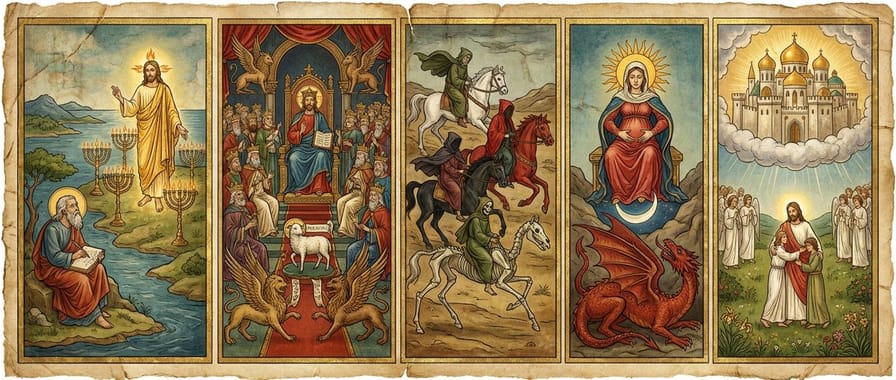
Illustration of the Book of Revelation, one of the 27 books of the New Testament (Nano Banana Pro).
1. Historical Context, Dating, and Authorship
1.1 Johannine Authorship and Apostolic Tradition
The book of Revelation, the prophetic culmination of the biblical canon, presents itself from its very first lines as "the revelation of Jesus Christ, which God gave Him to show His servants the things which must soon take place" (Revelation 1:1). The authorship of this book is traditionally attributed to John, the apostle, son of Zebedee and brother of James, one of the pillars of the early church and the "beloved" disciple of Jesus. This attribution is widely supported by robust testimony from the early church, dating back to the second century.
Church fathers such as Justin Martyr (c. 100-165 AD) in his Dialogue with Trypho, Irenaeus of Lyons (c. 130-202 AD) in Against Heresies, Clement of Alexandria (c. 150-215 AD), Tertullian (c. 160-220 AD), and Origen (c. 185-254 AD), all consistently attested to Johannine authorship. Irenaeus, in particular, is a weighty witness, as he was a disciple of Polycarp, who in turn was a disciple of the Apostle John himself. His assertion that "John, the disciple of the Lord, the same who leaned on His breast, also published the Gospel while residing in Ephesus in Asia" and that he was the author of Revelation, confers an unquestionable apostolic lineage to the work.
Although in the third century, Dionysius of Alexandria raised doubts about apostolic authorship based on stylistic differences between Revelation and the Gospel of John, the overwhelming majority of Christian tradition and the conservative evangelical perspective maintain the authorship of John, the apostle. The differences can be explained by the distinct literary genre (apocalyptic versus narrative/discourse), by the use of an amanuensis for the Gospel, or simply by the nature of divine inspiration which allows for stylistic variations within the same author. The text itself identifies its author as "John" (Revelation 1:1, 4, 9; 22:8), a common name, but one which, in the context of tradition and the book's apostolic claims, points to the apostle.
The defense of Johannine authorship is based not only on external tradition but also on internal evidence. The author's self-designation as "John" in a context where he was a prominent figure in Asia Minor, together with the implicit and explicit authority with which he addresses the seven churches, points to a person of apostolic stature. The language and symbolism, while distinct from the Gospel of John, still share certain theological affinities, such as the emphasis on Christ as the Lamb, the light, the truth, and the life, and the centrality of worship and witness. Such similarities, though not identical, suggest an underlying authorial unity.
1.2 Dating and the Context of Roman Persecution
The dating of Revelation is a crucial point for its interpretation. The majority and most defended position in evangelical scholarship is the "late date," placing the writing at the end of Emperor Domitian's reign (c. 95-96 AD). This dating is corroborated by patristic testimonies, notably that of Irenaeus, who states that the vision was seen "almost in our own time, at the end of Domitian's reign." This period was marked by severe persecution of Christians, especially in the provinces of Asia Minor, to which the book is addressed.
Domitian intensified the imperial cult, demanding worship of himself as "Dominus et Deus" (Lord and God), a practice that represented a direct challenge to the exclusive loyalty of Christians to Jesus Christ. Refusal to participate in the imperial cult resulted in social ostracism, economic persecution, and frequently, martyrdom. It is against this backdrop of intense pressure and suffering that Revelation's message of hope and victory resonates most strongly for the seven churches of Asia (Revelation 2-3).
Although an "early date" (c. 64-68 AD, during Nero's reign) is advocated by some scholars, the internal and external evidence for the late date is more convincing. The condition of the churches described in Revelation 2-3, with their history of struggles and heresies, seems more consistent with a period later than their initial founding. Furthermore, the intensity of persecution and the institutionalization of the imperial cult, which form the backdrop for Revelation's visions, are more characteristic of the late first century under Domitian than of Nero's period, whose focus of persecution was more localized in Rome and less systematic throughout the empire.
The late dating also aligns better with the theological and organizational maturity of the churches, some of which had already "abandoned their first love" (Revelation 2:4) or were dealing with heresies such as Nicolaitanism (Revelation 2:6, 15) and the false prophetess Jezebel (Revelation 2:20). Such developments suggest a considerable period of time since their apostolic founding. The persecution under Domitian was more comprehensive and ideological, focusing on religious loyalty to the emperor, which fits perfectly with Revelation's theme of resistance to the beast and its image.
1.3 Exile on the Island of Patmos and the Greco-Roman World
John, the author of Revelation, declares that he was "on the island called Patmos, on account of the word of God and the testimony of Jesus" (Revelation 1:9). Patmos was a small rocky island in the Aegean Sea, used by the Romans as a place of exile for political and religious prisoners. This detail contextualizes the author's experience: John was not on an idyllic spiritual retreat, but rather suffering for his faith, a reflection of the persecution the churches were facing. His exile was not accidental, but a direct consequence of his loyalty to the gospel, underscoring the book's message to believers who also faced tribulation.
The cultural and religious context of the Greco-Roman world at the time was complex. The cities of Asia Minor, such as Ephesus, Smyrna, Pergamum, Thyatira, Sardis, Philadelphia, and Laodicea, were vibrant centers of trade, culture, and syncretistic religion. Temples dedicated to Roman and Greek gods, mystery cults, and the imposing presence of imperial religion were omnipresent. Christians in these cities faced the temptation to compromise their faith to fit into society, to maintain their economic position, or to avoid persecution and martyrdom.
The pressure for conformity was immense. Cities like Pergamum were centers of imperial cult, where loyalty to the emperor was publicly tested. Social and economic life was often linked to trade guilds that had their own gods and rituals. Participating in these activities could mean participating in idolatrous rituals, which was unacceptable for Christians. Revelation, therefore, is not merely an exercise in eschatological speculation, but a pastoral and prophetic word deeply rooted in the lived reality of believers, offering them a theology of resistance and hope.
Understanding this historical context is fundamental to uncovering the layers of meaning and the lasting relevance of the book. It not only upholds the inerrancy of Scripture by presenting a faithful record of divine revelation, but also demonstrates God's authority over human history, even in the face of the most powerful empires. Revelation is a call to unwavering faithfulness, to resistance against worldly pressures, and to hope in Christ's final victory, even when present reality seems overwhelming and persecution intensifies.
2. Structure, Division, and Main Content
2.1 Literary Genre: Apocalyptic, Prophetic, and Epistolary
The book of Revelation is unique in the biblical canon for its rich and complex mixture of literary genres. Primarily, it is an apocalyptic work, a genre common in intertestamental Judaism, characterized by symbolic visions, revelations of heavenly and earthly secrets, and an eschatological perspective that emphasizes divine intervention in history to establish God's kingdom. The goal of the apocalyptic genre was to encourage the faithful in times of crisis, revealing that God is in control and that the final victory belongs to Him. Fantastic language and symbolic numbers are distinctive characteristics that require careful hermeneutics.
Furthermore, Revelation is intrinsically prophetic. John presents himself as a prophet (Revelation 1:3; 22:6-7, 10, 18-19), and the book contains predictions about future events, though often presented in symbolic language. Biblical prophecy, however, is not limited to predicting the future; it also "proclaims" God's will for the present, calling to worship, repentance, and obedience. Thus, Revelation is a proclamation of God's sovereignty and Christ's victory, which challenges readers to live according to that truth, applying the prophetic message to their current conduct.
Finally, the book also has an epistolary nature. It begins and ends with greetings and blessings characteristic of letters (Revelation 1:4-6; 22:21), and the messages to the seven churches of Asia (Revelation 2-3) are real letters with specific exhortations, rebukes, and promises for each congregation. This triple nature gives Revelation a depth and applicability that transcend mere speculation about the future, making it a living and relevant message for the church of all ages, with direct pastoral implications for Christian life.
Understanding these genres is vital to avoid literal interpretations where the symbolism is clear, or allegorical interpretations where the intent is historical or prophetic. Revelation is a letter from a prophet with an apocalyptic message, and each facet contributes to the richness of its meaning and its application to the life of the church.
2.2 Main Divisions and the Flow of Visions
The structure of Revelation is not linear or strictly chronological, but rather a series of cycles of visions that frequently recapitulate and intensify previous themes. A common and useful division for understanding the flow of the book, which facilitates theological analysis, is the following:
- I. The Prologue and the Inaugural Vision (Revelation 1:1-20): Presents the book's purpose, greetings, and the majestic vision of the resurrected and glorified Christ, who is the source and center of all revelation. This vision establishes Christ's authority over the church and history.
- II. The Letters to the Seven Churches (Revelation 2:1-3:22): Seven specific messages from Christ to real congregations in Asia Minor, offering praise, rebukes, exhortations, and promises. These letters serve as a spiritual diagnosis for the church of all times, addressing issues of faithfulness, commitment, and perseverance.
- III. The Heavenly Visions and God's Judgments (Revelation 4:1-16:21): This is the most extensive and complex section, with the opening of God's throne in heaven and a sequence of divine judgments upon the earth.
- Revelation 4-5: The heavenly worship of God on the throne and of the Lamb, who is worthy to open the seals by His sacrifice and victory.
- Revelation 6-7: The opening of the Seven Seals, revealing progressive judgments upon the earth and the protection of the sealed saints.
- Revelation 8-11: The Seven Trumpets, announcing more intense judgments and the persistent proclamation of the gospel.
- Revelation 12-14: The cosmic war between the woman (Israel/church) and the dragon (Satan), and the rise of the two beasts as agents of evil, contrasted with the Lamb and the 144,000.
- Revelation 15-16: The Seven Bowls of God's wrath, poured out upon the earth, representing the final consummation of divine judgments.
- IV. The Fall of Babylon and the Final Victory of Christ (Revelation 17:1-20:15): Describes the destruction of the "great prostitute" (Babylon, symbol of the worldly and antichristian system), the glorious return of Christ as victorious Warrior, the imprisonment of Satan, the millennial reign of Christ on earth, the final defeat of Satan, and the Great White Throne Judgment.
- V. The New Heavens and New Earth (Revelation 21:1-22:5): The consummation of redemption, the description of the New Jerusalem as God's eternal dwelling with His people, and the eradication of all evil and suffering, culminating in perfect restoration.
- VI. The Epilogue (Revelation 22:6-21): Concludes the book with final exhortations, warnings against altering the prophecy, and the promise of Christ's imminent coming, reinforcing the urgency of the message.
It is important to note that the series of judgments (seals, trumpets, bowls) are not necessarily sequential in time, but can be seen as parallel and escalating descriptions of divine wrath, each series intensifying the previous one and revealing different aspects of the same period or the same reality. This "recapitulation" approach helps to avoid an excessively literalistic and chronological interpretation that often fails to capture the symbolic nature of the apocalyptic genre and its theological intent.
2.3 Synthetic Outline of Content
In essence, Revelation is a revelation of God's sovereignty and Christ's consummate victory over all forces of evil, offering hope and encouragement to the faithful who suffer persecution. The book begins with a vision of the glorified Christ, who is in control of His church and history, and who has a specific message for each of the seven churches of Asia, addressing their virtues, faults, and challenges.
Most of the book is dedicated to a series of apocalyptic visions describing the ongoing spiritual warfare, God's judgments upon a rebellious world, and Satanic opposition to God's kingdom. These visions culminate in the definitive defeat of Satan, the beast, and the false prophet, and the establishment of Christ's millennial reign. The destruction of Babylon, a symbol of the sinful world system, precedes the triumph of the Lamb and His saints.
The climax of the narrative is the description of the new heavens and new earth, where God will dwell eternally with His redeemed people in the New Jerusalem, a place without pain, sorrow, or death, where communion with God is full and uninterrupted. The book ends with an exhortation to faithfulness and the promise of Christ's swift coming.
Revelation is not primarily a manual for deciphering future events with journalistic precision, but rather a profound theological work that affirms God's faithfulness to His promises, the centrality of the sacrificial and victorious Lamb, and the certainty of the consummation of His redemptive plan. Its central message is that, despite appearances, God is on the throne, Christ will reign, and the faithful who persevere will inherit eternal life in His presence. It is, above all, a book of hope for the persecuted and a call to unwavering faithfulness.
3. Central Theological Themes and Purpose
3.1 God's Sovereignty and the Lamb's Victory
One of the most prominent and comforting theological themes in Revelation is the sovereignty of God. From chapter 4, the book transports us to the heavenly throne, where God the Father is glorified as the Creator and Sustainer of all things. He is "who was and who is and who is to come, the Almighty" (Revelation 1:8; 4:8), the One who holds absolute control over history and the destiny of humanity. Amidst the chaos of earthly persecution and divine judgments, the vision of the throne serves as a constant reminder that God is firmly in command, and His purposes cannot be frustrated.
Intimately linked to God's sovereignty is the victory of the Lamb, Jesus Christ. Presented as the "Lamb who was slain" (Revelation 5:6), He is the only One worthy to open the sealed book, revealing and executing divine plans. This image of the Lamb is deeply Christocentric, referring to Christ's atoning sacrifice on the cross, but also to His victory over sin and death. The Lamb is not just a passive martyr, but a victorious King, the "Lion of the tribe of Judah" (Revelation 5:5), who leads the heavenly armies and defeats His enemies.
God's sovereignty and the Lamb's victory are the anchor for believers facing suffering. They guarantee that, despite appearances, history is moving towards a predetermined end by God, where evil will be eradicated and justice will prevail. This theme offers a solid foundation for the perseverance of the saints, as faith is placed not in changing circumstances, but in the unchanging God and the victorious Christ. Reformed theology underscores this truth, emphasizing God's providential governance over all events, great and small, and the certainty of the consummation of His kingdom.
The repetition of the expression "Hallelujah! Salvation and glory and honor and power belong to our God" (Revelation 19:1) echoes the certainty of divine sovereignty and the vindication of His character in the face of evil. The triumph of the Lamb is the guarantee that God's redemptive plan will be fully realized, culminating in the eradication of all rebellion and the establishment of a new heaven and a new earth where righteousness dwells.
3.2 Worship and the Call to Faithfulness
Worship is a pervasive theme throughout Revelation. Heavenly scenes are filled with heavenly beings, elders, and an innumerable multitude of redeemed giving praise and glory to God and the Lamb (Revelation 4:8-11; 5:9-14; 7:9-12; 19:1-7). This worship is not just a description of what happens in heaven, but serves as a model and a call for the church on earth. In a world that demands worship of idols and human rulers, Revelation reaffirms that only God and Christ are worthy of all honor and praise, for their creation and for their redemption.
The contrast between true worship of God and false worship of the beast and Babylon is a central element. The refusal to worship the beast (the worldly and antichristian system) and its image is the mark of Christian faithfulness, even if it costs their lives (Revelation 13:15; 14:9-12). Thus, worship becomes an act of resistance and a public testimony of exclusive loyalty to Christ. Revelation, therefore, not only describes worship, but prescribes it, calling believers to a life of radical faithfulness to God, who is the only sovereign.
Faithfulness implies perseverance in the face of tribulation, resistance to the temptation of compromise, and patience in waiting for the coming of Christ. The messages to the seven churches are full of exhortations to faithfulness and promises to the "overcomers" or "conquerors" (Revelation 2:7, 11, 17, 26; 3:5, 12, 21). This call to faithfulness is the pastoral backbone of the book, encouraging believers to maintain their confession of faith, even if it means suffering and martyrdom, for the final reward with Christ is certain.
This theme resonates with Reformed theology's emphasis on "Soli Deo Gloria" (To God alone be the glory), affirming that the supreme purpose of existence and redemption is the glory of God, manifested in the worship of His people. Faithfulness is the human response to God's glory and love, and it is the essence of true discipleship in the midst of a hostile world.
3.3 The Eschatology of Hope and the Consummation of the Kingdom
Revelation is, by nature, a deeply eschatological book, addressing the "last times" and the consummation of God's redemptive plan. However, its eschatology is not meant to incite fear or idle speculation, but to generate hope. The revelation of divine judgments upon evil is not an end in itself, but a necessary prelude to the definitive establishment of God's kingdom. Christian hope is centered on the certainty of Christ's second coming (the parousia), His reign, and the renewal of all creation.
The culmination of this hope is the vision of the new heavens and new earth (Revelation 21:1) and the New Jerusalem (Revelation 21:2-22:5). This is not an escape from the world, but its glorious transformation, where God will dwell with redeemed humanity and all creation will be restored to its original perfection. The promise that "He will wipe away every tear from their eyes, and death shall be no more, neither shall there be mourning, nor crying, nor pain anymore, for the former things have passed away" (Revelation 21:4) is the apex of Christian hope.
This theme of the consummation of the kingdom connects directly with Reformed theology and its emphasis on divine sovereignty over history and the certainty of the fulfillment of God's promises. Revelation's eschatology is a victorious eschatology, which views history not as a meaningless cycle, but as a divinely orchestrated drama that culminates in the glory of God and the blessing of His people. The conservative evangelical perspective upholds the future and literal reality of these events, including the millennium and the final judgment.
The primary purpose of the book, therefore, is to strengthen the faith of believers, assuring them that, despite present tribulations, Christ's final victory and the realization of God's kingdom are absolutely certain. It is a book that inspires courage, patience, and a life of holiness in anticipation of that glorious day. The expectation of Christ's coming and the establishment of His eternal kingdom should shape the way believers live and witness in the present, with a clear vision of history's ultimate destiny.
4. Relevance and Canonical Connections
4.1 Revelation as the Climax of Biblical Revelation
The book of Revelation is not an isolated appendix in the biblical canon, but its great climax and epilogue. It ties up loose ends, resolves tensions, and brings to its consummation themes and prophecies that run throughout all of Scripture, from Genesis. Without Revelation, the biblical narrative of redemption would be incomplete, for it offers us the final vision of God's victory over evil and the restoration of His creation, fulfilling divine promises.
From Eden, with the promise that the seed of the woman would crush the serpent's head (Genesis 3:15), Revelation shows the definitive fulfillment of that promise in the defeat of Satan and the eradication of sin. The vision of the New Jerusalem, with the river of the water of life and the tree of life (Revelation 22:1-2), echoes and reverses the loss of access to the tree of life in Genesis, restoring full communion. Revelation is, in many respects, the final answer to the question raised in Genesis: how will God restore His communion with humanity and His creation?
Thus, the importance of Revelation within the complete canon is immense. It provides the final perspective on the history of redemption, revealing the triumph of divine justice and the full realization of God's kingdom. It does not introduce new fundamental doctrines, but elaborates and concludes them, showing the coherence and unity of God's plan through the ages, from creation to new creation. The inerrancy of Scripture is confirmed by the way previous themes and prophecies find their glorious and consistent conclusion in this book.
Reading Revelation allows us to see the grandeur of God's redemptive plan, which unfolds throughout all biblical history and culminates in Christ. It is the book that gives us the final vision of God's purpose for humanity and the universe, offering unwavering hope for the future.
4.2 Typological Connections and a Christocentric Reading
The reading of Revelation is intrinsically Christocentric. Jesus Christ is not only the object of the revelation, but its interpretive center. He is the "Alpha and the Omega" (Revelation 1:8; 21:6; 22:13), the beginning and the end of all history. The book is full of typological connections that reveal Christ as the fulfillment of patterns, figures, and prophecies of the Old Testament, demonstrating the unity of God's plan.
Christ is the sacrificial Lamb, whose blood redeems humanity (Revelation 5:9; 7:14), echoing the Passover lamb and the sacrifices of the Old Testament, which prefigured His atoning work. He is the Lion of the tribe of Judah (Revelation 5:5), the promised Messiah from the line of David, who triumphs over His enemies and establishes His reign. He is the King of kings and Lord of lords (Revelation 19:16), the true sovereign who will reign forever, fulfilling the Davidic prophecies and the reign of the Son of Man in Daniel.
The images of Christ in Revelation, such as the "Faithful and True" (Revelation 19:11), the "Faithful Witness" (Revelation 1:5), and the one who holds the "keys of death and Hades" (Revelation 1:18), reinforce His divinity, His authority, and His central role in redemption and judgment. All of Revelation's theology, including its eschatology, converges on the person and work of Jesus Christ, making Him the focal point of believers' hope and faith. A Christocentric reading is, therefore, the only way to grasp the full richness and meaning of the book.
The fulfillments in the New Testament are abundant, with Revelation functioning as the apotheosis of Christ's work. The victory over death and Hades is a clear allusion to Christ's resurrection and His ascension, which inaugurated His heavenly reign and the certainty of His second coming.
4.3 Old Testament Allusions and the Contemporary Church
Revelation is the New Testament book that makes the most allusions and references to the Old Testament, although it rarely quotes it directly. It is estimated that more than two-thirds of its verses contain allusions to the OT, especially to the books of Daniel, Ezekiel, Isaiah, Zechariah, and the Psalms. This deep intertextuality demonstrates that John was immersed in the Hebrew Scriptures and used them to construct his prophetic and apocalyptic vision, showing the continuity of God's plan.
For example, the vision of God's throne (Revelation 4) evokes the visions of Isaiah (Isaiah 6) and Ezekiel (Ezekiel 1). The images of the beasts (Revelation 13) are clearly inspired by Daniel's visions (Daniel 7). The concept of "Babylon" as an evil empire and enemy of God (Revelation 17-18) refers to ancient Babylon and its prophesied destruction. These allusions are not mere repetitions, but a reinterpretation and an eschatological fulfillment of Old Testament prophecies and themes in the light of Christ's finished work, demonstrating the unity of the biblical message.
For the contemporary church, Revelation offers a message of immense relevance. In a world of uncertainties, persecutions, and religious pluralism, the book reaffirms God's sovereignty and Christ's final victory. It calls us to unwavering faithfulness, exclusive worship of God and the Lamb, and hope in the promise of the new heavens and new earth. It warns against compromise with worldly values ("Babylon") and encourages perseverance amidst suffering, reminding us that our reward is eternal.
Revelation calls us to live with an eschatological perspective, understanding that history has a divinely determined purpose and end. This implies an ethical and moral engagement in the present, living as citizens of the coming kingdom, witnessing to the truth of Christ, and eagerly awaiting His glorious second coming. The message of encouragement for the persecuted and the call to holiness in a fallen world are as pertinent today as they were for the seven churches of Asia.
5. Hermeneutical Challenges and Critical Issues
5.1 Difficulties of Interpretation and the Apocalyptic Genre
The book of Revelation is, without a doubt, one of the most challenging books of the Bible to interpret. Its main difficulty lies in its apocalyptic literary genre, which makes extensive use of symbols, vivid imagery, numbers, and allegories that should not be interpreted in a simplistic or literalistic way. Revelation's language is highly figurative, and attempting to map each symbol to a specific event or person in modern history often leads to erroneous and speculative interpretations, distorting the author's intent.
The symbols, such as the beasts, the horns, the eyes, the numbers (seven, twelve, a thousand, one hundred and forty-four thousand), the colors, and the cosmic events, are not mere adornments, but carry deep theological meaning, often rooted in the Old Testament and the cultural context of the time. The hermeneutical challenge is to discern the meaning intended by John for his original readers, without imposing anachronisms or predetermined agendas, and recognizing that symbolism serves the greater theological message.
Furthermore, the book's non-linear structure, with its series of judgments that seem to overlap or recapitulate, contributes to its complexity. The temptation to create a rigid timetable of future events from Revelation is strong, but often ignores the cyclic and intensifying nature of the visions, which aim more to convey theological truths about God's sovereignty and Christ's victory than to provide a detailed "time map." The inerrancy of the text does not mean that it should be read simplistically, but that its truth is profound and multifaceted.
Interpreting Revelation requires patience, careful study of the biblical and cultural background, and a hermeneutical humility that recognizes human limitations in the face of the depth of divine revelation. Avoiding dogmatism on secondary points and focusing on the central message of hope and victory is crucial.
5.2 Schools of Interpretation and the Evangelical Perspective
Throughout church history, four main schools of interpretation have developed for Revelation, each with its own approach:
- Preterist: Views most prophecies as already fulfilled in the first century, in the context of Roman persecution and the fall of Jerusalem in 70 AD. While recognizing the original context, it often minimizes the futuristic aspect.
- Historicist: Interprets Revelation as a panorama of church history from the first century until Christ's second coming, with events and figures corresponding to specific historical periods and characters. This approach has been historically associated with some Protestant currents, but is often criticized for its subjectivity.
- Idealist (or Symbolic/Spiritual): Understands Revelation as a timeless representation of the spiritual struggle between good and evil, of Christ's victory, and of the eternal principles of God's kingdom, without being tied to specific historical events. It focuses on moral and spiritual application.
- Futurist: Interprets most of the book (from chapter 4 onward) as prophecies that will be literally fulfilled in a future near Christ's second coming, including the rapture, the great tribulation, and the millennium. This is the most common view among conservative evangelicals.
The conservative evangelical perspective generally adopts an approach that can be described as "eclectic" or "modified futurist." It recognizes the importance of the first-century historical context (partial preterism), the truth of timeless spiritual principles (idealism), and the progression of redemptive history (historicist in a broader sense), but emphasizes that the great prophecies about Christ's second coming, the tribulation, the millennium, and the new heavens and new earth still await a future and literal fulfillment (futurism).
This approach seeks to balance faithfulness to the text with interpretive humility, avoiding the excesses of sensationalist futurist speculation, while maintaining belief in the reality of future eschatological events. The emphasis is always on biblical authority and inerrancy, allowing Scripture to interpret itself, especially through its allusions to the Old Testament, and maintaining a strong Christocentric interpretation.
5.3 Ethical, Apparent Theological Issues, and Evangelical Responses
Some passages in Revelation can raise apparent ethical and theological questions for the modern reader. The violence and intensity of divine judgments, the language of war and destruction, and the apparent retribution may seem at odds with the image of a God of love and mercy. However, a faithful evangelical response understands that these elements are manifestations of God's holiness and justice, which are as essential to His character as His love.
God's wrath is not a capricious emotion, but a just and holy response to human rebellion, sin, and oppression. The judgments described in Revelation are the inevitable consequence of rejecting God and worshipping idols, and serve to purify the earth and establish justice, vindicating God's name. Far from being a vengeful God, the God of Revelation is one who finally corrects all injustices, punishes evil, and redeems those who are faithful to Him, demonstrating His perfect righteousness.
Modern academic critiques frequently challenge the traditional authorship, dating, or theological coherence of Revelation, often based on skeptical presuppositions about the supernatural or biblical inspiration. The evangelical response to these critiques is founded on the biblical worldview that upholds the verbal and plenary inspiration of Scripture. While acknowledging the interpretive challenges and nuances of the apocalyptic genre, faith in the text's inerrancy and John's apostolic authorship remains firm, based on internal and external evidence that, though contested, is robust and consistent with church tradition.
The evangelical perspective argues that Revelation, like all Scripture, is the inspired Word of God, without error in its original autographs, and fully authoritative for faith and practice. Apparent difficulties are challenges to our understanding, not to the text's veracity.
5.4 Hermeneutical Principles for a Correct Interpretation
To interpret Revelation correctly, the Bible student must adhere to sound hermeneutical principles that respect the book's unique nature and the authority of Scripture:
- Recognize the literary genre: Understand that Revelation is an apocalyptic, prophetic, and epistolary book, meaning it uses symbolic and visionary language. One should not literalize what is clearly symbolic, nor spiritualize what is explicitly literal. The genre dictates the form of interpretation.
- Interpret symbols in light of the Old Testament: Most of Revelation's symbols have deep roots in the Old Testament (especially Daniel, Ezekiel, Isaiah, Zechariah). The key to understanding a symbol in Revelation often lies in its first occurrence or use in the OT, revealing the continuity of divine revelation.
- Focus on the main message: Prioritize the central theological truths (the sovereignty of God, the victory of Christ, the call to faithfulness, the hope of consummation) over speculation about peripheral details. The pastoral purpose of the book should guide interpretation.
- Maintain a Christocentric perspective: All revelation converges on Christ. He is the interpreter and the theme of the book. The work and person of Jesus Christ are the lens through which all of Revelation must be understood.
- Consider the historical and cultural context: Understanding the situation of the seven churches and the context of persecution under Domitian helps to grasp the original urgency and relevance of the message, and to apply its principles to the contemporary context.
- Avoid sensationalism and the imposition of modern events: Resist the temptation to "fit" newspaper headlines into Revelation's prophecies. The book was not written to be a calendar of contemporary events, but to encourage the church of all ages, and its message is timeless in its principles.
- Humility and dependence on the Holy Spirit: Recognize human limitations and seek divine illumination, knowing that some truths may remain mysterious until their fulfillment. Interpretation is an act of faith and submission to the Word.
By applying these principles, Revelation reveals itself not as an indecipherable enigma, but as a powerful revelation of the glory of God and the Lamb, a beacon of hope for the church amidst the darkness of the world, and a call to worship and perseverance until Christ returns. It is a source of encouragement for the saints and a warning to the world.