


Osée
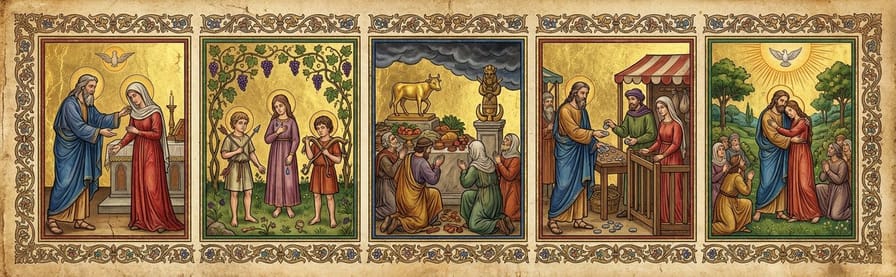
Illustration of the Book of Hosea, one of the 39 books of the Old Testament (Nano Banana Pro).
The introduction to any book of the Holy Bible is not merely an informative preface, but a hermeneutical portal that invites us to enter the theological and historical universe of a portion of the Word of God. For the conservative evangelical reader, this door must be guided by non-negotiable presuppositions: divine inspiration and biblical inerrancy, which ensure the authority and veracity of every sacred text. It is with this reverence and commitment that we approach the book of the prophet Hosea, a poetic and prophetic gem of the Old Testament, which resonates with the unwavering faithfulness of God in the face of human unfaithfulness.
Hosea, often referred to as the "prophet of suffering love," offers one of the most poignant and intimate revelations of God's character. His message, though ancient and contextualized in a period of deep apostasy in Israel, transcends eras and cultures, exposing eternal truths about sin, judgment, redemption, and, above all, the covenantal and unwavering love of the Lord for His people. Hosea's uniqueness lies not only in his words but in his own life, which becomes a living parable of the relationship between God and Israel, a mirror of the tragedy of sin and the glory of grace.
In this introduction, we will seek to unfold the book of Hosea through an analytical structure that serves as a model for the study of any biblical book. We will traverse its historical context, confirming its traditional authorship and situating its message in the tumultuous 8th century B.C. in Israel. Next, we will dissect its literary structure and main content, recognizing the prophet's poetic mastery and theological depth. We will delve into the central theological themes, which reveal the sovereignty, justice, and mercy of God, and connect Hosea to the grand arc of salvation history, demonstrating its canonical relevance and its profound Christocentric roots.
Finally, we will address the hermeneutical challenges and critical questions that the book presents, offering a reasoned evangelical response that reaffirms the integrity and authority of Scripture. In doing so, we will not only honor Hosea as a prophetic voice from the past but also reclaim him as a living voice for the contemporary church, which still today struggles against the temptation of idolatry, the superficiality of faith, and the need for a genuine return to the living and true God. May this journey lead us to a deeper "knowledge of the Lord," as Hosea himself exhorts us.
1. Historical Context, Dating, and Authorship
The understanding of any biblical text is intrinsically linked to its historical matrix. For the book of Hosea, the context is the northern kingdom of Israel, also known as Ephraim, during a period of profound political turmoil, moral decay, and religious apostasy. The prophet Hosea, son of Beeri, prophesied during the reigns of Uzziah, Jotham, Ahaz, and Hezekiah, kings of Judah, and during the reign of Jeroboam II, king of Israel, as attested by Hosea 1:1. This dating places Hosea's ministry in the 8th century B.C., specifically between approximately 755 and 725 B.C., a crucial period that would culminate in the fall of Samaria and the Assyrian exile of Israel in 722 B.C.
1.1 Traditional Authorship and Internal Evidence
Jewish and Christian tradition, from the earliest times, has attributed the authorship of the book to the prophet Hosea himself. The opening verse, Hosea 1:1, serves as a clear and unambiguous heading, designating him as the author and the period of his prophetic ministry. This is the majority position and most consistent with the internal evidence of the text. The personal and deeply emotional style, the intimate references to his life and family, and the detailed knowledge of the social, political, and religious realities of Israel, point to the authorship of someone who intensely lived and suffered the message he proclaimed.
The language of the book, replete with Northern Hebrewisms (such as the use of "Ephraim" for Israel and specific geographical and cultural references of the northern kingdom), corroborates the idea that the author was a native of that region. Furthermore, the thematic unity and coherent development of the message, despite its sometimes fragmented structure, suggest a single organizing mind behind the text. Although some modernist critics propose multiple layers of redaction or later authorship, the solidity of tradition and the internal consistency of the text provide a robust basis for upholding the authorship of the prophet Hosea, as he himself presents it.
1.2 Political, Social, and Cultural Context
The reign of Jeroboam II (c. 793-753 B.C.) marked a period of relative economic prosperity and territorial expansion for Israel, reminiscent of the days of Solomon. However, this prosperity was superficial and accompanied by a profound moral and spiritual deterioration. The nation lived under an illusion of security, ignoring the imminent signs of collapse. Hosea prophesied amidst a series of coups and assassinations of kings after Jeroboam II's death, evidencing political instability and the absence of a godly leader who could guide the nation back to God.
Socially, inequality was stark. The rich oppressed the poor, justice was perverted in the courts, and corruption was endemic. Hosea vehemently denounces the lack of "truth, nor mercy, nor knowledge of God" in the land (Hosea 4:1). Culturally, Israel had turned away from the covenant with the Lord to embrace Canaanite fertility cults, especially the worship of Baal. Temples of Baal proliferated, and idolatrous practices, including cultic prostitution, were common. Popular religion was a syncretistic mix of elements of Yahweh worship with pagan rituals, an abomination in the eyes of God.
1.3 Response to Modern Academic Criticisms
Modern higher criticism has raised questions about Hosea's authorship and integrity, suggesting that the book may be a compilation of oracles from different prophets or that it was significantly edited and expanded after the exile. Arguments about the supposed lack of stylistic unity or the presence of anachronisms are frequently cited. However, the conservative evangelical perspective defends traditional Mosaic authorship and the integrity of the text, arguing that apparent discontinuities can be explained by the nature of Hebrew prophecy, which is often a collection of oracles delivered on different occasions, compiled and organized by the prophet himself or his disciples.
2. Structure, Division, and Main Content
The book of Hosea, although at times challenging in its poetic structure and abrupt transitions, possesses a literary organization that reveals the progression of the divine message. It is not a linear narrative or a systematic treatise, but a collection of prophetic oracles, poems, and laments that intertwine to communicate the depth of God's love and justice. Its structure can be broadly divided into two main sections, each with its own sub-themes and characteristics.
2.1 Literary Organization and Argumentative Flow
Hosea is predominantly a poetic prophetic book, utilizing a rich variety of figures of speech, vivid metaphors, and symbolism. The language is charged with emotion, reflecting God's passion for His people and the prophet's pain in witnessing Israel's apostasy. The argumentative flow is not always obvious to the modern reader, but it is guided by associations of ideas and thematic contrasts. The prophet frequently alternates between denunciation of sin, proclamation of imminent judgment, and promises of restoration and divine love. This oscillation creates a dramatic tension that mirrors the dynamic between God's wrath and mercy.
The repetition of certain phrases and images, such as Israel's unfaithfulness being compared to prostitution and God's love to marital fidelity, acts as a unifying thread that binds the message together. The book is a complex tapestry of covenant law, supplication, warning, and hope, all woven with the language of a broken heart. The abrupt transitions between oracles are characteristic of the prophetic style, where the message was often delivered in fragments over time, and then compiled, retaining its original force and impact.
2.2 Main Divisions and Their Characteristics
The book of Hosea can be divided into two main parts, each with a distinct yet interconnected focus:
- Chapters 1-3: The Parable of Hosea's Marriage to Gomer. This section serves as a living allegory of God's relationship with Israel. Hosea's marriage to Gomer, a "harlot" (or one who would become one), and the birth of their children, whose symbolic names (Jezreel, Lo-Ruhamah, Lo-Ammi) prophesy judgment upon Israel, establish the central theme of Israel's unfaithfulness and God's faithfulness. Chapter 3 narrates Hosea's redemption of Gomer, symbolizing Israel's future restoration by God's enduring love.
- Chapters 4-14: Oracles of Judgment and Promise. This section is a collection of prophetic oracles that elaborate on the themes presented in the marriage parable. Hosea denounces in detail the sins of Israel: idolatry, social injustice, political corruption, lack of knowledge of God, and reliance on foreign alliances. Divine judgment is proclaimed with intensity, often with images of desolation and destruction. However, interspersed with the warnings of judgment are moving appeals to repentance and promises of restoration and healing, culminating in a note of hope for Israel's future and God's faithfulness.
2.3 Synthetic Outline of Content
A synthetic outline of the book of Hosea can be presented as follows:
- I. The Parable of the Marriage and Its Children (1:1-3:5)
- 1.1. Title and introduction (1:1)
- 1.2. Hosea's marriage to Gomer and the names of the children (1:2-9)
- 1.3. Promise of future restoration for Israel (1:10-2:1)
- 1.4. The accusation against Israel and the promise of covenant renewal (2:2-23)
- 1.5. The redemption of Gomer, symbol of Israel's restoration (3:1-5)
- II. Oracles of Judgment and Promise (4:1-14:9)
- 2.1. God's case against Israel: lack of knowledge and unfaithfulness (4:1-5:7)
- 2.2. Judgment upon the leaders and the people for their rebellion (5:8-7:16)
- 2.3. The inevitability of captivity and Israel's folly (8:1-10:15)
- 2.4. God's love amidst judgment: a lament and a promise (11:1-12:14)
- 2.5. The imminent destruction and the final appeal to repentance (13:1-14:3)
- 2.6. Promises of healing, restoration, and prosperity (14:4-8)
- 2.7. Epilogue: the way of wisdom (14:9)
This outline demonstrates the progression of Hosea's argument, moving from personal illustration to national application, always with the tension between deserved judgment and promised mercy by a God who, even when punishing, yearns to restore His people.
3. Central Theological Themes and Purpose
The book of Hosea is a treasure of profound theological truths that reveal the heart and character of God in a singular way. Its message is multifaceted, but some themes stand out as pillars upon which the rest of the prophecy rests. These themes are not merely abstract concepts, but truths lived and experienced both by the prophet and by God in His relationship with Israel. Reformed theology, with its emphasis on the sovereignty of God and human depravity, finds in Hosea rich illustrations for its doctrines.
3.1 The Covenant Love (Hesed) of God and Israel's Unfaithfulness
The central and most prominent theme in Hosea is the covenantal and unwavering love of God, often expressed by the Hebrew word hesed, which means "loyal love," "kindness," "covenant faithfulness." This love is dramatically contrasted with Israel's persistent unfaithfulness, which is consistently portrayed as spiritual prostitution or adultery. Hosea's personal experience with Gomer serves as a vivid allegory for this relationship. Just as Hosea loved and sought his unfaithful wife, God loved and sought Israel, despite their constant pursuit of other gods and human alliances.
This divine hesed is not a sentimental love, but a firm and unconditional commitment, rooted in the covenant God made with His people. It is the basis of Israel's hope, for even in the midst of judgment, God's love is the guarantee that there will be restoration. Israel's unfaithfulness, on the other hand, is a direct breach of this covenant, a betrayal that provokes God's wrath, but never exhausts His fundamental love for those He has chosen.
3.2 Divine Judgment and the Need for Repentance
A theme inseparable from God's love is His divine justice. Hosea repeatedly proclaims imminent judgment upon Israel due to their idolatry, social injustice, and refusal to repent. Judgment is not an arbitrary act of vengeance, but the logical and just consequence of breaking the covenant. God, as the holy and just God, cannot tolerate sin unpunished. The warnings of destruction, exile, and desolation are severe and detailed, serving as an urgent call to repentance.
Hosea emphasizes that true repentance involves a sincere return to God, not merely external rituals or empty sacrifices. God desires "knowledge of God" (Hosea 6:6) and hesed, more than burnt offerings. Reformed theology emphasizes the need for genuine regeneraçtion and conversion, which transform the heart and produce fruits of repentance, echoing Hosea's message that true faith is manifested in a life of obedience and love for God.
3.3 The Knowledge of God (Da'at Elohim)
The phrase "knowledge of God" (Hebrew: da'at Elohim) is one of the most important expressions in Hosea. It is not merely an intellectual knowledge, but an intimate and experiential relationship with God, manifested in loyalty, obedience, and a lifestyle that reflects the values of the Kingdom. The lack of this knowledge is the root of all Israel's sins, leading to idolatry, immorality, and injustice (Hosea 4:1-2, 6). Hosea laments that his people are destroyed for lack of knowledge.
This knowledge is the essence of the covenant and the purpose of Israel's election. It is what God most desires from His people. The promised restoration at the end of the book includes a renewal of this knowledge, which will lead to spiritual healing and prosperity. For Reformed theology, this "knowledge of God" is mediated by Christ, who is the full revelation of the Father, and is the result of the work of the Holy Spirit in the believer's heart, enabling them to live in fellowship and obedience.
3.4 The Primary Purpose of the Book
The primary purpose of the book of Hosea for its original audience was threefold:
- To Expose Israel's Sin: To reveal the depth of the nation's apostasy and unfaithfulness, confronting them with the gravity of their betrayal of the covenant with God.
- To Proclaim Imminent Judgment: To warn of the inevitable consequences of sin, showing that God's patience has limits and that judgment is certain if there is no repentance.
- To Offer Hope of Restoration: Despite the judgment, to reinforce God's unwavering faithfulness and the promise that He, by His love and grace, would bring a remnant back to Himself, restoring the covenant and healing His nation. Hosea, therefore, is a book that balances the severity of God with His redemptive goodness.
4. Relevance and Canonical Connections
The importance of Hosea within the biblical canon transcends its message for ancient Israel, extending as a prophetic voice that echoes through generations, pointing to the fullness of revelation in Jesus Christ. Its profound exploration of God's love, the nature of sin, and the promise of restoration makes it a vital link in the chain of salvation history, connecting the Old and New Testaments in significant and Christocentric ways.
4.1 Importance of the Book within the Complete Canon
As one of the Minor Prophets, Hosea plays a crucial role in expanding our understanding of God's character and the dynamic of the covenant. He not only provides a vivid historical testimony to Israel's spiritual and political decline before the Assyrian exile but also articulates universal theological principles about the relationship between God and His people. The intensity of his language and the depth of his personal experience with Gomer offer an unparalleled metaphor for God's passion for His creation. Hosea reminds us that God's holiness demands judgment upon sin, but His mercy always seeks redemption, a tension that runs through all of Scripture and culminates at the cross of Christ.
The book also serves as a model for prophetic preaching, demonstrating how the prophet's life can become an integral part of the divine message. Its inclusion in the canon validates the idea that theology must be lived and felt, not merely intellectualized. Hosea is a voice that cries out for a return to truth and integrity of faith, a timeless message for all eras of the church.
4.2 Typological Connections with Christ (Christocentric Reading)
The Christocentric reading of Hosea reveals rich typological connections with the person and work of Jesus Christ. Hosea's unwavering faithfulness to his unfaithful wife, Gomer, prefigures Christ's sacrificial love for His bride, the Church, who is often unfaithful and in need of redemption. God's love for Israel, who is called "my son" in Hosea 11:1, finds its ultimate fulfillment in Jesus Christ, the only begotten Son of God. Christ is the true Israel, the obedient Son who perfectly fulfills the Father's will, unlike historical Israel who failed.
The "knowledge of God" that Hosea so yearns for Israel is fully revealed in Christ, who is the exact image of the Father (Colossians 1:15). To know Christ is to know God (John 14:7). The promise of restoration and healing in Hosea points to the new covenant established in Christ's blood, through which true spiritual healing and reconciliation with God are achieved. Hosea, therefore, is not merely a book about Israel's past, but a prophecy that, in its essence, points to the coming of the Messiah and the age of grace.
4.3 New Testament Fulfillment and Allusions
The New Testament cites or alludes to Hosea at several points, confirming its authority and its Messianic and eschatological implications:
- Matthew 2:15: Quotes Hosea 11:1 ("Out of Egypt I called my son") to describe Jesus' flight into Egypt and His return. This is a notable application of a text that originally referred to Israel's exodus, but which Matthew interprets as a type of Christ Himself.
- Romans 9:25-26: The apostle Paul quotes Hosea 2:23 ("I will call 'My people' those who were not My people; and 'Beloved' her who was not beloved") and Hosea 1:10 ("In the place where it was said to them, 'You are not My people,' there they shall be called 'children of the living God'") to illustrate the inclusion of Gentiles in salvation and God's sovereignty in choosing whom He wills.
- 1 Peter 2:10: Also echoes Hosea 2:23 and 1:10, applying the promise of restoration to Gentile believers who are now God's people.
- 1 Corinthians 15:55: The phrase "O Death, where is your victory? O Death, where is your sting?" is an allusion to Hosea 13:14, where God promises to redeem Israel from the power of the grave, a prophecy that Paul applies to Christ's victory over death and the resurrection of believers.
These citations demonstrate that the writers of the New Testament saw in Hosea not just a prophecy for their time, but a prophecy that pointed to the final fulfillment in Christ and the Church.
4.4 Relevance for the Contemporary Church
Hosea's message continues to be profoundly relevant for the contemporary church. In a postmodern world, where idolatry takes on new forms (materialism, individualism, the pursuit of self-affirmation) and spiritual unfaithfulness is a constant temptation, Hosea's call to repentance and the "knowledge of God" is more urgent than ever. The book reminds us of God's holiness and the consequences of sin, but also assures us of His unwavering love and His willingness to forgive and restore those who turn to Him.
For the church, Hosea is an invitation to examine its own faithfulness to the covenant with Christ. It challenges the superficiality of faith and empty religiosity, emphasizing the need for a genuine and transformative relationship with the Lord. Hosea also calls us to social justice and compassion for the oppressed, reflecting the heart of God. Ultimately, Hosea is a powerful reminder that, despite our failings, God's love in Christ is our only hope, and His faithfulness is the rock upon which we can build our faith.
5. Hermeneutical Challenges and Critical Issues
The book of Hosea, with its poetic language and its profound emotional charge, presents various hermeneutical challenges that require a careful and biblically founded approach. Furthermore, the questions raised by modern academic criticism demand an evangelical response that reaffirms the authority and inerrancy of Scripture, while dealing honestly with the complexities of the text.
5.1 Specific Interpretive Difficulties of the Book
One of the greatest interpretive difficulties in Hosea lies in the nature of its language. The prophet employs vivid metaphors, complex symbolism, and abrupt transitions between different voices (that of God, the prophet's, Israel's), which can make reading challenging. Precise identification of who is speaking or to whom it refers in certain verses requires attention to the immediate context and the general thematic flow. Furthermore, the intensity of the emotions expressed, both God's wrath and His love and pain, can be difficult to reconcile for the reader unaccustomed to Hebrew prophetic rhetoric.
The ambiguity of certain phrases and the richness of meanings of Hebrew words, such as hesed, require an in-depth study of biblical vocabulary. Understanding the cultural and historical references of ancient Israel, such as the rituals of Baal or the political alliances of the time, is essential to unravel the full meaning of Hosea's denunciations and warnings. The apparent fragmentation of the text, with oracles that seem to lack a linear logical connection, is another difficulty that must be approached by understanding the nature of the prophetic genre.
5.2 Questions of Literary Genre and Cultural Context
Hosea is primarily a book of prophecy, but it incorporates elements of other genres, such as laments, legal disputes (rib), allegories, and biographical narratives. Understanding the literary genre is crucial for correct interpretation. For example, the parable of Hosea's marriage to Gomer (chapters 1-3) is a vivid allegory that symbolizes God's relationship with Israel, and must be interpreted as such, although it has roots in real events of the prophet's life.
The cultural context of the ancient Near East is indispensable for interpreting Hosea's images and metaphors. The language of prostitution and adultery, for example, is not merely a moral condemnation, but a direct reference to the fertility cult practices of Baal, which involved cultic prostitution and were an abomination to Yahweh. Understanding the laws of covenant and marriage in Israelite culture also illuminates the depth of Israel's betrayal and God's faithfulness. Evangelical hermeneutics insists on historical-grammatical interpretation as the starting point, seeking to understand the text in its original context before applying its truths to contemporary life.
5.3 Apparent Ethical or Theological Problems
One of the most challenging problems in Hosea is the divine command for the prophet to "marry a woman of whoredom" (Hosea 1:2). This raises significant ethical and theological questions about God's morality and the nature of His commands. The conservative evangelical perspective generally interprets this command in two main ways:
- Literal: Hosea actually marries a prostitute, or a woman who would become one, as a performative prophetic act that illustrates the depth of Israel's unfaithfulness. The gravity of the command serves to shock and convey the seriousness of Israel's transgression.
- Symbolic/Visionary: Some suggest that the marriage was a vision or an allegory, not a physical event, to preserve the prophet's holiness and avoid the idea that God would command an immoral act. However, most conservative commentators lean towards the literal interpretation, arguing that the prophetic act, however shocking, serves a greater divine purpose of revelation.
5.4 Faithful Evangelical Response to Skeptical Criticisms
Skeptical criticisms frequently question the historicity of Hosea's marriage, the unity of the book, its authorship, and even God's morality. The faithful evangelical response is based on a high view of Scripture, affirming divine inspiration and biblical inerrancy.
- Historicity: The marriage narrative is presented as a historical event, and there are no contextual or textual reasons to doubt it. Divine intervention in the prophet's life for symbolic purposes is consistent with other prophetic acts in the Old Testament.
- Unity and Authorship: As discussed previously, the thematic unity and consistent voice of the prophet, despite the literary complexity, support Hosea's authorship. Stylistic variations are attributed to the nature of prophecy and not to multiple authors or late redactions that would undermine the original message.
- Divine Morality: The command for Hosea to marry Gomer is an act of divine communication that serves a didactic and redemptive purpose. It is not an approval of immorality, but a demonstration of God's suffering love for an unfaithful people. God, in His sovereignty, uses difficult circumstances to reveal profound truths about Himself and about human sin.
5.5 Hermeneutical Principles for Correct Interpretation
To interpret Hosea correctly, some hermeneutical principles are essential:
- Historical-Grammatical Interpretation: Understanding the original meaning of the text for the original audience, considering the historical, cultural, and linguistic context. This includes analysis of Hebrew grammar, vocabulary, and cultural references.
- Literary Genre: Recognizing and interpreting the literary genre of each section (prophecy, allegory, lament, etc.) to avoid literal readings where the text is figurative, and vice versa.
- Biblical and Canonical Theology: Interpreting Hosea in light of the complete canon of Scripture, recognizing its contribution to salvation history and its connections with the New Testament, especially Christocentric typology.
- Christocentric Perspective: Seeing Jesus Christ as the ultimate fulfillment of Hosea's promises and themes. God's love, judgment upon sin, restoration, and the "knowledge of God" culminate in Christ.
- Theological and Pastoral Application: Once the original meaning is established, seek theological application for the contemporary church, always with the guidance of the Holy Spirit and in submission to the authority of the Word of God.