


Deutéronome
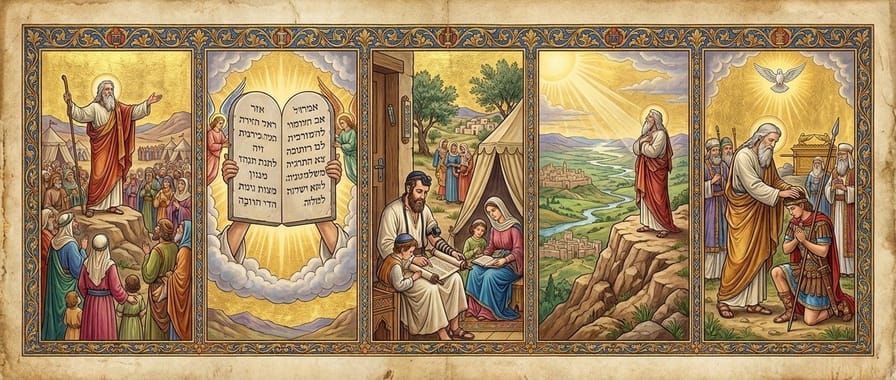
Illustration of the Book of Deuteronomy, one of the 39 books of the Old Testament (Nano Banana Pro).
The book of Deuteronomy, the fifth and final part of the Pentateuch, emerges as a theological and legal monument, a solemn and passionate proclamation of the fundamental truths of Israel's faith. More than a mere repetition of previous laws, it presents itself as the voice of Moses in his final days, a spiritual and ethical legacy left for a nation on the cusp of a new era. For the Protestant evangelical reader, Deuteronomy is not just an ancient historical text, but a living revelation of God's nature, the terms of His covenant, and the path to life and blessing.
In this introduction, we will seek to uncover the riches of Deuteronomy, approaching it with the reverence and rigor that its nature as inspired Word demands. We will adopt a perspective that affirms biblical inerrancy, traditional authorship, and a Christocentric reading, seeking to balance academic scholarship with a deep pastoral sensitivity. Our goal is to offer a model of analysis that can be replicated for any book of the Bible, providing tools for deeper understanding and more faithful application.
Deuteronomy serves as the crucial bridge between the wilderness pilgrimage and the possession of the Promised Land, rearticulating the Mosaic covenant for a new generation. It resonates with the voice of God Himself, calling His people to loving obedience and exclusive worship. As we delve into its pages, we will be confronted with the majesty of Yahweh, the seriousness of the law, and the depth of His covenantal love, elements that continue to shape the faith and practice of the church to this day.
The following structure will delineate the path for a systematic exploration, beginning with its historical context and authorship, moving through its literary organization and central theological themes, to its canonical relevance and the hermeneutical challenges it presents. Each section will be developed with the aim of illuminating the particularities of Deuteronomy, while also offering a methodology applicable to the vast tapestry of the Scriptures.
1. Historical Context, Dating, and Authorship
The book of Deuteronomy, as the crown of the Pentateuch, cannot be fully understood without a careful investigation of its historical context, its dating, and, crucially, its authorship. The conservative Protestant evangelical perspective traditionally upholds the Mosaic authorship of the book, situating it in the final moments of Moses' life, before Israel's entry into Canaan. This position, though challenged by modern higher criticism, finds robust support in both internal and external evidence, besides being theologically coherent with the nature of biblical revelation.
1.1 Mosaic Authorship and Internal Evidence
Moses' authorship of Deuteronomy is one of the oldest and most firmly established traditions in Judaism and Christianity. The text itself frequently presents itself as the voice of Moses, with phrases like "These are the words that Moses spoke to all Israel" (Deuteronomy 1:1) and "Moses wrote this law" (Deuteronomy 31:9). There is a clear intention for the book to be perceived as Moses' final testament and exhortations to the people.
Furthermore, the style and content of the book reflect an intimate familiarity with Egyptian and desert culture, consistent with Moses' biography. The legal language and treaty forms found in Deuteronomy have significant parallels with the suzerainty treaties of the Ancient Near East from the second millennium B.C., a period in which Moses lived. This suggests an ancient dating and an authorship that was immersed in that specific cultural and legal environment.
The emphasis on the covenant, the law, and Yahweh's exclusive relationship with Israel is a connecting thread that runs throughout the Pentateuch, and Deuteronomy masterfully synthesizes it, culminating the legislation and narratives begun in Exodus and Numbers. The thematic and theological unity with the preceding books reinforces the view of a cohesive authorship for the Pentateuch, traditionally attributed to Moses.
1.2 The Ancient Near Eastern Context
Deuteronomy is intrinsically linked to the context of the Ancient Near East (ANE). Its structure, as we will see, echoes the Hittite and Assyrian suzerainty treaties of the second and first millennia B.C., respectively. These treaties were legal documents that formalized the relationship between a powerful king (suzerain) and his less powerful vassals, including a preamble, historical prologue, stipulations, provisions for deposit and reading, a list of gods as witnesses, and, crucially, blessings and curses.
Deuteronomy's structural correspondence with these treaties (the Great King Yahweh as suzerain, Israel as vassal) is a strong argument for its antiquity and for its Mosaic authorship, as such forms were prevalent in Moses' time. The absence of gods as witnesses, replaced by Yahweh Himself and by heaven and earth, highlights the uniqueness of Israelite monotheism within a recognizable cultural format.
The period of writing, therefore, is traditionally set around 1406 B.C. (assuming an early exodus in the 15th century B.C.), or 1210 B.C. (for a later exodus in the 13th century B.C.), at the end of Moses' life. The location is in the plains of Moab, on the banks of the Jordan River, with the Promised Land in sight. The social and political context is that of a nomadic nation about to settle, facing the challenges of a new culture and the temptation of idolatry from the Canaanite peoples.
1.3 Responses to Higher Critical Challenges
Higher criticism, especially since the 19th century, has challenged the Mosaic authorship and ancient dating of Deuteronomy, proposing theories such as the Documentary Hypothesis (JEDP) and the Deuteronomist theory. These theories, in their various forms, suggest that Deuteronomy was composed much later, perhaps during the monarchical or exilic period, and that the figure of Moses would be a literary projection.
The conservative evangelical perspective responds to these criticisms by affirming the inerrancy and historicity of the Scriptures. It is argued that the "evidence" for multiple sources is often subjective and based on philosophical assumptions that question the possibility of divine revelation and miraculous intervention. Differences in style and vocabulary, often cited as proof of different authors, can be explained by changes in literary genre, audience, or purpose within Moses' own writing, which spanned decades.
Furthermore, the discovery of ancient suzerainty treaties, as mentioned, undermined the thesis that Deuteronomy would be a later falsification, demonstrating that its structure was perfectly compatible with the Mosaic period. The emphasis on the centralization of worship in "one place that the Lord your God will choose" (Deuteronomy 12:5), often used to date Deuteronomy to the time of Josiah, can be interpreted as a prophetic provision for the future, not as a reflection of an already established practice.
In summary, the evangelical position holds that Moses, under the inspiration of the Holy Spirit, wrote Deuteronomy for the generation that would enter Canaan, solidifying the covenant and preparing them for the challenges and responsibilities to come. This ancient authorship and dating are crucial for the book's authority and theological understanding.
2. Structure, Division, and Main Content
The structure of Deuteronomy is a literary and theological masterpiece, carefully crafted to fulfill its purpose of covenant renewal and preparation for life in the Promised Land. Far from being a disorganized collection of laws, the book follows a clear and intentional pattern, reflecting the conventions of Ancient Near Eastern suzerainty treaties, but with distinctly Israelite content and theology.
2.1 Deuteronomy as an Ancient Near Eastern Covenant Treaty
As mentioned, the literary form of Deuteronomy mirrors the suzerainty treaties of the second millennium B.C., providing a framework for the covenant between Yahweh and Israel. This structure can be outlined as follows:
- Preamble (Deuteronomy 1:1-5): Identifies the suzerain (Yahweh, implicitly, through Moses as His spokesman) and the vassal (Israel).
- Historical Prologue (Deuteronomy 1:6-4:49): Recalls the benevolent acts of the suzerain in favor of the vassal, from Horeb to the plains of Moab. This is a crucial element for evoking gratitude and loyalty.
- Covenant Stipulations (Deuteronomy 5:1-26:19): Details the obligations of the vassal. These are the laws and commandments that Israel must observe, divided into general stipulations (the Decalogue, Deuteronomy 5) and specific stipulations (civic, social, and religious laws, Deuteronomy 12-26).
- Provisions for Deposit and Reading (Deuteronomy 27:1-31:30): Instructions for the transmission and preservation of the treaty, including the writing of the law on stones and its periodic reading to the people.
- Blessings and Curses (Deuteronomy 27:1-28:68): The consequences of obedience (blessings) and disobedience (curses), a fundamental element to motivate faithfulness.
- Succession and Witness Clauses (Deuteronomy 31-34): The appointment of Joshua as successor and heaven and earth as witnesses to the covenant.
This structure is not just a formality, but a vehicle for Deuteronomy's theological message, emphasizing the covenantal nature of God's relationship with Israel.
2.2 The Narrative Flow and Main Divisions
Deuteronomy is predominantly a series of speeches by Moses. The book can be divided into three major discourses, or "words," of Moses, followed by his final acts and death.
- First Discourse of Moses (Deuteronomy 1:6-4:49):
- This discourse is a historical prologue, reviewing Israel's journey from Mount Horeb (Sinai) to Moab.
- Moses recalls the rebellion at Kadesh-barnea, the 40-year punishment in the wilderness, and the victories over Sihon and Og.
- The aim is to remind the new generation of God's faithfulness and their parents' disobedience, exhorting them to obedience.
- Second Discourse of Moses (Deuteronomy 5:1-26:19):
- The heart of the book, containing the stipulations of the covenant.
- It begins with the reiteration of the Decalogue (Deuteronomy 5), followed by the Shema (Deuteronomy 6:4-9), the central declaration of Israelite faith.
- It details the laws governing Israel's life in the Promised Land, covering religious aspects (worship, feasts), social (justice, care for the poor), civic (leadership, war), and ethical.
- The centralization of worship in "one place" (Deuteronomy 12) is a recurring theme.
- Third Discourse of Moses (Deuteronomy 27:1-30:20):
- This discourse focuses on the formal renewal of the covenant and the consequences of obedience and disobedience.
- It includes instructions for the covenant ceremony on Mount Ebal and Gerizim (Deuteronomy 27).
- It presents the blessings for obedience and the terrible curses for disobedience (Deuteronomy 28), culminating in a choice between life and death.
- It contains a prophetic vision of Israel's future, including exile and restoration.
- Moses' Final Acts and Death (Deuteronomy 31:1-34:12):
- Moses encourages Joshua, hands the law to the Levites, and sings a prophetic song (Deuteronomy 32).
- He blesses the tribes of Israel (Deuteronomy 33).
- The book concludes with Moses' death on Mount Nebo, where he sees the Promised Land but does not enter it, and a eulogy for the greatest prophet in Israel (Deuteronomy 34).
2.3 Synthetic Outline of the Book
A concise outline of Deuteronomy, following Moses' divisions and the treaty elements, would be:
- I. Introduction: Words of Moses and Setting (Deuteronomy 1:1-5)
- II. First Discourse: Historical Retrospective and Exhortation (Deuteronomy 1:6-4:49)
- The Journey from Horeb to Kadesh-barnea (Deuteronomy 1:6-46)
- The Wilderness Wanderings and Conquest East of the Jordan (Deuteronomy 2:1-3:29)
- Exhortation to Obedience and Warning Against Idolatry (Deuteronomy 4:1-49)
- III. Second Discourse: The Covenant Stipulations (Deuteronomy 5:1-26:19)
- The Decalogue and the Great Commandment of Love (Deuteronomy 5:1-11:32)
- Laws Concerning Worship and Religious Life (Deuteronomy 12:1-16:17)
- Laws Concerning Leadership and Justice (Deuteronomy 16:18-21:23)
- Laws Concerning Social and Ethical Life (Deuteronomy 22:1-26:19)
- IV. Third Discourse: Ratification of the Covenant, Blessings, and Curses (Deuteronomy 27:1-30:20)
- Instructions for the Covenant Ceremony (Deuteronomy 27:1-26)
- The Blessings for Obedience (Deuteronomy 28:1-14)
- The Curses for Disobedience (Deuteronomy 28:15-68)
- The Renewal of the Covenant in Moab and the Call to Choose (Deuteronomy 29:1-30:20)
- V. Conclusion: Moses' Last Acts and Death (Deuteronomy 31:1-34:12)
- Entrusting Leadership to Joshua and the Law to the Levites (Deuteronomy 31:1-29)
- The Song of Moses (Deuteronomy 31:30-32:52)
- The Blessing of Moses (Deuteronomy 33:1-29)
- The Death of Moses (Deuteronomy 34:1-12)
This outline demonstrates the logical and theological progression of the book, from the remembrance of salvation history to the final exhortation and leadership transition, all centered on faithfulness to the covenant with Yahweh.
3. Central Theological Themes and Purpose
Deuteronomy is a treasure trove of theological themes, which not only define Israel's faith but also establish crucial foundations for Christian theology. These themes are presented with a rhetorical intensity and depth that resonate throughout the entire biblical canon. For the Protestant evangelical, understanding these themes is vital for a systematic and Christocentric view of revelation.
3.1 God's Sovereignty and Covenant Faithfulness
At the heart of Deuteronomy is God's sovereignty, Yahweh, the one Lord of Israel and of all creation. He is the God who chose Israel not because of their merit (Deuteronomy 7:7-8), but because of His love and faithfulness to the covenant made with the patriarchs. This election demonstrates His absolute freedom and power. The history of Israel, from the Exodus to the victories over the kings east of the Jordan, is presented as irrefutable evidence of His powerful and providential hand.
The covenant, central to Reformed theology, is the primary vehicle of God's relationship with His people in Deuteronomy. It is not a pact between equals, but a gracious imposition of the Great King upon His vassal. God's faithfulness to His covenant is unwavering, even in the face of Israel's unfaithfulness. This truth serves as the basis for the hope of restoration, even in the prophecies of exile (Deuteronomy 30:1-10). God's sovereignty guarantees that His covenantal purposes will be fulfilled.
3.2 God's Love and Israel's Response
Deuteronomy is notable for its emphasis on God's love for Israel. "The Lord loved you and chose you" (Deuteronomy 7:7-8) is a foundational declaration. This elective love is the root of all blessings and of Israel's very existence as a nation. In response to this divine love, Israel is repeatedly called to love God back. The Shema, "Hear, O Israel: The Lord our God, the Lord is one. You shall love the Lord your God with all your heart and with all your soul and with all your might" (Deuteronomy 6:4-5), is the central commandment and the essence of covenant life.
This love is not merely emotional, but active and obedient. To love God means to keep His commandments (Deuteronomy 10:12-13). Obedience, therefore, is not a legalistic burden, but the natural and expected expression of a heart that loves and trusts its God. Human depravity, though not explicitly detailed in systematic terms, is implicitly recognized by the constant need for exhortation and by the foresight of Israel's future disobedience.
3.3 Obedience as the Path to Blessing and Life
One of the most prominent themes in Deuteronomy is the direct correlation between obedience and blessing, and disobedience and curse. Chapter 28 is the clearest expression of this, listing abundant blessings for faithfulness and terrible curses for rebellion. Life in the Promised Land, prosperity, health, and security depend on continuous observance of God's law. "Choose life, that you and your offspring may live, by loving the Lord your God, by listening to his voice, and by holding fast to him" (Deuteronomy 30:19-20).
This is not a theology of salvation by works, but a theology of covenant that describes the conditions for maintaining blessings within the covenant. Israel's salvation from Egypt was an act of sovereign grace; permanence in the land and the enjoyment of its blessings depended on their obedience. This principle establishes a pattern for the life of God's people, in both the Old and New Testaments, although the nature of "blessing" and "life" is redefined in Christ.
3.4 The Uniqueness of God and the Exclusivity of Worship
The Shema (Deuteronomy 6:4) not only calls Israel to love, but also proclaims the uniqueness of Yahweh: "The Lord our God, the Lord is one". This is a radical declaration of monotheism in a polytheistic world. Consequently, the worship of God must be exclusive. Israel is repeatedly warned against idolatry and the pagan practices of the Canaanites. The centralization of worship in "one place that the Lord your God will choose" (Deuteronomy 12:5) is a measure to safeguard this exclusivity and purity of worship.
This theme is crucial for Israel's identity and for its mission as God's people. Exclusive worship of Yahweh is not just a matter of rituals, but of a lifestyle that reflects God's holiness and justice. The temptation of idolatry is seen as the greatest threat to the covenant and to Israel's existence.
3.5 Deuteronomy's Purpose for Ancient Israel
Deuteronomy's primary purpose for the original audience was multifaceted. Firstly, it served as a renewal of the Mosaic covenant for the new generation that was about to enter Canaan. The Exodus generation had died in the wilderness due to their disobedience, and this new generation needed to be reminded of the covenant stipulations and the lessons of history.
Secondly, the book functioned as an instruction manual for life in Canaan. It provided the legal, social, and religious framework for establishing a just and theocratic society in the Promised Land, distinct from the surrounding pagan nations. Moses, as prophet and lawgiver, prepared Israel to be the "light to the nations," a community that would reflect the character of its God.
Thirdly, Deuteronomy served as a prophetic testament, foreseeing Israel's future, including its disobedience, exile, and, finally, restoration by divine grace (Deuteronomy 30). This prophetic aspect underscores God's sovereignty over history and His covenantal faithfulness, even in the face of human failure. In essence, Deuteronomy is a passionate call to faithfulness, love, and obedience to Yahweh, the one God of Israel.
4. Relevance and Canonical Connections
Deuteronomy is not an isolated book in the biblical canon; on the contrary, it is a theological and literary pivot that resonates deeply throughout all of Scripture. Its importance transcends the context of Ancient Israel, establishing principles and prophecies that culminate in the person and work of Jesus Christ. A Christocentric reading of Deuteronomy reveals its continuing relevance for the contemporary church.
4.1 The Importance of Deuteronomy in the Canon
Deuteronomy is often called the "heart of the Old Testament" due to its pervasive influence. It serves as the theological foundation for the so-called "Deuteronomistic History" (Joshua, Judges, Samuel, and Kings), which interprets Israel's history through the lens of the covenant blessings and curses presented in Deuteronomy 28. Israel's prosperity or decline, the rise or fall of its kings, are consistently evaluated in terms of their faithfulness or unfaithfulness to the Mosaic law as rearticulated in Deuteronomy.
Furthermore, later prophetic books frequently echo the language and themes of Deuteronomy, calling Israel to repentance and covenant renewal. The Psalms and Wisdom books also reflect the Deuteronomistic worldview, where a godly and wise life is rooted in obedience to God's commandments. Without Deuteronomy, much of the Old Testament loses its interpretive framework.
4.2 Typological Connections with Christ
The conservative evangelical perspective emphasizes the Christocentric reading of the Old Testament, recognizing that it points to Christ through promises, prophecies, and typology. Deuteronomy offers significant typological connections with Jesus:
- The Prophet like Moses (Deuteronomy 18:15-18): Moses promises that God will raise up a prophet "like me" from among Israel. This prophet is a messianic figure, and the New Testament identifies Jesus as the definitive fulfillment of this prophecy (Acts 3:22-23; 7:37). Jesus is not just a prophet, but the supreme Prophet, who speaks the final Word of God.
- The True Israel and the Obedient Son: Israel, as God's son (Deuteronomy 14:1), failed in its obedience. Jesus, the true Israel and the perfect Son of God, fulfilled all righteousness and perfectly obeyed the Law. The account of Jesus' temptation in the wilderness (Matthew 4:1-11; Luke 4:1-13) is a vivid example, where Jesus quotes Deuteronomy three times (Deuteronomy 8:3; 6:16; 6:13) to resist the devil, contrasting His faithfulness with Israel's unfaithfulness in the wilderness.
- The Mediator of the New Covenant: Moses was the mediator of the Old Covenant. Jesus is the mediator of a New and superior Covenant, established in His own blood (Hebrews 8:6; 9:15). The Law, which Deuteronomy reiterates, reveals God's holiness and human sinfulness, pointing to the need for a Savior who could fulfill the Law and redeem His elect.
4.3 Fulfillments and Quotations in the New Testament
Deuteronomy is one of the most cited books in the New Testament, perhaps surpassed only by Psalms and Isaiah. Its influence is particularly evident in the Gospels and Pauline epistles:
- Jesus and Deuteronomy: As mentioned, Jesus uses Deuteronomy to combat Satan's temptations. He also quotes Deuteronomy 6:5 ("You shall love the Lord your God...") as the greatest commandment (Matthew 22:37; Mark 12:30). Jesus' authority as a teacher and interpreter of the Law is inseparable from His understanding and application of Deuteronomy.
- The Apostles and Deuteronomy: Peter and Stephen cite Deuteronomy 18:15 to identify Jesus as the promised Prophet (Acts 3:22; 7:37). Paul frequently alludes to Deuteronomy in his epistles, particularly in Romans, Galatians, and Corinthians, when discussing the Law, grace, righteousness, and the curse of sin (e.g., Galatians 3:10 quotes Deuteronomy 27:26; Romans 10:6-8 alludes to Deuteronomy 30:11-14). The curse of the cross (Galatians 3:13) is a direct reference to Deuteronomy 21:23.
- The Law and Grace: The New Testament, in explaining the relationship between the Law and grace, frequently draws upon the truths of Deuteronomy. The Law is holy, just, and good (Romans 7:12), revealing God's will, but unable to justify the sinner. It points to Christ, who is the end of the Law for righteousness to everyone who believes (Romans 10:4).
4.4 Relevance for the Contemporary Church
For the church today, Deuteronomy continues to be an inexhaustible source of truth and practical application. It calls us to:
- Exclusive Worship and Love for God: The Shema remains at the core of Christian faith, reminding us that our love and loyalty must be total and exclusively for the Lord.
- Obedience as an Expression of Love: The emphasis on obedience is not legalistic, but a reminder that genuine faith is manifested in a life of conformity to God's will, now empowered by the Holy Spirit and motivated by grace.
- Covenant Consciousness: Reformed theology, with its emphasis on God's covenants, finds in Deuteronomy rich material for understanding the continuity and discontinuity between the Old and New Testaments, and the covenantal nature of God's relationship with His people.
- Social Justice and Care for the Neighbor: Deuteronomy's laws concerning care for the poor, the foreigner, the widow, and the orphan (e.g., Deuteronomy 14:28-29; 24:17-22) provide an ethical imperative for the church to engage in acts of justice and mercy in the world.
- The Importance of God's Word: The book emphasizes the need to teach, meditate on, and obey God's Word. For the believer, this extends to the entirety of the Scriptures, which are God's voice to us, guiding us in Christ.
Deuteronomy, therefore, is much more than an ancient record; it is a living Word that continues to shape the faith, ethics, and hope of God's people.
5. Hermeneutical Challenges and Critical Issues
Despite its theological richness and rhetorical clarity, Deuteronomy presents certain hermeneutical challenges and has been the target of significant critical questions throughout academic history. Addressing these difficulties with faithfulness to biblical inerrancy and a conservative evangelical perspective is essential for a correct interpretation and a healthy application of the text.
5.1 The Application of Mosaic Law Today
One of the most pressing challenges is determining how the Mosaic Law, as rearticulated in Deuteronomy, applies to believers of the New Covenant. The Law is traditionally divided into three categories: moral, civil, and ceremonial. While the moral Law (like the Decalogue) is seen as universal and eternal, reflecting God's character, the civil and ceremonial laws were specific to ancient Israel and its theocratic and sacrificial context.
The evangelical perspective understands that Christ fulfilled the Law (Matthew 5:17), abolishing the need for the sacrificial system and Israel's civil ordinances as a means of salvation or righteousness. However, the moral principles underlying these laws, such as justice, holiness, and love for one's neighbor, remain valid and are reaffirmed in the New Testament. The Law, in Christ, now serves as a guide for godly living, revealing God's will and exposing sin, but not as a path to justification. God's grace, manifested in Christ, enables us to live a life that pleases God, without placing us under the curse of the Law.
5.2 The Ethics of Holy War (Herem)
The instructions for the herem, the "holy war" or "utter destruction" (e.g., Deuteronomy 7:1-6; 20:16-18), which commanded the complete destruction of the Canaanite peoples, represent one of the most difficult ethical problems for many modern readers. Critics frequently accuse God of genocide or immorality.
The evangelical response to this issue is multifaceted. Firstly, the herem must be contextualized within redemptive history and divine justice. The Canaanites were peoples notorious for their extreme immorality, idolatry, and abominable practices, including child sacrifices (Deuteronomy 12:31; 18:9-12). The herem was a divine judgment upon a culture that had reached a point of irreversible depravity, and not a universal model for warfare. God, as the sovereign Creator and Judge of all the earth, has the right to execute judgment on sinful nations, and He used Israel as His instrument in that specific case.
Secondly, the herem had a prophylactic purpose: to protect Israel from idolatrous and moral contamination, allowing the messianic line and divine revelation to be preserved. It is a unique event in salvation history, not a license for religious violence. In the New Testament, "holy war" is spiritual, against principalities and powers (Ephesians 6:12), and the final judgment is reserved for Christ at His second coming.
5.3 The Question of Higher Criticism and the Deuteronomist
As discussed in the authorship section, higher criticism has proposed that Deuteronomy is not a Mosaic document from the 15th/13th century B.C., but a later work, perhaps from the 7th century B.C., associated with a "Deuteronomist" or a Deuteronomistic school. This theory, which posits that the book was "discovered" in the temple during Josiah's reign (2 Kings 22) and used to promote reforms, questions the historical authenticity and traditional authorship of the book.
The evangelical perspective, in defending Mosaic authorship and inerrancy, challenges the philosophical basis and methods of higher criticism. Supposed inconsistencies and anachronisms are often explained by a deeper understanding of literary genre, the ANE context, and the very nature of revelation. The "discovery" of the book of the Law in Josiah's time is seen as the rediscovery of an ancient and authoritative manuscript of Moses, not the creation of a new one. Deuteronomy's emphasis on the centralization of worship can be seen as a prophetic provision for the future nation, rather than an anachronistic reflection of a later practice.
Acceptance of theories like the Documentary Hypothesis would undermine the authority of Deuteronomy and, by extension, much of the Old Testament, transforming it from divine revelation into a product of human religious evolution. Evangelical faith rests on the historical and theological reliability of the Scriptures, as testified by Jesus and the apostles.
5.4 Hermeneutical Principles for a Faithful Interpretation
To interpret Deuteronomy faithfully and fruitfully, some hermeneutical principles are crucial:
- Grammatical-Historical Interpretation: Seek the original meaning of the text within its historical, cultural, and linguistic context. This includes understanding the book as an ANE covenant treaty and as the discourses of Moses.
- Canonical Interpretation: Read Deuteronomy in light of all of Scripture, recognizing its position in the Pentateuch and its connections with the rest of the Old and New Testaments. This helps to understand how the Law points to Christ and how themes develop.
- Theological (Christocentric) Interpretation: Recognize that all of the Bible testifies to Jesus Christ. Seek the typological, prophetic, and thematic connections that reveal the person and work of Christ, the fulfillment of the Law and the covenant.
- Sensitivity to Literary Genre: Understand that Deuteronomy contains discourses, laws, songs, blessings, and curses. Each genre has its own interpretive conventions.
- Recognition of Unity and Inerrancy: Approach the text with the presupposition that it is the inspired Word of God, without error in its original autographs, and that it possesses an underlying theological unity, despite apparent complexities.
By applying these principles, the evangelical reader can navigate Deuteronomy's challenges, extracting its eternal truths and applying them to the life and faith of the contemporary church, always with an eye fixed on Christ, the Lord and fulfiller of all God's promises.