


Esther
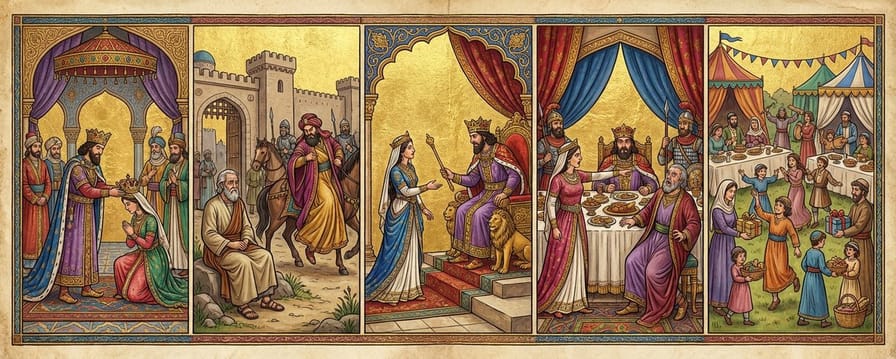
Illustration of the Book of Esther, one of the 39 books of the Old Testament (Nano Banana Pro).
An introduction to a biblical book is not merely an academic preface; it is a hermeneutical gateway that prepares the reader to encounter the Word of God with due reverence and understanding. Each book of Holy Scripture, inspired by the Holy Spirit and divinely preserved, possesses a unique identity, a specific historical context, and a singular theological purpose that harmonizes with the grand narrative of redemption. For the faithful interpreter, the challenge lies in uncovering these particularities without losing sight of the organic unity of the canon, recognizing that each text points, in some way, to the majesty and redemptive work of our Lord Jesus Christ.
The Book of Esther, in particular, presents itself as a fascinating testimony to divine providence, a historical drama that, at first glance, seems to lack explicit mention of God, but which, in its depth, reveals the invisible hand of the Almighty acting behind the scenes of human history. Its vibrant narrative, full of twists and memorable characters, offers perennial lessons about God's faithfulness to His covenant, courage in times of crisis, and the persistence of human wickedness.
This introduction model aims to establish a comprehensive framework for the analysis of any biblical book, anchored in a conservative evangelical Protestant perspective. Our approach will be guided by the belief in **biblical inerrancy** and **authority**, by the defense of traditional authorship where applicable, and by a **Christ-centered** reading that seeks the relevance of each text for the contemporary church. By applying this framework to the Book of Esther, we will seek to illuminate its historical, literary, and theological nuances, enabling the reader to a richer understanding and a deeper application of its eternal truths.
The scholarship proposed here is not intended to be an end in itself, but a means to the glory of God and the strengthening of faith. By exploring the context, structure, themes, canonical relevance, and hermeneutical challenges of Esther, the reader will be invited to delve into the divine wisdom manifested in the history of an exiled people, and to contemplate God's sovereignty that orchestrates the most improbable events to fulfill His purposes.
May this journey through the pages of Esther be an edifying experience, reinforcing our trust in divine providence and inspiring us to live with courage and faith, even when God seems to be silent.
1. Historical context, dating, and authorship
The understanding of any biblical text is profoundly enriched by its historical contextualization. For the Book of Esther, this is even more crucial, given its setting in a pagan empire and the absence of direct references to God, the Law, or the temple. The narrative unfolds during the post-exilic period, when a significant portion of the Jewish people remained in the diaspora, living under Persian rule, while others had returned to Judea under the decrees of Cyrus and Darius.
1.1 Traditional authorship and internal evidence
The authorship of the Book of Esther is not explicitly stated in the text itself, which is common for many historical books of the Old Testament. However, Jewish tradition, as recorded in the Babylonian Talmud (Bava Batra 15a), attributes authorship to "Men of the Great Assembly," which may imply figures such as Ezra or Nehemiah, or perhaps Mordecai, given his prominence and access to royal records (Esther 9:20, 29). The suggestion of Mordecai as author or principal source is quite plausible, considering the wealth of detail about the Persian court, royal customs, and the specific events he himself experienced and recorded.
Internal evidence strongly supports the idea of a Jewish author familiar with Persian culture and the events described. Intimate knowledge of Persian names, court protocols, Medo-Persian laws, the geography of Susa, and the nuances of imperial administration (Esther 1:3, 5, 10, 14; 2:21; 3:7, 12; 8:8) suggests a contemporary of the events, or someone with direct access to primary sources. The precision of these details is remarkable, although some critics try to disqualify them. The description of the banquets, the messenger system, the use of the gallows, and the immutable laws is consistent with what is known of Achaemenid Persia.
1.2 Situation of the writing period and historical context
The Book of Esther is set in the reign of Ahasuerus, who is widely identified with Xerxes I (486-465 BC), son of Darius I and father of Artaxerxes I. The narrative begins in the third year of his reign (Esther 1:3) and culminates with events of the twelfth year (Esther 3:7), spanning a period of about ten years. Historically, Xerxes is known for his campaign against Greece and for his extravagant lifestyle, which aligns with the descriptions of the banquets and life in the court of Susa.
The dating of the book's writing is generally placed in the late 5th century BC or early 4th century BC, after the narrated events. This would allow for the consolidation of the Feast of Purim and theological reflection on the events. An author who lived during this period, whether Mordecai or another Jew of the diaspora, would have a mature perspective on divine providence in the preservation of the Jewish people.
1.3 The Persian political, social, and cultural context
The Persian Empire, at the height of its power under Xerxes I, stretched from India to Ethiopia, governing 127 provinces (Esther 1:1). Its capital, Susa, was a cosmopolitan center and the main stage for Esther's story. The Jews, scattered throughout the empire as a result of the Assyrian and Babylonian exiles, lived as an ethnic and religious minority, subject to the laws and whims of the Persian rulers.
Persian culture was marked by a rigid hierarchy, a complex legal system, and strong royal control. Banquets were important events for demonstrations of power and status. The royal harem was a central institution, and the queen's position was one of great influence, though precarious, as exemplified by Vashti's deposition. In this environment, the life of a Jew in the diaspora was a constant negotiation between assimilation and the maintenance of identity, a tension that resonates in Esther.
1.4 Response to higher criticism
The Book of Esther has been the target of various criticisms by modern higher criticism, mainly regarding its historicity and the absence of divine mention. Some scholars classify it as historical fiction, a novella, or even an etiological tale to explain the origin of Purim. Objections include the lack of external corroboration for Vashti or Esther in Persian records, the exaggerated dimensions of the banquets, and the implausible nature of some events.
However, the conservative evangelical perspective defends the essential historicity of Esther. The absence of Persian records for Vashti or Esther is not proof of their non-existence; royal chronicles generally focused on political and military events, not on details of harem life or internal crises that might be embarrassing for the monarch. Furthermore, surviving Persian literature is fragmented. The descriptions of the banquets, though grandiose, are consistent with the known opulence of the Persian court. The presence of precise historical details, such as the names of officials and administrative procedures, lends credibility to the narrative. The supposed "improbability" of events is, for the believer, evidence of God's providential intervention, which operates in extraordinary ways.
As for the absence of God's name, this is a unique characteristic, but not an argument against its canonicity or historicity. On the contrary, it serves a specific theological purpose, demonstrating the **sovereignty of God** acting in a hidden but effective way in secular events, a central theme for the Jews of the diaspora who wondered about God's care in foreign lands. **Biblical inerrancy** assures us that, although God is not named, His presence is the invisible engine of the entire plot.
2. Structure, division, and main content
The literary beauty of the Book of Esther lies in its carefully crafted structure, which resembles a historical novel or a drama. The narrative is masterfully constructed, using elements such as dramatic irony, reversal of fortunes, and suspense to captivate the reader's attention and highlight underlying theological themes. The book's organization is not merely chronological, but also thematic and dramatic, culminating in the glorification of divine providence.
2.1 Literary organization and dramatic elements
Esther is predominantly a historical narrative, but with strong characteristics of a drama. The plot unfolds through a series of interconnected events, where the action and reaction of the characters drive the story. The use of banquets as transitional markers is notable: Ahasuerus's banquet (chap. 1), Esther's banquet for the king and Haman (chap. 5 and 7), and the Purim banquets (chap. 9). These events serve as stages for revelations, conspiracies, and resolutions.
One of the most prominent elements is the "irony of reversal" or peripeteia. The story is replete with twists where what was expected happens in the opposite way: Haman plans to hang Mordecai, but ends up being hanged on his own gallows; Haman desires honor, but is forced to honor Mordecai; the Jews are marked for destruction, but their enemies are destroyed. This mirrored structure, or chiasm in some aspects, emphasizes divine intervention in human affairs, even without explicit mention.
2.2 Main divisions and narrative flow
The Book of Esther can be divided into four main sections, which follow a clear dramatic flow of ascent, climax, decline, and resolution:
I. Esther's Ascent and the Imminent Threat (Chapters 1-3)
- 1.1 Vashti's Deposition (Chapter 1): King Ahasuerus holds a great banquet, Vashti refuses to appear and is deposed, paving the way for a new queen.
- 1.2 Esther's Ascent (Chapter 2): Esther, a Jewish orphan under the guardianship of her cousin Mordecai, is chosen as the new queen. Mordecai discovers a conspiracy against the king.
- 1.3 Haman's Ascent and His Genocidal Plan (Chapter 3): Haman, an Amalekite, is promoted to vizier. Mordecai refuses to bow down to him, leading Haman to plan the annihilation of all Jews in the empire.
II. The Crisis and Courageous Intercession (Chapters 4-5)
- 2.1 Mordecai and Esther Confronted with the Crisis (Chapter 4): Mordecai publicly laments Haman's decree and challenges Esther to act, reminding her that perhaps she has come to the kingdom "for such a time as this." Esther, after a period of fasting, decides to risk her life.
- 2.2 Esther's First Banquet (Chapter 5): Esther approaches the king without being summoned, obtains his favor, and invites the king and Haman to a banquet. She invites them to a second banquet the following day, increasing the suspense.
III. The Reversal of Fortunes (Chapters 6-7)
- 3.1 Mordecai's Honor (Chapter 6): The king has a sleepless night and asks for the royal chronicles to be read. He discovers that Mordecai was never rewarded for saving his life. Ironically, Haman is forced to publicly honor Mordecai.
- 3.2 Haman's Downfall (Chapter 7): At the second banquet, Esther reveals her identity and Haman's genocidal plan. The king, enraged, orders Haman to be hanged on the very gallows he prepared for Mordecai.
IV. The Deliverance and Institution of Purim (Chapters 8-10)
- 4.1 The Decree of Deliverance (Chapter 8): Mordecai is elevated to Haman's position. A new decree is issued, allowing the Jews to defend themselves and retaliate against their enemies.
- 4.2 The Victory and Institution of Purim (Chapter 9): The Jews victoriously defend themselves throughout the empire. The Feast of Purim is instituted to commemorate this great deliverance.
- 4.3 Mordecai's Greatness (Chapter 10): Concludes with a brief mention of Ahasuerus's greatness and Mordecai's prominence, who sought the good of his people.
2.3 Synthetic outline of content
The Book of Esther narrates the story of the Jewish queen Esther and her cousin Mordecai, who live in Persian exile during the reign of King Ahasuerus (Xerxes I). After Queen Vashti's deposition, Esther is chosen to be the new queen. Meanwhile, a powerful vizier, Haman, plots the annihilation of all Jews in the empire because of Mordecai's refusal to bow down to him. Upon learning of the genocidal decree, Mordecai challenges Esther to intervene with the king, risking her own life. Esther, with courage and wisdom, organizes banquets where she exposes Haman's plot and her own Jewish identity to the king. Through a series of providential events – including the king's sleeplessness and the discovery of Mordecai's act – Haman is hanged on his own gallows, and Mordecai is elevated to his position. A new decree is issued, allowing the Jews to defend themselves and defeat their enemies. The story culminates with the celebration of victory and the institution of the Feast of Purim, an annual memorial of divine deliverance.
3. Central theological themes and purpose
Although God's name is not explicitly mentioned in Esther, His theological presence is undeniable and deeply rooted in every event of the narrative. The absence of the divine name is, paradoxically, one of the greatest demonstrations of **God's sovereignty**, which acts behind the scenes, orchestrating every detail to fulfill His purposes. The evangelical Protestant perspective, especially the Reformed one, emphasizes that divine providence is the central theme, weaving the tapestry of Esther's story.
3.1 The providential sovereignty of God
The most prominent and theologically dense theme of Esther is the **providential sovereignty of God**. Despite the absence of direct prayers, prophecies, or miraculous interventions, God's hand is visible throughout the plot. Seemingly random coincidences, such as Vashti's deposition, Esther's election, King Ahasuerus's sleeplessness on the crucial night (Esther 6:1), and the exact timing of the chronicle reading, are, in fact, manifestations of divine providence. God is in control, manipulating hearts and circumstances, even the actions of pagan kings, to protect His people and fulfill His covenant promises.
This hidden providence of God offers great comfort to the believer, showing that God operates even in times of apparent silence, in hostile environments, and when faith is tested. For the Jews of the diaspora, who might feel abandoned by God in foreign lands, Esther is a vivid reminder that God never forgets His people, but works tirelessly for their preservation, even when His presence is not explicitly perceived.
3.2 The preservation of God's people and covenant faithfulness
Intimately linked to providence is the theme of the **preservation of God's people**. Haman's plot is a direct attack on the existence of Israel, an echo of the genocidal attempts of other enemies throughout biblical history. Had Haman's plan succeeded, the messianic lineage would have been destroyed, and God's promises to Abraham (Genesis 12:1-3) and David (2 Samuel 7:12-16) would have been thwarted. The survival of the Jews in Esther is not just a political victory, but a theological reaffirmation of God's faithfulness to His unconditional covenant.
God, in His unchanging faithfulness, guarantees the continuity of His people, through whom the Messiah would come. The salvation of Israel in Esther is a testimony to the truth that "the gates of hell will not prevail" against God's plan for redemption. This preservation is a harbinger of the preservation of the Church, the new Israel, through the ages, against all adversities.
3.3 Human responsibility, courage, and divine sovereignty
Although God's sovereignty is supreme, the Book of Esther also highlights the importance of **human responsibility** and **courage**. Esther and Mordecai are not mere passive pawns; they make bold and risky decisions. Mordecai's challenge to Esther: "who knows whether you have come to the kingdom for such a time as this?" (Esther 4:14), is a call to conscious and courageous action. Esther, in deciding to go to the king without being summoned, declares: "If I perish, I perish" (Esther 4:16), demonstrating extraordinary faith and courage.
This interaction between divine sovereignty and human responsibility is a theological tension present throughout Scripture. God uses human means to accomplish His ends. The choices and actions of Esther and Mordecai are instrumental in the salvation of their people, not nullifying God's providence, but being the channels through which it is manifested. This encourages believers to act with faith and courage, trusting that God can use even their small actions for great purposes.
3.4 The danger of antisemitism and divine justice
The Book of Esther exposes the **virulent danger of antisemitism**, personified in the figure of Haman, a descendant of Agag, king of the Amalekites, ancestral enemies of Israel (1 Samuel 15). Haman's hatred is not merely personal against Mordecai, but extends to the entire Jewish people, culminating in a plan of genocide. This narrative serves as a somber warning about the persistence of racial and religious hatred throughout history.
Haman's defeat and the salvation of the Jews also illustrate **divine justice**, even if executed through human means. Although the violence of the Jews against their enemies (Esther 9) may raise ethical questions, it must be understood in the context of an imperial decree of self-defense and retribution against those who sought to annihilate them. It is a demonstration that God, in His justice, will not allow His people to be destroyed with impunity, and that wickedness will eventually be confronted and punished.
3.5 The primary purpose of the book
The primary purpose of the Book of Esther is twofold: first, to **explain the origin and observance of the Feast of Purim** (Esther 9:20-32), ensuring that future generations of Jews understood the historical and theological significance of this celebration. Second, and more importantly, it is to **reaffirm God's continuous faithfulness to His covenant people**, even when they are in exile and seemingly distant from His explicit presence. It assures the Jews of the diaspora that God has not abandoned them, but is actively involved in their protection and preservation, guaranteeing the continuity of the messianic lineage and the eventual coming of the Savior. The book serves as a powerful message of hope and encouragement for a people facing assimilation and the threat of extermination.
4. Relevance and canonical connections
The inclusion of the Book of Esther in the biblical canon, despite its peculiarities (such as the absence of the divine name), is a testimony to its profound theological relevance and its intrinsic connection to the grand biblical narrative. Far from being an anomaly, Esther fits perfectly into the tapestry of redemption, offering a unique perspective on God's providence and the preservation of His people, subtly pointing to the redemptive work of Christ.
4.1 Importance of the book within the complete canon
Esther is the last of the historical books of the Old Testament in our canonical order, closing the cycle of Israel's history before the coming of Christ. It serves as a vital bridge between the exile and the intertestamental period, showing that God was active and working on behalf of His people even when there were no prophets or direct revelations. Its canonicity was debated by some ancient rabbis, mainly due to the absence of God's name, but its acceptance was universally established, reflecting the recognition of its fundamental message about **God's covenant faithfulness**.
The story of Esther resonates with other deliverance events in Israel's history, such as the Passover, and reinforces Israel's identity as a chosen people. It illustrates the truth that God is the Lord of history, governing all things for His purposes, and that His covenant with Abraham and David would remain unshaken, guaranteeing the coming of the Messiah.
4.2 Typological connections with Christ (Christ-centered reading)
A **Christ-centered** reading of Esther reveals various typological connections with the person and work of Jesus Christ. Although there are no direct messianic prophecies, the events and characters prefigure aspects of Christian redemption:
- Esther as a Type of Christ, the Intercessor: Esther, a Jewish queen who risks her life to intercede for her people before the king, is a powerful type of Jesus. Christ, our great High Priest and King, intercedes for us before the Father, risking (and indeed laying down) His life to save us from death and judgment (Hebrews 7:25; Romans 8:34). Just as Esther approached the king on behalf of her people, Christ approached the throne of grace on our behalf.
- Mordecai as a Type of Christ, the Exalted Savior: Mordecai, who suffers humiliation and is rejected, but is subsequently exalted to a position of power and authority to save his people, prefigures Christ. Jesus was humbled, suffered, and died, but was exalted by God and received all power and authority in heaven and on earth (Philippians 2:6-11). The salvation brought by Mordecai is a shadow of the eternal salvation that Christ offers.
- The Salvation of the Jews as a Figure of the Church's Salvation: The miraculous deliverance of the Jews from annihilation is a type of the salvation that Christ offers to His Church. Just as the Jews were rescued from a decree of death, believers are rescued from the condemnation of sin and eternal death through the work of Christ.
- The Reversal of Fortunes: The dramatic reversal where Haman, the enemy, is destroyed and Mordecai, the oppressed, is exalted, prefigures Christ's final victory over Satan and the forces of evil. Satan, the enemy of the soul, is defeated, and God's people are vindicated and exalted in Christ.
4.3 New Testament fulfillments and allusions
There are no direct quotes from the Book of Esther in the New Testament. However, the themes of **divine providence**, **preservation of God's people**, and **victory over evil** resonate strongly throughout the New Testament. The story of Esther serves as a backdrop for understanding God's faithfulness in keeping the messianic lineage intact until the coming of Jesus. The absence of quotation does not diminish its importance, but highlights the implicit nature of its theology, which is manifested more in principles and patterns than in explicit declarations.
The perseverance and courage of Esther and Mordecai can be seen as examples of faith that align with the "cloud of witnesses" in *Hebrews 11*, although they are not named there. The idea that God uses the humble and the weak to confound the powerful (1 Corinthians 1:27-29) is vividly illustrated in Esther.
4.4 Relevance for the contemporary church
The Book of Esther offers a wealth of practical and theological lessons for the contemporary church:
- Trust in Divine Providence: In a world that often seems chaotic and godless, Esther reminds us that God is actively involved in history, even when we do not see or feel Him. He works behind the scenes, orchestrating events for His purposes. This encourages believers to trust in His sovereignty amidst personal and global crises.
- Courage and Responsibility for Faith: Esther's story is a call to courage for believers. Just as Esther was placed in a position of influence "for such a time as this," Christians are called to use their gifts, talents, and positions for God's glory and the good of their neighbor, even if it involves personal risk.
- Combatting Injustice and Hatred: Esther exposes the ugliness of racial hatred and injustice. The church is called to stand against all forms of prejudice, discrimination, and persecution, defending the oppressed and seeking justice, reflecting the character of God.
- The Importance of Community and Fasting: Fasting and collective intercession (Esther 4:16) demonstrate the power of prayer and community solidarity in times of crisis. The church is reminded of the need for unity in prayer and mutual support.
- Hope in God's Final Victory: The reversal of fortunes in Esther is a reminder that, in the end, God will prevail over all evil. This offers hope and encouragement to believers facing persecution or difficulties, assuring them that the ultimate victory belongs to Christ.
5. Hermeneutical challenges and critical questions
The Book of Esther, with its captivating narrative and peculiarities, presents several hermeneutical challenges and has been the subject of various critical questions throughout the history of biblical interpretation. A faithful evangelical approach does not shy away from these difficulties but seeks to answer them based on the **inerrancy** and **authority of Scripture**, using sound hermeneutical principles and a contextualized understanding.
5.1 Specific interpretive difficulties of the book
The primary and most notable difficulty of interpretation in Esther is the **explicit absence of God's name**. No other book in the Hebrew canon shares this characteristic. This raises the question: how to interpret a "biblical" book that does not mention God, the Law, the temple, prayer, or any direct religious practice? The evangelical answer is that Esther's theology is implicit, but powerful. The absence of direct mention serves to emphasize the **hidden providence of God**, showing that He is in control even when humans do not perceive Him or explicitly invoke Him. The story is a practical demonstration of the truth of Romans 8:28, where "all things work together for good for those who love God."
Another difficulty lies in the **apparent lack of piety of the main characters**. Esther and Mordecai are not portrayed as devout figures in the traditional sense, living in a pagan environment. Esther marries a pagan king and participates in non-kosher banquets. However, their actions of courage and self-sacrifice, especially Esther's fasting (Esther 4:16), can be seen as manifestations of faith, even if not expressed in explicit religious terms. Fasting, in this context, is an act of humiliation and supplication to God, even if God's name is not pronounced.
5.2 Questions of literary genre and cultural context
The classification of Esther's literary genre is crucial for its interpretation. Critics often label it as "historical fiction" or "novella," questioning its historicity. However, a conservative evangelical perspective sees it as **historical narrative**, albeit with dramatic and stylistic elements that make it a high-quality literary work. The presence of precise historical details, as already discussed, suggests a factual foundation. The genre can be more precisely described as a "royal chronicle" or "memoir" with a didactic theological purpose.
The Persian cultural context is vital for understanding the characters' actions. Court laws, banquet rituals, immutable laws, the practice of hanging, and antisemitism are elements that must be understood within their own time and place. Judging the characters' actions by anachronistic standards would be a hermeneutical flaw. For example, Esther's participation in the royal harem, although morally questionable by ideal biblical standards (monogamy), must be viewed in the context of her position as a Jewish orphan in a pagan empire, where her options were limited, and her ascent was part of divine providence.
5.3 Apparent ethical or theological problems
The Book of Esther presents some ethical problems that can challenge the modern reader. The **massive violence perpetrated by the Jews** against their enemies (Esther 9:5-10, 16-17) is often cited as a difficulty. It is important to contextualize this violence. First, it was a response to a genocidal decree that aimed at the complete annihilation of the Jews, a matter of self-defense and survival. Second, the royal decree allowed the Jews to retaliate against those who attacked them, not to initiate an indiscriminate attack. Third, the Jews' refusal to plunder their enemies' goods (Esther 9:10, 15-16) is noteworthy and differentiates them from other ancient retaliations, suggesting that the motivation was not personal gain, but justice and survival. This violence, though difficult for modern sensibility, must be understood as the execution of divine justice upon those who sought to eradicate the covenant people, a recurrent principle in the Old Testament against the enemies of God.
Another problem is the **origin of the Feast of Purim** and its possible connection with pagan festivals. Although some critics suggest a pagan origin, the book presents Purim as a Jewish institution that commemorates a specific historical deliverance. **Biblical inerrancy** leads us to accept the internal narrative as the legitimate explanation for the origin of the feast, which was then adopted and sanctified by the Jewish people as a memorial of God's providence.
5.4 Faithful evangelical response to skeptical criticisms
The evangelical response to skeptical criticisms is founded on the belief in **divine inspiration** and the **authority of Scripture**. Esther's historicity is defended not only by internal details but by the conviction that God reveals Himself in history. Supposed historical "inaccuracies" are often exaggerated or based on an incomplete understanding of Persian records or ancient historiography. The absence of mention of God is not an oversight, but a deliberate literary and theological choice that serves to uniquely and powerfully highlight divine providence. The canonicity of Esther, accepted by Judaism and the Christian church, testifies to its authority and its essential message for faith.
The criticism that views Esther as "nationalistic" or "vindictive" fails to recognize the context of the covenant and divine justice. The preservation of Israel was crucial to God's plan of redemption, and retribution against its enemies was a manifestation of divine justice against the evil that threatened the fulfillment of that plan. The evangelical perspective seeks to understand the text on its own terms, recognizing God's larger plan in salvation history.
5.5 Hermeneutical principles for correct interpretation
For a correct interpretation of the Book of Esther, some hermeneutical principles are essential:
- Implicit Interpretation of Theology: Recognize that the absence of God's name does not mean the absence of God. Seek God's hand in the "coincidences" and plot twists, understanding **divine providence** as the great underlying theme.
- Historical-Cultural Context: Read the book within its context of the Persian Empire and the Jewish diaspora. Understand the laws, customs, and mentality of the time to avoid anachronisms and unjust judgments of characters and events.
- Literary Genre: Understand Esther as a historical narrative with dramatic elements. This allows appreciation of its literary skill without compromising its essential historicity.
- Canonical and Christ-Centered Reading: Integrate Esther into the grand narrative of redemption. See how it points to Christ through types and themes, and how it fits into the history of God's covenant faithfulness, culminating in the coming of the Messiah.
- Theological and Ethical Application: Extract lessons about God's sovereignty, the courage of faith, the fight against injustice, and hope in God's final victory. Address ethical questions with sensitivity, but within a biblical theological framework, recognizing God's justice and the reality of human sin.
By applying these principles, the reader can uncover the theological riches of Esther, seeing it as a powerful testimony to God's unwavering faithfulness to His people and His sovereignty over all kingdoms and events of human history, preparing the way for the coming of our Savior, Jesus Christ.