


Adah
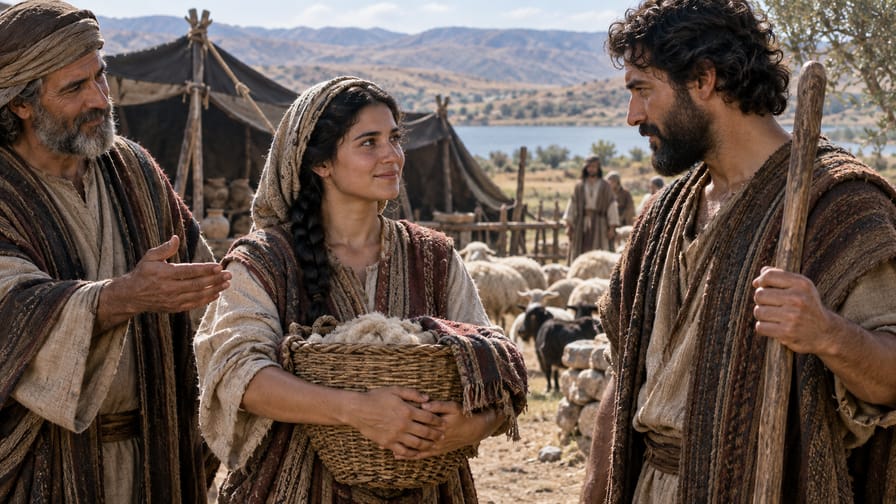
The figure of Ada is mentioned in two distinct passages of the Old Testament, referring to two different women who share the same name. Both figures, though with few direct mentions, play significant roles in their respective narrative and genealogical contexts, contributing to the understanding of human history and God's redemptive plan. This analysis will explore the etymology, historical context, character, and theological significance of both Adas from a conservative evangelical Protestant perspective.
1. Etymology and Meaning of the Name
The name Ada, in Hebrew ‘ādāh (עָדָה), derives from a root meaning "to adorn," "to beautify," or "to pass on," "to advance." The most common meaning attributed to ‘ādāh is "ornament" or "beauty." This connotation of adornment may suggest an aesthetic quality or a perceived value in the person bearing the name, although the biblical narratives about the Adas do not explicitly explore this aspect.
The Hebrew root can also carry the nuance of "to move" or "to pass," which, in a broader sense, could be interpreted as a figure who "advances" the lineage or contributes to the development of a new phase, whether in culture (in the case of the Cainite Ada) or in the formation of a people (in the case of the Edomite Ada). However, the predominant and most direct interpretation is "ornament" or "beauty."
There are no significant variations of the name Ada in biblical languages that alter its fundamental meaning. The name consistently appears as ‘ādāh in the Hebrew Old Testament. It is important to note that, while the meaning is "beauty," Scripture does not dwell on describing the physical appearance of either Ada, focusing instead on their relationships and offspring.
There are no other prominent biblical characters with the same name besides the two women in Genesis. The uniqueness of the name and its association with key figures in different genealogical branches underscores the importance of carefully distinguishing between them for precise exegesis. The theological significance of the name itself is limited, but its presence in crucial contexts invites reflection on the role of these women in the unfolding of biblical history.
For the evangelical theologian, the meaning of "ornament" can be viewed metaphorically. Although there is no direct application of "spiritual beauty" to the Adas, the idea of something that adds or complements may be underlying. They are part of the "adornment" of the biblical narrative, contributing to the fullness of salvation history, even if in indirect and often obscure ways.
2. Historical Context and Biblical Narrative
The Bible presents two distinct women named Ada, each embedded in a particular historical and genealogical context that shapes her relevance in the canonical narrative. It is fundamental to distinguish between them for a precise analysis of their roles and theological meanings.
2.1 Ada, Wife of Lamech
The first Ada is introduced in the book of Genesis as one of the two wives of Lamech, a descendant of Cain, in the pre-Flood period. Lamech is the seventh in the line of Cain, a period characterized by rapid moral degeneration and the proliferation of violence on the earth (Genesis 4:19). The context is one of a developing but morally corrupted civilization, where polygamy, as practiced by Lamech (the first polygamist recorded in the Bible), was a symptom of this decay.
The narrative presents her as the mother of Jabal, "the father of those who dwell in tents and have livestock," and Jubal, "the father of all who play the harp and flute" (Genesis 4:20-21). This mention is crucial, as Ada’s sons are depicted as pioneers in fundamental aspects of human civilization: nomadic pastoralism and music. They represent the development of human culture, even within a lineage marked by sin and rebellion against God.
The geography associated with this Ada is the land of Nod, east of Eden, where Cain settled after his banishment (Genesis 4:16). There are no specific details about her family origin other than being the wife of Lamech, who also had another wife, Zillah, mother of Tubal-Cain and Naamah (Genesis 4:22). Family relationships, therefore, include Lamech, Zillah, and their children, forming a microcosm of Cainite society.
The mention of this Ada and her sons occurs at a point in the narrative that precedes the account of the Flood, serving to illustrate both humanity's creative capacity (even fallen) and the depth of its corruption. She is part of a genealogy that culminates in Lamech's statement about his own violence (Genesis 4:23-24), strongly contrasting with the lineage of Seth, which invokes the name of the Lord (Genesis 4:26).
2.2 Ada, Wife of Esau
The second Ada is presented in the patriarchal context as one of the wives of Esau, son of Isaac and Rebekah. She is identified as "Ada, daughter of Elon the Hittite" (Genesis 36:2), and her union with Esau is first mentioned in Genesis 26:34, where she is called Judith. This discrepancy can be explained by alternative names, a common practice in antiquity, or by a textual or traditional confusion. The Septuagint and the Samaritan Pentateuch also present variations.
Esau's marriage to Canaanite women, including Ada, is a point of tension in the narrative. Genesis 26:35 states that these wives were "a grief of spirit" to Isaac and Rebekah, Esau’s parents. This lament reflects the patriarchal concern for the purity of the covenantal lineage and the preservation of faith, avoiding marriages with peoples who did not share the worship of the God of Abraham.
Ada is the mother of Eliphaz, Esau's firstborn (Genesis 36:4), who becomes one of the chiefs of Edom (Genesis 36:10-12). Her genealogy is crucial for tracing the origin of the Edomite people, descendants of Esau. The passages in Genesis 36 detail Esau's descendants, establishing the nation of Edom and its clans, which would become a neighbor and often an antagonist of Israel.
The historical period is that of the formation of the nations of Israel and Edom, approximately between 2000-1800 BC. The main geography is the land of Canaan and, later, the mountainous region of Seir, which would become the territory of Edom. Ada's relationships include Esau, her parents-in-law Isaac and Rebekah, and her co-wives Basemath and Oholibamah, all contributing to the complex tapestry of patriarchal families.
3. Character and Role in Biblical Narrative
The Bible offers very few details about the individual character of both women named Ada. Their roles are defined primarily by their marital relationships and, more significantly, by their motherhood, which inserts them into lineages crucial to biblical history. Character analysis, therefore, must be inferred indirectly from the context in which they appear.
3.1 Ada, Wife of Lamech
The biblical narrative does not directly describe the virtues or flaws of Ada, wife of Lamech. She is mentioned in Genesis 4:19-23 as one of Lamech's two wives, which already places her in a context of polygamy, a practice that deviates from the monogamous pattern established by God in creation (Genesis 2:24). Lamech's polygamy is indicative of the growing moral corruption in the Cainite lineage.
Her primary role is that of mother to Jabal and Jubal. Through her sons, Ada is indirectly associated with the development of nomadic pastoralism and music, significant aspects of human culture. The Bible neither praises nor condemns her for these achievements, but records them as part of human history before the Flood. This demonstrates the human capacity for creativity and work, even in a lineage far from God, a reflection of divine common grace.
There is no indication of any specific vocation or calling for Ada beyond her role as wife and mother within Lamech's family structure. Her actions are not detailed she is a passive figure in the narrative, serving primarily as a genealogical link. Her development as a character is nonexistent, as she appears briefly and there are no further mentions of her after the genealogy.
Her significance lies in being part of the Cainite lineage which, although creative, was in spiritual decline, culminating in the violence described in Lamech's "song of the sword" (Genesis 4:23-24). She represents, therefore, humanity that, even with talents and abilities, was alienated from the Creator and moving towards divine judgment.
3.2 Ada, Wife of Esau
Just like the first Ada, the character of Ada, wife of Esau, is not explicitly delineated in Scripture. Her identity is marked primarily by her ethnic origin: she is the daughter of Elon the Hittite (Genesis 36:2). Esau's choice to marry Canaanite women, including Ada, is a crucial point that reveals his own character, or lack thereof, in relation to the divine promises and covenant.
Esau's wives, including Ada, are described as "a grief of spirit" to Isaac and Rebekah (Genesis 26:35). While this is an assessment by Esau's parents and not directly of Ada, it highlights the theological and spiritual problem of these marriages. They represented a threat to the purity of the covenantal lineage and to faithfulness to the God of Abraham, who had instructed his servant not to take a Canaanite wife for Isaac (Genesis 24:3).
Ada's role is fundamentally genealogical, as the mother of Eliphaz, Esau's firstborn and ancestor of several Edomite clans (Genesis 36:4, 10-12). Her contribution, therefore, is to the formation of a neighboring nation, often hostile to Israel. There is no mention of vocation, significant actions, or character development for Ada. She is a point of connection in the genealogy that distinguishes Esau's lineage from Jacob's lineage.
The absence of details about her character can be interpreted in a few ways. It may indicate that her role is purely functional for the narrative, or that she did not perform notable deeds worthy of record. From an evangelical perspective, her story serves to illustrate the consequences of Esau's choices, who despised his birthright and the blessings of the covenant, manifesting this in his marital choices that offended his God-fearing parents.
4. Theological Significance and Typology
The two figures of Ada, though secondary in the biblical narrative, contribute to central theological themes, especially regarding the history of redemption, the nature of fallen humanity, and the distinction between the covenantal lineages and those who stray from it. Neither of the Adas possesses a direct Christocentric typology, but their stories fit into the broader panorama of humanity's need for salvation.
4.1 Ada, Wife of Lamech
The Cainite Ada and her family are crucial for the progressive revelation of the nature of sin and God's common grace. Her lineage, descended from Cain, is marked by rebellion, fratricide, and alienation from God. Lamech, her husband, is an exponent of violence and polygamy, illustrating the moral degradation of humanity before the Flood (Genesis 4:19, 23-24).
However, Ada's sons, Jabal and Jubal, represent the development of human culture: agriculture and music. This demonstrates God's common grace, which allows fallen humanity to preserve and develop skills and talents, even outside of a covenantal relationship with Him. This creative capacity is a reflection of the imago Dei remaining in humanity, despite the Fall (Genesis 1:27).
Theologically, the story of Ada and her family serves as a contrast to the lineage of Seth, from whom Noah and, eventually, Abraham would come. While the Cainite lineage focused on building cities and cultural advancement without God, the Sethite lineage is noted for "calling upon the name of the Lord" (Genesis 4:26). This prefigures the distinction between those who seek God and those who live independently of Him, a recurring theme in the history of redemption.
There are no prophecies or covenants directly related to this Ada, nor any mentions of her in the New Testament. Her relevance lies in her contribution to understanding the condition of pre-Flood humanity, the depth of sin, and the need for a new beginning, preparing the ground for the narrative of the Flood and the subsequent covenant with Noah.
4.2 Ada, Wife of Esau
The Hittite Ada, wife of Esau, has a distinct theological significance. Her story is intrinsically linked to the theme of covenant and election. Esau's marriage to Canaanite women, including Ada, is an act of disrespect toward his covenantal inheritance and the concerns of his parents, Isaac and Rebekah (Genesis 26:34-35).
This marriage illustrates Esau's attitude toward his birthright and the blessing of the covenant. By marrying women from pagan peoples, he demonstrated that he did not value the purity of the covenantal lineage nor the separation required by God's covenant with Abraham (Genesis 24:3-4). This choice, along with the selling of his birthright for a mere meal (Genesis 25:29-34), is cited in Hebrews 12:16 as evidence of his "impiety" or "profaneness," for not valuing spiritual things.
Ada's motherhood, giving birth to Eliphaz, Esau's firstborn, is fundamental to the establishment of the nation of Edom. Edom, descended from Esau, is often portrayed as an enemy of Israel, the nation descended from Jacob. Thus, Ada, though passively, contributes to the theological distinction between the "two nations" in Rebekah's womb, representing God's sovereign election (Romans 9:10-13).
She does not directly prefigure Christ, but her story reinforces the doctrine of election and the importance of obedience to God's will in the preservation of the covenantal lineage. The "grief of spirit" she caused Isaac and Rebekah highlights the seriousness of marital choices from a divine perspective and how they affect the course of salvation history. Her narrative, therefore, is a testament to God's faithfulness in preserving His covenant, despite human failures.
5. Biblical-Theological Legacy and Canonical References
The legacy of the figures of Ada in biblical theology is perceived more through the implications of their existences and their descendants than through any direct action or teaching attributed to them. Both contribute to the narrative tapestry of Genesis, establishing contrasts and foundations for later theological developments.
5.1 Ada, Wife of Lamech
The Cainite Ada is not mentioned in other biblical books outside of Genesis 4. Her literary contribution is limited to being a name in Cain's genealogy. Her influence in biblical theology lies in her association with the development of human culture before the Flood. She is part of the narrative that demonstrates the creative capacity of fallen humanity and, at the same time, the depth of corruption that led to divine judgment.
In Jewish and Christian interpretive tradition, Ada of Lamech is often seen as an example of the lineage that drifted away from God, yet still produced material advancements. Evangelical commentators, such as John Calvin and Matthew Henry, frequently highlight God's common grace that allows for such cultural developments, even outside the covenant, while lamenting the absence of a relationship with God. She does not appear in intertestamental literature or the New Testament.
For Reformed and evangelical theology, the story of Ada and her sons serves to illustrate the dichotomy between the "city of man" (represented by the Cainite lineage) and the "city of God" (represented by the Sethite lineage, which calls upon the name of the Lord). This distinction is fundamental to understanding the history of salvation and God's sovereignty in preserving a faithful remnant, even amidst widespread depravity. Her importance for understanding the canon is to provide the backdrop for the judgment of the Flood and the need for a new covenant.
5.2 Ada, Wife of Esau
Similar to the first Ada, the Hittite Ada is mentioned only in the book of Genesis (Genesis 26:34 36:2, 4, 10, 12). Her literary contribution is that of being a crucial genealogical link for the formation of the Edomite nation. Her influence in biblical theology is more pronounced, as she is directly linked to the history of election and the distinction between Israel and Edom.
Her presence in Jewish and Christian interpretive tradition is notable for her connection to Isaac and Rebekah's lament over Esau's marriages. Evangelical commentators view Esau's choice to marry Ada and other Canaanite women as a symptom of his contempt for the birthright and the blessing of the covenant, reinforcing the idea that Esau "sold his inheritance" not only for food but also through his life choices that disregarded his parents' faith (Hebrews 12:16).
In Reformed and evangelical theology, Ada of Esau is a character who, though not active, illuminates the doctrine of God's sovereign election and the importance of the purity of the covenantal lineage. The separation between Jacob and Esau, and consequently between Israel and Edom, is a theme that resonates throughout the entire Old Testament, culminating in Malachi's affirmation: "Jacob I have loved, but Esau I have hated" (Malachi 1:2-3), which is quoted by Paul in Romans 9:13 to illustrate God's gracious election.
The story of Ada, wife of Esau, is, therefore, vital for understanding the canon, as it establishes the roots of the conflict between Israel and Edom, and serves as an example of the consequences of devaluing divine promises. She is an element in the narrative that demonstrates how human choices intertwine with God's sovereign plan for redemption, even if those choices are of disobedience and disregard for the covenant.