


Zillah
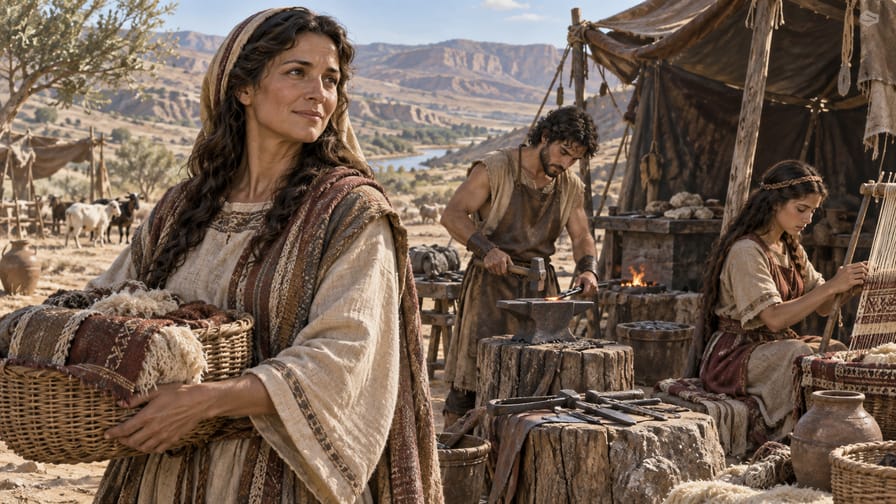
The figure of Zilah, though briefly mentioned in the Scriptures, offers an entry point for understanding crucial aspects of early human history, pre-Flood genealogy, and progressive theological revelation. Her appearance in the book of Genesis positions her within the lineage of Cain, a branch of humanity distinguished by its cultural innovations and, simultaneously, by increasing moral and spiritual decay. The analysis of Zilah, from an evangelical Protestant perspective, requires careful exegesis of her limited context, drawing theological inferences from her family and social environment.
This in-depth study will seek to explore the onomastic meaning of Zilah, contextualize her existence within the biblical narrative, and discern her theological relevance, even if indirect, for understanding the human condition, sin, and the need for redemption in Christ. The scarcity of details about her personal life does not diminish her importance as a link in the chain of events that shaped the world before the Flood, providing a backdrop for the manifestation of divine grace and judgment.
1. Etymology and meaning of the name
The name Zilah (in Hebrew: צִלָּה, Tsilah) is of Hebrew origin and appears in the Old Testament in Genesis 4:19 and 4:22. Its etymological root derives from the Hebrew verb tsalal (צָלָל), meaning "to shade," "to give shade," or "to protect." Consequently, the literal meaning of the name Zilah is "shadow," "protection," or "refuge."
This meaning evokes images of shelter and safekeeping, but can also suggest the ephemerality or transient nature of life, as a shadow is fleeting. In the broader biblical context, shadow is often used as a metaphor for divine protection (cf. Psalm 91:1, Isaiah 49:2) or, conversely, for human fragility and the brevity of existence (cf. Job 14:2, Psalm 144:4).
There are no significant variations of the name Zilah in biblical languages, and she is the only prominent character with this name in the canon. The uniqueness of the name adds an element of distinction, although its bearer is a secondary figure in the narrative. The absence of other biblical characters with the same name reinforces the specificity of her mention in Genesis.
The theological significance of the name, though not explicitly developed in the narrative, can be inferred by contrast with the environment in which Zilah lived. In a world marked by violence and the moral decay of Cain's lineage, the name "shadow" or "protection" may, ironically, highlight the absence of true security or spiritual refuge, or perhaps, subtly, the search for such shelter amidst the turmoil.
For some commentators, the name may allude to the protection Zilah, as a mother, offered her children in a hostile environment, or perhaps to the shadow of an uncertain destiny that hung over Cain's lineage. From a broader perspective, "shadow" can symbolize the fallen human condition, living under the shadow of sin and death, needing the light and life that only God can offer.
2. Historical context and biblical narrative
Zilah is introduced in the Scriptures in the book of Genesis, chapter 4, placing her in the antediluvian period, the era preceding the great Flood. This period, though difficult to date precisely, covers the first centuries of human existence after the Fall, as narrated in Genesis. It is a time of rapid human proliferation and cultural development, but also of a dizzying escalation of sin and violence.
The political, social, and religious context of Zilah's time is characterized by a progressive turning away from God. Cain's lineage, to which Zilah belongs, is notable for its civilizational progress — the development of agriculture (Jabal), music (Jubal), and metallurgy (Tubal-Cain) — but also for marked ungodliness. The absence of worship of the Lord and the prevalence of violence and polygamy are distinctive features.
Zilah's genealogy directly connects her to the lineage of Cain. She is one of Lamech's two wives, the seventh in the line of Cain (Genesis 4:19). His co-wife was Adah. This mention of Lamech's polygamy is the first in the Bible, marking a clear break with the monogamous pattern established by God in creation (Genesis 2:24). Lamech is also known for his song of vengeance, which exceeds Cain's vengeance (Genesis 4:23-24), evidencing increasing moral corruption.
The main events of Zilah's life are limited to her identification as Lamech's wife and mother of Tubal-Cain and Naamah (Genesis 4:22). Tubal-Cain is described as "the forger of every cutting instrument of bronze and iron," indicating technological advancement in metallurgy. Naamah, his daughter, is mentioned without details about her activities, but some Jewish traditions associate her with music or beauty, though the Bible does not specify.
The key biblical passages where Zilah appears are Genesis 4:19, where she is named as Lamech's wife along with Adah, and Genesis 4:22, where her children, Tubal-Cain and Naamah, are introduced. These few references are the core of all canonical information about her. Her existence is crucial for completing the genealogy of Cain's lineage, showing the continuity and evolution of this branch of humanity.
The geography related to Zilah and her family would be the "land of Nod" (Genesis 4:16) or adjacent regions, east of Eden, where Cain settled after his banishment. This region became the cradle of Cainite civilization, a place of human development and, tragically, of increasing ungodliness. Zilah's relationships with other biblical characters are primarily with Lamech, her husband, Adah, her co-wife, and her children, Tubal-Cain and Naamah, and Adah's children, Jabal and Jubal. This familial interconnectedness illustrates the complexity and decay of social relationships in the pre-Flood era.
3. Character and role in the biblical narrative
The analysis of Zilah's character, as revealed in the Scriptures, is a challenge due to the extreme brevity of her mention. The Bible offers no direct descriptions of her virtues, spiritual qualities, moral flaws, or significant actions. She is a passive figure in the narrative, whose importance lies more in her genealogical identification than in her own actions or decisions.
However, we can infer some aspects of her role and the reality of her life. As Lamech's wife, Zilah lived in a polygamous household, a practice that, as already noted, deviated from God's original design for marriage (Genesis 2:24). Polygamy was a symptom of the increasing moral degradation of that era. Her position as a co-wife, alongside Adah, suggests a complex family dynamic, possibly marked by rivalries or hierarchies.
Her primary role, as recorded, is that of a mother. She bore Tubal-Cain, a pioneer in metallurgy, and Naamah. Motherhood, in any context, is a vocation of great responsibility and influence. Although we know nothing about how Zilah raised her children, Tubal-Cain's legacy, with his technological innovations, demonstrates that she was part of the lineage that contributed to the advancement of antediluvian civilization.
The absence of any direct moral judgment about Zilah in the Bible is notable. She is neither praised nor condemned. Her figure serves more as a structural element in Cain's genealogy, illustrating the continuity of the lineage and the development of human society, even amidst progressive apostasy. She is part of the backdrop that will culminate in the judgment of the Flood.
In a broader sense, Zilah's presence in the Genesis 4 narrative highlights the role of women in human history, even those who are only briefly mentioned. They are the bearers of life, the mothers of future generations, and their lives, even if not detailed, are an integral part of the tapestry of biblical history. Zilah, as the mother of influential figures, contributes to the understanding of the cultural and technological environment of the pre-Flood world.
Therefore, Zilah's character is indirectly delineated by her association with Lamech and her children. She is a woman situated in a context of disobedience to God, violence, and human innovations. Her role is that of a generational link, contributing to the lineage that, despite its cultural achievements, was progressively moving away from the Creator, setting the stage for the need of a new beginning through Noah.
4. Theological significance and typology
The theological significance of Zilah, though not direct or prominent, resides in her inclusion in the narrative of redemptive history and progressive revelation in Genesis. She is a piece in the mosaic of Cain's lineage, which serves as a theological counterpoint to the lineage of Seth. Cain's lineage, to which Zilah belongs, is characterized by its pursuit of autonomy and the exaltation of human achievements, but also by increasing immorality and violence.
Zilah's presence in Lamech's genealogy (Genesis 4:19-22) vividly illustrates the consequences of the Fall of man (Genesis 3). Lamech's polygamy, which involves Zilah, is a clear example of the distortion of marriage, a divine institution. This deviation from God's original plan for humanity demonstrates the rapid deterioration of morality and social structure in the antediluvian period. Zilah's life, inserted into this context, underscores the depth of human sin and the necessity of divine intervention.
There is no direct Christocentric prefiguration or typology associated with Zilah. She does not explicitly point to Christ. However, her family and social context, as part of the fallen lineage of Cain, serves to accentuate the darkness and hopelessness of a world without God, creating the backdrop for the coming of the Redeemer. The description of the pre-Flood world, where Zilah lived, highlights the need for a Savior who could break the cycle of sin and death.
The history of Cain's lineage, which includes Zilah and her children, is intrinsically linked to central theological themes such as sin and the Fall. Humanity, separated from God, seeks satisfaction in cultural and technological achievements, such as Tubal-Cain's metallurgy, but without divine direction, these innovations coexist with violence and immorality. This demonstrates the fallacy of human autonomy and man's inability to redeem himself by his own means.
The contrast between the lineage of Cain (which includes Zilah) and the lineage of Seth (which culminates in Noah and, ultimately, in Christ) is a fundamental theme in Genesis. While Cain's lineage is marked by ungodliness and material progress, Seth's lineage is where the name of the Lord began to be invoked (Genesis 4:26). Zilah's existence contributes to the clarity of this contrast, showing that the condition of sin permeated society, making divine intervention a matter of judgment and grace.
Although Zilah is not mentioned in the New Testament, her existence in Genesis 4 contributes to the understanding of the doctrine of original sin and total depravity. She is a silent testimony to the reality that "all have sinned and fall short of the glory of God" (Romans 3:23). The setting in which Zilah lived reinforces the necessity of divine grace and the plan of salvation that would be fully revealed in Jesus Christ.
5. Biblical-theological legacy and canonical references
Zilah's biblical-theological legacy, though not vast in terms of direct mentions or explicit doctrinal influence, is significant in its contribution to the narrative and theological structure of the book of Genesis. She is mentioned exclusively in Genesis 4:19 and 4:22. There are no other references to her in other biblical books, neither in the Old nor in the New Testament.
Zilah left no literary contributions, nor is she associated with the authorship of Psalms, epistles, or other biblical texts. Her importance lies in the function she performs within Cain's genealogy, serving as a vital link in documenting the progression of humanity before the Flood. The inclusion of her name, along with Adah's, highlights Lamech's practice of polygamy, which is one of the first and most explicit violations of the divine marital model in the Bible.
Zilah's influence on biblical theology is indirect, but substantial. She helps paint a vivid picture of antediluvian society, which was steeped in sin and violence, justifying the divine judgment of the Flood. The mention of her children, Tubal-Cain, the forger of metal instruments, and Naamah, illustrates the cultural and technological development of Cain's lineage, which, paradoxically, coexists with moral decay. This reinforces the idea that human progress alone does not lead to redemption or righteousness.
In Jewish and Christian interpretive tradition, Zilah is generally treated as a peripheral figure, whose main function is to complete the genealogy. However, her presence is always noted in the context of discussions about Lamech's polygamy and the increasing wickedness of Cain's lineage. Evangelical commentators, such as John Calvin and Matthew Henry, when addressing Genesis 4, often use Lamech's family, including Zilah, as an example of humanity's rapid moral deterioration after the Fall and before the Flood.
There are no significant references to Zilah in intertestamental literature. Her theological relevance is more prominent in Reformed and evangelical theology as part of the demonstration of the doctrine of original sin and human depravity. Her life, inserted into the context of Cain's lineage, serves as an illustration of the universal need for a Savior and God's grace in providing a path of redemption through the lineage of Seth and, ultimately, Jesus Christ.
Zilah's importance for understanding the canon lies in her contribution to the foundational narrative of Genesis. She helps establish the contrast between the two lineages that develop after the Fall: the lineage of Cain, which turns away from God, and the lineage of Seth, which seeks God. This contrast is fundamental for biblical theology, preparing the ground for the history of redemption and the choice of a people for God. Thus, even a figure as briefly mentioned as Zilah plays a crucial role in the progressive revelation of the divine plan.