


Jubal
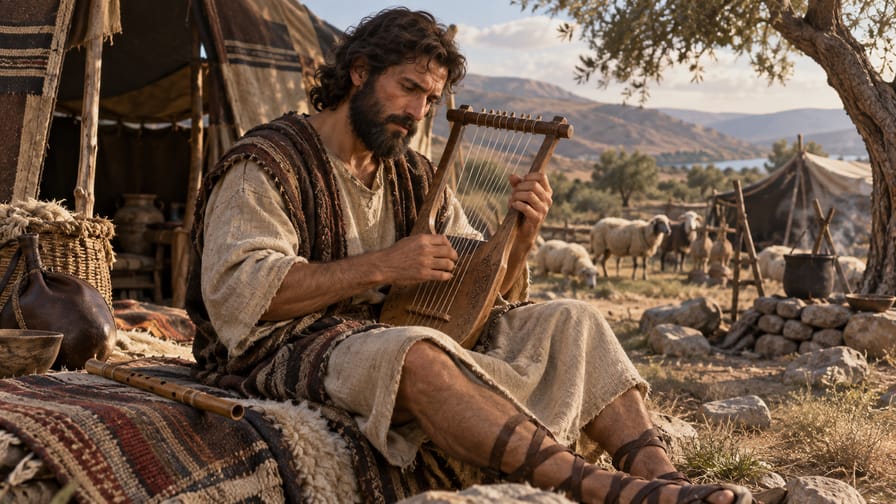
The figure of Jubal, though briefly mentioned in the Scriptures, holds profound significance in understanding the early history of humanity, the origin of culture and the arts, and the implications of the Fall for civilization. His appearance in Genesis 4 establishes him as the patriarch of musical arts, a detail that, from an evangelical Protestant perspective, invites a rich theological analysis of human creativity, common grace, and the redemption of culture.
This study seeks to explore the relevance of Jubal, not merely as a historical-biblical character, but as a focal point for discussions on the nature of creation, the impact of sin on society, and the ultimate purpose of all artistic expression in a universe created by God and redeemed in Christ. The analysis will follow an encyclopedic structure, addressing everything from the etymology of his name to his theological legacy, always founded on the authority of the Holy Scriptures.
1. Etymology and meaning of the name
The name Jubal (in Hebrew: יוּבָל, Yûḇāl) appears only once in the Scriptures, in Genesis 4:21, as the ancestor of all who play the harp and flute. The etymological root of the name Yûḇāl is complex and has been the subject of various academic interpretations.
One of the most accepted derivations connects Yûḇāl to the Hebrew root yābāl (יָבָל), which means "to bring," "to produce," or "to flow." This root is also associated with words such as yôbēl (יוֹבֵל), which refers to the "ram's horn" or "trumpet" used to announce the Year of Jubilee (Leviticus 25:10). The term yôbēl can also designate the "Jubilee" itself, a period of liberation and restoration.
The connection with yôbēl suggests that the name Jubal may evoke the idea of "he who brings," "he who produces," or "he who flows," which aligns perfectly with his description as the "father of all who play the harp and flute." He is, therefore, the originator or the "producer" of instrumental music, causing melodies to flow from the instruments.
Another possible derivation relates Yûḇāl to the Hebrew root meaning "stream" or "current," reinforcing the idea of something that flows or emanates. In this sense, Jubal would be the point of origin, the source from which instrumental music springs forth and spreads.
The literal meaning of the name, therefore, points to the idea of flow, production, and origin, characteristics that are theologically significant. Jubal is not just a name, but a marker of the function God assigned to him in human history, even within Cain's fallen lineage. He is the initiator, the one who gives form to a fundamental aspect of human culture.
There are no other biblical characters with the same name, which makes Jubal a singular and unmistakable figure in the biblical narrative. This exclusivity highlights the importance of his brief mention and the specificity of his contribution to antediluvian civilization.
Theologically, the name Jubal, with its connotation of "flowing" or "producing," can be seen as a manifestation of the innate creative capacity in human beings, even after the Fall. This capacity reflects the image of God (Genesis 1:27), the Creator par excellence, who infuses His creation with the power to create and innovate.
2. Historical context and biblical narrative
Jubal emerges in the biblical narrative during a very early period of human history, the antediluvian era, as recorded in the first chapters of the book of Genesis. This period is marked by rapid development of human civilization, but also by increasing corruption and violence, culminating in the judgment of the universal Flood (Genesis 6:5-7).
The historical and social context of Jubal is that of Cain's lineage, who, after the murder of Abel, was cursed and driven from the presence of God (Genesis 4:11-16). This lineage is portrayed as one that builds cities and develops material culture, but is progressively estranged from communion with the Creator.
2.1 Family origin and genealogy
Jubal is presented as the son of Lamech and Adah. Lamech is a direct descendant of Cain, being the seventh generation from Adam through Cain (Genesis 4:17-18). This genealogy is crucial, as it places Jubal in the line that is not of divine promise, but rather of secular civilization.
He is the brother of Jabal, the "father of those who live in tents and raise livestock" (Genesis 4:20), and half-brother of Tubal-Cain, the "father of all who forge instruments of bronze and iron," and of Naamah (Genesis 4:22). This family is notable for its cultural and technological innovations, demonstrating significant advancements in social organization and material production.
The mention of Lamech having two wives, Adah and Zillah (Genesis 4:19), is also significant, as it represents the first occurrence of polygamy recorded in the Bible, a deviation from the monogamous pattern established by God at creation (Genesis 2:24). This underscores the increasing moral decline of Cain's lineage, even amidst cultural progress.
2.2 Key events and biblical passages
Jubal's life is not detailed in the Bible he is mentioned in a single key passage, Genesis 4:21: "His brother's name was Jubal he was the father of all who play the harp and flute." This brief statement is the only biblical record of his existence and his contribution to humanity.
This passage establishes him as the originator of instrumental music. While his brother Jabal initiated nomadic pastoralism and Tubal-Cain metallurgy, Jubal is the pioneer of musical arts, specifically with stringed instruments (harp, kinnôr) and wind instruments (flute, ‘ûḡāb).
There are no specific geographical references associated with Jubal, beyond the general context of the "land of Nod" (Genesis 4:16), where Cain settled after his curse. Cain's lineage is characterized by an urban and developed culture, but without an explicit connection to God.
Jubal's relationships with other biblical characters are limited to his immediate family: Cain (great-grandfather), Lamech (father), Adah (mother), Jabal (brother), and Tubal-Cain and Naamah (half-siblings). This family collectively represents the development of pre-diluvian civilization outside the line of faith, highlighting human capacity for culture and technology, even in a state of alienation from God.
3. Character and role in the biblical narrative
The Bible does not offer a direct analysis of Jubal's personal character, as his mention is purely genealogical and descriptive of his function. There are no records of his words, actions, or decisions that reveal specific moral or spiritual traits. His "character" is inferred from his designation as the "father" of instrumental music.
In this sense, Jubal is a symbol of human innovation and creativity. His contribution to music demonstrates an innate human capacity for artistic expression and cultural development. This ability, given by God at creation, manifests itself even in Cain's lineage, which had turned away from the Creator.
No virtues or spiritual qualities are explicitly attributed to Jubal. The narrative of Genesis 4, on the contrary, focuses on the unbelief and violence of Cain's lineage, culminating in Lamech's arrogance (Genesis 4:23-24). The absence of any mention of faith or obedience to God in Jubal's life is notable and consistent with the general portrayal of his lineage.
Similarly, there are no sins, weaknesses, or moral failures documented specifically for Jubal. He is a neutral character in terms of direct moral evaluation. However, his inclusion in Cain's lineage, which is characterized by estrangement from God, suggests that his cultural achievements occurred outside of a covenant relationship with the Lord.
Jubal's calling, or his specific function, is to be the originator of instrumental music. He is the pioneer who developed or systematized the use of harps (kinnôr) and flutes (‘ûḡāb), laying the foundation for musical art in human history. This positions him as one of the architects of human culture, alongside his brother Jabal (livestock) and half-brother Tubal-Cain (metalworking).
The role played by Jubal is, therefore, that of a cultural founder. He does not have a prophetic, priestly, or royal role. His importance lies in his contribution to material and artistic civilization, demonstrating that human creativity flourished even in a spiritually degraded environment.
Jubal's significant actions are indirect, yet profound: he is responsible for giving humanity a form of expression that transcends words and has the power to touch the soul. Music, in its various forms, has become an intrinsic part of human experience, from praise to God to entertainment and lamentation.
There is no character development for Jubal throughout the narrative, as he is presented statically, as a point of origin. His mention serves to illustrate the complexity of post-Fall humanity, capable of great cultural and technological feats, yet simultaneously inclined to sin and rebellion against God.
4. Theological significance and typology
The figure of Jubal, though peripheral in the direct redemptive narrative, possesses considerable theological significance from an evangelical Protestant perspective, especially concerning the understanding of common grace, culture, and the image of God in fallen humanity. He is not an explicit prefigurement of Christ, but his existence and function point to greater truths.
Jubal's role in redemptive history is indirect but illuminating. He demonstrates that, even after the Fall and within Cain's lineage, humanity's creative capacity, a reflection of the image of God (Imago Dei), was not completely obliterated. God, in His common grace, allows humanity to continue developing civilization, technology, and the arts, even outside the covenant of faith. This is evidenced in Genesis 4:20-22.
The existence of Jubal and his inventions highlight the distinction between cultural progress and spiritual progress. Cain's lineage, though advanced in terms of civilization, was spiritually distant from God, as indicated by the absence of worship or calling upon the Lord in its record (in contrast to Genesis 4:26, the lineage of Seth). This serves as a reminder that true prosperity is not measured solely by material or artistic advancements.
Music, initiated by Jubal, is a gift from God to humanity, a means of expression and communication. However, like everything human after the Fall, it can be used both for the glory of God and for profane purposes. Reformed theology, in particular, emphasizes that every good and perfect gift comes from the Father of lights (James 1:17) and that human creativity is a reflection of the Creator.
Although Jubal is not a direct Christocentric typology, the redemption that Christ offers encompasses all areas of human life, including the arts and culture. Christ, as the Reconciler of all things (Colossians 1:20), redeems and purifies culture, allowing music and other artistic expressions to be used for the glory of God and for the advancement of His Kingdom.
Music, originated by Jubal, is central to the worship of God, in both the Old and New Testaments. Psalms such as Psalm 33:2 and Psalm 150:3-5 instruct God's people to praise Him with harps, lyres, and flutes, instruments that have their roots in Jubal's legacy. Thus, what began in the fallen lineage can be redeemed and elevated to a holy purpose.
The story of Jubal connects with central theological themes such as the sovereignty of God over human history, the persistence of the image of God in humanity, the common grace that sustains civilization, and the necessity of the redemption of all facets of human existence through Christ. He illustrates that the Fall did not completely nullify humanity's capacity to create and innovate, but corrupted its ultimate purpose.
In the New Testament, there are no direct mentions of Jubal. However, the value placed on music and singing in the life of the church (Ephesians 5:19 Colossians 3:16) demonstrates the continuity of using these cultural gifts for worship and edification, now purified and directed to God in Christ. Music, an invention of a son of Lamech, is sanctified and reintegrated into the divine purpose.
The doctrine and teachings associated with Jubal emphasize that culture and art are not inherently evil, but are neutral in their essence and can be directed toward good or evil, depending on the human heart. The conservative evangelical perspective argues that Christians should engage with culture, redeeming it and using its gifts for the glory of God, as exemplified by music which has become a pillar of worship.
5. Biblical-theological legacy and canonical references
Despite his single mention in Genesis 4:21, the biblical-theological legacy of Jubal is surprisingly significant, especially when analyzed in light of systematic theology and the history of culture. There are no other direct mentions of Jubal in other biblical books, nor is he the author of any literary contributions within the canon.
His influence on biblical theology lies mainly in the understanding of biblical anthropology and the doctrine of common grace. The brief narrative in Genesis 4, which describes cultural development in Cain's lineage, is fundamental to understanding how God allows humanity to flourish in its creative capacities, even outside of a covenant relationship with Him.
The presence of Jubal in Jewish and Christian interpretive tradition has been consistently recognized as the point of origin of musical arts. Ancient Jewish commentators and church fathers, such as Augustine of Hippo, frequently referred to this passage when discussing the origin of music and its place in society and worship.
In intertestamental literature, there are no explicit references to Jubal. However, the themes of creation, the Fall, and the development of civilization are frequently explored, and the figure of Jubal fits into this panorama as an example of human capacity for culture, even in a fallen world.
The treatment of the character Jubal in Reformed and evangelical theology highlights the importance of God's common grace. Theologians such as Abraham Kuyper and Cornelius Van Til emphasized that all culture, even that developed by non-Christians, is, to some degree, sustained by God's grace, which prevents the total degeneration of creation and allows the flourishing of human gifts and talents.
Music, as part of Jubal's creation, is seen as a divine gift that, although it can be corrupted by sin, can and should be redeemed and used for the glory of God. The hymns and spiritual songs in the evangelical tradition are a living testament to this legacy, transforming Jubal's inventions into vehicles of praise and worship to the Creator and Redeemer (Ephesians 5:19-20).
The importance of Jubal for understanding the biblical canon lies in his function of illuminating the early chapters of Genesis. He helps to paint a complete picture of antediluvian humanity, showing that life after the Fall was not only one of moral decline but also of remarkable cultural and technological development, a testament to the persistence of the image of God in humanity.
In summary, Jubal, the father of instrumental music, is a theological reminder that human creativity is a reflection of the Creator. Although his inventions arose in a lineage estranged from God, the Lord, in His sovereignty and common grace, allowed these gifts to flourish. Jubal's legacy invites us to reflect on the redemption of culture and the elevation of all artistic expressions to the glory of God, the ultimate Maestro of the universe.